At A Glance
Experian’s 2026 State of advertising report shows that advertising trends in 2026 will be defined by how well organizations connect data, identity, and measurable outcomes. Leaders across the ecosystem point to five themes: AI that reshapes workflows, measurement that guides decisions earlier, identity and privacy as strategic inputs, channels aligning around outcomes, and identity connecting planning, activation, and measurement.What advertising trends does Experian’s 2026 State of advertising report highlight?
2026 State of advertising report
Experian’s 2026 State of advertising report shows that advertising trends in 2026 will be defined by how well organizations connect data, identity, and measurable outcomes. Our 2026 State of advertising report brings together perspectives from 14 leaders operating across key parts of the advertising ecosystem to show how these shifts are taking shape in practice.
Who’s featured in Experian’s 2026 State of advertising report?
Our 2026 State of advertising report includes perspectives from 14 leaders across the ecosystem covering a variety of topics including:
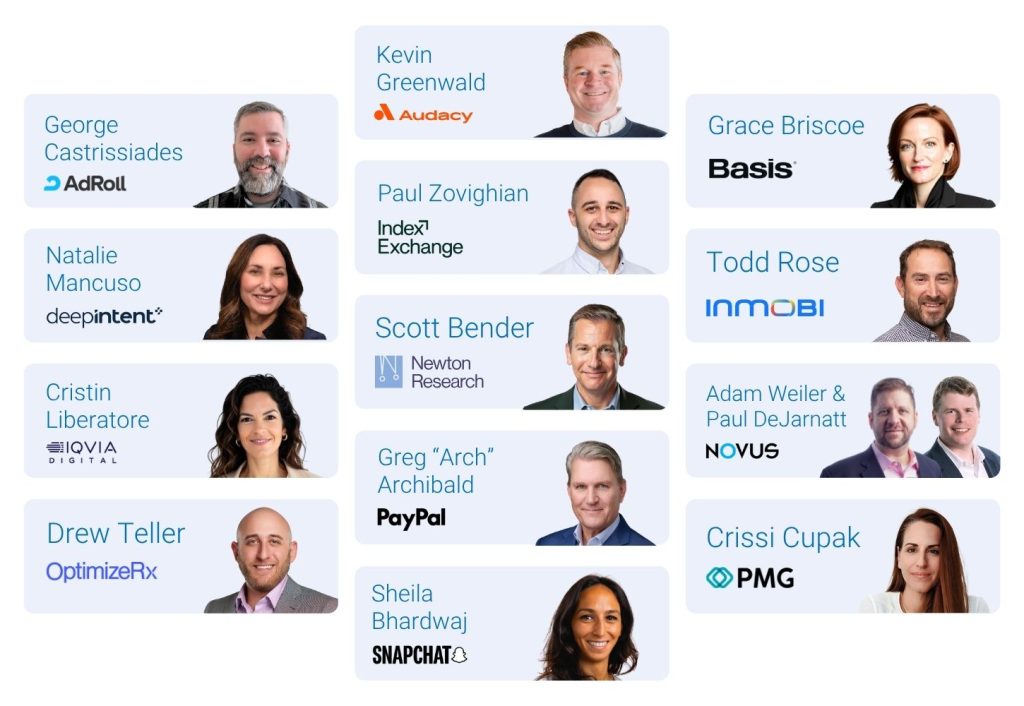
These perspectives reflect directional signals from leaders across the ecosystem. They are not exhaustive views of any one vertical. They are operational insights from teams navigating change in real time.
In addition to the written analysis, you can watch the full one-on-one Q&A conversations with each partner here.
What signals are shaping advertising trends in 2026?
Five signals are shaping advertising trends in 2026. Together, they explain why advertising trends in 2026 center on clarity, connection, and measurable outcomes. Across every conversation with our partners, five themes stand out:
Below, we spotlight three perspectives from our report.
Scott Bender’s perspective on AI-driven workflows
Scott Bender, Head of Publisher & Platform Partnerships at Newton Research, is a media and AdTech veteran who has led go to market and revenue teams across traditional media, retail media, consulting, andearly stagestartups, helping organizations translate data and product strategy into scalable commercial growth.
How is AI moving upstream into planning and measurement?
AI is changing how teams work before campaigns run. Teams apply AI to planning and measurement first, then scale into activation with clear rules and human oversight.
AI’s first impact is operational
Teams are applying AI to planning and measurement before activation. The early gains are showing up in analytics, forecasting, and workflow compression, especially in areas constrained by time and data science resources.
Automation works when humans define the rules
Repeatable, rules-based processes are where AI performs best today. Strategy, guardrails, and judgment remain human-led. AI scales execution without removing accountability.
The biggest barrier in AI is rethinking workflows
AI adoption slows when teams try to layer automation onto legacy playbooks. Progress happens when workflows are redesigned for agentic execution, rather than human-only processes.

“The workflows we’ve built for humans don’t always make sense for AI. Progress comes when teams redesign how work gets done, not when they simply add automation.”
Newton ResearchScott Bender, Head of Publisher & Platform Partnerships
If advertisers fix one thing in 2026
Focus on data context. Not perfect data, but a clear semantic layer that defines what data means and how it should be interpreted and used.
Watch our agentic media panel at CES 2026
Greg “Arch” Archibald’s perspective on commerce media’s expansion
Greg “Arch” Archibald is VP, Global Ad Sales at PayPal. A sales leader for nearly 25 years, Arch has worked at some of the largest AdTech companies in the world. Now with PayPal Ads, he is helping build the foundation upon which advertisers can use true intent-based signals to inform advertising campaigns.
How is commerce media expanding beyond retail?
Commerce media is extending into more ecosystems and more purchase moments. Commerce media is defined through transactions that show what people buy, not intent signals that imply what people might buy.
Commerce media is defined by transactions, not intent
Commerce media is fundamentally powered by transactional data. Unlike retail media, which is often intent-led and vertically confined, commerce media spans horizontally across merchants, payment platforms, and ecosystems, providing a clearer view of the full consumer purchase journey.
Transactional data is the true differentiator
As basic targeting and inventory become commoditized, the ability to activate transactional signals at scale is what separates effective commerce media strategies. These signals help brands connect upper-funnel investment to conversion and prove measurable outcomes.
On-site validates performance, off-site drives reach
Effective commerce strategies balance both on-site and off-site, focusing less on where ads run and more on who is being reached based on real purchase behavior.

“Transactional data is a powerful signal that helps brands reach consumers more effectively and connect upper-funnel investment to measurable outcomes.”
PayPalGreg “Arch” Archibald, VP, Global Ad Sales
If advertisers fix one thing in 2026
Prioritize transactional signals over intent proxies to connect spend to outcomes.
Cristin Liberatore’s perspective on healthcare marketing
Cristin Liberatore,Sr. Director, Commercial Strategy for Pharma, IQVIA Digital, has over a decade of experience leading commercial and product strategy for data‑driven healthcare solutions, developing frameworks at IQVIA Digital that connect data, analytics, and omnichannel execution to drive meaningful business results.
How do identity and privacy work together in regulated markets like healthcare?
Healthcare marketing uses a dual approach that reflects distinct audiences and data environments. Teams succeed when they connect identity and privacy through governance that supports personalization and outcome measurement.
Healthcare requires two playbooks: HCP and consumer
On the healthcare professional (HCP) side, personalization benefits from deterministic identity and high-fidelity signals that enable “read, respond, act” marketing. On the consumer side, data is more disparate, making identity resolution and privacy-safe connection across data sets essential for relevant personalization.
From onboarding to outcomes
Pharma marketing teams need identity workflows that can support accurate audience creation, governed activation, and partner-enabled measurement without combining DTC and HCP identity paths.
Download our pharma marketing playbook to help your team:
- Evaluate audience quality, usable reach, and governance
- Plan DTC and HCP identity strategies with clearer separation
- Prepare audiences for activation across approved channels and partners
Timeliness is the difference between insight and impact
Healthcare data varies widely in latency. The most effective marketing is powered by timely signals. Fresh signals influence whether brands respond in meaningful moments along diagnostic and treatment pathways.
Sustainable identity depends on governance
An identity spine paired with de-identification methodology and strong compliance frameworks allows exposure to connect to outcomes such as script lift, without compromising privacy.

“Across data, activation, and measurement, healthcare marketing works best when privacy and personalization are balanced, as that push pull is ubiquitous with consumer marketing in healthcare.”
IQVIA DigitalCristin Liberatore, Sr. Director, Commercial Strategy for Pharma
If advertisers fix one thing in 2026
Invest in a connected identity spine that balances timeliness, personalization, and privacy across the full care journey.
Watch our healthcare marketing panel at CES 2026
What do 2026 advertising trends mean for advertisers?
In 2026, success will be shaped by how well advertisers connect data, decisioning, and outcomes across an increasingly complex ecosystem. The leaders featured in this report consistently point to connection as the defining factor for progress.
The shifts advertisers must act on
- Audiences, not channels, define strategy. Planning anchored in identity and behavior scales more effectively across screens, platforms, and formats.
- Measurement moves upstream.Outcomes now inform optimization in real time,rather than serving a post-campaign validation.
- First-party data becomes infrastructure. Activation, data governance, and interoperability matter more than ownership alone.
- AI accelerates decisions, not accountability. Automation works best when paired with clear rules, transparency, and human oversight.
- Privacy is a growthlever.Consent-driven, privacy-first design enables durable performance at scale.
Advertisers that lead in 2026 will:
- Connect planning, activation, and measurement into a single operatingframework
- Invest in data and identity foundations before expanding into new channels
- Work withpartners that reduce fragmentation, not add to it
To see how these signals play out across AI, commerce media, healthcare, and more, download our 2026 State of advertising report and watch the Q&A videos with our partners.
FAQs
A CMO should treat advertising trends in 2026 as a shift in how teams plan, activate, and measure, not a channel shift. Teams get stronger performance when they connect data, identity, and measurement into one decision loop that guides planning, activation, and optimization.
Measurement moves closer to the moment of decision when teams use outcomes to steer optimization in real time. That approach turns measurement into a planning input that shapes budget allocation, audience strategy, and creative decisions across the lifecycle of a campaign.
Experian helps marketers connect identity, data, and measurement so teams plan and activate with consistency across platforms. Experian’s data and identity foundation supports audience connection and privacy-forward activation, and Experian’s measurement approach links media exposure to outcomes for clearer decisioning.
Latest posts
Advertisers continue to increase their spending across addressable TV, connected TV (CTV), and digital. According to IAB’s “2021 Video Ad Spend and 2022 Outlook” report, digital video ad spending is expected to increase by 26% to $49.2 billion in 2022. Understanding who consumers are and how to best reach them in their preferred channel is becoming more complex. Damian Amitin and Colleen Dawe discuss how a seamless identity strategy can address the complexity of the emerging TV space. The evolution of identity resolution Around ten years ago, the idea of digital “identity resolution” or “Device Graphs” was born. This idea connected cookies and MAIDs to understand when many IDs were the same person or household. In more recent years, our industry began to connect that initial understanding to the CTV ecosystem. But, a large part of the TV ecosystem existed in silos, like first and third-party audience data, and the growing advanced TV market. The goal of identity resolution has always been to understand the consumer better. To achieve more accurate targeting and measurement in the CTV ecosystem, we must incorporate the following: What we know about the household and consumer from an ID perspective Who the consumer is as it relates to audience data, as well as the wealth of first-party data in the advanced TV space We know the cookie is a flawed way to collect data. While Google delayed the deprecation of third-party cookies, there are other challenges that we face right now. Such as the glaring gap in Safari traffic and the Identifier for Advertisers (IDFA) turning to “opt-in.” Understanding consumer behavior across devices and platforms continues to challenge marketers and publishers. These challenges are creating the need to find more stable identifiers. Though the cookie remains valuable, it has an uncertain future. This has led advertisers to place bigger bets on the combination of addressable and CTV. The overlap in addressable and CTV data leads to fragmentation Personally identifiable information (PII) makes up the majority of addressable TV households’ data. Part of the attraction to CTV is that their IDs remain universal, persistent, and stable. Analysts project that CTV ad spending will hit $23B in 2023. Consumers now have an average of 4.7 streaming subscriptions per household. It’s no surprise then, that Disney+, HBO, and Netflix released or announced ad-supported tiers. Addressable TV and CTV are often thought of as distinct markets across the industry. But, in the context of identity, we should look at them through the same lens. Millions of households still consume TV and video content via a set-top box or through apps on CTVs. This is in addition to what they consume on their laptops, tablets, and phones. Of the top 11 cable and satellite providers, 65 million U.S. households still have a box in their homes. On the other hand, approximately 96 million U.S. households have at least one or more Smart TVs and streaming services. With about 126 million total U.S. TV households, that’s a lot of overlap. There are still significant numbers of both addressable and CTV homes. How can we address fragmented TV consumption? Through a holistic and comprehensive approach to identity. An approach that captures addressable TV, CTV, and digital identifiers. An approach that captures all audience attributes inside of a single identity graph. This is the ideal approach for publishers, AdTech vendors, and brands. Discover how to unlock holistic identity How can we achieve a holistic identity? Through a three-pillared approach: First-party data onboarding Digital identifiers Consumer data First-party data onboarding Bringing offline data from a brand’s consumers is very valuable due to the quality of the data. Because the data is being collected right from the source, you know it’s accurate. It provides the foundation you can build your identity strategy from. Digital identifiers Once you create a foundation with first-party data, you need to connect it. Either with an internal or licensed digital ID graph. Then you can understand the connections between all devices within the household. Consumer data After you know which devices tie to a single consumer, you’ll want to act on that knowledge. The next step is to partner with a data provider that can help you understand your consumers. Establishing this partnership will help improve targeting, measurement, and the customer experience. To achieve a well-rounded customer view tomorrow, we need to start today The three-pillared approach bridges the gap between the offline and online worlds. This provides a well-rounded view of customers and audiences. However, the ability to tie these aspects of identity together still presents several challenges. To achieve the three-pillared approach today, you need to use many vendors and fragmented data sources. Often with conflicting data. As we look forward, the tools to do this are becoming more advanced and unified. The players in our ecosystem should adopt a seamless identity strategy. One that provides a privacy-safe yet full-picture solution. That means capturing and unifying all devices within a household. While also understanding the consumer behaviors and profiles behind those devices. Keep up with your customers and their data Once we create an informed identity strategy, we can begin to understand the makeup of each household and the individuals within. In this new world, personalizing the experience for an audience is key. Where do they prefer to spend their time? What type of content are they most engaged in? Only then can we as an industry provide an optimal experience for each consumer. All while driving greater ROI for advertisers and publishers. Are you ready to know more about your customers than ever before? Let’s get to work together to achieve your marketing goals. Contact us to learn how we can connect the complex dots of identity resolution. About our experts Damian Amitin, VP of Enterprise Partnerships, Experian Marketing Services Damian Amitin is the VP of Enterprise Partnerships and joined Experian during the Tapad acquisition in November 2020. Damian is a senior sales and partnerships executive, specializing in the identity resolution and marketing data ecosystem. Damian helps brands, publishers, and technology vendors enable enhanced ID resolution through The Experian/Tapad platform to attain a 360 view of the customer across targeting analytics, attribution, and personalization. Colleen Dawe, Senior Account Executive, Experian Marketing Services Colleen Dawe is a Senior Account Executive on the Advanced TV Team within Experian Marketing Services. With 15 years of experience working within the television ecosystem, Colleen works with clients to bring the value and expertise of Experian to support their objectives in the areas of data, identity, activation, and measurement. Get in touch

Brands can leverage non-clinical factors, like the social determinants of health, to gain a holistic view of their patients and increase access to care.
Next up in our Ask the Expert series, we hear from Sarah Ilie and Lauren Portell. Sarah and Lauren talk about the internet’s value exchange – what we gain and lose when it’s so easy to share our information. Is convenience hurting or helping us? The age of connectivity Today, it’s almost unimaginable to think about how your day-to-day life would look without the convenience of the internet, smartphones, apps, and fitness trackers; the list goes on and on. We live in the age of connectivity. We have the convenience to buy products delivered to our homes on the same day. We can consume content across thousands of platforms. We also have watches or apps that track our health with more granularity than ever before. The internet’s value exchange In exchange for this convenience and information, we must share various kinds of data for these transactions and activities to take place. Websites and apps give you the option to “opt in” and share your data. They also often let you know that they are collecting your data. This can feel like an uncomfortable proposition and an invasion of privacy to many people. What does it mean to opt-in to a website or app’s tracking cookies? What value do we exchange? What opting in means for you Opting in to cookies means that you are allowing the app or website to track your online activity and collect anonymous data that is aggregated for marketing analytics. The data provides valuable information to understand users better to create better online experiences or offer more useful products and content. Granting access to “tracking” offers several benefits to users such as a customized, more personal user experience or advertising that is more likely to be relevant. For example, let’s imagine you have recently been using an app or website to plan a camping trip. By sharing your data, the website or app has visibility into what is interesting or useful to you which can lead to related content suggestions (best campsites) or relevant advertising and product recommendations (tents and camping equipment). It’s important to know that the marketing data collected when you opt in is extremely valuable. The revenue that advertising generates is often very important to websites and apps because this is how they make money to continue providing content and services to consumers. Data privacy practices Privacy concerns regarding how companies and developers use tracking information have risen over the last couple of years and have resulted in additional protection for consumers’ privacy while still allowing companies to improve their products and advertising. One big step in this direction has been simply making people aware that their data is being collected, why it’s being collected, and providing users with the option to share this data for marketing analytics through opting-in or not. Other important steps to maintain online privacy include formal legal legislation and self-regulation. The right to privacy is protected by more than 600 laws between individual states and federal legislation and the U.S. House Committee on Energy and Commerce recently voted to pass the American Data Privacy and Protection Act. Additionally, marketing organizations such as the Interactive Advertising Bureau and Association of National Advertisers regulate themselves with codes of conduct and standards given there is so much attention on privacy issues. Is the internet’s value exchange worth it? The data that we choose to share by opting in has a lot of benefits for us as consumers. There are laws in place to protect our data and privacy. Of course, it’s important to be aware that data is collected and used for marketing purposes, but it’s also reasonable to share a certain amount of data that translates into benefits for you as well. The best data unlocks the best marketing. Contact us to tap into the power of the world’s largest consumer database. Learn how you can use Experian Marketing Services’ powerful consumer data to learn more about your customers, drive new business, and deliver intelligent interactions across all channels. Meet the Experts: Lauren Portell, Account Executive, Advanced TV, Experian Marketing Services Sarah Ilie, Strategic Partner Manager, Experian Marketing Services Get in touch