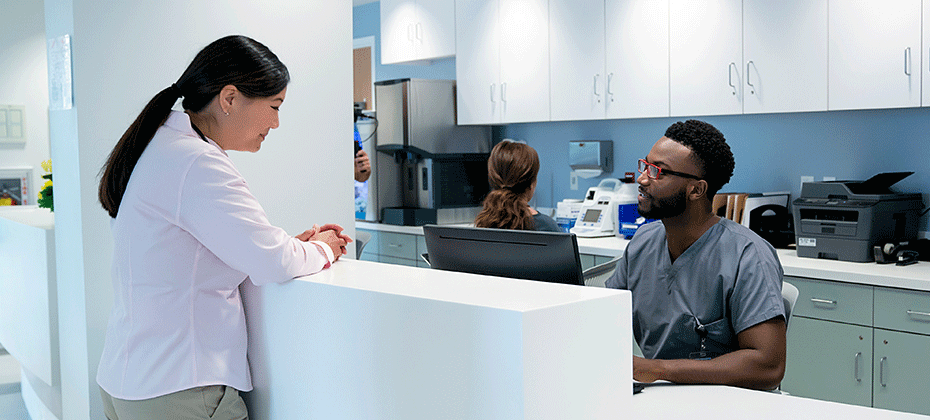
“We ran a pilot across 10-15 service lines, and the team was able to schedule without any training. It makes it extremely easy to work in different service lines that you're unfamiliar with.” — Justin Baur, Manager of Patient Access and Referral Management at IU Health Challenge Indiana University Health (IU Health) is the largest network of physicians in Indiana, with over 36,000 team members across five patient regions and 16 partner hospitals. IU Health plans to launch the Unified Medical Group in 2025, combining its five patient regions. In preparation for this move, the health system sought an enterprise call center scheduling solution to manage growing patient volume while maintaining its current staff size. Solution IU Health selected Experian Health's Patient Schedule – Call Center Scheduling, an automation-powered digital scheduling platform, because it can effectively manage complex service lines in primary and specialty care. This decision was backed by Experian Health's track record in providing call center scheduling solutions for large health systems. Patient Schedule supports seamless self (patient) and staff scheduling. This solution helps IU Health staff handle the increasing patient numbers with minimal training. Front office staff and call centers can swiftly and accurately schedule appointments and resolve patients' queries. Schedulers no longer have to memorize complex scheduling rules or work with lengthy notes, increasing staff efficiency, morale, satisfaction, and productivity. Listen in to an on-demand webinar to hear how IU Health transformed patient scheduling with Patient Schedule. Outcome Thanks to Patient Schedule, IU Health achieved the following results: 52 departments now use Call Center Scheduling 114% increase in patient utilization within a year 600 referrals on average scheduled each month Staff cross-trained across multiple specialty service lines Patient Schedule optimized IU Health's scheduling capacity, making the call center more efficient and increasing specialty referrals. This solution has also brought more and unexpected benefits, including improving referral management, which means that patients can schedule cross-speciality appointments before the patient leaves the office. Call Center Scheduling also enabled the implementation of a single phone line for all patient bookings. Additionally, the product's analytical features are helping IU Health discover ways to improve its scheduling infrastructure, as it works to standardize and expand the solution to all regions as part of the Unified Medical Group. Altogether, this solution has improved provider, staff, and patient flexibility, satisfaction, and experience so much that it has become indispensable to IU Health's scheduling operations. “Now we have pods of four people managing seven or eight service lines because it's so easy to work,” said Justin Baur, Manager of Patient Access and Referral Management at IU Health. “The team wouldn't be able to go back to the old way. You don't have to keep track of who you can schedule at what time or at what location because the algorithm does it for you.” “We really could not have started this initiative without the platform, because we had to make sure we had staff who were well versed in the product and service lines that were properly embedded in the product before rolling it out. This was a big success and we probably could not have started this launch without Experian,” he concludes. Watch the webinar to hear examples of how guided scheduling was implemented in specific specialties and learn more about using automated patient scheduling to create a resilient and efficient scheduling infrastructure that works better for patients, providers and staff.

Patient expectations of their healthcare providers have changed. Today, patients expect providers to offer the same convenience as their favorite e-commerce site, with intuitive self-service options that put them in the driver's seat. It's a brave new world for healthcare providers, who know the patient experience is about more than providing quality care—it's also about opening a digital front door with patient access technology. What do patients want from their healthcare providers? Experian Health's State of Patient Access 2023 survey shed light on what healthcare customers want: 76% want online scheduling from their favorite mobile device. 72% want an online payment option that is mobile-friendly. 56% want more (not fewer) digital options for managing their health. Outdated manual workflows do more than bog down backend healthcare teams; there's evidence this also frustrates patients. One study showed that 85% of patients believe technology can improve communication with their providers. Beyond the convenience of self-scheduling and improved communication, there is also evidence that patient access technology improves patient safety. Most people hate paperwork, and patients are no exception. Providers can digitize many of these manual tasks. Streamlining the patient access experience online could include: Online self-service appointment scheduling. Pre-registration via a patient portal. Real-time insurance eligibility verification. Automated, accurate out-of-pocket estimates. Text and email reminders to reduce no-shows. Online bill payments with personalized payment plans. Today's patients have grown accustomed to the immediacy of online shopping thanks to vendors like Amazon. That expectation transfers to healthcare, where administrative and financial tasks can be repetitious and frustrating. Technology can improve engagement with healthcare consumers, from patient intake to bill payment, while lowering the administrative burden on medical staff. How can patient access technology make healthcare convenient? Digital technology can transform the healthcare experience into a more accessible and patient-centric model. For example, 24/7 online scheduling lets patients book appointments at their convenience from their favorite online device without lengthy phone calls or complex scheduling processes. These solutions reduce wait times and patient frustration. Providers benefit from improved call center efficiency, lower no-show rates, and higher patient satisfaction. Digital patient portals are an easy conduit to better communication and faster access to healthcare information. Patients can fill out forms, get price estimates, check test results, and update insurance details. Providers benefit from more accurate patient data, not to mention more satisfied patients. Mobile-friendly tools enable on-the-go access to patient health information. From viewing test results to communicating with healthcare providers, mobile apps empower patients to actively engage in their healthcare journey. Secure messaging platforms enable patients to interact with healthcare providers by email and text, when they want, on their chosen device. Patient access technology also streamlines labor-intensive administrative processes with digital registration systems. Patients experience reduced wait times, as these technologies expedite check-in, contributing to a more efficient and hassle-free healthcare experience. Ultimately, these tools make life for patients and providers easier. Manual healthcare workflows cause bottlenecks and mistakes that lead to increasing claims denials. Patient access technology automates many labor-intensive tasks for patients and providers, including prior authorizations, which, if declined, can delay care and negatively affect patient outcomes. Tools like Experian Health's Patient Access Curator can check patient coverage within just a few seconds, speeding up reimbursement workflows from registration through payment. The software is particularly helpful for self-pay patients, helping providers identify a clear path towards financial accountability at the beginning of the encounter. Can automation improve patient engagement? Automation technology does more than improve human workflows in the complex service delivery world. These tools engage patients across their healthcare journey, a crucial component of effective, patient-centered care. Patient engagement refers to the active involvement of individuals in their healthcare journey, and automation can play a pivotal role in facilitating this process. Patient data allows technology to personalize each encounter. Automated systems can deliver timely and tailored messages to patients, reminding them of appointments, medication schedules, and preventive care. Automated patient access technology lets patients know that their chosen healthcare provider is looking out for their well-being. These solutions help patients stay informed and create accountability for adhering to treatment plans. Behind the scenes, sophisticated analytics provide valuable insights into the health of various patient populations. Healthcare providers make data-driven decisions that can guide any intervention before issues escalate. Automation can streamline administrative tasks, allowing healthcare providers to focus more on direct patient care. Digital platforms handle appointment scheduling, prescription refills, and routine inquiries, reducing the burden on healthcare staff and patients. Automating routine processes allows healthcare professionals to spend more time on meaningful patient interactions that build stronger long-term relationships. Improve patient access technology and improve patient experiences A recent Accenture study shows healthcare consumers are willing to switch providers if their needs and preferences are not met. Millennial and Gen Z populations are six times more likely to switch providers. The study also showed patient access was the top factor when choosing to stay or leave their healthcare provider. The increasing level of consumerism in healthcare should be incentive to change for any provider with legacy technology and outdated administrative processes. Experian Health’s automated patient access solutions improve the patient's experience at each point in their encounter with their provider. To find out more, speak to the Experian Health team.

A recent study by Experian Health found that 62% of healthcare workers consider patient scheduling to be one of the areas hit hardest by staffing shortages. Labor gaps result in delayed patient care, staff burnout, additional hiring and training demands – not to mention snowballing overtime costs. Faced with wide-reaching financial and operational ramifications, healthcare organizations must make a strategic shift in how they manage patient scheduling. For Indiana University (IU) Health, the answer lay in using automation to handle increasing patient volumes with less staff. Justin Baur, Alex Nussman and Josh Brown of IU Health's Patient Access management team partnered with Experian Health to share how guided scheduling has allowed them to scale their operations, optimize staff efficiency and reduce scheduling errors, keeping both providers and patients happy. This article breaks down IU Health's key successes with Patient Schedule (including some that were unexpected), as discussed on the webinar. Discover how IU's strategic shift to automated scheduling not only scaled their operations and optimized staff efficiency, but also significantly reduced scheduling errors, keeping both providers and patients happy. “Guided scheduling helps us deliver better care, more efficiently” Like many healthcare organizations, changing market dynamics forced IU Health to find a fresh approach to patient scheduling. Competitor closures led to an influx of new patients, while the precarious labor market demanded a solution be found within the existing headcount. That solution was Patient Schedule, a digital scheduling platform that uses automation to support convenient patient self-scheduling, more efficient call center scheduling, and targeted patient outreach. IU Health piloted the platform across 52 service lines in 2023. Josh Brown, Program Manager for Provider Match at IU Health, outlined the key results: “We were able to accomplish some significant achievements to set our system up for success in 2024. We've booked over 230,000 patients through Patient Schedule and 35,000 through the Self Scheduling platform. It's as efficient as two schedulers doing similar work. We've had a 3% increase in one call resolutions and 16% growth in new patients since implementation. “Overall, guided scheduling has given us an opportunity to transform our operations by improving our patient access and reducing some administrative burdens. We've seen a reduction in no shows and an increase in patient engagement. By leveraging technology and data analysis, the guided scheduling platform has helped deliver better care more efficiently and effectively.” “Call Center Scheduling helps us minimize training and maximize referral capture rates.” IU Health's Patient Access Centre supports 31 specialties, 24 primary care clinics and radiology scheduling across Indianapolis, handling a total of 2.4 million calls in 2023. Finding innovative ways to meet growing demand was imperative. Justin Baur, Manager of Patient Access and Referral Management, described how Patient Schedule's Call Center Scheduling tool improves the workflow for call center coordinators: “Patient Schedule simplified processes in all our call centers so we can work with more patients and more service lines than before. Coordinators are onboarded quickly and can schedule for more service lines. Patient Schedule builds specialty considerations into the algorithm, reducing the need for subject matter experts. This increases scheduling accuracy, and reduces cancellation and reschedule rates, resulting in more effective visits between patient and provider.” The referral team also piloted Patient Schedule in urgent care and primary care facilities, successfully scheduling specialty referral appointments for patients before they leave their primary care provider's office. In the emergency department, providers can send messages to registration staff to schedule follow-up appointments. Baur says, “checkout staff can schedule patients' referrals within 3-5 minutes, instead of spending 30 minutes making follow up calls to reach those patients.” This reduces wait times, improves continuity of care, and streamlines the entire experience for patients and providers. “Self Scheduling does the work of two full time schedulers.” IU Health's pilot also involved using the platform to allow patients to book their own appointments. With Patient Schedule's Self Scheduling component, patients can make appointments online when and where it's most convenient. The sophisticated decision support technology means they only see relevant calendars and appointment types. During the pilot, almost 40% of patients opted to use self-scheduling, with 28% of those patients succeeding in booking an appointment online, significantly reducing the pressure on call centers. Josh Brown observed that “around 64% of our patients self-scheduled during non-business hours, so we're getting a lot of value-add when we're not at work. This gives us an opportunity to meet the patient when they're available. It enhances patient satisfaction and increases access to care. More than 35,000 appointments were booked using Self Scheduling, without any staff intervention, which Brown said equates to two full-time schedulers. He also observed that the platform is helping to grow IU Health's patient base and reduce no-shows: “We're seeing that the platform is very new patient-focused, with new patients accounting for over 59% of Self Scheduling bookings. With those bookings, we're seeing an 87% show rate.” Guided scheduling: the foundation of efficiency To close, the team explained how Patient Schedule had cut the time taken to secure appointments, by ensuring patients get the assistance they need and eliminating unnecessary paper-pushing. The next steps for IU Health are to roll out Patient Schedule across more specialties. They want to increase uptake of self-scheduling and ensure more patients can successfully book appointments using their preferred method. They also hope to implement location- and diagnosis-specific starting points for online bookings. By 2025, the team hopes to introduce a single phone number to cover scheduling needs across the whole state. Patient Schedule will form a key part of the solution by supporting efficient, centralized scheduling across four additional regions. Watch the webinar to hear examples on how guided scheduling was implemented in specific specialties, and find out more about using automated patient scheduling to create a resilient and efficient scheduling infrastructure that works better for patients, providers and staff.

Hospital admissions for COVID-19 increased by almost 92% between the last week in July 2023 and the last week in August 2023, according to figures published by the Centers for Disease Control and Prevention (CDC). It is worth noting that this time last year, the numbers were double what they are now. However, it is important to acknowledge that the virus is still evolving. Demand for services may be unpredictable over the coming months, so providers will need to position their teams to adapt to changing patient volumes and staff absences. Additionally, seasonal flu vaccination programs are underway, putting extra pressure on patient access. Now is the perfect opportunity for healthcare providers to reassess and streamline patient intake processses. This article looks specifically at how online scheduling for patients can help providers prepare for the unexpected this fall. Rethinking patient intake Online scheduling helps providers create a more efficient patient access experience by allowing patients to schedule appointments from home, instead of by phone or in person. It's more convenient for patients, limits exposure to infection and reduces the administrative burden on front office staff. Understandably, some providers without online scheduling software in place may worry about implementing new tools during the busiest time of year. They may see it as a “nice to have” to deploy when demand is more stable. But this is a false economy: any time saved by postponing the switch to online scheduling will be lost to costly inefficiencies over the hectic winter period. It's crucial to start the process now, before the stress hits. In a 2022 evaluation of self-scheduling processes at the Mayo Clinic, the authors describe themselves as “fortunate to have the self-triage and self-schedule process in place during the unanticipated surge of COVID variant omicron in the winter of 2021-2022.” The organization saw utilization of self-scheduling for COVID-19 tests increase from 4% of appointments booked in December 2020 to 44% in January 2022, saving thousands of hours of staff time, reducing no-shows and streamlining the patient experience. Get more benefits from online scheduling with a tailored approach Switching to online scheduling doesn't have to be complicated. To simplify implementation, providers should focus on how online scheduling can support their organization's specific operational challenges and goals. Choosing a solution that integrates with existing practice management and hospital information systems will also ensure implementation is as frictionless as possible. Here are a few examples of ways to maximize the benefits of online scheduling for their organization: 1. Create screening questionnaires to manage demand Screening questionnaires can be given to patients as soon as the log in to book appointments for specific services. Their answers can then be used to determine the appropriate appointment type and guide patients to their next step quickly and efficiently. Clinical needs, billing requirements, and patient preferences (such as the need for an accessible location or interpreter), can all be managed automatically.It's an effective strategy to manage demand for high throughput and routine services that are less likely to need staff assessment, such as COVID-19 testing or flu vaccinations. In the Mayo Clinic example, self-scheduling took just 3.1 minutes for asymptomatic patients, increasing to just 5.8 minutes for symptomatic patients who self-triaged with a screening questionnaire. 2. Use guided search to direct patients to virtual services Online scheduling can also guide patients to appropriate and convenient services they may not otherwise have considered, such as virtual care. Virtual care proved its value at the height of the pandemic, and while utilization has levelled off, providers should not see this as a lack of appetite for digitally-enabled care among patients. In Experian Health's State of Patient Access survey 2023, 56% of patients said they wanted more digital options for managing healthcare. Respondents (particularly younger patients) listed mobile scheduling for telehealth appointments among their expectations of the digital front door.The recent explosion in digital health companies offering at-home care solutions also speaks to patient demand for virtual services. Established providers should look to expand and promote their digital offerings, or risk losing their competitive edge. Leveraging the incumbent advantage is a move to make now, while new players are still finding their feet. One effective method to achieve this is by directing patients to existing virtual services through an online scheduling platform. 3. Eliminate walk-in traffic at urgent care centers Urgent care centers are the 'doctor of choice' for many patients, with patient volumes increasing by 60% since 2019, according to the Urgent Care Association. If COVID-19 and seasonal flu cases collide over the winter, urgent care centers may become overwhelmed by patients with both infections. Urgent care center managers may want to consider switching to an appointment-only system, where appointments must be scheduled online or by phone. This helps reduce the number of in-person visits and walk-in traffic, which will not only help prevent spread of infection, but also contribute to a better patient experience.Online self-scheduling also eases pressure on urgent care centers in another important way. Allowing patients to book their own appointments reduces the risk of cancellations and no-shows. This proactive approach prevents delays in care, effectively bridging gaps that can potentially escalate into costlier and riskier emergency situations. 4. Extend staffing capacity with real-time resource allocation Experian Health's data shows that between June 2022 and June 2023, providers that used Patient Schedule saw an average of 40% of patients book appointments after hours, saving hours of administrative time. Efficiencies on this scale will be invaluable, should COVID-19 or seasonal flu cases trigger a rise in patient volumes and staff absences.Patient Schedule automatically optimizes patient and provider capacity in real-time. Scheduling rules based on providers' calendars, appointment types and business needs are built into the platform, so that patients only see the available appointments based on those rules. The tool gathers calendar inventory from across multiple providers for a comprehensive view of network capacity, to make even better use of available staff time. The calendar inventory can cover an entire care team, such as a physician, physician assistant and nurse practitioners. This frees up staff to focus on other administrative tasks and assist patients with additional needs. Get ahead of winter pressure points with online self-scheduling These are just a few examples of how providers can use online patient scheduling to zero in on their own operational priorities, make life easier for schedulers and patients, and ease pressure on services over the coming months. Contact Experian Health today to explore self-scheduling options and immediately boost your service capacity.

Could patient access software be the 'most valuable player' in healthcare? Experian Health's annual State of Patient Access surveys show an upward trend in the use of digital tools and software to help minimize the hoops patients must jump through to access care. In the most recent, 46% of providers said they expected to increase their digital investment over the next six months. The business advantages around increased capacity, reduced cancellations, improved data accuracy and higher patient satisfaction make a strong case for investing in patient access software. This article looks at how patient access tools can solve for some of the most stubborn problems in patient scheduling, registration and payments. Finding the formula for frictionless patient access Revenue cycle management comes down to minimizing service utilization while maximizing revenue potential. This starts with patient access. Efficient scheduling, intake and financial processes means more patients get better care, sooner – and providers get paid for their services without delay. Patient access software includes a range of digital and self-service tools that allow patients to complete administrative patient intake tasks with ease. Appointment management, patient registration, patient outreach, and patient estimates and billing are common use cases for patient access software. These solutions use in-depth data and automation to pre-fill patient information, check data for accuracy and completeness, tailor patient communications and accelerate workflows. Advances in AI and machine learning are creating new opportunities to remove obstacles in patient access and boost patient satisfaction. 5 problems that can be solved with patient access software 1. Painfully slow scheduling operations Problem: Too often, patient access processes are complex and time-consuming. Over time, small frustrations from errors, delays, and repetitive manual tasks can cause a significant decline in the patient experience. It's unsurprising that 56% of patients want digital options to manage care and speed things up. Solution: Patient access software makes it easier for patients to see their doctor without delay. For example, rather than being forced to call the provider's office and wait for an agent to check for an available slot, patients can use online scheduling software to book, reschedule and cancel appointments whenever suits them best. This also alleviates call center volumes, easing pressure on staff. 2. Error-prone registration processes Problem: Manual intake and registration systems are vulnerable to quality issues, resulting in denied claims, increased admin costs and delayed access to care. Illegible writing, incomplete insurance information and missing forms mean patients and staff must spend more time going back and forth to find and fix mistakes. And at the extreme end of the spectrum, data errors can lead to medical errors, with life-or-death consequences. Solution: Automated patient registration can pull patient data from reliable sources and fill out basic details ahead of time, reducing the need for manual data entry. Preventing avoidable errors in this way improves communication, workflows and profitability. For example, Registration Accelerator is a text-to-mobile patient intake solution that allows patients to complete appointment registration from the comfort of home. The patient takes a photo of their insurance card and driver's license, and then optical character recognition (OCR) technology automatically enters the correct information for insurance verification. The patient can review and sign authorization and consent forms, and confirm their appointments all at once, with just a few clicks. 3. Excessive (and growing) admin burdens and staffing shortages Problem: Patient access is admin heavy. This wastes valuable staff time and resources and diverts attention from patient care. With healthcare staffing shortages reaching emergency levels and patient volumes on the rise, providers must find ways to manage workloads while maintaining output. Solution: By automating administrative tasks and expanding self-service options, patient access software takes the pressure off busy teams. In Experian Health's survey, 36% of respondents reported that technological improvements offset staff shortages, by making better use of staff time and lowering operational costs. Automated prior authorizations are a good example of how digital tools can help tame the admin burden. This software generates real-time updates for multiple health plans, so staff no longer need to cross-reference individual payer policies and websites. It uses exception-based workflows and guided work queues to help staff prioritize their activities. Patient access tools can also issue performance reports, so staff can continue to find ways to work more efficiently. Cutting-edge technology also offers a less obvious but equally important competitive advantage – helping providers attract and retain high quality staff. 4. A patient experience that falls short of expectations Problem: Unnecessary administrative obstacles, unclear communication, and slow processes result in subpar patient experiences. More than 6 in 10 patients don't think their experiences have improved much in the last few years, despite the wider availability of digital patient access tools. Providers need a solution urgently, given that 56% of patients would switch providers for a better patient experience. Solution: With automation and self-service digital tools, providers can finally put patients in the driver's seat and deliver the patient-centered experience that has been promised for years. Patients say they want access and payment experiences to be convenient and transparent, with specific examples including: Accurate pre-care estimates Payment plans Digital payment options A multi-purpose portal Mobile access for scheduling, registration, communications and care Alex Harwitz, VP, Digital Front Door at Experian Health, says that while this list may seem daunting, providers have reason to be optimistic about delivering a better patient experience: “Patients want a lot from the digital front door, especially younger and digitally savvy consumers. Speed, convenience and compassion are through-lines in our patient surveys. As expectations increase, so does the pressure on providers to deliver. But the good news is that technology is advancing too. There's a wealth of patient access software ready to help optimize the patient experience. And you don't have to implement them all at once: Experian Health's patient access tools are specifically designed to work independently or in combination, for hassle-free implementation.” 5. Missed revenue opportunities Problem: Missed appointments, billing mistakes and operational inefficiencies lead to avoidable revenue leakage. A significant portion of denied claims occur earlier in the revenue cycle, so improving patient access processes should be top of the list when it comes to optimizing revenue. Solution: Revenue loss in patient access comes down to data errors, poor analytics and workflow inefficiencies. By leveraging the right software, front- and back-office teams can collaborate to resolve issues and enhance decision-making. Digital tools can also improve the patient billing and payment experience, so providers get paid promptly. Upfront price estimates, payment plan recommendations and one-click payment options can make it easier for patients to understand and pay their bills. Implementing transparent and empathetic billing procedures not only enhances patient satisfaction but also accelerates the collection process. With Experian Health's Patient Payment Solutions, providers can collect payments 24/7 via mobile, web and patient portals. Maximizing revenue opportunities while meeting the changing needs and expectations of healthcare consumers calls for smart patient access strategies. Find out more about how Experian Health's patient access software helps healthcare organizations lay the foundations for a solid revenue cycle and a positive patient experience.

The healthcare staffing crisis was one of the biggest challenges facing healthcare providers pre-pandemic, only to be exacerbated by the pressures of dealing with the COVID-19 crisis. Almost a fifth of healthcare workers resigned between February 2020 and September 2021. Unfortunately, the problem isn't in the rearview mirror yet – a new study from McKinsey reveals that worker shortages persist, with 31% of nurses declaring their intent to leave their jobs in the next year. These shortages put pressure on remaining staff, compromise hiring efforts and make high-quality services difficult to maintain. Without a thriving, vibrant workforce, how can healthcare providers meet the needs of their patients? Can automation help address the healthcare staffing crisis? Stubborn staff turnover levels aren't unique to healthcare, but addressing them is even more critical, given the detrimental effect on patients. As the staffing crisis shows no signs of letting up, providers should consider how technologies that leverage automation and AI can help. Tom Cox, President at Experian Health, says, “Automation has transformed many aspects of healthcare, from driving down appeals and denials to improving the digital front door. We're now seeing AI starting to make waves, too. These technologies are the future and are changing healthcare for the better.” Opening healthcare's digital front door is a good place to start. By eliminating repetitive and time-consuming tasks like data entry, manual patient registration and prior authorizations, staff will be freed up to focus on what matters most: delivering high-quality patient care. Here, we look at three areas where automation can simultaneously alleviate the burden of staff shortages and create a better patient experience. Use case 1: automate patient access to manage the growing demand for services Manual and repetitive processes eat up valuable time and create greater workloads that contribute to staff burnout. This is especially true in patient access, which is a typically admin-heavy process. Allowing patients to complete more of their registration and scheduling tasks themselves can reduce the workload in understaffed teams. Many patients prefer not to book appointments through call centers, and high call volumes are a major pressure point for staff. Similarly, manual patient registration is labor-intensive and error-prone, eating up staff time and creating bottlenecks for patients. Automated registration and self-scheduling solutions help patients access care without waiting in phone queues. Patients can book, cancel and reschedule appointments through their mobile devices. On the back end, data can be leveraged to predict and manage demand, while digitized scheduling means agents can spend less time checking referrals against scheduling rules. Automated prior authorizations mean staff no longer need to spend hours poring over payer policies and checking individual payer websites to check for changes – the software updates automatically in real-time. Simplifying these processes with automation not only minimizes operational strain but also reduces friction for patients who want to see the right specialist in the least amount of time. Use case 2: automate personalized patient outreach to reduce call volumes Another way to reduce the administrative burden is with automated patient outreach. Reducing no-shows is an important strategy to promote better health outcomes and boost financial performance. Instead of burying staff with a list of patients to follow up with, providers should utilize automated patient reminders. Automated patient outreach solutions allow providers to segment patients according to their individual needs and preferences, so patients get relevant information through the most appropriate channel. This allows patients to proactively and conveniently manage their own healthcare journey. Automated messages can also be sent to remind patients of outstanding bills and link them to payment options. This means patient collections teams can spend less time on calls and focus instead on meaningful conversations with patients who need extra guidance or support. Use case 3: automate patient collections for faster payments and a better patient experience With fewer staff, patient collections teams must figure out which accounts to prioritize, while navigating increasingly complex payer policies. Advanced data analytics and automation can be used to make these processes more efficient. Similarly, automated patient collections software can screen and segment patient accounts to allow staff to quickly prioritize those with the highest probability of being paid. Collections Optimization Manager offers convenience and clarity to staff with an easy-to-use interface, while targeted collections strategies facilitate conversations with patients based on accurate information and fewer calls and emails. Speed and accessibility create a better experience all around for both patients and staff. Using automated solutions to reduce the pressure of the healthcare staffing crisis Cox says, “Over the last few years, Experian Health has focused on helping providers and payers solve the immediate challenges associated with a remote workforce and staffing constraints while scaling services in response to surging demand. Integrating automation with self-service tools is just the beginning. Our vision is to continue driving innovative and automated solutions that will improve care outcomes and transform our clients' healthcare operations.” These are just a few examples of how automation can create new opportunities for healthcare providers. Digital processes that were once considered merely “nice to have” are now critical components to alleviate the healthcare staffing crisis and deliver positive patient experiences. Contact us to find out more about how Experian Health can help your organization use automation to alleviate the healthcare staffing crisis.

Is the digitalization of patient access services losing momentum? Experian Health’s State of Patient Access 2023 survey suggests that both patients and providers feel there’s still work to do to open healthcare’s digital front door. Where are the gaps? And how can providers fulfill patients’ digital expectations? This article looks at the advantages of offering a digital patient access experience and three technologies that can help providers stay competitive and give patients what they need and want. What is healthcare’s digital front door? The term “digital front door” refers to the virtual gateway through which patients access healthcare services and information. It has become a synonym for patient access, encompassing the digital touchpoints patients interact with when they’re booking appointments, registering for care, verifying insurance eligibility, paying for services and checking their medical records. This can include a hospital’s website, mobile apps for registration and payment, patient portals, telemedicine platforms and online appointment scheduling systems. Digital services have become an integral part of daily life, and healthcare should be no different. Patients and providers alike are seeking streamlined ways to connect and engage. What are the benefits of opening healthcare’s digital front door? According to the State of Patient Access survey, patients want one thing above all else: to see their doctor as soon as possible. More than three-quarters said online scheduling was a top priority. Being able to book appointments online sidesteps geographical and practical barriers to care, reduces wait times, and prevents more serious and costly health situations from arising. For providers, this is an effective route to patient loyalty as well as better health outcomes. Opening healthcare’s digital front door unlocks financial advantages, too. Registration forms can be pre-filled with verified patient data, eliminating the errors that can occur through manual processes. This saves time, effort and expense for patients and providers later. CAQH estimates that the efficiencies gained through automated processes across the entire revenue cycle, including patient access, could allow the medical industry to release savings of as much as $22.3 billion each year. As healthcare labor challenges continue, a third of providers also noted that digital technology can help offset staff shortages, easing pressure on staff by automating repetitive tasks. Clarissa Riggins, Chief Product Officer at Experian Health, says, "For those in the healthcare industry who have been hesitant about implementing technology due to fears about replacing workers, the current staffing shortage may be the catalyst they need to change." And with a wealth of insights about service utilization and staff workflows now at their fingertips, data-driven digital services can facilitate continuous operational improvements. Why has the digital momentum slowed? Despite these benefits, patients report a slowdown in the digitalization of patient access. While the acceleration of the adoption of digital services seen during the pandemic could be expected to level off, survey responses from patients and providers hint at a more significant dip. Only 17% of patients think patient access has improved over the last two years, and 47% of providers say it’s gotten worse. Riggins says, "Patients have increasingly high expectations for easy and efficient tech-enabled solutions when it comes to accessing healthcare services...The bottom line is providers must prioritize updating their technology to avoid being left behind. Patients, especially younger generations, are demanding a better 'digital front door' experience or they could look elsewhere for care. In fact, Experian Health's survey found that 56% of patients who believed the access experience was worse said they would switch providers because of it." How can healthcare providers improve their digital front door? Fulfilling patients’ digital expectations comes down to three things: 1. Quick and convenient self-scheduling Survey results show that 76% of patients want to schedule appointments online or via a mobile device. With Experian Health’s patient scheduling software, providers can offer patients the option to book, cancel and reschedule appointments from any device, at any time. This omnichannel platform acts as the central scheduling hub across an entire health system. Self-service scheduling and integrated text and IVR outreach campaigns reduce the number of calls to agents. And for those calls that are needed, guided search makes scheduling quicker and easier. 2. Mobile-enabled patient registration Data from Experian Health and PYMNTS found that a third of patients chose to fill out registration forms for their most recent healthcare visit using digital methods, while 61% said they’d consider switching providers to one that could let them manage care through a patient portal. Aside from boosting patient engagement, automated registration also reduces the risk of denied claims, by preventing data entry errors that occur during patient registration. With Experian Health’s patient intake software, providers can simplify registration for a better patient experience, reduced administrative costs and fewer denied claims. 3. Anytime, anywhere payments More than seven in ten patients say they want to be able to pay for healthcare using online or mobile methods. But before that, they also want to know in advance how much their bill is likely to be. The survey suggests that providers still struggle to deliver accurate, upfront cost estimates to patients. With tools like Patient Financial Advisor, Patient Estimates and self-service payment options, providers can help patients navigate the financial side of their healthcare journey, resulting in prompter payments and more positive reviews. Implementing new systems and tools can be daunting, but with the support of an expert vendor, providers can deliver the convenience and choice that patients demand in the most efficient and cost-effective way. As labor costs continue to rise, now is the time to invest in digital technology to ease pressure on staff, increase patient engagement and safeguard revenue going forward. Discover how Experian Health is helping to open healthcare’s digital front door with comprehensive patient access solutions.

As the flu season collides with COVID-19—and an unexpected surge in respiratory syncytial virus (RSV) strains hospital capacity—healthcare providers need digital tools that give patients simple, easy access to appointment scheduling and self-registration, while helping staff meet increased demand. Digital appointment scheduling software, together with online registration solutions and automated patient outreach, help providers create a better patient experience, achieve greater operational efficiency, and ultimately improve access to care. 24/7 self-scheduling opens the digital front door A surge in seasonal viruses presents numerous challenges for healthcare providers. The sheer volume of patient calls can be overwhelming for staff. Meanwhile, patients need immediate help, often 24/7. “Patients who are feeling sick, or who have a sick child, are in a vulnerable position,” says Sanju Pratap, Vice President, Product Management at Experian Health. “They need care, but they may also need help figuring out where they should receive that care and how urgent their situation is. Can they wait until the next available appointment, or should they go to the emergency room now?” With patient scheduling software, providers can configure the online self-scheduling process to include key questions about the patient’s symptoms that help determine what the next steps should be. Patients who need immediate medical treatment receive a recommendation to seek emergency care; patients with less urgent needs can schedule appointments online or may be directed to telemedicine visits or urgent care. Digital appointment scheduling tools provide patients with the kind of around-the-clock access they enjoy every day. They already use online portals and mobile apps to book flights, make dinner reservations, and even schedule their COVID-19 vaccinations. They expect scheduling healthcare to be equally convenient. “Patient scheduling software changes the way patients feel about the availability of care. When patients have to wait for the office to open or negotiate with a call-center representative to make an appointment, scheduling feels like a hassle,” Pratap says. “For patients who are accustomed to online scheduling in other areas of their lives, this lack of access could be a reason to look elsewhere for care. Meanwhile, our experience is that providing online self-scheduling can add as many as eight new patients per provider per month. Self-scheduling opens the digital front door.” Making the waiting room a safer space As the flu, COVID, and RSV cause the number of patients needing appointments to surge, online self-scheduling can relieve front desk and call center staff by offloading a large volume of calls—both from patients needing immediate care for viral illnesses and from patients needing to cancel unrelated appointments due to illness. From there, digital tools also improve efficiency and make the waiting room a safer space once patients come in for care. “Patient scheduling software that integrates with patient self-registration and targeted patient outreach can further ease the workload for over-burdened staff,” says Pratap. “After patients schedule online, they receive automated reminders and the opportunity to complete registration forms before they come in for their appointments.” Recent data from Experian Health and PYMNTS found that a third of patients chose to fill out registration forms for their most recent healthcare visit using digital methods, while 61% of patients said they’d consider changing healthcare providers to one that offers a patient portal. Pre-appointment registration keeps sick and contagious patients out of the waiting room, which reduces exposure to other patients and staff, and makes everyone more comfortable. Automated patient outreach can send appointment reminders and follow-up emails to patients who miss their appointments and may need to reschedule. Preparing for a busy season—and beyond Getting ready for a busy virus season is just one reason providers are adding digital tools to improve the patient experience and lighten the burden on staff. Expanded access to appointments, automated outreach, and online registration gives patients the digital engagement they expect from their healthcare providers. Digitalization also improves efficiency. Experian’s Patient Scheduling Software can also provide insights into patient demand and capacity and allows providers to better optimize appointment capacity and the patient scheduling experience. Integrated digital tools make scheduling, intake, verification, billing, and collections more efficient while reducing the need for human input. The result is not only greater capacity for providers, but also greater resilience. The fall and winter virus season may be annual, but it takes on a different magnitude each year. Meanwhile, no one can predict whether a new or recurring virus (think RSV or Monkeypox) will trigger a surge in care needs. Adding digital solutions that can flex with changing patient volume takes some of the strain off staff members who may be stretched thin—and may require care or downtime after catching a seasonal virus themselves. “The challenge for providers lies in identifying and implementing the digital solutions they need to move their operations to a new level, keeping in mind patients’ needs as digital consumers. Patients expect and demand constant and real-time connections. These solutions can help providers grow and thrive even as they experience continued staffing shortages and pressure to find new operational efficiencies and timely access to care,” Pratap says. Learn more about how Experian Health can help organizations implement digital appointment scheduling software, registration solutions, and increase patient outreach.

As the COVID-19 pandemic collides with another winter flu season, patient volumes are likely to climb – which could leave traditional patient registration processes crumbling under the pressure. Healthcare providers should identify opportunities to improve the patient registration process and guard against bottlenecks in patient access over the coming months. Streamlined patient intake isn’t just about alleviating pressure – it lays the foundations for the entire patient journey. The question for providers is whether this first touchpoint signals efficiency, compassion and convenience, or hints at errors and delays to come. The answer to that question will most likely depend on the organization’s success in delivering a digital patient access experience. Patients don’t want a stack of papers to fill out by hand in the waiting room. They don’t want to make lengthy phone calls at inflexible times. They want frictionless processes, user-friendly tools, and quick, accurate information. Pre-registration should demand as little of their attention as possible. For this reason, automated and digital patient registration solutions are likely to be differentiators for healthcare providers. Here are 5 ways to improve the patient registration process before flu season hits: 1. Offer patients convenience and choice with virtual registration options More than 8 in 10 providers say their patients prefer an online registration experience, according to Experian Health’s 2021 State of Patient Access 2.0 survey. In a more recent study, Experian Health and PYMNTS found that a third of patients filled out registration forms at home. It’s no wonder: completing forms in the waiting room is time-consuming, inconvenient, and exposes patients to the risk of infection. With Registration Accelerator, providers can offer a simple text-to-mobile experience so patients can begin registration with a single click. Registration forms can be filled out from the comfort and convenience of home, where patients are more likely to have insurance details to hand. Alternatively, some patients may choose to do this in their car before their appointment, which reduces waiting room traffic. Not only does this meet the expectations of Gen C healthcare consumers, but it also helps patients prepare for their appointments, so they’re more likely to remain actively engaged in their care. 2. Increase efficiency and reduce delays with streamlined workflows Automated patient intake also alleviates the administrative burden for busy staff. Manual patient registration incurs high labor costs, and as patient numbers increase, patient access staff cannot afford to lose time to inefficient paper-based systems. Self-service options such as patient portals allow patients to take care of more of these tasks themselves, freeing staff to focus their efforts on patients who need extra help. Automated reminders to complete forms and schedule appointments also help to reduce delays, in turn creating more efficient workflows. An added benefit of software-based processes is the ability to generate detailed insights and performance reports, which eliminates redundant tasks and flags up opportunities for further improvement. 3. Avoid costly errors with integrated data management systems One of the biggest advantages of an automated registration solution is that it can be integrated with other data management systems, including hospital information systems, electronic medical records, and project management systems. This means that staff no longer need to input the same data multiple times into different systems. It saves time and avoids errors that lead to delayed reimbursement. When patient data is pre-filled and checked automatically against information on file, there’s a far lower risk of error than in situations where a patient or staff member writes it out by hand or communicates it verbally across a noisy reception desk. Reimbursement need not be delayed while errors are found and fixed. This is the thinking behind eCare NEXT®, which integrates and automates patient access activities within a single platform. When Martin Luther King Jr Community Hospital integrated eCare NEXT® with Cerner, they saw a huge improvement in their registration processes, saving two to three minutes on more than half of their registrations. For healthcare organizations grappling with increasing registrations this winter, those minutes add up. 4. Accelerate payments from patients and payers to improve the patient registration process According to the State of Patient Access 2.0 survey, 88% of providers said they were planning to invest in patient intake capabilities in 2021, up 15% on the previous year. While the shift to online and virtual patient registration was undoubtedly motivated by the pandemic, the opportunity to accelerate reimbursements and reinforce the revenue cycle was another major driver. Registration Accelerator works alongside Patient Financial Advisor so patients can get accurate, personalized pre-service price estimates and payment management options through a single unified experience. Providers may also consider running repeated coverage checks from the moment a patient registers, to find any missing or forgotten coverage. If coverage is found, claims can be submitted promptly to payers, further increasing the options and likelihood for reimbursement. 5. Reduce no-shows and increase bookings with automated scheduling Finally, as service utilization increases over the winter months, providers will want to ensure that every possible appointment slot is filled. Integrating registration solutions with digital patient scheduling tools can help to reduce no-shows and improve the patient registration process. Patient Scheduling is a multi-channel platform for guided search and allows 24/7 access to scheduling options, which makes it easier for patients to book appointments. Automated reminders can be sent to patients so they don’t miss their appointments, with easy links to reschedule if they can no longer attend. These tools can be customized to meet the specific needs of the organization’s workflows, to increase the number of bookings and reduce the number of patients lost to follow-up. Find out more about how Experian Health’s digital patient access solutions can help improve the patient registration process ahead of the busy winter period.