At A Glance
Healthcare claim denials remain high as payer policy changes, coverage issues and reimbursement pressure continue to complicate the claims process. Experian Health’s State of Claims 2026 report finds that 40% of providers have 10% or more of claims denied, while 89% now rank denial reduction as an organizational priority. These findings underscore the need to prevent avoidable errors at intake, keep pace with payer rules and evaluate technology based on measurable results.
Key takeaways:
- According to Experian Health’s State of Claims 2026 report, the denial rate has barely moved: 40% of providers report that 10% or more of claims are denied, compared with 41% in 2025 and 31% in 2022.
- “Services not covered” is the most frequently cited denial reason for the first time, while changing payer policies, code errors and prior authorization remain common sources of friction.
- Technology adoption is cautious, but interest remains high: 64% definitely or probably plan to invest in artificial intelligence (AI) for claims or denial management and 83% would replace current technology for a compelling return on investment.
Revenue cycle leaders are still working to submit clean claims — claims that are complete, accurate and ready for payer adjudication without preventable correction, and the 2026 report shows why that work remains difficult.
The 2026 State of Claims survey was fielded August 5–23, 2026, among 204 healthcare staff responsible for finance, billing, registration, reimbursements, claims and collections. Participants included chief officers, presidents, vice presidents and directors, and their responses describe a denial burden shaped by changing payer rules, incomplete data, economic pressure and uneven technology adoption.
This article examines four findings and their implications for providers seeking to reduce avoidable denials and protect reimbursement.
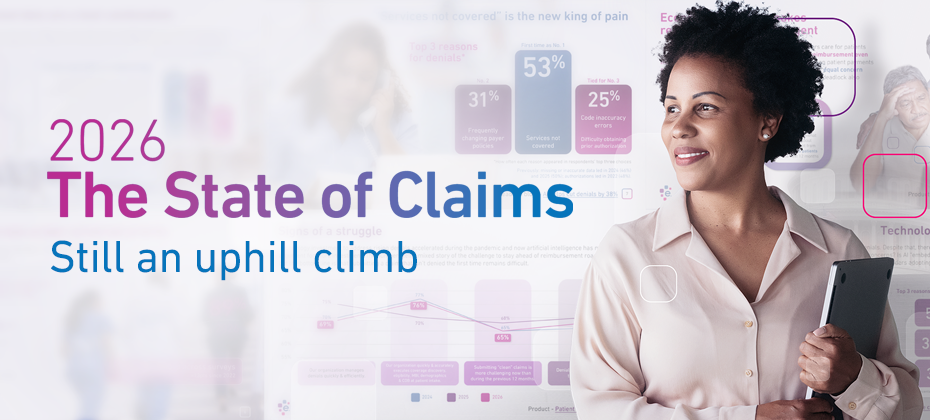
Download the report to uncover actionable strategies and see the tactics healthcare providers are using to get ahead of denials.
Takeaway 1: Denial rates remain high as urgency rises
Denial rates did not rise in 2026, but they did not meaningfully retreat. Forty percent of providers say 10% or more of claims are denied, compared with 41% in 2025, 38% in 2024 and 31% in 2022.
At the same time, reducing denials has become a greater priority, with 89% saying it is now an organizational priority, up from 82% in 2025. The economy adds further pressure, with 79% saying it makes payer reimbursement more urgent – the highest result since the survey began.
For revenue cycle teams, the practical message is to move denial prevention upstream, since a denied claim creates work across billing, coding and patient access teams. Preventing a correctable error before submission can keep staff from spending time on appeals with uncertain recovery.
Takeaway 2: Coverage rules and payer policy changes are driving denials
Coverage-related issues topped the survey’s list of reported denial reasons, with “Services not covered” appearing in 53% of respondents’ top three reasons for denials — making it the most frequently cited reason for the first time. Frequently changing payer policies followed at 31%, while code inaccuracy errors and difficulty obtaining prior authorization were tied at 25%.
That same pressure shows up elsewhere in the survey, too. Seventy-nine percent say payer reimbursement is more challenging and 78% say payer policy changes are more frequent. When policy changes outpace internal rules and workflows, claims can go out to payers with outdated coverage, authorization, or coding information.
Meanwhile, data quality is adding to the problem, with 53% of respondents saying errors in submitted claims are on the rise. One bright spot is that intake accuracy improved, with 43% saying inaccurate registration/intake data accounts for at least 5% of denials — down from 52% in 2025. Even so, a single inaccurate field can still delay adjudication and create downstream work.
Patient Access Curator™, an Experian Health solution, can help providers improve front-end data intake by combining coverage discovery, eligibility, coordination of benefits, Medicare Beneficiary Identifier verification and demographic checks in one workflow, giving teams a way to address patient and coverage data before the claim is even created.
Takeaway 3: Providers want technology investments that can prove their value
In the last year, providers have made several targeted changes, with 48% upgrading or replacing their claims technology.
Even so, current use of some technologies remains modest, with 20% saying they use robotic process automation (RPA), down from 25% in 2025, and 9% saying they use AI, down from 14%. The report raises the question of whether AI has become embedded and less visible, been removed or is simply being adopted more cautiously — though the survey does not resolve it.
However, interest has not disappeared. Sixty-four percent definitely or probably plan to invest in AI for claims or denial management and 83% would fully replace existing technology for a compelling return on investment. The most frequently cited reasons for evaluating existing technology are rising denials (57%), continued reliance on manual processes (35%) and interest in using AI to optimize claims (31%).
Seventy-six percent of respondents say AI can dramatically change the claims process now or over time, but optimism alone will not close the gap — providers still need investment plans tied to measurable workflow and financial outcomes.
Turn denial prevention into a measurable operating plan
The State of Claims 2026 report shows a system under sustained pressure: denial frequency remains high, payer rules keep changing and successful resubmission does not always produce full recovery. At the same time, providers report taking steps to improve front-end data, automate payer policy tracking and evaluate new technology.
The next step is turning that momentum into a concrete plan. That starts with identifying which denial categories are doing the most damage, then pinpointing where in the workflow each one takes root. From there, a focused set of metrics — covering clean claim rates, denial frequency, appeal outcomes and dollars recovered – gives revenue cycle leaders a way to judge if their technology is moving the needle.
Frequently asked questions
The report assesses the current state of claims management, the reasons behind today’s challenges, actions providers are taking and awareness of emerging technology intended to improve claims and reimbursement. The survey included 204 healthcare staff and was fielded Aug. 5–23, 2026.
Forty percent of providers report that 10% or more of claims are denied, compared with 41% in 2025, and the 2026 result is still 9 percentage points above 2022.
“Services not covered” is the most frequently cited reason, appearing in 53% of respondents’ top three choices, with frequently changing payer policies ranking second at 31%.
Reported AI use remains limited. Nine percent report using AI today, but 64% definitely or probably plan to invest in AI for claims or denial management. That gap suggests providers are interested but are still looking for a clear business case and return on investment.
To see the full picture of where claims management stands in 2026 and how providers are responding, download the State of Claims 2026 report.
Contact Experian Health
Complete the form below to be connected with a member of our Sales team. For Customer Support, including password resets, please visit our Support page.
Click here to view Experian’s U.S. Consumer Data Privacy Notice.
This site is protected by reCAPTCHA and the Google Privacy Policy and Terms of Service apply.