At A Glance
Healthcare collections are facing drastic changes under the One Big Beautiful Bill Act (OBBBA). In the third webinar in Experian Health’s three-part OBBBA series, industry leaders discussed how precision collections strategies can help defend margins without breaking trust.
Key takeaways:
- Healthcare collections are changing dramatically under OBBBA, requiring a new approach to collections for more robust margin protection.
- To navigate OBBBA successfully, organizations will need precision collections strategies capable of identifying appropriate financial pathways earlier and automatically segmenting accounts based on payment likelihood.
- Automation and AI are becoming essential to managing collections and defending margins by improving data accuracy and reducing administrative burden.
In April 2026, policy changes under the One Big Beautiful Bill Act (OBBBA) started to take effect – triggering one of the most significant healthcare funding shifts since the Affordable Care Act was enacted in 2010. For revenue cycle leaders, the long-anticipated impact of OBBBA on collections has become an operational reality.
To protect margins, new collections strategies will be critical. But how should healthcare organizations prepare?
This was the focus of Experian Health’s third webinar in a three-part series on navigating OBBBA. Matt Hanas, Product Manager (Collections Optimization) at Experian Health, talked about how the new law is likely to affect back-end operations and what providers can do to bolster collections efforts – without breaking patient trust. Brandon Burnett, VP, Revenue Cycle at Community Health System, also joined the discussion to share insights from the front lines. This article summarizes the key takeaways.
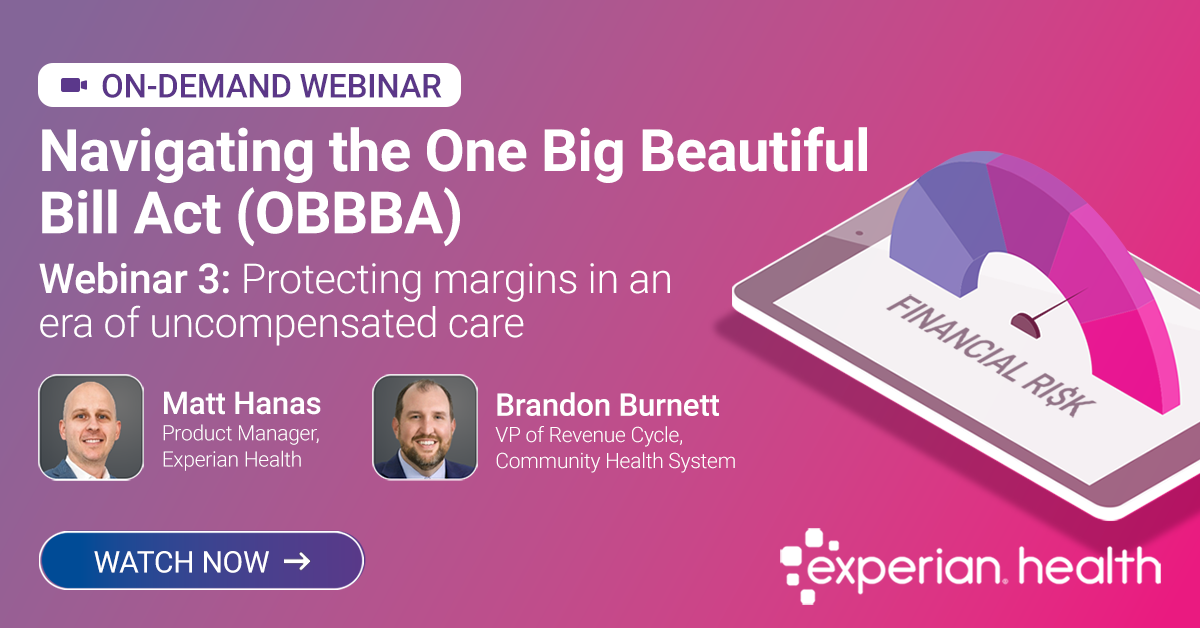
Now is the time to rethink collections.
This webinar shows how leading health systems are turning collections into a precision discipline using data, automation, and continuous monitoring to protect margins against uncompensated care.
The big shift: How OBBBA is reshaping healthcare finance
OBBBA doesn’t just change coverage rules; it reshapes who pays, when they pay, and how often they move in and out of coverage. “What we’re seeing here is a broader funding shift taking place across healthcare, one that many industry groups are characterizing as the most material change since the Affordable Care Act,” said Rob May, Senior Director of Marketing, Experian Health.
| Key ways OBBBA is changing healthcare finance include: |
| Rise in uninsured and underinsured patients: Over the next decade, 14 million Americans are expected to lose some or all of their coverage due to OBBBA’s tighter eligibility requirements and funding cuts. |
| Lower recoveries: With fewer patients covered by Medicaid or commercial plans and changes to state-directed Medicaid payments, providers will see reimbursement rates go down and fewer ways to offset underpayment. |
| Increased patient responsibility: More patients will enter collections systems as self-pay, putting providers at risk for uncompensated care and bad debt. |
| Less revenue predictability: Providers will see greater volatility in cash collections, making forecasting revenue predictability a challenge – especially for organizations operating in multiple states. |
| Higher administrative effort: Factors like coverage verification, documentation requirements, and payer follow-ups will increase administrative burden across the revenue cycle. |
Why traditional healthcare collections strategies no longer work
With OBBBA, “We’re seeing a systemic shift with more uninsured patients, lower recoveries, increased patient responsibility, and higher administrative effort all happening at the same time,” says Hanas. As providers brace for the financial impact, one thing is clear: a traditional one-size-fits-all collections approach is simply not going to work anymore.
However, organizations that approach collections with precision, intelligence, and adaptability will be well-positioned to navigate OBBBA successfully.
“Revenue cycle leaders can protect margin by identifying the right patients, the right moment, the right financial pathway, whether that’s coverage, charity, or collections, instead of treating every self-pay account the same.”
Matt Hanas, Product Manager at Experian Health
The patient perspective: A fragmented financial journey
“OBBBA doesn’t just change policy, it reshapes the patient journey in ways that ultimately influence financial outcomes across the entire revenue cycle,” says Hanas. Before OBBBA, coverage was predictable and financial conversations were straightforward – particularly for patients enrolled in Medicaid or ACA plans. However, as coverage instability becomes more common, patients will face a “far more fragmented and reactive” financial journey.
OBBBA’s effects on payment behavior and care decisions have already started to impact the patient financial journey and will compound over time. “Patients face higher medical debt risk and greater anxiety around healthcare costs, while long-term health outcomes can worsen due to delayed diagnosis or interrupted care, particularly for the most vulnerable populations,” Hanas explains.
| Upstream impact: |
| Before receiving care, patients are likely to experience additional stress from more frequent eligibility changes, increased verification requirements, and less clarity around what’s covered. |
| Downstream impact: |
| Retroactive eligibility changes that cause shifting balances and result in surprise bills after care is rendered may add to patient financial stress. |
A new collections strategy for healthcare providers
The financial pressure OBBBA brings for healthcare providers and patients is significant and creates an opportunity for revenue cycle leaders to rethink collections strategies.
Collect smarter, not more
“What that means in practice is moving away from a mindset of collecting everything and toward collecting on the right accounts,” says Hanas. Instead of simply ramping up traditional one-size-fits-all collections efforts, providers should focus on making smarter, more targeted decisions for individual patients.
Shifting financial decisions upstream, rather than after billing, with tools like Experian Health’s Patient Financial Clearance allows healthcare organizations to assess patients’ financial capacity and guide them accordingly. When charity-eligible and high-risk self-pay patients are identified earlier, it helps providers limit bad debt write-offs while also improving the patient experience.
Brandon Burnett shares that Patient Financial Clearance is a key tool Community Health System “uses on the front end to screen patients through the charity process or their ability to pay.” Automating presumptive charity screening has helped his organization navigate new California legislation around charity care requirements.
“I’m managing changes with the Medicaid population. I’m managing patients in and out of charity. But when you have the right technology, like we do at Community Health System, many of those decisions are automated.”
Brandon Burnett, VP, Revenue Cycle at Community Health System
Segment and prioritize accounts
Not every self-pay account requires the same approach. As self-pay volumes grow, success depends on focusing effort where recovery is most likely. Providers should focus on prioritizing accounts based on propensity to pay, balance size and eligibility risk rather than treating all balances the same.
Segmentation also helps organizations easily route each balance to the most appropriate collections path, including automation, digital outreach, payment plans, or financial assistance. “Patient-friendly communication, flexible resolution options, and digital engagement help maintain trust while improving outcomes,” says Hanas.
Add automation
As collections volumes rise and require a more individualized approach, recovery expenses go up. Automating low-balance and low-touch accounts allows staff and agency resources to stay focused on higher-value, higher-probability recoveries.
Community Health System relies on Collections Optimization Manager to automatically analyze patient data. Burnett says, “We have a tool with Experian Health that allows us to get insights on our patients through AR scrubbing that shows what patients are falling in certain federal poverty levels, what patients’ propensity to pay is, and how I’ve assigned them in the system.”
And the insights from the data help his organization “really understand and manage workflow from vendor management, reporting and analytics,” says Burnett. “It’s also automating things like bankruptcy, bad debt, charity and return mail.”
OBBBA collections readiness: Investing in the right technology
To prepare for OBBBA’s financial impact while also providing a better patient experience, Burnett says Community Health System knew “we were going to invest in technology” to bolster collections strategies. His organization was already relying on Experian Health’s solutions across the revenue cycle, and he says that staying engaged with your technology vendor is critical.
“There were many solutions that came out of our long-term partnership with Experian Health from an analysis perspective. We found many ways we could automate potential coverage changes and navigate self-pay patients based on their ability to pay even before they came in.”
Brandon Burnett, VP, Revenue Cycle at Community Health System
FAQs
Sweeping updates to healthcare coverage and reimbursement under the One Big Beautiful Bill Act (OBBBA) are driving major changes in healthcare collections. Increases in uninsured patients, lower recovery, more self-pay accounts, and higher administrative costs – all happening at the same time – are causing a system shift that’s affecting how revenue cycle leaders approach collections under OBBBA.
Precision collections in healthcare is a defensive approach that leading health systems are adopting to protect margins under OBBBA. Instead of trying to collect more, tools like Experian Health’s Patient Financial Clearance and Collections Optimization Manager allow organizations to collect smarter. By leveraging data, automation and continuous monitoring, providers are better able to defend against uncompensated care – without breaking patient trust.
Learn more about how Patient Financial Clearance and Collections Optimization Manager use data-driven insights to help healthcare organizations improve collections rates and deliver a better patient financial experience.
Contact Experian Health
Complete the form below to be connected with a member of our Sales team. For Customer Support, including password resets, please visit our Support page.