At A Glance
The U.S. small business population has expanded significantly since the pandemic, with much of that growth coming from sole proprietors. For CROs and credit risk teams, this changing borrower profile creates both opportunity and new considerations. Rising early-stage delinquency and higher business card utilization suggest potential cash-flow pressure, while late-stage delinquency remains relatively close to larger firms. The takeaway: lenders should closely monitor multiple risk signals and ensure their segmentation, underwriting and portfolio management strategies evolve alongside the small business market.A New Small Business Landscape Is Reshaping the Credit Risk Equation

The small business market that Chief Risk Officers are managing today looks meaningfully different from the one that entered the pandemic.
The number of small businesses in the U.S. has risen from 30.7 million in 2019 to 36.2 million in 2026, according to data presented in the latest Experian Commercial Pulse. That represents growth of roughly 18% in seven years. For financial institutions, that growth creates opportunity.
Watch the Commercial Pulse Update
For Chief Risk Officers and credit risk management teams, the important question may be: What kind of businesses are being created, and does the existing approach to assessing and monitoring small business risk adequately reflect this changing population?
The data suggests this is a question worth examining.
More businesses, but a different kind of business
The increase in small businesses is only part of the story.
New business formation accelerated sharply during the pandemic and has remained elevated. But as the chart below illustrates, much of this activity is being driven by sole proprietors rather than businesses planning to employ workers. By 2026, sole proprietors represented 93.3% of new business formation applications in the data presented.
That distinction matters for credit risk.
A growing population of very small businesses can have fundamentally different financial characteristics from larger, more established firms. They may have thinner operating histories, smaller liquidity cushions and greater dependence on the financial capacity of the owner.
For CROs, therefore, the growth in business formation shouldn’t necessarily be interpreted simply as growth in the traditional small business segment. It represents a change in the composition of the addressable credit population.
And that can have implications across acquisition, underwriting, portfolio segmentation and account management.
The risk signal isn’t necessarily where you might expect it
With a rapidly expanding population of small businesses, a natural concern is whether credit performance is deteriorating.
The answer from the current data is nuanced.
Experian commercial credit data shows that small businesses have consistently experienced higher early-stage delinquency than larger businesses. By June 2026, the three-month rolling average of 31+ day delinquency was approximately 1.9% for small businesses versus approximately 1.6% for larger businesses. The report describes this pattern as a potential indication of cash-flow pressure.
Yet the late-stage picture looks different.
As the above chart shows, 91+ day delinquency has risen for both populations, but the difference between small and larger businesses is relatively narrow. By June 2026, the two series had converged considerably compared with earlier periods.
That distinction is important for risk leaders.
Higher early-stage delinquency can be an early warning signal without necessarily indicating that the portfolio is headed toward equivalent increases in severe delinquency. The current data suggests small businesses are experiencing more payment pressure while, so far, demonstrating greater resilience at later stages than their early-stage performance alone might imply.
For CROs, that argues for monitoring the migration of risk rather than reacting to a single delinquency measure.
Watch utilization alongside delinquency
Another potentially important signal appears in how small businesses are using existing credit.
At the beginning of 2023, business card utilization rates for small and larger businesses were almost identical. Since then, the trajectories have separated.
By mid-2026, the three-month rolling utilization rate for small businesses was around 27.5%, compared with approximately 25% for larger businesses.
For risk teams, the direction of that gap may matter as much as its absolute size.
Rising utilization can have multiple explanations and should not be interpreted as distress on its own. But when considered alongside higher early-stage delinquency, it provides another dimension for monitoring potential cash-flow pressure.
This is where a multidimensional view of the borrower becomes increasingly valuable. Rather than waiting for late-stage delinquency to provide confirmation of stress, risk teams can consider how utilization, payment behavior and other portfolio signals are changing together.
What should CROs consider now?
The post-pandemic expansion of small business is not inherently a negative credit story. Quite the opposite: millions of new businesses represent a significant opportunity for lenders seeking responsible portfolio growth.
The challenge is making sure risk strategies evolve with the population they are designed to assess.
For CROs and credit risk management teams, three considerations stand out:
- Revisit segmentation. A market increasingly composed of sole proprietors may require more granular segmentation than a broad definition of “small business” provides.
- Monitor combinations of early-warning indicators. Early-stage delinquency, utilization and changes in credit-seeking behavior may provide a more useful picture together than any one metric in isolation.
- Separate emerging pressure from realized loss. Small businesses currently show signs of greater early-stage stress, but late-stage delinquency remains much closer to that of larger firms. That distinction can help risk teams calibrate responses rather than overcorrect.
The objective is not necessarily to tighten credit because the market has changed. It is to understand how it has changed and make sure underwriting, monitoring and portfolio management strategies remain aligned with the underlying risk.
For CROs, that balance is increasingly important: capturing the growth opportunity created by a rapidly expanding small business economy while identifying changes in borrower behavior early enough to protect portfolio performance.
The small business population has changed significantly since the pandemic. The next question for risk leaders is whether their credit risk frameworks have changed with it.
Learn more
- ✔ Visit our Commercial Insights Hub for in-depth reports and expert analysis.
- ✔ Subscribe to our YouTube channel for regular updates on small business trends.
- ✔ Connect with your Experian account team to explore how data-driven insights can help your business grow.
Related Posts
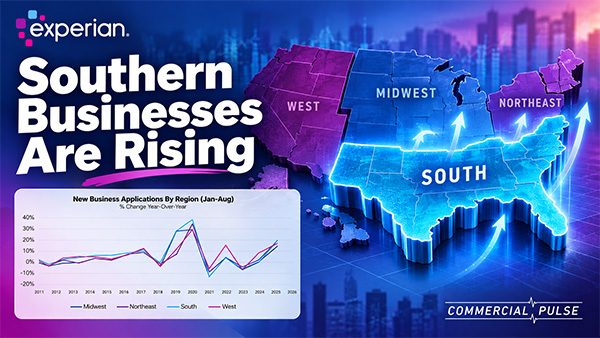
Small business formation remains one of the more notable trends in the U.S. economy. In August 532,000 new businesses launched across the country. While that was down from July, it remained well above historical averages. Since July 2020, an average of 455,000 new businesses have opened each month—56% higher than the pre-pandemic monthly average in 2018 and 2019. But the national numbers only tell part of the story. Watch The Commercial Pulse Update Experian’s latest Commercial Pulse report analysis examines where this growth is occurring and what it means for the commercial credit market. The data show that the South has emerged as an important center of small-business growth. And the businesses driving that expansion tend to have a different profile from their counterparts in other regions. For commercial lenders, understanding those differences can provide valuable context when evaluating new opportunities, credit demand and portfolio risk. Business growth is shifting geographically New business formation has increased across all U.S. regions, but the pace has not been uniform. Prior to 2018, regional differences in growth were relatively modest. During the pandemic years of 2020 and 2021, the South led the country in new business application growth. Since 2022, the West has posted the strongest growth, while the South continues to account for the greatest volume of new business openings. One factor providing context for that growth is population. The population of the South has grown more than 7% since 2019. Since 2020 alone, the region has added more than 3.6 million residents, outpacing every other U.S. region. Meanwhile, populations in other parts of the country declined between 2020 and 2022 before beginning to recover. Business formation and population movement do not necessarily have a simple cause-and-effect relationship. But their parallel growth highlights how the geographic makeup of both consumers and businesses has been changing. Credit-active businesses are growing even faster in the South The shift becomes even clearer when looking at businesses using commercial credit. Experian data shows the number of credit-active businesses in the United States has increased 55% since 2018. Every region participated in that expansion, but the South experienced the greatest growth at 70%, followed by the North at 52%, West at 50% and Midwest at 36%. The South now represents approximately 39% of U.S. credit-active businesses. It also accounted for more than 40% of newly opened commercial accounts in 2026, compared with 37% in 2019. For commercial credit organizations, that means the South represents not just a growing population of businesses, but an increasingly significant share of businesses participating in the commercial credit ecosystem. Southern businesses tend to be smaller and younger The composition of this growth is just as important as its scale. Credit-active businesses in the South and West tend to skew smaller and younger than those in the North and Midwest. In the South, 53% of businesses generate less than $500,000 in annual revenue, while 59% have fewer than five employees. Only 36% have been operating for more than 10 years, compared with 43% in the Midwest. Those characteristics can influence how businesses interact with credit. A younger business, for example, may have had less time to establish multiple commercial credit relationships. That pattern appears in Experian’s data. Across the United States, the average number of commercial credit accounts per business has declined from approximately 1.8 in 2018 to 1.5 in 2026. The South experienced the steepest decline and currently has the fewest accounts per business. At the same time, commercial credit inquiries have increased since 2023, most recently peaking in early 2026. Inquiry rates have typically been higher in the Midwest and South. The combination of fewer existing accounts and elevated inquiry activity provides useful context for lenders seeking to understand the credit needs of a growing population of younger businesses. Credit utilization tells another part of the story Regional differences also appear after businesses establish credit relationships. Businesses in the Midwest and North opening new commercial accounts tend to receive higher lines than businesses in the South and West. At the same time, businesses in the South show higher commercial card utilization despite carrying somewhat lower average balances. Experian’s analysis points to lower credit lines as an important factor behind that relationship. These trends reinforce why looking beyond a single credit metric can be important. Higher utilization, for example, can take on additional context when considered alongside credit-line size, business age, balances and regional business formation. Growth brings opportunities—and risk factors to monitor Despite significant growth and changes in business composition, regional credit performance has remained relatively steady. Commercial delinquencies across all regions are near pre-pandemic levels, while commercial credit risk scores have been relatively stable. There are regional differences worth monitoring, however. Businesses in the South have lower average commercial credit scores than businesses in the other regions analyzed, and delinquency rates tend to be higher in the North and South than in the Midwest and West. The broader takeaway is not simply that there are more small businesses in the South. It is that the composition of the commercial market is evolving alongside that growth. The South represents a growing share of credit-active businesses and new commercial accounts. Many of those businesses are younger, smaller and have fewer established commercial credit relationships. Their credit needs and behaviors may therefore differ from those of more mature businesses in other parts of the country. For commercial lenders and risk leaders, understanding those distinctions can help provide greater context around acquisition, underwriting and portfolio management decisions. As small business formation continues, Experian will continue monitoring where that growth is occurring—and how the changing business landscape is showing up in commercial credit behavior. Learn more ✔ Visit our Commercial Insights Hub for in-depth reports and expert analysis. ✔ Subscribe to our YouTube channel for regular updates on small business trends. ✔ Connect with your Experian account team to explore how data-driven insights can help your business grow. Download the Commercial Pulse Report Visit Commercial Insights Hub Where are small businesses growing in the U.S.? Experian data points to significant growth in the South. While new business formation has increased across the country, the South has consistently recorded the highest volume of new business openings and has seen the number of credit-active businesses grow 70% since 2018—compared with 55% nationally. Where are small businesses growing the most? The South has consistently had the largest volume of new business openings. The South led application growth during 2020–2021, while the West has posted the strongest growth rates since 2022. That distinction is important because it prevents the SEO headline from overstating what the data shows. Why has small business growth been so strong in the southern U.S.? The South has added more than 3.6 million residents since 2020, substantially outpacing other regions. Our report establishes a correlation rather than causation. Related Posts

Explore Experian insights on U.S. manufacturing investment, AI and automation adoption, employment trends, and commercial credit performance.

Experian’s latest Commercial Pulse analysis examines these trends using retail spending data alongside Experian commercial credit data.