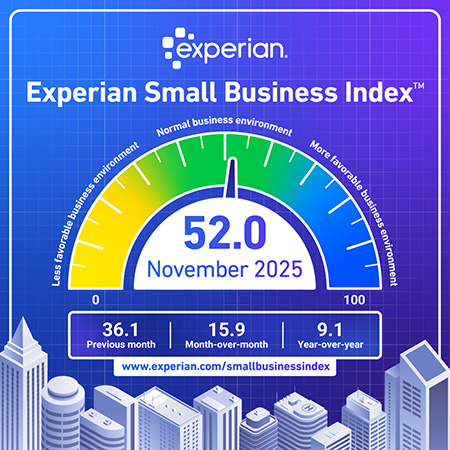
The Experian Small Business Index™ improved by 15.9 points month-over-month and 9.1 points Year-Over-Year
Nov 2025
- Index Value (Nov):52.0
- Previous Month:36.1
- MoM:15.9
- YoY:9.1 (Nov 2024 = 42.9)
The Experian Small Business Index™ increased substantially in November by 15.9 points to 52.0. This also represents a YoY increase of 9.1 points. There was increased business activity with the end of the government shutdown in November. Business owners saw an increase in new account openings and approval rates, along with an increased number of new business formations.
Negative credit conditions improved, with reductions in delinquencies and utilization. The Small Business Optimism Index from NFIB increased to 99.0 from 98.2 in October. There was an increase in the number of new business applications to 535K from 499K in October, the most in a single month since July 2020. Inflation fell in November, to 2.7% from 3.0% in September, the lowest level since July. November unemployment was up to 4.6% from 4.4% in September. The inflation and unemployment rates are likely to influence Federal Reserve policy decisions as they consider whether additional rate cuts are warranted in 2026 after a 25 bps drop in December.
Related Posts
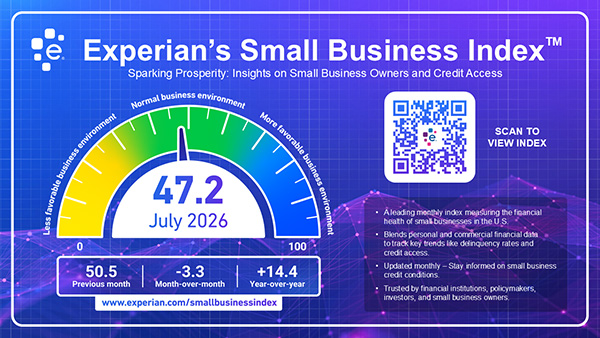
Experian Small Business Index saw rising utilization and 91+ day past-due rates, which contributed to the monthly decline.
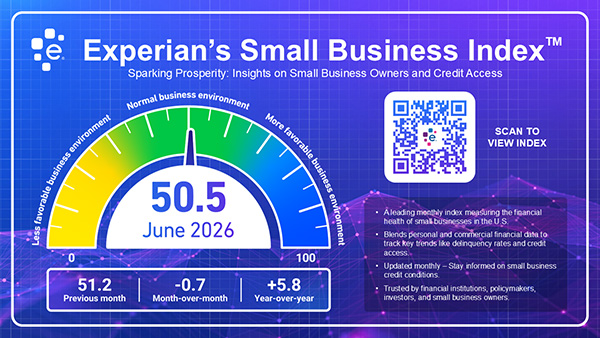
The Experian Small Business Index declined by 0.7 in June, but remains well above last years level on strong small business sentiment.
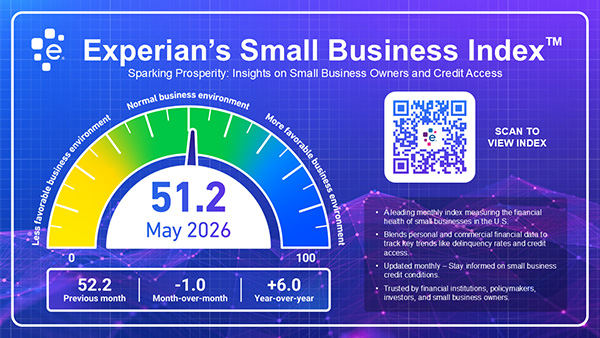
Small businesses navigated headwinds in May as uncertainty began to rise May 2026 Index Value (Mar): 51.2 Previous Month: 52.2 MoM: -1.0 YoY: +6.0 (May 2025 = 57.2) The Experian Small Business Index™ decreased slightly, falling 1 point to 51.2 in May, but remained 6 points higher than a year ago. Several credit risk factors supported the index in May. Past-due balances on business owners’ consumer accounts declined, as did later-stage delinquencies on their commercial accounts. However, several factors weighed on the index. Commercial credit utilization increased, and there was a sharp rise in consumer public records filings. While public records are typically a lagging indicator, this trend warrants monitoring in the coming months. In the broader economy, the unemployment rate declined to 4.2% from 4.3%, and GDP grew by 2.1%, exceeding expectations. Several measures of inflation also increased in May. Headline inflation rose from 3.8% in April to 4.2%, while core inflation, which excludes food and energy, increased from 2.8% to 2.9%. Energy prices were 23.5% higher than a year earlier and likely contributed to broader inflationary pressures. Food prices declined 0.1%, while rent increased 0.1%. Business formation remained strong, with 524,000 new business applications filed in May, up from 505,000 in April. This occurred despite the NFIB Uncertainty Index increasing to 91. The NFIB Small Business Optimism Index edged down to 95.3 in May from 95.9 in April. Explore Experian Small Business Index Related Posts