The Experian Small Business Index™ declined in October, dropping by 5.0 points month-over-month.

Oct 2025
- Index Value (Oct):36.1
- Previous Month:41.1
- MoM:-5.0
- YoY:-4.6 (Oct 2024 = 40.7)
The Experian Small Business Index™ decreased in October by 5 points to 36.1. This drop is attributable to decreased origination activity for small businesses and small business owners, along with an increase in delinquencies for small business owners’ consumer trades. Small business trade delinquency rates have remained stable.
The NFIB reported a decrease in small business optimism to 98.2 in October from 98.8 in September, and the University of Michigan reported a drop in consumer sentiment to 51.1 in November from 53.6. Due to the extended government shutdown, several of the economic indicators were not reported for October, but there were signs of positive factors in the macroeconomic environment. US employers reported hiring 283K in October, up from 117K in September, and existing home sales were up 1.2% in October to 4.1M.
Related Posts
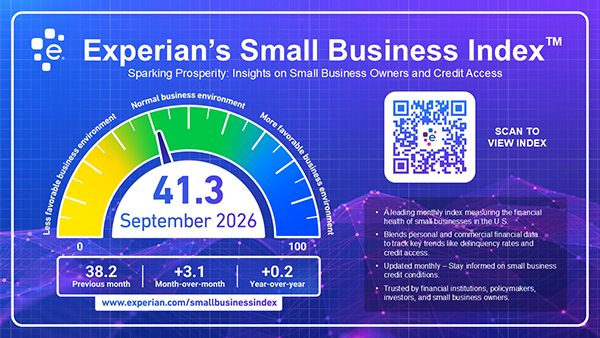
The September index marks the first increase since April 2026 September 2026 Index Value (Sep): 41.3 Previous Month: 38.2 MoM: +3.1 YoY: +0.2 (Sep 2025 = 41.1) The Experian Small Business Index™ increased by 3.1 points to 41.3 in September, which is on par with September of last year. This marks the first increase in the score since April 2026. Small business and business owner risk showed mixed signals in September. Business owners were able to originate more trades and the utilization on their late delinquency trades fell, both positive signs of improving credit risk. They also had more emerging businesses establishing credit than in the previous month. While owners’ consumer trades had higher 31+ day delinquency rates and a higher 61+ day delinquency rate on revolving trades, those values were nearly identical to this time last year. There were signs of increased risk in small business owners’ commercial trades with increases in both commercial trade utilization and 91+ day delinquency rates. On the macroeconomic side, GDP is strong and unemployment continues to be low. The advanced estimate of annualized GDP for the third quarter was 3.4% and unemployment was up slightly from 4.1% in August to 4.2% in September. Inflation continues to be the main challenge in the economy, with headline inflation at 3.7%, up from 3.4% in August, driven largely by energy costs. While fuel prices decreased slightly over the last month, prices for regular and diesel fuel are up 40% and 73%, respectively, from a year ago. These high costs are challenging for both small businesses and small business owners. New businesses continue to form at a very high rate, with nearly 535K new businesses launched in September, well above the historical average. The improvement in the Experian Small Business Index and the improving risk metrics for small business owners’ consumer trades suggest the lending market remains healthy for small businesses. Explore Experian Small Business Index Related Posts
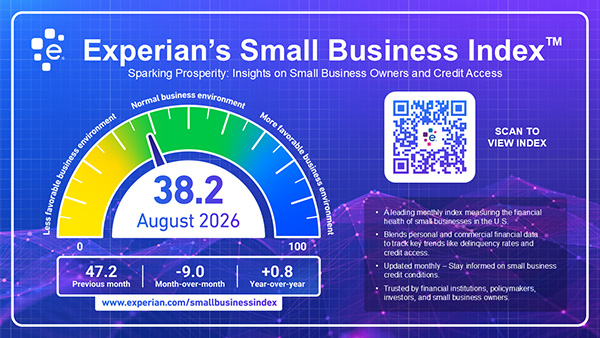
The Experian Small Business Index™ declined 9 points to 38.2 in August, which is nearly level with last year at this time.
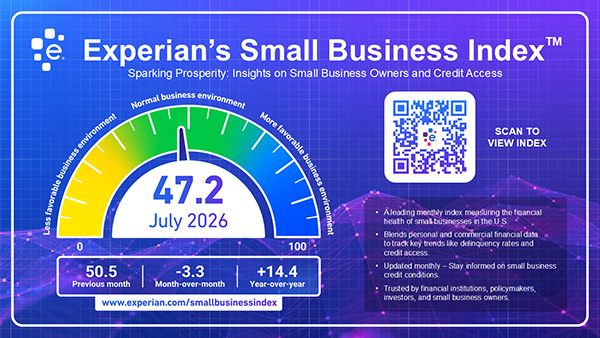
Experian Small Business Index saw rising utilization and 91+ day past-due rates, which contributed to the monthly decline.