Business owners sough and obtained new credit while delinquency remained in check
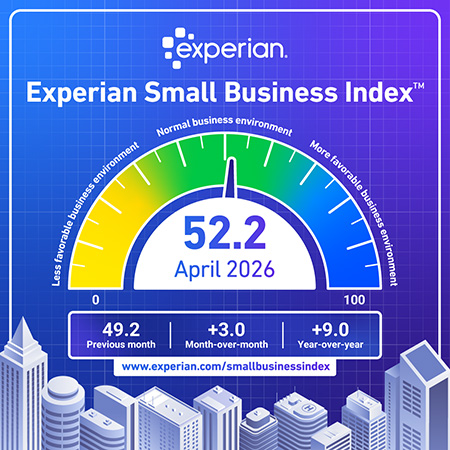
Apr 2026
- Index Value (Mar):52.2
- Previous Month:49.2
- MoM:+3.0
- YoY:+9.0 (Apr 2025 = 43.2)
The Experian Small Business Index™ increased by 3 points to 52.2 in April and was up 9 points year-over-year.
The index was boosted in April by several positive consumer credit trends among business owners. Consumers sought and obtained new credit in April while their utilization and delinquency rates were down. These positive trends helped to mitigate some signs of weakness in their commercial credit, where utilization was up and the number of emerging businesses decreased slightly.
In the broader economy, inflation continued to rise in April to 3.8% from 3.3% in March. Energy prices were a significant contributor, increasing 17.9% from a year ago. Core inflation increased more modestly from 2.6% in March to 2.8% in April. Unemployment remained flat at 4.3% and the U.S. economy added 115K jobs in April, down 70K from March. These labor market and inflation trends coincided with the Federal Reserve’s decision to maintain interest rates at the end of April.
New businesses continue to form at a strong rate with 503K new businesses launched in April, up from 493K in March, continuing the trend observed since the end of the Covid pandemic. Small Business optimism also increased slightly, to 95.9 in April from 95.8 in March.
Related Posts
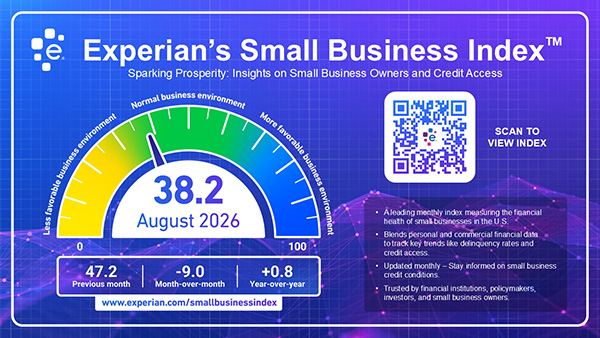
The Experian Small Business Index™ declined 9 points to 38.2 in August, which is nearly level with last year at this time.
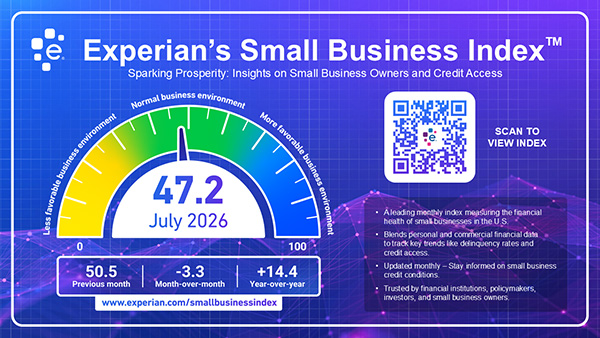
Experian Small Business Index saw rising utilization and 91+ day past-due rates, which contributed to the monthly decline.
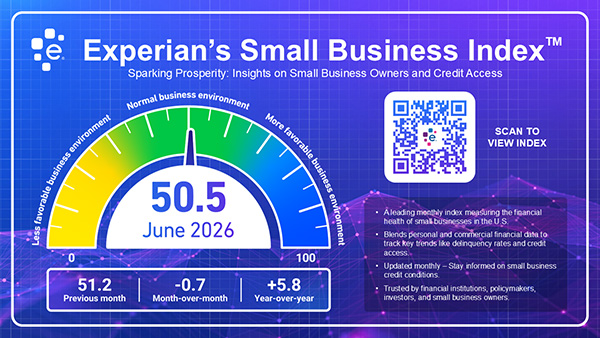
The Experian Small Business Index declined by 0.7 in June, but remains well above last years level on strong small business sentiment.