Monthly Pullback Aside, Small Business Sentiment Remains Well Above 2025 Levels
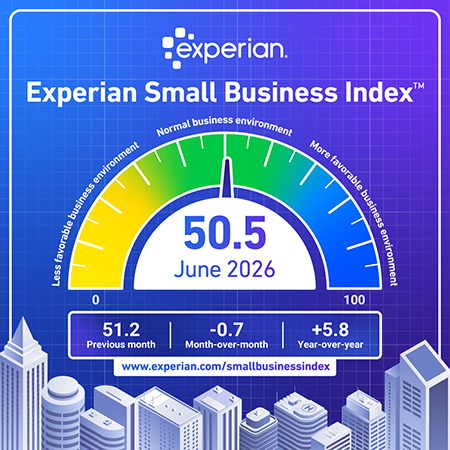
June 2026
- Index Value (Mar):50.5
- Previous Month:51.2
- MoM:-0.7
- YoY:+5.8 (Jun 2025 = 44.7)
The Experian Small Business Index™ declined 0.7 points to 50.5 in June but remained 5.8 points higher than a year earlier, indicating that small business conditions continue to be stronger than they were a year ago despite some month-to-month softening.
Inflation eased modestly in June. Headline inflation declined from 4.2% in May to 3.5%, while consumer prices fell 0.4% month over month, the first monthly decline since 2020, largely reflecting lower oil prices. Rent and food inflation also moderated, with both declining by 0.1 percentage points from May. The labor market remained relatively stable, with the unemployment rate falling to 4.2% from 4.3% in May, while average hourly earnings continued to rise, reaching $32.38 in June.
Oil prices fell in June giving consumers a welcome break in gasoline prices, but renewed conflict in the Middle East could lead to higher oil prices. Inflation remained above the Federal Reserve’s 2% target in June. The U.S. personal savings rate fell to 2.7%, down from 3.0% in May, at its lowest level since June 2022.
Easing inflation and a steady labor market position small businesses on stronger footing entering the second half of the year than they were a year ago.
Related Posts
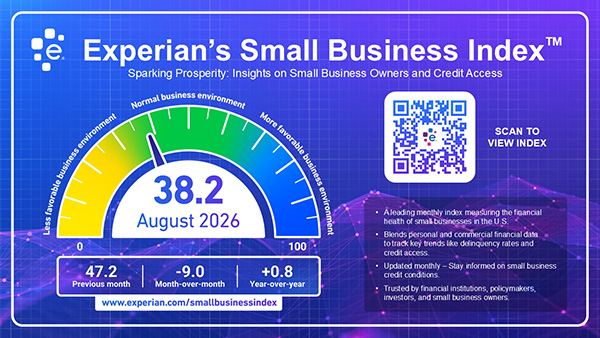
The Experian Small Business Index™ declined 9 points to 38.2 in August, which is nearly level with last year at this time.
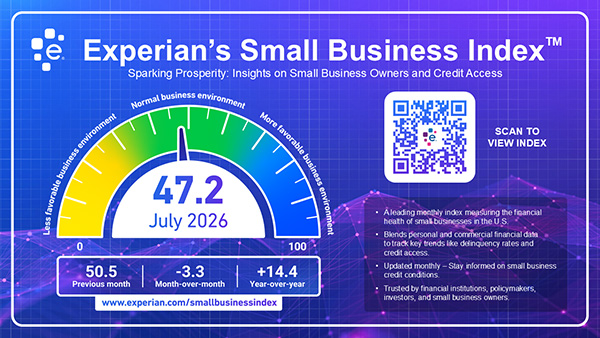
Experian Small Business Index saw rising utilization and 91+ day past-due rates, which contributed to the monthly decline.
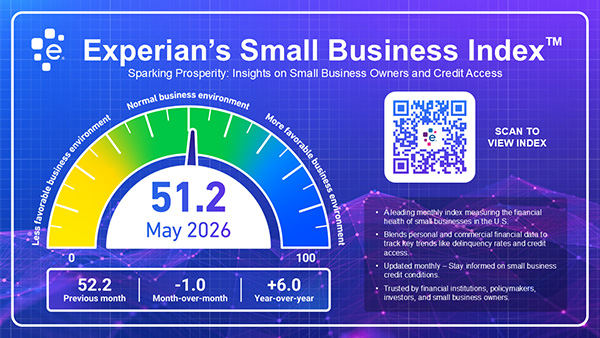
Small businesses navigated headwinds in May as uncertainty began to rise May 2026 Index Value (Mar): 51.2 Previous Month: 52.2 MoM: -1.0 YoY: +6.0 (May 2025 = 57.2) The Experian Small Business Index™ decreased slightly, falling 1 point to 51.2 in May, but remained 6 points higher than a year ago. Several credit risk factors supported the index in May. Past-due balances on business owners’ consumer accounts declined, as did later-stage delinquencies on their commercial accounts. However, several factors weighed on the index. Commercial credit utilization increased, and there was a sharp rise in consumer public records filings. While public records are typically a lagging indicator, this trend warrants monitoring in the coming months. In the broader economy, the unemployment rate declined to 4.2% from 4.3%, and GDP grew by 2.1%, exceeding expectations. Several measures of inflation also increased in May. Headline inflation rose from 3.8% in April to 4.2%, while core inflation, which excludes food and energy, increased from 2.8% to 2.9%. Energy prices were 23.5% higher than a year earlier and likely contributed to broader inflationary pressures. Food prices declined 0.1%, while rent increased 0.1%. Business formation remained strong, with 524,000 new business applications filed in May, up from 505,000 in April. This occurred despite the NFIB Uncertainty Index increasing to 91. The NFIB Small Business Optimism Index edged down to 95.3 in May from 95.9 in April. Explore Experian Small Business Index Related Posts