
Dispute Rates Rising? Five Ways to Uncover Data Inaccuracies

by Shelly Shakespeare 3 min read February 27, 2018

Many data furnishers are experiencing increases in dispute rates. It’s a tough spot to be in. Data furnishers are not only obligated under the FCRA to investigate and respond to all consumer disputes – reviewing every Automated Consumer Dispute Verification – but they must also do so within less than 30 days.

As the number of disputes rise, resources become taxed and the risk of not meeting Fair Credit Reporting Act (FCRA) obligations increases. Let’s face it, consumer disputes aren’t going away, but understanding the reported data and metrics behind disputes can help data furnishers minimize them and defend reporting strategies and processes.

5 Way to Uncover Data Inaccuracy

1. Gain perspective against the industry and peers. Depending on the industry you service, the general benchmarks for dispute rates can vary. It’s important to understand where you fall in regards to dispute rates. Are you trending high or low? As an annualized average, we’ve recently experienced the following industry dispute rates through the end of the year:
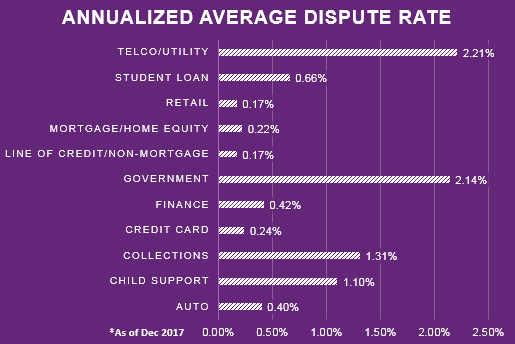
However, industry averages are just the tip of the iceberg. Measurement against peers can provide a clearer picture of where you fall. Are you an outlier or on par? How do you respond in comparison to peers? Are you deleting the trade as the result of the dispute at a higher rate? This could be an indicator of a systemic problem that needs addressing.

2. Implement pre-submission quality checks. Once you know where you stand, make sure your data is accurate before it heads out the door and hits the consumer’s credit report. Implement manual checks against Metro 2 rules. Build SQL queries to perform your checks. Better yet, use data validation software to automatically identify, track and remediate errors before sending the file to the bureaus. These steps can catch disputes before they happen.

3. Review any data being rejected after submission. Even if your new reporting motto is ‘know before it goes’; once the data has been transmitted, you’ll still want to monitor data being rejected due to Metro 2® errors. When data is rejected that means the update you provided did not make it to file. This leaves room for disputes. Incorporating a robust review of all rejected data in a timely and detailed manner, with updates made before the next reporting period, can improve the accuracy of your data.

4. Audit to identify and correct any stale data on file. An audit for any stale data  – which includes open accounts with a balance greater than zero that have not been updated recently – should be performed at least annually. Review, research and remediate any outdated data that could affect your customer, making it susceptible to a dispute.

5. Educate your customers. Why are your customers disputing? Are there common themes within your customer base? Often, a dispute can be eliminated before it happens, with some explanation on the way an account is reported. By providing proactive access to materials and resources that help demystify the credit reporting process, a potentially negative interaction can be turned into a positive learning opportunity, helping the overall customer experience.

Learn more about data accuracy solutions.

Related Posts

Identity intelligence and alternative data can help lenders validate consumers and support more informed decisions across the customer lifecycle.

September 16, 2026 by Julie Lee
As Electric Vehicle Adoption Eases, Dealers Can Find New Opportunities To Reach Consumers

After years of rapid growth, new electric vehicle (EV) registrations have moderated, and the EV market has entered a new chapter. But slower growth shouldn’t be mistaken for disappearing demand, with data suggesting the reality is much more nuanced. According to Experian Automotive’s Automotive Consumer Trends Report: Q2 2026, battery EVs accounted for 8.21% of new retail registrations in the last 12 months, down from 9.23% a year earlier. However, consumers aren’t simply walking away from electrification. In fact, more than one million new EVs were registered during the past 12 months and the used EV market recorded more than 540,000 registrations over the same period. The opportunity may be less about waiting for the EV market to grow and more about understanding where EV demand is present, who is driving them, and how to reach those consumers more effectively. Who is likely to purchase an EV and what vehicle types are they interested in? Understanding who’s in the market for an EV can allow dealers to position themselves around consumers’ needs as they choose a vehicle that fits their everyday lifestyle. In the second quarter of 2026, Millennials and Gen X accounted for 67.83% of new EV registrations, nearly 10 percentage points above their combined share of all new, retail registrations. Millennials were also the largest generational audience across both new and used EV market share, coming in at 35.76% and 38.42%, respectively. It’s important to consider that the EV shopper isn’t necessarily looking for an unfamiliar or new type of vehicle. In many cases, they’re seemingly looking for an electric version of the practical vehicle they already know. For instance, SUVs accounted for 77.47% of new EV registrations in Q2 2026, which was similar to SUVs’ 63.49% share of all new retail registrations. For these shoppers, creating messaging around value, practicality, and available choices may resonate differently than premium technology messaging aimed at some new-EV prospects. The more precisely dealers can identify those audiences, the less they need to depend on broad EV market momentum to generate demand. To learn more about EV insights, view the full Automotive Consumer Trends Report: Q2 2026 presentation.

September 15, 2026 by Kirsten Von Busch
Infographic – The Mortgage Conversion Opportunity: How Finding the Right Borrowers Drives More Closings

With only one in three mortgage shoppers who submit a hard credit inquiry ultimately closing, lenders have an opportunity to rethink how they identify and engage prospective borrowers. This post explores why credit scores alone may not provide a complete picture of borrower readiness and how broader financial insights can help lenders identify consumers who may be more prepared to move forward, prioritize engagement, and improve mortgage conversion.

September 10, 2026 by Royce Chang

Subscribe to our Newsletter

Enter your name and email for the latest updates.

This site is protected by reCAPTCHA and the Google Privacy Policy and Terms of Service apply.

Subscribe to our Newsletter

Don't miss out on the latest industry trends and insights!
Subscribe