Loading...

What happens when first-party, third-party, contextual, and geographic data work together

Published: January 28, 2026 by Scott Kozub, VP, Product Management

At A Glance

Your audience strategy works like a story. First-party data sets the outline, but scale and relevance come from connecting additional signals such as contextual, geographic, and behavioral data. Experian helps CMOs unify these inputs through identity, enabling consistent activation, privacy-forward targeting, and measurable outcomes as marketing strategies evolve in 2026.

How should CMOs think about data as part of their audience strategy?

The best digital marketers possess excellent storytelling capabilities—and they fuel the plot with data.

When you think about it, your audience strategy is the whole story, and the type of data you use helps create each chapter. Just as any good book incorporates numerous literary devices, you must use more than one type of data to develop a dynamic, relevant, and timely narrative that captures your target users’ attention.

In 2026, marketers should prioritize and invest in data and targeting strategies beyond just first-party to drive growth, improve efficiency, and strengthen customer relationships.

Our 2026 Digital trends and predictions report is available now and reveals five trends that will define 2026. From curation becoming the standard in programmatic to AI moving from hype to implementation, each trend reflects a shift toward more connected, data-driven marketing. The interplay between them will define how marketers will lead in 2026.

Why is first-party data not sufficient on its own?

First-party data provides a strong foundation for targeting and measurement. It reflects information consumers have shared directly through brand interactions. That makes it reliable and central to audience strategy.

That foundation alone does not tell the full story. First-party data defines known customers, but limits reach and frequency. Growth depends on expanding beyond existing relationships.

Think of first-party data as a way to create an outline, not the whole story, about your target audiences—the main characters in your marketing. To flesh out the entire narrative about them, you must source, connect, and activate additional data.

The ability to unify different data sources with accuracy, scale, and privacy at the forefront sits at the core of Experian’s business. We unify household, individual, device, demographic, behavioral, and first-party signals, along with contextual and geographic data points, to build a reliable view of consumers, even when specific signals are missing. This clarity helps you personalize, target, activate, and measure with confidence.
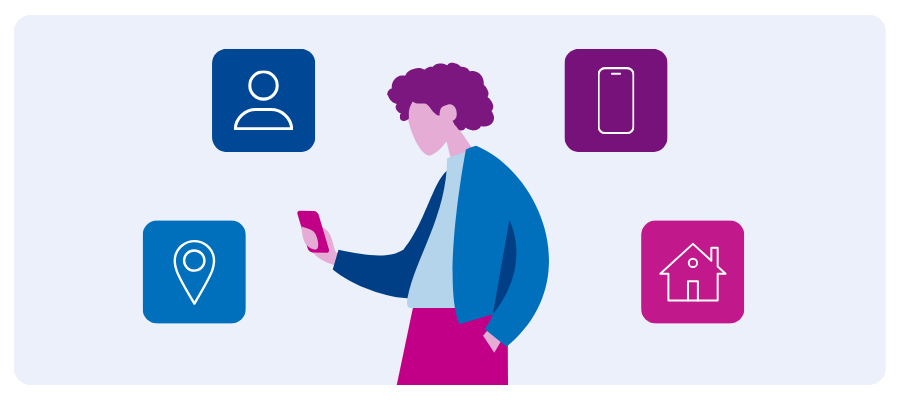
A person looking at their phone with icons for location, individual, phone, and house around them in a circle

By layering third-party data, contextual data, and geolocation data onto your first-party data foundation, your advertising strategies become stronger than if you used any of these sources as standalone solutions.

How do different types of third-party data add depth to audience profiles?

Third-party data expands understanding beyond known customers. If first-party data is the outline, third-party data helps with “character development”—a.k.a., addingdetailto your audience profiles. Good third-party marketing data complements first-party insights with demographic, behavioral, and transactional context, providing the missing puzzle pieces to complete the full customer profile. Filling in gaps in customer understanding helps youidentify, reach, and engage current and new customers more effectively. Third-party data allows brands to build loyalty with consumers by speaking to their interests and intent behind purchases.

Third-party data opens up new targeting tactics for advertisers, such as:

Behavioral

How people engage with brands or how they use social media

Demographic

Age, gender, education, income, and religion

Health

A combination of demographics, behaviors, and health needs

Interest

Delivering ads based on interests, hobbies, or online activities

Location

Where people live, work, or spend large amounts of time

Psychographics

Shared characteristics like attitudes, lifestyles, and interests

Purchases

Using previous purchase behavior to identify the right audiences

In addition to targeting, third-party data also remains critical to AI models, which must train on both structured and unstructured data. At Experian, our AI-powered technology interprets live bidstream data, device activity, content, and timing to optimize in the moment, ensuring campaigns deliver meaningful relevance, not just broader reach.

How are contextual and geographic approaches reshaping audience targeting?

Contextual and geographic approaches to targeting focus on environment and behavior rather than identifiers. Regulatory scrutiny, stricter and more fragmented compliance standards, and rising consumer expectations are transforming how marketers approach third-party data targeting. Evolving privacy laws and inconsistent identifiers across environments require new approaches that balance performance and privacy.

Contextual and geographic targeting help marketers reach relevant audiences while maintaining privacy.

What is data-informed contextual targeting?

Contextual targeting connects audience attributes to the content environments people choose. It helps determine the setting of your story—where your characters spend their time.

Solutions like Experian’s Contextually-Indexed Audiences harness advanced machine learning technology to combine contextual signals (a tried–and-true targeting tactic) with third-party targeting to ensure marketers reach their target audiences on the content they tend to consume, regardless of environment or location. What’s excellent about data-informed contextual targeting is that it moves beyond traditional keyword-based strategies to reach consumers on websites that over-index for visitors with the demographics, behaviors, or interests they are looking to target.

What is data-informed geotargeting?

Geotargeting uses shared location patterns to support relevance at scale. Geotargeting is another possibility for further developing the scene of your story.

People with similar behaviors and interests tend to live in similar areas, which is why so much effort goes into location planning for brick-and-mortar stores. Data-informed geotargeting combines geos with third-party data to make more informed media buys based on common behaviors within a geographic location.

We launched our Geo-Indexed audiences, which use advanced indexing technology to identify and reach consumers based on their geographic attributes. These audiences help marketers discover, segment, and craft messaging for consumers without relying on sensitive personal information, enabling them to reach target audiences while maintaining data privacy confidently.

What role does AI play in third-party data targeting?

AI acts like an automated editor of your book, refining and finding new ways to put valuable third-party audiences and data to work without relying on segments linked to known or disparate identifiers.

We’ve used AI and machine learning at Experian for decades to bring identity, insight, and generative intelligence together so brands and agencies can reach the right people, with relevance, respect, and simplicity.

Why does a balanced, integrated approach that combines first-party, third-party, contextual, and geo-targeting data matter?

The combined effects of integrating third-party, contextual, and geotargeting data (and the marketing tactics it underpins) with first-party data will drive your success.

Think of how any good author crafts a story. Regardless of whether it’s fiction or non-fiction, they draw on both first-person experience and external research and sources to develop their plot. No single data source tells the full story. Integration allows marketers to understand audiences more completely and act with confidence.

Pooling these inputs together moves you closer to your goal of understanding the whole story about your target customers. In fact, an almost even number of marketers plan to use contextual targeting (41%) and first-party data (40%) as their main targeting strategies, amid privacy laws and the loss of persistent advertisers.

Primary data strategyPercent of marketers that plan to use this data strategy
Contextual targeting41%
First-party data40%

A brand with strong first-party insights can extend reach by layering in additional signals. For example, a nutrition brand that knows who purchases protein supplements can expand prospecting by combining:

First-party signals

Customers who purchase protein supplements

Contextual signals

Engagement with fitness blogs, healthy recipe content, or workout apps

Geographic signals

Consumers located in the Greater Philadelphia area

By connecting these inputs, the brand can identify new health-conscious audiences with similar interests and behaviors. This approach supports privacy-safe targeting while improving engagement and performance.

How can marketers build an integrated data strategy in 2026?

An integrated data strategy reduces friction and supports scale. The right data partner offers a unified solution that helps unify data, activate audiences, and adapt as the ecosystem evolves. Here’s how:

Organize data

Create a clean, usable data foundation by eliminating fragmented silos. Experian’s solutions unify disparate data, enabling identity resolution and a single customer view.

Create a complete profile

Experian links a persistent offline core of personally identifiable information (PII) data with fresh digital signals, giving you a high-fidelity view of consumers to decorate with marketing data. This allows for improved customer understanding and personalized marketing that competitors struggle to replicate.

Build addressable audience segments

Create audiences using a mixture of signals, including first-party data, third-party behavioral, interest, and demographic data, as well as contextual signals. If you partner with Experian, you can use audiences built on our identity graph to guarantee accuracy, scale, and maximum addressability.

Drive innovation

Look for partners and platforms that prioritize innovation in finding new ways to reach target audiences across the ecosystem. You don’t want a vendor or a system that can’t keep pace and adapt with our rapidly evolving industry.

Marketers who want to create and activate campaigns more efficiently and effectively in 2026 need an integrated approach that combines first-party, third-party, contextual, and geotargeting data. Streamlining data integration and activation positions brands and agencies for sustainable growth and stronger consumer relationships in a privacy-conscious marketplace.

Build your next chapter on a connected data foundation

As audience strategies evolve, connection and interoperability matter more than ever. Connect with our team to learn how Experian helps marketers unify data, identity, and activation across channels.

This site is protected by reCAPTCHA and the Google Privacy Policy and Terms of Service apply.


About the author

Scott Kozub headshot, VP, Product, Experian

Scott Kozub

VP, Product Management, Experian

Scott Kozub is the Vice President of the Product Management team at Experian Marketing Services working across the entire product portfolio. He has over 20 years of product experience in the marketing and advertising space. He’s been with a few startups and spent many years at FICO and Oracle Data Cloud heavily focused on loyalty marketing and advertising technology.


FAQs

How should CMOs think about data as part of their 2026 audience strategy?

In 2026, CMOs should prioritize and invest in data and targeting strategies that combine first-party, third-party, contextual, and geographic data to drive growth, improve efficiency, and strengthen customer relationships. 

Why is first-party data not sufficient on its own? 

First-party data is not sufficient on its own because first-party data defines known customers but limits reach and frequency. Growth depends on expanding beyond existing relationships. The ability to unify different data sources with accuracy, scale, and privacy at the forefront sits at the core of Experian’s business. We unify household, individual, device, demographic, behavioral, and first-party signals, along with contextual and geographic data points, to build a reliable view of consumers, even when specific signals are missing. This clarity helps you personalize, target, activate, and measure with confidence.

How do different types of third-party data add depth to audience profiles?

Third-party data expands understanding beyond known customers. Third-party data opens up new targeting tactics for advertisers, such as:  
Location: Where people live, work, or spend large amounts of time
Health: A combination of demographics, behaviors, and health needs
Purchases: Using previous purchase behavior to identify the right audiences 
Behavioral: How people engage with brands or how they use social media 
– Interest: Delivering ads based on interests, hobbies, or online activities
Psychographics: Shared characteristics like attitudes, lifestyles, and interests
Demographic: Age, gender, education, income, and religion 
 
In addition to targeting, third-party data also remains critical to AI models, which must train on both structured and unstructured data. At Experian, our AI-powered technology interprets live bidstream data, device activity, content, and timing to optimize in the moment, ensuring campaigns deliver meaningful relevance, not just broader reach. 

What is data-informed contextual targeting?

Data-informed contextual targeting connects audience attributes to the content environments people choose. It helps determine the setting of your story—where your characters spend their time. Experian’s Contextually-Indexed Audiences harness advanced machine learning technology to combine contextual signals (a tried–and-true targeting tactic) with third-party targeting to ensure marketers reach their target audiences on the content they tend to consume, regardless of environment or location.

What is data-informed geotargeting?

Data-informed geotargeting uses shared location patterns to support relevance at scale. Experian launched our Geo-Indexed audiences, which use advanced indexing technology to identify and reach consumers based on their geographic attributes. These audiences help marketers discover, segment, and craft messaging for consumers without relying on sensitive personal information, enabling them to reach target audiences while maintaining data privacy confidently.

What role does AI play in third-party data targeting?

In third-party data targeting, AI refines and finds new ways to put valuable third-party audiences and data to work without relying on segments linked to known or disparate identifiers. We’ve used AI and machine learning at Experian for decades to bring identity, insight, and generative intelligence together so brands and agencies can reach the right people, with relevance, respect, and simplicity. 


Latest posts
Loading…
How Cuebiq improved campaign measurement with Experian’s Activity Feed

Cuebiq’s mission, as an offline intelligence and measurement company, is to quantify how digital marketing impacts offline consumer behavior. This case study shows how Cuebiq partnered with Experian to continue delivering in-store lift analyses despite signal loss. To achieve this, Cuebiq used Experian’s Activity Feed to resolve digital ad exposures to mobile ad IDs, so that marketers could know the effectiveness of their media campaigns on in-store visits and purchases.  Even as Google backs away from third-party cookie deprecation, the need for flexible, future-proof identity solutions remains. By working with Experian, Cuebiq could help their clients more accurately measure their campaigns and optimize their media.    Challenge: Increasing match rates across digital platforms Cuebiq wanted to enhance how well they connect digital ad exposures, across web, mobile, and connected TV (CTV), to mobile ad IDs (MAIDs), of consumers who visited their clients’ stores. They needed a single technology partner who could collect data across these environments and improve these connections.  With the ability to resolve exposures to households, individuals, and MAIDs to then facilitate attribution of digital exposures to offline store visitation, Cuebiq could continue to provide accurate reports on how digital ads impact offline consumer behavior. This clarity in data enables their clients to fine-tune their marketing strategies.   Cuebiq’s key objectives included:   Resolving digital exposures to MAIDs Increase overlap of offline and online data Improving the effectiveness of offline measurement offerings  Activity Feed: The solution to increase match rates Experian’s Activity Feed pulls together fragmented digital event data from all digital channels, including browsers like Safari and Firefox that restrict traditional tracking methods. Activity Feed ingests and ties digital ad exposure and website activity data to household or individual profiles hourly, helping client's associate ad exposures to impact by a household or individual. Activity Feed plays a crucial role in overcoming fragmented data and helping marketers accurately measure their cross-channel marketing efforts.   Cuebiq used Activity Feed to resolve exposure data from all environments, even cookieless ones, to a single household or individual and saw significantly higher match rates. Cuebiq received their clients’ ad exposure data resolved to mobile ad IDs (MAIDs) and correlated it to their clients’ in-store visitation and sales. To do so, Cuebiq implemented the Experian pixel, which they placed to track all their marketers’ impressions (mobile, CTV, web traffic, etc.). The Experian pixel collects information in real-time, such as:   Timestamp Cookies Device ID (MAID/CTV) when available IP address User-Agent Impression ID “Before we started working with Experian, we couldn’t fully maximize ad views across the complex digital landscape. In just a few weeks, they were able to maximize the match rate across the fragmented digital inventory, solving a huge problem when it comes to cross-channel attribution.” Luca Bocchiardi, Director of Product, Cuebiq Results Activity Feed combines separate data streams and matches them back to a household. This enables Cuebiq to expand household IDs and accurately identify MAIDs that are seen in-store for cross-channel measurement. Over a 21-day period, Cuebiq passed ~1 billion events to Experian. Activity Feed resolved 85% of total events to a household, 91% of which were tied to MAIDs.   By implementing Activity Feed, Cuebiq was successfully able to: Gain clearer insights into the success of their client‘s campaigns  Match consumer engagements in a privacy-compliant manner Tell the story of the key performance indicators (KPIs) related to their marketing efforts  A solution for measurement across cookied and cookieless environments Activity Feed is prepared for whatever the future of signal loss holds in store, capable of using third-party cookies and alternative IDs, like UID2.0s, ID5 IDs, hashed emails, and IPs for identity resolution. Experian remains fully committed to exploring a suite of next-generation solutions and prioritizing continued testing of different industry solutions to help customers maintain consumer visibility amidst signal loss. We’ve identified six viable alternatives to third-party cookies, how these alternatives fall short, and how Experian can help you navigate these alternatives.   “Experian’s customer service is extremely efficient and collaborative. We trust them to keep putting our business first long-term.”Luca Bocchiardi, Director of Product, Cuebiq Download the full case study to discover how Cuebiq used Activity Feed to overcome their challenges. Your path to maximizing match rates and resolving data from cookieless environments starts here.  Download the full case study Contact us About Cuebiq Cuebiq is transforming the way businesses interact with mobility data to providing a high-quality and transparent currency to map and measure offline behavior. They are at the forefront of all industry privacy standards, establishing an industry-leading data collection framework, and making it safe and easy for businesses to use location data for innovation and growth. To learn more, visit their website at www.cuebiq.com Latest posts

Jun 26,2024 by Lucy Simmonds, Content Marketing Specialist

How Experian’s Digital Graph delivers next-generation signal-agnostic advertising solutions

Experian offers a suite of next-generation tools built on the Experian Digital Graph to help marketers adapt to ongoing signal fragmentation and privacy regulation. These solutions enable brands to maintain behavioral targeting and campaign performance even as traditional signals decrease. Through Experian's integration with Audigent, we now offer early access to Curated Deals, contextually-indexed audiences, and Geo-Indexed Audiences that help advertisers test privacy-first audience activation in a period of accelerating signal fragmentation.  Experian and Audigent offer a data management platform (DMP) that enables publishers to collect, manage, and understand their first-party data, while also accessing third-party data, to better monetize their data assets. At the same time, Experian continues to advance its signal-agnostic Digital Graph, which already covers industry-standard universal IDs, like Unified ID 2.0 (UID2) and ID5, as well as both IPv4 and IPv6, which are becoming more and more prevalent. Together, these updates give marketers a reliable, privacy-forward foundation for audience reach, cross-device targeting, and measurement as signal fragmentation continues to reshape digital advertising. How is Experian's Digital Graph evolving in a multi-signal world? Signal fragmentation is reshaping how marketers reach and measure audiences, so we continue to strengthen the Experian Digital Graph to keep performance steady across channels. Recent updates focus on improving connectivity, accuracy, and durability: More signals to keep reach strong: We added IPv6 and phone-based UID2s to our Digital Graph, building on the hashed email (HEM)-based UID2s we already support. Better AI models for cleaner identity data: We improved our AI clustering and device classification models to sharpen ID resolution. More stable customer profiles: We enhanced stability in our Digital Graph by tying it more closely to our Offline Graph, ensuring more complete customer profiles that last over time. Together, these updates give marketers a more resilient identity foundation and help maintain performance in a market defined by rising signal fragmentation. How is Experian advancing contextual targeting and geo-based targeting with our partners? AWith more signals in market and traditional identifiers becoming less reliable advertisers are returning to tactics that don’t rely on cookies. Contextual targeting and geo-based targeting have both delivered results for years, and are becoming even more important as marketers look for consistent ways to reach audiences without relying on ID-level data. Experian is modernizing these approaches by pairing Experian Marketing Data with contextual and geographic signals to create privacy-first activation paths that hold up as identifiers fade. With our acquisition of Audigent, we’re expanding the ways marketers can activate privacy-forward audiences at scale. Together, these capabilities strengthen how brands reach people with relevant experiences, even as traditional IDs fade:  Contextually- Indexed Audiences: We index Experian’s syndicated audiences against contextual signals inside private marketplace (PMP) deals using Experian’s Digital Graph and Audigent’s Hadron ID. In a 15-day test with a national advertiser, this ID-less approach exceeded click-through rate goals by 25% while matching the scale and delivery of ID-based campaigns. Geo-Indexed Audiences: We also offer Geo-Indexed Audiences that use location-based signals to reach consumers in the right places and moments, providing another durable option when IDs are unavailable or restricted. Evolving toward more intent-rich signals: Looking ahead, we are developing ways to incorporate additional intent indicators, such as content consumption patterns and repeated contextual behaviors, to give marketers stronger cues about where their audiences are in their decision process, all without relying on user-level identifiers. Together, these tactics make contextual and geo-based targeting more measurable, scalable, and privacy-safe, helping marketers keep performance steady as signal fragmentation accelerates. Which alternative IDs does Experian's Digital Graph support? Experian’s signal-agnostic Digital Graph is designed to interoperate across identity frameworks and connect digital identifiers into a single, privacy-compliant system. It now supports alternative IDs such as: UID2s ID5 IDs HEMs Connected TV (CTV) IDs Our Digital Graph is rebuilt weekly to maintain high accuracy and addressability across campaigns. These capabilities ensure marketers can continue cross-device activation and measurement as legacy signals decline. “Experian is a valued partner in Nexxen’s unified identity graph powering the Nexxen data platforms, which bring us the ability to seamlessly onboard client data, activate campaigns, and measure performance while maximizing biddable opportunities for our advertisers. They help ensure our clients can continue reaching audiences at scale and successfully execute campaigns.”Chance Johnson, Chief Commercial Officer What's next for Experian's identity and connectivity roadmap? As digital signals change and CTV viewership grows, we continue to expand the identifiers supported within the Experian Digital Graph. Recent additions such as IPv6 and phone-based UID2s, alongside existing IPv4 and email-based IDs, help marketers and platforms understand the full customer journey across screens and households within a privacy-first framework. We are committed to maintaining and increasing connectivity in the digital world, ensuring that clients can reach their audiences even as familiar signals decline. A core part of that commitment is strengthening the overlap between our Offline and Digital Graphs. This work improves cross-channel consistency and gives marketers more reliable links between individuals, households, and devices. As we keep investing in identity resilience, clients can expect ongoing innovation that supports addressability and performance despite evolving privacy constraints. Start exploring privacy-first audience targeting through Experian's data marketplace How can marketers maintain addressability at scale today? Experian’s connected toolkit of signal-agnostic advertising solutions empowers brands to continue reaching audiences with confidence: Identity resolution through Experian’s Digital Graph Curation via Audigent Cross-device measurement built for privacy compliance Universal ID interoperability across platforms As the industry adjusts to signal fragmentation, Experian provides the scale, trust, and connectivity required to sustain effective targeting. A resilient path forward for addressable advertising As the AdTech industry continues to evolve, Experian’s Digital Graph continues to power interoperability, scale, and privacy-safe measurement. With data ranked #1 in accuracy by Truthset, collaborations across the AdTech ecosystem, and ongoing support for universal IDs, Experian gives marketers a reliable path to addressable, measurable, and privacy-first advertising. Connect with our team About the author Budi Tanzi, VP of Product and Solution Engineering, Experian Marketing Services Budi Tanzi is the Vice President of Product at Experian Marketing Services, overseeing all Identity Products. Prior to joining Experian, Budi worked at various stakeholders of the ad-tech ecosystem, such as Tapad, Sizmek and StrikeAd. During his career, he held leadership roles in both Product Management and Solution Engineering. Budi has been living in New York for almost 11 years and enjoys being outdoors as well as sailing around NYC whenever possible. FAQs How does Experian's Digital Graph help marketers prepare amidst signal fragmentation? Experian’s Digital Graph enables consistent audience targeting and measurement across browsers and devices using privacy-compliant identifiers. It connects verified digital data, giving advertisers continuity as traditional IDs become less reliable.Experian’s Digital Graph supports consistent audience targeting and measurement across browsers and devices using privacy-compliant identifiers. By connecting verified digital data, the Digital Graph gives marketers continuity as signals such as cookies, device IDs, and IP-based identifiers become less reliable. Recent updates, including IPv6, phone-based UID2s, and improved AI clustering, help you maintain reach and accuracy even as digital signals shift. What partners support Experian’s signal fragmentation strategy? Experian works with a variety of partners to source digital IDs. We work with The Trade Desk and ID5 to incorporate their universal IDs into our Digital Graph. Additionally, Audigent, now a part of Experian, offers Curated Deals, which are a non-cookie dependent way to provide reach and relevance.  Does Experian’s Digital Graph comply with privacy standards? Yes. Experian’s identity and data solutions align with IAB Data Privacy Standards and regulations such as the California Consumer Privacy Act (CCPA), ensuring transparent and compliant data use. What future plans does Experian have for the Digital Graph? Our current focus is to increase the overlap between our Offline and Digital Graphs, enabling more cross-channel addressability for our clients. We also continue expanding supported identifiers and improving our AI models to maintain performance as signal fragmentation grows. How can I get started testing Experian’s signal-agnostic solutions? You can reach out directly to explore privacy-first activation options, including contextual, geo-indexed, curated deals, and ID-based strategies supported by the Experian Digital Graph. Latest posts

Jun 13,2024 by Budi Tanzi, SVP, Product and Solution Engineering

Introducing Experian Third-Party Onboarding

What is Experian Third-Party Onboarding? Experian Third-Party Onboarding is a our capability that streamlines how third-party data providers distribute and monetize their audience segments across Experian’s connected ecosystem. It reduces friction in the onboarding process, allowing data providers to reach more buyers through direct integrations with over 20 programmatic, social, and TV platforms. Key benefits at a glance Future-proofed addressability Access to premium connected TV (CTV) and cross-channel activation Clear pricing and faster reporting Self-service control and expert support Flexible audience support Data providers including AnalyticsIQ, Circana, Dun & Bradstreet, PurpleLab, PlaceIQ, and over 20 more are already using Experian Third-Party Onboarding. Read the announcement in AdExchanger Why now? The industry shift driving third-party onboarding Marketers and platforms are under growing pressure to maintain audience addressability amidst signal loss and increasing privacy regulations. Experian’s Third-Party Onboarding meets this demand by unifying AI-enhanced identity, compliance, and monetization in one place. What's the difference between first-party and third-party onboarding? Find out here How does Experian Third-Party Onboarding improve connectivity and addressability? Experian Third-Party Onboarding builds on the infrastructure that powers our own syndicated audience distribution. Since 2020, we've shifted from third-party partners to direct platform connections, giving data providers access to the same high-performance network. Verified performance metrics The data below highlights the performance advantage of Experian Third-Party Onboarding compared to our competition. MetricExperian performanceProgrammatic addressability50% higherConnected TV (CTV) addressability73% higherActive digital IDs (weekly)4.2 billion "Moving beyond cookie-only third-party onboarding solutions is critical for our users in the age of cookie deprecation, and Experian's identity graph does that. Experian's match rates and speed to turn around audiences to a large number of platforms is critical for our political buyers during this very busy campaign season."Paul Westcott, EVP What unique advantages does Experian Third-Party Onboarding offer? Experian Third-Party Onboarding combines AI-powered identity technology with user-centric design to make onboarding seamless and scalable. Future-proofed addressability With Experian's advanced Digital and Offline Graphs embedded within our Third-Party Onboarding solution, user audiences will automatically be expanded to a deep set of identifiers to ensure scale and maximum addressability. Identifiers include: CTV IDs Mobile ad IDs (MAIDs) IP addresses Unified I.D. 2.0 (UID2) Hashed emails (HEMs)  and more Access to premium CTV and cross-channel activation Tap into 300 million CTV IDs and 350 million UID2s through integrations with TV and digital platforms. Clear pricing and faster reporting Enjoy a straightforward, revenue-share pricing model with self-service reporting available within days. Track segment adoption, advertiser usage, and destination performance instantly. Flexible audience support Seamlessly onboard bulk syndicated audience taxonomies and custom audiences to programmatic, social, and TV platforms through our existing integrations. “Both activation platforms and data providers familiar with our world-class identity graph and top-notch service have proactively asked Experian to provide third-party onboarding services. After listening carefully to how we can improve upon their current setup, we are excited to bring a solution to the market that directly addresses their needs.”Scott Kozub, VP, Product Key takeaways Experian Third-Party Onboarding streamlines audience monetization for third-party data providers. Built on Experian’s AI-powered identity graph with direct integrations across more than 20 programmatic, social, and TV platforms. Experian Third-Party Onboarding provides 50% greater programmatic addressability and 73% higher CTV reach than the competition. Experian Third-Party Onboarding is privacy-first, transparent, and designed for interoperability. Connect with our team to learn more about Experian Third-Party Onboarding and how you can get started About the author Scott Kozub VP, Product, Experian Scott leads the Product Strategy team at Experian Marketing Services working across the entire product portfolio. He has over 20 years of product experience in the marketing and advertising space. He’s been with a few startups and spent many years at FICO and Oracle Data Cloud heavily focused on loyalty marketing and advertising technology. Experian Third-Party Onboarding FAQs What makes Experian’s onboarding process different from other providers? Experian Third-Party Onboarding eliminates intermediaries and uses direct integrations with more than 20 programmatic, social, and TV platforms. This creates faster audience availability, higher match rates, and transparent pricing. Can data providers onboard both syndicated and custom audiences? Yes. Data providers can upload and manage syndicated taxonomies or custom audience builds for activation across Experian’s network of programmatic, social, and CTV destinations. How quickly can data providers access reporting? Self-service reporting is available within days of audience activation, giving providers near real-time visibility into usage by destination, advertiser, or campaign. Where can I learn more about Experian’s identity capabilities? Visit our website to learn more about Experian's AI-powered identity solutions. Latest posts

Jun 11,2024 by Scott Kozub, VP, Product Management

Subscribe to our newsletter

Enter your name and email for the latest updates

This site is protected by reCAPTCHA and the Google Privacy Policy and Terms of Service apply.

About Experian Marketing Services

At Experian Marketing Services, we use data and insights to help brands have more meaningful interactions with people. As leaders in the evolution of the advertising landscape, Experian Marketing Services can help you identify your customers and the right potential customers, uncover the most appropriate communication channels, develop messages that resonate, and measure the effectiveness of marketing activities and campaigns.

Visit our website

Subscribe to our newsletter

Stay up to date on the latest industry news and receive expert tips from our marketing experts.
Subscribe now!