At Experian, we understand the critical role that audience targeting plays in the success of marketing campaigns. That’s why we’re excited to share this curated list, aimed at helping agencies and media buyers plan their campaigns and effectively reach their audiences with precision and confidence.
What separates Experian’s syndicated audiences
- Experian’s 2,400+ syndicated audiences are available directly on over 30 leading television, social, programmatic advertising platforms, and directly within Audigent for activation within private marketplaces (PMPs).
- Reach consumers based on who they are, where they live, and their household makeup. Experian ranked #1 in accuracy by Truthset for key demographic attributes.
- Access to unique audiences through Experian’s Partner Audiences available on Experian’s data marketplace, within Audigent for activation in PMPs and directly on platforms like DirectTV, Dish, Magnite, OpenAP, and The Trade Desk.
Here’s a look at the Experian audiences that were the most popular in Q2 2023. Which ones will you add to your Q2 campaign planning?
Our top 10 audiences for Q2
Fitness enthusiast
Lifestyle and Interests (Affinity) > Health & Fitness > Fitness Enthusiast
In-store high spender on baby products
Retail Shoppers: Purchase Based > Shopping Behavior > Baby Products: In Store High Spenders
Has a bachelor’s degree
Demographics > Education > Bachelor Degree
In-market for an SUV and CUV
Autos, Cars and Trucks > In Market-Body Styles > SUV and CUV
In-market for a mid-size truck
Autos, Cars and Trucks > In Market-Body Styles > Mid-Size Truck
Homeowner
Demographics > Homeowners/Renters > Homeowner
In-market for a small, mid-size SUV
Autos, Cars and Trucks > In Market-Body Styles > Small Mid-Size SUV
In-market for a full-size truck
Autos, Cars and Trucks > In Market-Body Styles > Full-Size Trucks
In-market for a full-size SUV
Autos, Cars and Trucks > In Market-Body Styles > Full-Size SUVs
Household income level
Demographics > Household Income (HHI) > $75,000+
Our top 5 audiences by vertical
Which audience segments were the most popular by advertiser vertical?
Advanced TV
Household income level
Demographics > Household Income (HHI) > $75,000-$99,999
Interested in dogs
Lifestyle and Interests (Affinity) > Pets > Dogs (FLA / Fair Lending Friendly)1
Homeowner
Demographics > Homeowner/Renter > Homeowner
Household income level
Demographics > Household Income (HHI) > $100,000-$124,999
Interested in arts and entertainment
Lifestyle and Interests (Affinity) > Art and Entertainment > Visual Art and Design (FLA / Fair Lending Friendly)
Agency
Dog owner
Lifestyle And Interests (Affinity) > Pets > Dog Owners
Cat owner
Lifestyle And Interests (Affinity) > Pets > Cat Owners
Active investor
Lifestyle And Interests (Affinity) > Investors > Active Investor
Mutual fund investor
Lifestyle And Interests (Affinity) > Investors > Mutual Fund Investor
In-market for a full-size SUV
Autos, Cars and Trucks > In Market-Body Styles > Full-Size SUVs
Auto
In-market for a new car
Autos, Cars and Trucks > In Market-New/Used > New Car
In-market for a used car
Autos, Cars and Trucks > In Market-New/Used > Buyer Used
In-market for a Honda
Autos, Cars And Trucks > In Market-Make And Models > Honda
In-market for an auto loan
Financial FLA Friendly > In Market Auto Loan
In-market for an auto lease
Financial FLA Friendly > In Market Auto Lease
Did you know?
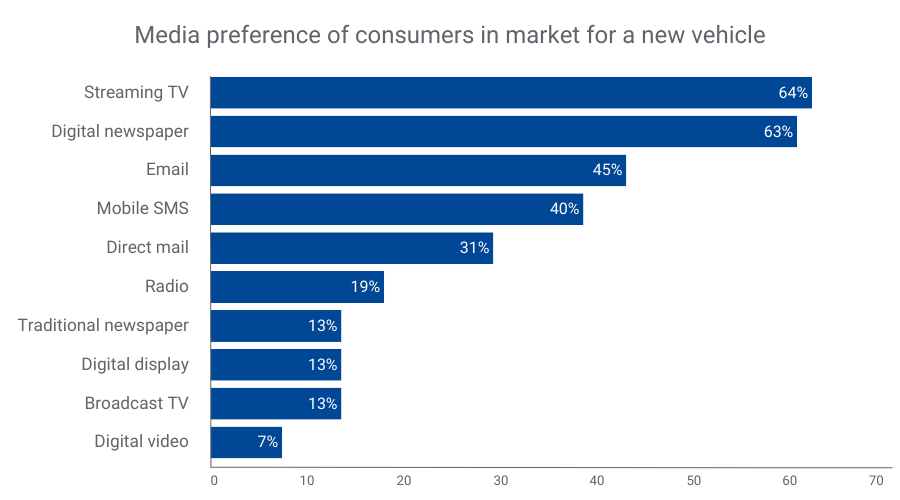
Consumers looking to buy a new vehicle prefer streaming TV, digital newspapers, and email for communication2. By merging our TrueTouchTM engagement channel audiences with our Auto in-market audiences, you can effectively target these consumers through their preferred channels. TrueTouch facilitates personalized advertising campaigns by predicting consumer preferences, ensuring messaging styles align with the right channels and calls to action.
By understanding what types of media people prefer, you can match the best way to talk to them with what to offer, using the right channels for personalized ads. No consumer is the same – and you need to engage with them on their terms to successfully market to them.
Financial
Active in the military
Lifestyle And Interests (Affinity) > Occupation > Military – Active
In-market for a credit union loan
Financial FLA Friendly > In Market Credit Union Loan
40-49 years old
Demographics > Ages > 40-49
30-39 years old
Demographics > Ages > 30-39
Small business owner
Consumer Behaviors > Occupation: Small Business Owners
Health
25-29 years old
Demographics > Ages > 25-29
30-34 years old
Demographics > Ages > 30-34
Weight conscious
Lifestyle and Interests (Affinity) > Health & Fitness > Weight Conscious
Moms interested in fitness
Lifestyle and Interests (Affinity) > Moms, Parents, Families > Fitness Mothers
High spenders at vitamin/supplement stores
Retail Shoppers: Purchase Based > Health and Fitness > Vitamins/Supplements: Vitamins/Supplements
Retail & CPG
Dog owners
Lifestyle And Interests (Affinity) > Pets > Dog Owners
Cat owners
Lifestyle And Interests (Affinity) > Pets > Cat Owners
Fitness enthusiast
Lifestyle and Interests (Affinity) > Health & Fitness > Fitness Enthusiast
Interested in healthy living
Lifestyle and Interests (Affinity) > Health & Fitness > Healthy Living
High spenders at vitamin/supplement stores
Retail Shoppers: Purchase Based > Health and Fitness > Vitamins/Supplements: Vitamins/Supplements
Activate the right audiences with Experian
When you choose Experian’s syndicated audiences, you gain access to over 2,400 audiences that span across 15 verticals and categories. These audiences are directly available for activation on over 30 platforms and can be sent to over 200 media platforms. Experian is ranked #1 for data accuracy (as validated by Truthset) and Experian Marketing Data is the foundation for successful targeting, enrichment, and activation.
For a full list of Experian’s syndicated audiences and activation destinations, download our syndicated audiences guide. Need a custom audience? We can help you build and activate an Experian audience on the platform of your choice.
Check out other seasonal audiences you can activate today.
Contact us
Footnotes
- Fair Lending Act Friendly audiences: “Fair Lending Friendly” indicates data fields that Experian has made available without use of certain demographic attributes that may increase the likelihood of discriminatory practices prohibited by the Fair Housing Act (“FHA”) and Equal Credit Opportunity Act (“ECOA”). These excluded attributes include, but may not be limited to, race, color, religion, national origin, sex, marital status, age, disability, handicap, family status, ancestry, sexual orientation, unfavorable military discharge, and gender. Experian’s provision of Fair Lending Friendly indicators does not constitute legal advice or otherwise assure your compliance with the FHA, ECOA, or any other applicable laws. Clients should seek legal advice with respect to your use of data in connection with lending decisions or application and compliance with applicable laws.
- Experian looked at our Auto and TrueTouch audience data to understand media preference trends over the past year.
Latest posts

Madison Logic partners with Tapad, a part of Experian, to realize attribution across every channel for global B2B marketers
FeaturedB2B marketers can now deliver the right message to the right user at the right time across devices and channels NEW YORK, NY–(Marketwired – Jun 1, 2016) – Madison Logic, one of the world’s fastest growing companies dedicated to solving the digital needs of B2B marketers, is partnering with Tapad, the leading provider of unified and now a part of Experian, cross-screen marketing technology solutions. Now business-to-business (B2B) marketers can power targeted advertising and content syndication programs across all channels, including smartphones, computers and tablets. The increasing shift in content consumption across mobile devices makes cross-device identification and attribution a top priority for B2B marketers. The Madison Logic and Tapad partnership gives B2B marketers unprecedented reach and scale with the ability to run always-on, cross-device, account-based marketing programs targeting decision makers who are actively researching similar products and services. “Screens are everywhere and so is the B2B buyer,” said Vin Turk, SVP of Audience Development for Madison Logic. “This partnership allows marketers to harness the power of Madison Logic’s intent data and combine it with Tapad’s cross-device solutions to connect with the most-likely-to-convert prospects with hyper-relevant content wherever and whenever they’re doing their research.” “Relevance is essential to the success of B2B marketers, particularly now, when breaking through the clutter is difficult,” said Dave Fall, COO of Tapad. “This partnership with Madison Logic allows marketers to leverage their existing customers while identifying and reaching new audiences with messaging tailored to every device.” For more information about Madison Logic’s account-based marketing platform, please visit https://www.madisonlogic.com/account-based-marketing/. For more information about Tapad’s cross-platform advertising solutions, please visit https://www.experian.com/marketing/consumer-sync. Contact us today
NEW YORK, June 1, 2016 /PRNewswire/ — Are Traasdahl, CEO and founder of Tapad, the leader in cross-device marketing technology and now a part of Experian, has been named Founder of the Year by the Nordic Startup Awards. The Nordic Startup Awards’ Founder of the Year Award recognizes an individual that has shown exceptional achievements in fundraising, customer growth, financial savvy, and/or leadership throughout the past year. The Nordic Startup Awards evaluates hundreds of players in the startup ecosystem, ranging from investors and founders, to developers and journalists in Denmark, Sweden, Iceland, Norway and Finland. Taking place in two stages, each country selects its nominees for consideration for the regional awards which were held in Iceland on May 31, 2016. Traasdahl is recognized for his continuous investment in Tapad as a whole, as well as his dedication to growing and developing Tapad since founding the company in 2010. He has led Tapad from startup through a steady period of growth resulting in an acquisition by the Telenor Group for $360 million in February 2016. “I am truly honored to be named Founder of the Year by the Nordic Startup Awards, among so many other remarkable leaders in the space,” said Traasdahl. “That said, this has always been a team effort. We started Tapad with the goal of giving employees unprecedented growth opportunities while developing breakthrough solutions for our clients. This is a win for everyone at Tapad who has committed themselves to these principles over the past four-and-a-half years.” Tapad is reinforcing its commitment to fostering entrepreneurship with the launch of their new Propeller Program. Through Propeller, Tapad will host five early-stage companies at Tapad’s New York headquarters for a year to set them up for global expansion. In its inaugural year, the first participants will come from Traasdahl’s native Norway. For more information on the Nordic Startup Awards, please visit: http://www.nordicstartupawards.com. Contact us today
Tapad, a part of Experian, wins iMedia ASPY awards for Best Customer Service and Best Mobile Partner
FeaturedNEW YORK, May 4, 2016 /PRNewswire/ — Tapad, the leader in cross-device marketing technology and now a part of Experian, has been honored with two iMedia ASPY Awards. Announced on May 3rd at the iMedia Summit in Lost Pines, TX, Tapad’s 2016 ASPY Awards include “Best Customer Service” and “Best Mobile Partner.” In 2015, Tapad’s proprietary technology, Tapad Device Graph™, was named “Best New Media Innovation” and Tapad employee Chris Martin was awarded the “Rising Star Award.” The iMedia ASPY Awards – determined exclusively by agency votes – recognize the industry’s top marketing technology, media companies and publishers for outstanding service to agencies. The award for “Best Customer Service” recognizes Tapad’s client services team and their dedication to helping agencies fully understand their consumers’ behavior and achieve the best cross-screen campaign ROI through Tapad’s Campaign Pulse and TV Pulse analytics reporting. The “Best Mobile Partner” win recognizes the abilities of the Tapad Device Graph™ to deliver unified cross-screen solutions for the company’s partners. “We are privileged to have a talented and dynamic group of people on our client services team, and we are honored to be recognized by iMedia Connection and our agency partners,” said Tapad Founder and CEO, Are Traasdahl. “We have always strived to provide the best solutions and the best customer support, so it’s extremely gratifying to be rewarded for our efforts. If our clients and partners are happy, we are happy.” For more information on the iMedia ASPY Awards please visit: http://aspyawards.com. Read the full press release here. Contact us today