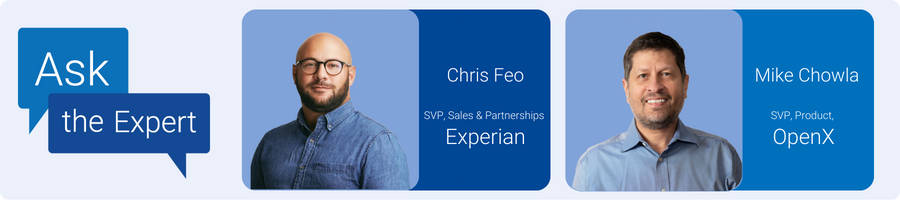
We’re excited to introduce the next segment in our Q&A series, Ask the Expert! Ask the Expert features a series of conversations with product experts where we dive into the areas you care most about like identity resolution, targeting, attribution, and more. Our next segment features a conversation about sell-side targeting.
Mike Chowla, SVP of Product at OpenX joins us to chat with Experian’s SVP of Sales & Partnerships, Chris Feo. OpenX is the world’s leading sell-side platform for audience, data, and identity targeting. In their conversation, Mike and Chris review:
- The shift to targeting on the sell-side
- How first- and third-party data are being used on the sell-side
- How OpenX is thinking about alternative IDs

What is sell-side targeting?
Sell-side targeting optimizes the way buyers and supply-side platforms (SSPs) work together. This approach moves the responsibility of inventory and audience targeting from the demand-side platform (DSP) into the SSP, providing advertisers with increased reach and better performance.
With sell-side targeting, locating your target audience becomes easier as you have a more direct connection with publishers. This increases your ability to scale against a target audience. Specifically, the SSP directly matches the buyer’s audience or data segment to the publisher inventory and audience and automatically sends the impression to the buyer’s DSP of choice via a deal ID, providing advertisers with improved reach and performance metrics as well as control over their inventory. With more direct access, your budget can likely go further, and you can decrease your effective cost per mille (eCPM) and get more working media.
“Supply-side targeting is the next phase of how supply path optimization (SPO) and buyers will need to work more closely with SSPs.” – Mike Chowla, SVP, Product, OpenX
Buying on the sell-side vs. open exchange
When buying on the open exchange, you have access to a vast number of impressions. With sell-side targeting, you can apply your campaign targeting directly on the supply-side and activate those impressions through a deal ID. Sell-side targeting works across various formats including web display, mobile, in-app, and connected TV (CTV) for a seamless advertising experience.
OpenX offers the unique capability to match users using their device graph within their SSP. This means you can target users from traditional data sources such as cookies or mobile ad IDs (MAIDs) and reach them in CTV or app environments. This gives you even more reach and precision in your advertising efforts.
The role of first- and third-party data on the sell-side
Buyers are showing a keen interest in bringing their own first-party data into the process of sell-side targeting. Meanwhile, certain agencies have been actively involved in working with identity and data. OpenX is currently collaborating with several agency ID solutions such as Choreograph, Merkel, and Horizon.
Buyers are also purchasing third-party data and data segments from various providers through OpenX’s platform for sell-side targeting purposes. By utilizing this data on the supply side, buyers are able to increase the match rate against their first- and third-party data segments in all environments. This ultimately maximizes scale against these audiences and drives a more efficient CPM due to eliminating waste.
Measurement and attribution on the sell-side
In the current state of SSP advertising, there is more of an emphasis on targeting capabilities than measurement and attribution. That said, SSPs can provide granular log level reports that can be utilized for multi-touch attribution (MTA) or mixed media models (MMM). These granular insights not only inform measurement and attribution models, but they also provide valuable optimization insights such as clearing price.
Additionally, advertisers have all of the same reporting options that they’re used to getting through their DSP because their buys are activated via deal ID in the DSP of their choice.
What to consider when transitioning to sell-side targeting
There are two primary items you should consider when transitioning to sell-side targeting:
- Supply
- Reach
Reach
Collaborating with partners who have the right capabilities can greatly improve reach and audience extension across different devices. For instance, if you bring your first-party audience or a third-party audience and are identifying that consumer via a cookie or MAID, being able to extend that targeting segment to other devices and platforms can be highly beneficial.
Supply
It’s crucial to collaborate with partners who have the right access to supply and direct connections with publishers. While targeting is essential, it’s equally important to have high-quality supply to drive performance.
Reaching consumers in a cookieless future
Whether you’re targeting on the demand or sell-side, it always starts with the consumer and who you’re trying to reach.
Significant changes in the consumer privacy landscape are impacting advertisers’ ability to access various signals emitted by consumers through their devices and browsers. Recent developments from Apple and Google have further amplified this situation.
Alternative IDs as a solution to signal loss
In response, we’re seeing the emergence of alternative IDs like UID2, Ramp ID, and ID5. OpenX supports these types of IDs and considers them crucial for audience buying in a privacy-centric cookie-less future.
We are still in the early stages of this evolution. While some of the IDs have good coverage, cookies will continue to be the primary targeting method as long as they remain available.
Nevertheless, we see alternative IDs as one of several solutions that will become increasingly important as third-party cookies disappear. Contextual buying will also emerge, and a set of solutions will come together to enable advertisers to keep finding their audience in a cookie-less world.
Overcoming signal loss with identity resolution
Looking ahead, as we continue to lose signals due to the evolving consumer privacy landscape, we will witness two things:
- Continued fragmentation
- A wide variety of identifiers
Content will continue to be available on various devices. We’re currently experiencing the emergence of connected TV, but who knows what other devices will surface over the next five to ten years. As cookies disappear, which have been the primary identifier, and alternative IDs are introduced, the wide variety of identifiers will create further fragmentation. This highlights the need for identity in the future.
Identity resolution at Experian matches fragmented identifiers to a single profile to create a unified, cross-channel view of your consumers. Our identity resolution solutions can help future-proof your marketing strategies.
How Experian and OpenX work together
Experian is a key player in OpenX’s OpenAudience solution and helps to power many of their data segments as well as their identity graph. While OpenX collaborates with a variety of providers and operates a fully interoperable platform, Experian remains valuable to the core technology within OpenX’s SSP.
“Experian powers a lot of the data segments and identity graph that OpenX has in our OpenAudience capabilities as part of our SSP.” – Mike Chowla, SVP, Product, OpenX
Watch the full Q&A
Visit our Ask the Expert content hub to watch Mike and Chris’s full conversation on sell-side targeting. In the Q&A, Mike and Chris also share their thoughts on the impact artificial intelligence (AI) will have on the AdTech industry and their go-to sources for staying up to date on all things AdTech.
Get in touch
About our experts

Mike Chowla, SVP, Product, OpenX
Mike Chowla is the SVP of Product at OpenX where he leads product development and innovation, from customer discovery and user research to the development, delivery, and support of a market-leading product suite. Chowla holds a BS in Engineering from the University of Southern California, and an MBA from The University of Pennsylvania.

Chris Feo, Chief Business Officer, Experian
As SVP of Sales & Partnerships, Chris has over a decade of experience across identity, data, and programmatic. Chris joined Experian during the Tapad acquisition in November 2020. He joined Tapad with less than 10 employees and has been part of the executive team through both the Telenor and Experian acquisitions. He’s an active advisor, board member, and investor within the AdTech ecosystem. Outside of work, he’s a die-hard golfer, frequent traveler, and husband to his wife, two dogs, and two goats!
Latest posts

Global Engineering Team Staffing Up New Oslo Hub; Nordic Operational Team Also Slated for Q1'17 NEW YORK, Jan. 11, 2017 /PRNewswire/ – Tapad, now a part of Experian, the leader in cross-device marketing technology, is opening an office in downtown Oslo, Norway, effective January 16, 2017. This development reflects Tapad's continued growth following its acquisition by the Telenor Group in early 2016. Tapad Oslo will be comprised of a globally-focused engineering team as well as an upcoming operational headquarters for the region. Jeff Olchovy, a senior Tapad developer and one of its earliest employees, will forge the company's Nordic engineering presence by supporting the build-out of the team. The initial hiring plan of more than 20 open positions includes roles such as Head of Engineering, Senior Software Engineers and Solution Engineers. Plans for Tapad's Nordic Region business line, including its leadership, will be announced within the first quarter of 2017. "Given the caliber of technical talent and our extensive network in the region, Oslowas the logical choice at this stage of our growth," says Dag Liodden, Tapad CTO and co-founder. "This enables us to continue building out our innovative team on a global scale in a region that is close to our hearts and minds." In collaboration with its New York-based developers, Tapad's Oslo-based engineers will continue to advance the company's renowned product portfolio, such as the Tapad Device Graph™. An early adopter of Scala and big data processing technologies, Tapad has long been an influencer in U.S. tech. "As the head of our platform group, which daily processes several petabytes of data and is the foundation for all of our real-time systems, Jeff is a highly respected engineer," said Pål Høye, Tapad's senior vice president of engineering. "Given his experience and skillset, he is ideally suited to find and lead an innovative team focused on building the industry-leading products we are known for." About TapadTapad Inc. is a marketing technology firm renowned for its breakthrough, unified, cross-device solutions. With 91.2% data accuracy confirmed by Nielsen, the company offers the largest in-market opportunity for marketers and technologies to address the ever-evolving reality of media consumption on smartphones, tablets, home computers and smart TVs. Deployed by agency trading desks, publishers and numerous Fortune 500 brands, Tapad provides an accurate, unified approach to connecting with consumers across screens. In 2015, Tapad began aggressively licensing its identity management solution, the Tapad Device Graph™, and swiftly became the established gold-standard throughout the ad tech ecosystem. Tapad is based in New York and has offices in Atlanta, Boston, Chicago, Dallas, Detroit,Frankfurt, London, Los Angeles, Miami, Minneapolis, San Francisco and Toronto. Tapad's numerous awards include: EY Entrepreneur of The Year (East Coast) 2014, among Forbes' Most Promising Companies two year's running, Deloitte's Technology Fast 500, Crain's Fast 50, Entrepreneur 360, Digiday Signal Award, iMedia ASPY Award and a MarCom Gold Award. Contact us today
Are Traasdahl, CEO and founder of Tapad, the leader in cross-device marketing technology and now a part of Experian, has been named Founder of the Year by the Global Startup Awards. The Global Startup Awards' Founder of the Year Award recognizes an individual that has pushed the boundaries of technology to empower new innovations and ideas. The Global Startup Awards places each year's regional category winners against each other to determine whose achievements stand out from the rest of the startup ecosystem through nomination, voting and jury evaluation. In May 2016, the Nordic Startup Awards named Traasdahl Founder of the Year. "Are is a force of nature and his creativity and passion know no boundaries, it seems," said George Tilesch, Global Startup Awards juror and U.S. managing partner of Innomine Group. "Extra kudos for the mentoring work and the Norwegian superfund plans. Are knows giving back is of the utmost importance." "Are is a superstar within the Norwegian startup ecosystem," said Kim Balle, founding partner and CEO of the Global Startup Awards. "From the jury feedback I could see that not only are his impressive achievements the reason for their rating, but also his focus and ability to give back to the startup scene played an important factor in him winning the category." "It is an enormous honor to be named Founder of the Year by the Global Startup Awards," said Traasdahl. "I am so committed to fostering entrepreneurship both at Tapad and throughout the startup space. This win is a remarkable bookend for a stellar year that began with our acquisition by the Telenor Group and continued with best-in-class product innovation, superior solutions for our clients and our Propeller Program that is so dear to my heart." Tapad's Propeller Program hosts five early-stage companies at Tapad's New York headquarters for one year to mentor them through global expansion. The participants of this inaugural program come from Traasdahl's native Norway. For more information on the Global Startup Awards, please visit: http://www.globalstartupawards.com/#gsa. Contact us today

NEW YORK, Nov. 29, 2016 /PRNewswire/ — For the second consecutive year, Tapad, part of Experian, has been listed among Deloitte's Technology Fast 500™, a ranking of the 500 fastest-growing technology, media, telecommunications, life sciences and energy tech companies in North America. Tapad, number 147 on the 2016 Deloitte list, is the leading provider of unified, cross-device marketing technology solutions. "It is an honor to once again be recognized by Deloitte for our growth and momentum, particularly given the stature of the other technology companies on the list," said Are Traasdahl, founder and CEO of Tapad. "Our product innovation, particularly in TV analytics and measurement, is a major contributor to our progress. I'm extremely proud of our hard-working, talented team for continually executing at such a high level." "Today, when every organization can be a tech company, the most effective businesses not only foster the courage to explore change, but also encourage creativity in using and applying existing assets in new ways, as resourcefully as possible," said Sandra Shirai, principal, Deloitte Consulting LLP and U.S. technology, media and telecommunications industry leader. "This ingenious approach to innovation calls for the encouragement of curiosity and collaboration both within and outside the office walls." "This year's Fast 500 winners showcase that when organizations are open to diverse perspectives and insights, they are able to create an environment for their employees and customers to see the possibilities and ingenious solutions that might lie ahead," added Jim Atwell, national managing partner of the emerging growth company practice, Deloitte & Touche LLP. "Entrepreneurial environments foster change and innovation within businesses, and we look forward to watching these companies continue to drive change across all sectors." Contact us today