Delivering personalized customer experiences is essential, with 81% of customers preferring a personalized approach to their relationships with brands. However, 80% of consumers are concerned about how their data is used, presenting businesses with the challenge of balancing data collection and privacy with personalization.
Despite consumer appetite for personalization, many organizations lack the data to make data-driven decisions: 68% of businesses don’t understand how their customers think, and 82% don’t confidently know their customers’ pain points.
Without this critical data, businesses cannot effectively create personalized consumer connections. Experian offers businesses robust and unique data through our Marketing Attributes to empower businesses with the insights required to derive accurate insights into consumers and drive personalized experiences.
How Experian can help businesses with their data acquisition needs through Marketing Attributes
Experian’s Marketing Attributes allow businesses to license Experian’s data attributes in part or full to provide reliable and accurate data solutions. These solutions assist companies in finding, reaching, and influencing their customers. They are supported by rigorous quality and privacy controls which has earned Experian a #1 data accuracy ranking by Truthset helping our clients reach people based on who they are, where they live, and what they do.
Experian has built a strong foundation of consumer behavioral and demographic data with over 5,000 attributes available across over 15 categories and verticals, helping our clients gain deep insights into their consumers. Below we go through five common use cases we have seen using Experian’s data to power various business initiatives.
Exploring everyday use cases for Experian’s Marketing Attributes
1. Understand areas of the country where your products or services are underserved
For instance, a brand offers a diverse range of products that cater to various market segments and audience personas. They seek to gain a deeper understanding of geographic distribution to refine their marketing strategies. Specifically, they aim to identify which market areas are currently underserved, presenting a valuable opportunity for targeted marketing campaigns to boost product adoption in regions that have not fully embraced their offerings.
Utilizing Marketing Attributes from Experian, the brand can access detailed data aggregated at the geographic level. This data provides crucial insights into markets where their products have seen limited adoption yet show a strong potential for success based on the preferences of their target audiences. This approach will help the brand strategically direct its marketing efforts to areas with high growth potential.
2. Better understand consumers who purchase within a category
Brands frequently operate based on assumptions regarding their customers’ preferences and interests, yet they may lack the comprehensive data necessary to substantiate these beliefs.
Experian’s Marketing Attributes provides brands with access to extensive data across 15 diverse verticals and categories. This wealth of information allows businesses to develop a holistic understanding of their customer base, enabling them to validate their assumptions and uncover valuable insights into customer behaviors. By utilizing this data, brands can significantly enhance their marketing strategies, refine their product offerings, and implement personalized tactics that resonate with their audiences on a deeper level.
3. Reach a new segment of the market for a new product offering
Introducing a new product to a new segment of the market presents unique brand challenges. Without any historical customer data to draw upon, companies lack vital insights that could help them identify and reach their target audience. This absence of foundational knowledge makes it challenging to understand consumer preferences, craft suitable messaging, or determine the most effective channels for connecting with potential customers.
To navigate these hurdles, brands frequently turn to Marketing Attributes for consumer research within the new segment. Analyzing demographics, common behaviors within a geographic region, or previous purchase behaviors can uncover patterns and preferences among potential customers. This deeper understanding enables them to create tailored audience models, allowing brands to develop and activate customized messaging based on common interests, identify channels consumers are most likely to engage by using TrueTouch data from Experian.
4. Create custom lookalike models based on your current customers
We have found brands trying to launch an acquisition campaign to look at consumers whose behaviors and interests closely mirror those of their highest-converting customers. However, they often lack the necessary data to find new customers that look like their most loyal base.
To address this gap, they turn to Marketing Attributes in combination with Experian’s Offline Graph or Digital Graph, which allow them to pinpoint and analyze the key characteristics and behaviors that define their top customers and reach these consumers on digital or offline channels. Marketing Attributes power the insights into their client’s behaviors and Experian’s Offline or Digital Graph create the linkage to their customer base. Using these insights, the brand can develop a distinct audience model tailored to reflect their most successful customers’ unique traits and preferences. This customized approach will help them reach potential new customers who will likely engage and convert.
5. Develop unique audience products
We have seen clients use their own first-party data alongside Experian Marketing Attributes and other data sets they own or lease. With Experian’s Offline Graph or Digital Graph, they can connect the different data sources together to create a tailored audience solution that meets the specific needs of the brand’s clients and the requirements of their market segment.
Exploring joint solutions
Combining Experian’s Offline Graph with Marketing Attributes
Many customers use Experian’s Offline Graph with Marketing Attributes to connect Experian’s data to the brand’s offline marketing strategy. Experian’s Offline Graph offers companies a license of stable offline data points, like name, address, phone number, email, geographic, date of birth, and more that provide a complete view of household and individual identities.
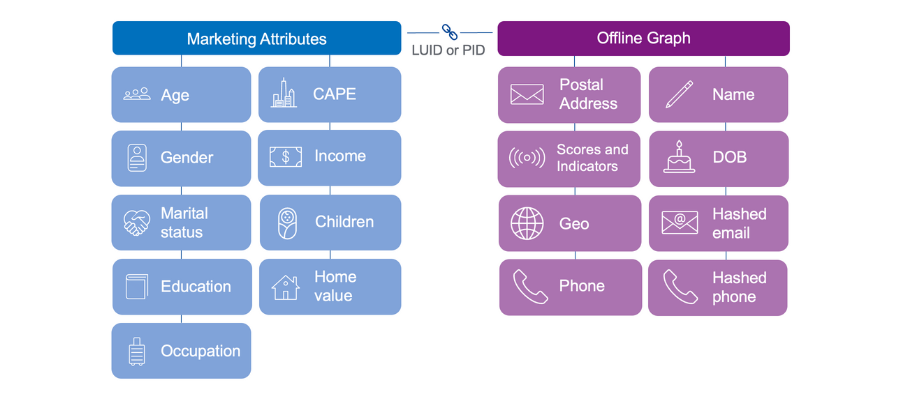
Powering use cases like:
- Regional consumer insights for marketing strategy, media activation, product and location planning
- Offline media activation, including direct mail, telemarketing, out-of-home, and more
- Client-driven enrichment
The combination of Offline Graph and Marketing Attributes provides unmatched consumer connectivity, enabling clients to generate custom insights, inform product strategy, and activate marketing campaigns. Offline Graph acts as the link between consumers insights and activation.
Combining Experian’s Digital Graph with Marketing Attributes
The uncertainty around third-party cookies in Chrome and the overall decline in signal complicates the industry’s ability to reach the right consumer. Omnichannel media consumption results in scattered data, making it harder for marketers and platforms to understand consumer behavior and reach them across channels. These challenges call for a comprehensive solution.
Our Digital Graph and Marketing Attributes solution addresses these challenges by providing identifiers for seamless cross-channel engagement. By adding Marketing Attributes, like demographic and behavioral data, marketers and platforms also gain a better understanding of their customers. This solution uses Experian’s Living Unit ID (LUID) to combine offline and digital data, giving customers deeper insights into consumer behavior, greater audience reach, and improved cross-channel visibility.
Transform insights into loyalty with Experian’s Marketing Attributes
Experian’s Marketing Attributes enable businesses to gain valuable insight into their prospects and customers. Through this deeper understanding, they can deliver personalized experiences while successfully navigating the complexities of data acquisition and privacy. This helpful information allows brands to make strategic, informed decisions that enhance their marketing efforts. Ultimately, these insights foster more substantial, meaningful connections between businesses and their customers, leading to enhanced customer satisfaction.
Get started today
Latest posts
Discover how retail media standardization can streamline your marketing efforts, enhance campaign efficiency, and drive better results.

Discover Experian’s 19 new holiday shopping audiences designed for you to reach the most relevant shoppers this holiday season.

In our Ask the Expert Series, we interview leaders from our partner organizations who are helping to lead their brands to new heights in ad tech. Today’s interview is with Jordan Feivelson, VP, Digital Audiences at Webbula. Jordan is a 22-year advertising industry veteran who has worked for media properties such as WebMD and Disney. Over the past ten years, he has transitioned to the data and programmatic space, including growing the data business for Kantar Shopcom and Adstra. What types of advertisers might benefit from utilizing Webbula audiences across various verticals? Can you provide examples of how different industries successfully leverage your data to achieve specific campaign goals? Most advertisers can leverage Webbula’s award-winning attributes for their activation initiatives. Webbula offers approximately 3,000 syndicated segments covering categories such as Demographics, Automotive, Political, Mortgage, B2B, Hobby/Interest/Lifestyle, and Interests & Brand Preferences (brand name targeting). Audience insights and marketing strategies What specific types of audience segments does Webbula provide? How can advertisers leverage these segments to craft more effective, personalized marketing strategies? Webbula has incredible depth and breadth within its verticals, giving marketers the tools to deliver targeted messaging effectively. Our Demographic, B2B, Mortgage, Automotive, and Interest and Brand Preferences segments each contain 500-1,000 segments, all built on deterministic, self-reported, and individually linked data. We ensure the best accuracy with multiple deterministic data points tied to the real world (ex., first name, last name, postal address, and email address). Some examples of our unique syndicated audience types: B2B: A view of the latest industry trends with detailed cuts of the professional world, such as companies with and not within the Fortune 500 companies and job positions that are directors and below. This also includes custom capabilities, including ABM (list of target companies in an activation campaign or by industry code (ex. NAICS, SIC). Interest and Brand Preferences: Consumers who have shown interest and affinity to hundreds of brands (ex., Nike), genres (ex., comedy, hip hop), sports teams, and more. Mortgage: A detailed view of homebuyers’ purchase range, loan type (ex. jumbo loan, standard loan), mortgage amount, interest rate, and more. With Webbula’s audience data, brands can create a comprehensive picture of their audiences down to the individual level and reach them accurately. Data quality, sourcing, and differentiation How is consumer data sourced and curated at Webbula? Are there data quality standards that Webbula establishes for consumer data, and how do you ensure your sources and methods meet these standards consistently? Webbula’s data is aggregated from over 110 trusted and authenticated sources, including publishers, data partners, social media, and more. The data collected comes directly from consumers who self-report information through surveys and other methods. We apply our hygiene filters to mitigate fraud and accurately score the data. Data Collection: The data collected comes directly from consumers who self-report information through surveys, questionnaires, transactions, and sign-ups. This ensures that brands display ads to audiences based on self-identified, cross-channel behaviors, not modeled assumptions. Hygiene Solutions: Webbula applies multi-method hygiene solutions to mitigate fraud and accurately score the data before onboarding, ensuring that all data meets the highest quality standards. Examples of Data Sources: Questionnaires: Self-reported data through surveys, offer submissions, and telemarketing. Transactions: Deterministic data from aftermarket parts, online purchases or services, and more. Sign-ups: Individually linked data from information entered through sweepstakes, infomercials, newsletters, and forms. What differentiates Webbula’s data from other data providers in the market? Can you explain the unique value proposition that Webbula offers in terms of data depth and breadth? Due to our extensive experience in data cleansing, we provide the most accurate data within the programmatic ecosystem. TruthSet, the leading programmatic accuracy measurement company, has ranked Webbula as having the highest number of top attributes compared to other data providers with 150M+ HEMs. Additionally, Publicis Groupe and Neutronian further validate Webbula’s data quality, underscoring its position as a leader in the industry. Webbula’s data stands out in the market due to its unmatched accuracy and quality, achieved through years of expertise in data cleansing. Unlike other providers, Webbula’s foundation lies in its robust email hygiene process, ensuring that all data entering the programmatic ecosystem is thoroughly cleansed. Privacy, compliance, and future-proofing What measures does Webbula take to maintain data privacy and compliance? How do these efforts benefit advertisers in an evolving regulatory landscape and ensure ethical standards? Webbula was created over a decade ago with a future-proof, privacy-compliant foundation. We understand the industry’s rapid changes, including government and state legislation and cookie depreciation. Our goal has always been to build long-term partnerships and ensure we are prepared for industry changes. We rely on validated offline data sources, making us resilient to external influences. Success stories Can you share success stories where advertisers saw significant campaign improvements using Webbula’s data? What were the key factors that contributed to these successes? Our success is measured by client feedback and increased client spend. Webbula has helped several key advertisers achieve six-figure monthly thresholds by providing the most accurate data to meet campaign KPIs. Clients consistently return to use our data, validating our belief that “the proof is in the pudding.” Thanks for the interview. Any recommendations for our readers if they want to learn more? For those interested in learning more about Webbula, reach out for a personalized consultation. Contact us Latest posts