Loading...

Omnichannel marketing: The path to more connected campaigns

Published: August 21, 2025 by Kimberley Klevstad, Account Director, Retail

Why omnichannel is no longer optional

Marketers aren’t thinking in channels anymore: they’re thinking in audiences.

As consumer media habits have scattered across devices, platforms and formats, brands have shifted their focus from managing one channel at a time to delivering a connected experience. That’s the core of omnichannel marketing: meeting people where they are and making each touchpoint feel like part of a larger narrative.

However, most brands still encounter the same roadblocks: siloed data, fragmented planning and tools that don’t integrate. And while the industry talks a great deal about omnichannel marketing, few are actually doing it well. The brands that figure it out won’t just reach more people; they’ll improve brand perception while improving the customer journey, achieving better outcomes, and optimizing their media spend more efficiently.

Learn more about this trend in our 2025 Digital trends and predictions report.

Why omnichannel is no longer optional

Omnichannel marketing has long been a goal, but recent shifts in media and technology now make it a necessity. According to Forrester, 21% of global B2C business and tech professionals identified enhancing omnichannel or cross-channel customer experiences as a top priority for their organization today.

Connected TV (CTV) and commerce media networks are emerging as dominant channels, necessitating the coordination of messaging across an expanding ecosystem of streaming, programmatic display, and commerce-driven environments in addition to the multitude of other addressable (and non-addressable) channels. Fortunately, identity solutions continue to evolve, enabling marketers to maintain audience addressability in digital channels even as traditional signals decline and privacy regulations intensify.

Consumers expect this kind of cohesion. They don’t see “channels” – they just see a brand. A member of your loyalty program might browse a product online, see the exact item later on their socials, and then receive an email offer. If those messages feel disconnected or out of sync, this will not be a good customer experience, and a brand risks wasting impressions and losing conversions.

Omnichannel isn’t about showing up in more places. It’s about showing up with a consistent message.

The opportunities inherent in true omnichannel execution

Despite the industry’s movement toward omnichannel marketing strategies, there are a few untapped opportunities brands would benefit from pursuing.

Performance optimization icon

Break down planning silos to optimize performance

Many marketers still plan and measure media in silos: programmatic display, CTV, commerce media, search, social, email, SMS, and each might have their own budgets, strategies, and KPIs. This disjointed approach leads to inconsistent messaging, inefficient spend, and overexposure or underexposure to key audiences.

The opportunity? Shift toward integrated media planning and measurement. By aligning teams and KPIs across channels, marketers can optimize frequency, coordinate creative sequencing, and better attribute business outcomes. Breaking down internal silos improves the customer experience and drives more effective performance. With two-thirds of North American CMOs naming siloed data as their biggest obstacle, those who solve it stand to gain a clear advantage.

An icon of a finger pointing at something

Encourage interoperability to activate audiences consistently

Omnichannel success depends on defining an audience once and reaching them everywhere. But in today’s ecosystem, where walled gardens control inventory and many tools remain disjointed, this is easier said than done. Just under a third of marketers say the tools they use don’t work well together.

The opportunity? Invest in interoperable systems that give you control over your data and privacy-safe solutions like clean rooms or universal IDs that enable consistent audience activation across platforms.

Icon of three people

Advocate for a unified identity framework

Audience data remains fragmented: commerce media networks control shopper data, TV platforms hold viewership data, and walled gardens provide limited data transparency and determine which data they will share, making it difficult to recognize, reach, and follow the customer journey across digital touchpoints. Without a unified view, campaigns remain disconnected and cross-channel attribution is difficult.

The opportunity? Advocate for a centralized, privacy-conscious identity framework that bridges fragmented data sources. This would allow marketers to recognize consumers across platforms and deliver cohesive messaging.

Marketers need solutions that enable connected audience activation while respecting privacy requirements and platform-specific constraints. Without this, omnichannel remains an aspiration rather than a reality.

Data and identity: The tools you need in your toolkit to make omnichannel work

Implementing omnichannel right starts with establishing identity. Brands need a foundation that lets them connect the dots: across data, platforms and channels. Here’s how:

Build a unified identity foundation

“A single view of the customer is the foundation of a successful omnichannel program,” says Forrester in a December 2023 report on omnichannel. This begins by connecting disparate data sources, including persistent offline information, such as addresses, emails, names, and phone numbers, with digital signals, in a privacy compliant way. And this, in turn, creates a strong identity foundation. Solutions that integrate hashed email addresses (HEMs), mobile ad IDs (MAIDs), IP addresses, CTV IDs, and universal IDs enable brands to resolve customer identities across different platforms, ensuring that campaigns remain addressable as users transition between channels.

An image that represents a person's offline data - their name, address, and email

Activate audiences everywhere, without the hassle

Brands should be able to define an audience once and activate it across all addressable channels without unnecessary complexity. Interoperability between demand-side platforms (DSPs), supply-side platforms (SSPs), clean rooms, and private marketplaces (PMPs) ensures that high-quality audiences are matched with premium inventory in a targeted, transparent, and efficient manner. This connectivity helps maintain consistent audience targeting—even as consumers engage in different environments. By working with a partner that seamlessly integrates with major platforms, marketers ensure that data quality and identity resolution remain intact throughout campaigns, avoiding data loss that occurs when data is transferred between different, disparate platforms.
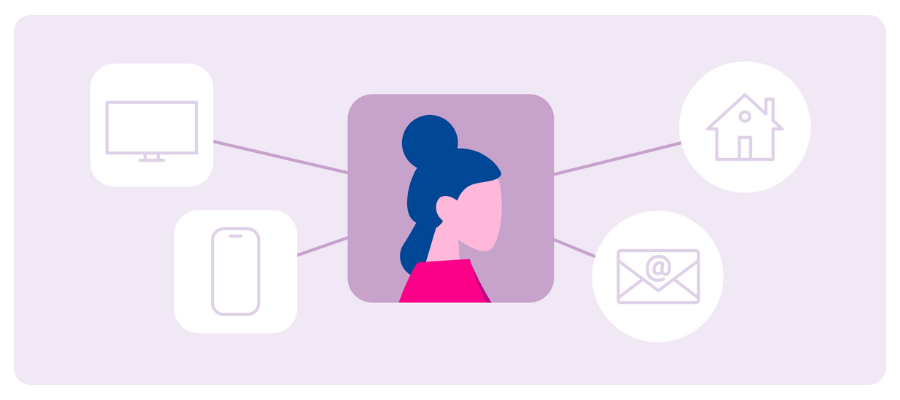
A picture of a woman with four icons surrounding her that represent a TV, cell phone, house, and email

Measure across channels, and the customer journey

Effective omnichannel marketing isn’t just about reaching audiences—it’s about understanding how different touchpoints contribute to conversions. Advanced attribution models, incrementality testing, and cross-platform frequency management enable brands to use consistent identity across campaign planning, activation and measurement so they connect ad exposures to real-world outcomes. Achieving this requires a strong identity resolution partner—one that can unify audience data across environments and power accurate, privacy-compliant measurement at scale.

An icon of a man on the left and a megaphone icon on the right with 3 icons in between them that represent a TV, cell phone, and laptop

The future of omnichannel marketing

Omnichannel is becoming the baseline expectation for modern marketing. The brands that figure out how to connect the dots across the increasingly disparate media landscape will drive better performance and build stronger customer relationships.

By working with a partner that can offer you an end-to-end data and identity solution focused on consumers, not channels, you can better understand your best customers (and your next customers), reach them across channels, and measure cross-channel campaigns more effectively, making true omnichannel execution more achievable.

Get started today

This site is protected by reCAPTCHA and the Google Privacy Policy and Terms of Service apply.


About the author

Kimberley Klevstad, Account Director, Retail

Kimberley Klevstad

Account Director, Retail, Experian

Kimberley Klevstad is 25-year industry veteran with a wide range of experience driving strategic growth for global accounts across print, online, mobile, location-based and streaming audio platforms. Kimberley is currently a member of the Experian Marketing Services Retail team, advising top retail brands on data and identity strategies that will deepen loyalty and drive acquisition in an increasingly competitive landscape.


Latest posts

Loading…
A deep dive with an Experian partner, Infillion

In our Ask the Expert Series, we interview leaders from our partner organizations who are helping lead their brands to new heights in AdTech. Today’s interview is with Ben Smith, VP of Product, Data Products at Infillion. Adapting to signal loss What does the Experian–Infillion integration mean for advertisers looking to reach audiences as signals fade? As cookies and mobile identifiers disappear, brands need a new way to find and reach their audiences. The Experian integration strengthens Infillion’s XGraph, a cookieless, interoperable identity graph that supports all major ID frameworks, unifying people and households across devices with privacy compliance, by providing a stronger identity foundation with household- and person-level data. This allows us to connect the dots deterministically and compliantly across devices and channels, including connected TV (CTV). The result is better match rates on your first-party data, more scalable reach in cookieless environments, and more effective frequency management across every screen. Connecting audiences across channels How does Experian’s Digital Graph strengthen Infillion’s ability to deliver addressable media across channels like CTV and mobile? Experian strengthens the household spine of XGraph, which means we can accurately connect CTV impressions to the people and devices in that home – then extend those connections to mobile and web. This lets us plan, activate, and measure campaigns at the right level: household for CTV, and person or device for mobile and web. The outcome is smarter reach, less waste from over-frequency, and campaigns that truly work together across channels. The value of earned attention Infillion has long championed “guaranteed attention” in advertising. How does that philosophy translate into measurable outcomes for brands? Our engagement formats, such as TrueX, are based on a simple principle: attention should be earned, not forced. Viewers choose to engage with the ad and complete an action, which means every impression represents real, voluntary attention rather than passive exposure. Because of that, we consistently see stronger completion rates, deeper engagement, and clearer downstream results – like lower acquisition costs, improved on-site behavior, and measurable brand lift. To take that a step further, we measure attention through UpLift, our real-time brand lift tool. UpLift helps quantify how exposure to a campaign influences awareness, consideration, or purchase intent, providing a more complete picture of how earned attention translates into business impact. Creative innovation and location insights Beyond identity resolution, what are some of Infillion’s capabilities, like advanced creative formats or location-based insights, that set you apart in the market? One key area is location intelligence, which combines privacy-safe geospatial insights with location-based targeting through our proprietary geofencing technology. This allows us to build custom, data-driven campaigns that connect media exposure to real-world outcomes – like store visits and dwell time – measured through Arrival, our in-house footfall attribution product. We also build custom audiences using a mix of zero-party survey data, first-party location-based segments, and bespoke audience builds aligned to each advertiser’s specific strategy. Then there’s creative innovation, which is a major differentiator for us. Our high-impact formats go beyond static display, such as interactive video units that let viewers explore products through hotspots or carousels, rich-media ads that feature polls, quizzes, dynamic distance, or gamified elements, and immersive experiences that encourage active participation rather than passive viewing. These creative formats not only capture attention but also generate deeper engagement and stronger performance for a variety of KPIs. Future ready media strategies How does Infillion’s ID-agnostic approach help brands future-proof their media strategies amid ongoing privacy and tech changes? We don’t put all our eggs in one basket. XGraph securely unifies multiple durable identifiers alongside our proprietary TrueX supply to strengthen CTV household reach. This agnostic design allows us to adapt as platforms, regulations, and browsers evolve – so you can preserve reach and measurement capabilities without getting locked into a single ID or losing coverage when the next signal deprecates. Raising the bar for media accountability Looking ahead, how is Infillion evolving its platform to meet the next wave of challenges in audience engagement and media accountability? From an engagement standpoint, we’re expanding our ability to support the full customer journey, offering ad experiences that move seamlessly from awareness to consideration to conversion. That includes smarter creative that adapts to context, intelligent targeting and retargeting informed by real data, and formats designed to drive measurable outcomes rather than just impressions. When it comes to accountability, we’re ensuring that measurement is both flexible and credible. In addition to our proprietary tools, we partner with leading third-party measurement providers to validate results and give advertisers confidence that their investment is truly performing. Within our DSP, we emphasize full transparency and log-level data access, ensuring advertisers can see exactly what’s happening on every impression. All of this builds toward the next era of agentic media buying – one enabled by our MCP suite and modular, component-based tools. This evolution brings greater accountability and next-generation audience engagement to an increasingly automated, intelligent media landscape. Our goal is to help brands connect more meaningfully with audiences while holding every impression – and every outcome – to a higher standard of transparency and effectiveness. Driving impact across the funnel What is a success story or use cases that demonstrate the impact of the Experian–Infillion integration? We recently partnered with a national veterans’ organization to raise awareness of its programs for injured or ill veterans and their families. Using the Experian integration, we combined persistent household- and person-level identifiers with cross-device activation to reach veteran and donor audiences more precisely across CTV, display, and rich media. The campaign achieved standout results – industry-leading engagement rates, a 99% video completion rate, and measurable lifts in both brand awareness (3.6 % increase) and donation consideration (13.7% lift). It’s a clear example of how stronger identity and smarter activation can drive meaningful outcomes across the full funnel. Contact us Identity resolution FAQs Why is identity resolution critical for CTV and cross-channel campaigns?  Identity resolution ensures accurate connections between devices, households, and individuals. Experian's Offline Identity Resolution and Digital Graph strengthen these connections for improved targeting and consistent measurement across CTV, mobile, and web.  What strategies help address the loss of cookies and mobile IDs?  Solutions like Experian's Digital Graph enable brands to connect first-party data to household and person-level identifiers, ensuring scalable reach and compliant audience targeting legacy signals fade.   How can engagement translate into measurable results?  Focusing on earned attention (where audiences actively choose to engage) leads to stronger completion rates, improves on-site behavior, and drives measurable increases in brand awareness and consideration.  What makes cross-channel targeting more effective?  By linking CTV impressions to households and extending those connections to mobile and web, Experian's identity solutions ensure campaigns work together seamlessly, reducing over-frequency and improving overall reach. About our expert Ben Smith VP Product, Data Products, Infillion Ben Smith leads Infillion’s Data Products organization, delivering identity, audience, and measurement solutions across the platform. Previously, he was CEO and co-founder of Fysical, a location intelligence startup acquired by Infillion in 2019. About Infillion Infillion is the first fully composable advertising platform, built to solve the challenges of complexity, fragmentation, and opacity in the digital media ecosystem. With MediaMath at its core, Infillion’s modular approach enables advertisers to seamlessly integrate or independently deploy key components—including demand, data, creative, and supply. This flexibility allows brands, agencies, commerce and retail media networks, and resellers to create tailored, high-performance solutions without the constraints of traditional, all-or-nothing legacy systems. Latest posts

Nov 17,2025 by Experian Marketing Services

Audigent, a part of Experian, was named Microsoft Advertising’s Curator of the Year 

Audigent, a part of Experian, was named Microsoft Advertising’s Curator of the Year. The honor recognizes Audigent’s leadership for advancing privacy-safe, sell-side curation that packages high-quality audiences with premium supply for measurable campaign performance. Once only a buzzword, curation has become a mainstream strategy for activating advertisers’ first-party data and streamlining programmatic buying. To recognize this shift and the leaders driving it, Microsoft introduced Curate and established the Curator of the Year award to celebrate excellence in this category. Audigent was recognized for: End-to-end curation from audience planning through activation for outcomes-based, closed-loop programs. Breadth of deal and supply types using unique datasets, real-time supply connections and always-on optimization. Data-driven activation with curation across a large publisher footprint that utilizes Experian marketing data, first-party data, and partner audiences. Audigent’s unique, contextual, and predictive audience data solutions are built into all programmatic media buying. The combination of Audigent’s Real-Time Data and Curation Platform and first-party data, along with Experian identity and optimization, turns real engagement into ready-to-activate audiences. These audiences are available within Microsoft Curate and across omnichannel buying. "Audigent is proud to be named Microsoft Advertising’s Curator of the Year. This is a clear validation of the work our team has done to make curation the new standard in data-driven programmatic activation. We will continue to set the standard by expanding curated deals in Microsoft Curate. This will help maximize efficiency across the bidstream.”Chris Meredith, Head of Supply Side Partnerships Together, Experian and Audigent connect identity to inventory, enabling advertisers to reach the right audiences with precision and scale. By harnessing Experian identity and audience solutions and activating Audigent-curated deals in Microsoft Curate, brands can unlock new levels of efficiency and performance across every programmatic channel. This recognition sets the stage for even greater innovation, collaboration, and results in the year ahead. Ready to design your curated library? Let's connect Latest posts

Nov 06,2025 by Experian Marketing Services

The end of the Wild West in third-party data 

How third-party data has changed and why it matters in 2025 For years, third-party data operated in an expansive, lightly regulated marketplace: fast-moving, high-growth, and filled with players eager to capitalize on digital marketing’s demand for audience insights.   That era is over. Regulatory scrutiny, stricter compliance standards, and rising consumer expectations have already transformed the market. Today, third-party data belongs to partners with proven expertise and built-in compliance. This isn’t a space for opportunistic newcomers; it’s one that rewards long-term commitment and trust.  Even the rapid rise of retail media networks (RMNs) reflects this shift. These platforms are built on long-standing, trusted relationships between brands, retailers, and data partners, utilizing that foundation in new ways to reach audiences responsibly and effectively. The best providers have already made this transition; those still “shifting” are catching up. From growth to governance: A market defined by accountability The third-party data ecosystem has matured. After years of rapid expansion and recalibration, the market has stabilized around a new standard: data quality and regulatory accountability. Third-party data enriches first-party insights with attributes such as income, gender, and interests that round out the customer view. But when the industry grew unchecked, unreliable providers diluted quality and trust. This resulted in a decline in the overall value and reliability of the third-party data marketplace. That breakdown led directly to today’s privacy laws, now active across more than 20 U.S. states and numerous countries worldwide. These regulations reflect a permanent consumer expectation: relevance delivered responsibly. Consumers aren’t rejecting personalization; they’re rejecting how it’s been done in the past. They still want relevant, tailored experiences, but they expect brands to deliver them through ethical, transparent data practices. Does third-party data still matter in a privacy-first era?  Third-party data isn’t disappearing, if anything, it’s become more important. Brands will always need additional insight to deepen customer understanding; first-party data alone only reflects what’s already known. The industry has entered a mature phase where data quality and compliance are table stakes. The companies leading today built their data infrastructure on rigorous standards, regulatory foresight, and transparent governance. That same foundation powers the next wave of innovation, including the explosive growth of RMNs. RMNs rely on responsibly sourced third-party data to enrich shopper insights, validate audiences, and extend addressability beyond their own walls. Trusted data partners make that expansion possible, connecting retail environments with broader media ecosystems while maintaining privacy and accuracy. High-quality, compliant third-party data remains essential because it: Fills knowledge gaps Good third-party marketing data complements first-party insights with demographic, behavioral, and transactional context, providing the missing puzzle pieces to complete the full customer profile.  Improves accuracy Filling in gaps in customer understanding helps you identify, reach, and engage your customers more effectively. This helps improve the delivery of relevant messages and offers to your customers and prospects across channels.  Builds connections Third-party data helps brands build loyalty with consumers by speaking to their interests, and intent behind purchases.  Fuels prospecting Third-party data can help you find your best prospects. By enriching customer files, you can understand who your best customers are, and how to find more of them. By modeling this data, you can determine who your best customers are and source prospects similar to them.  Advancements in AI and machine learning are reshaping how this data is used across the ecosystem. What was once primarily a buy-side tactic is now expanding into the sell-side, where publishers and platforms are using data to curate, package, and activate audiences more intelligently. As AI enhances modeling accuracy and automation, third-party data will play an even greater role in connecting brands and consumers in more meaningful, privacy-conscious ways.  The bottom line: it’s not about having more data; it’s about having better, verified data you can trust. How can you spot a trustworthy data partner?  The strongest third-party data partners demonstrate accountability through experience, infrastructure, and integrity. Swipe right on the perfect data partner Look for providers that: Operate with clear data principles  Trustworthy partners publish and follow codified data principles that guide every step of data handling. Experian adheres to a set of global data principles designed to ensure ethical practices and consumer protection across all our operations. Treat new privacy regulations as routine  For mature providers, evolving privacy laws are routine, not disruptive. At Experian, privacy and compliance have long been built in. Every partner and audience goes through Experian’s rigorous review process to meet federal, state, and local consumer privacy laws. Decades of experience have shaped processes that emphasize risk mitigation, transparency, and accountability. Stay deeply connected  Leading data companies maintain deep relationships with technology partners and industry and regulatory groups to ensure that ethical data practices are put into practice and their customers are aware of platform-specific regulations. Experian's relationships with demand-side platforms (DSPs), supply-side platforms (SSPs), and even social platforms like Meta, ensures we are aware of any platform-specific initiatives that may impact audience targeting. We’re also active participants in many trade groups to ensure that the industry puts ethical data practices in place to ensure consumers still receive personalized experiences but their data usage and collection is opt-in, transparent and handled with their privacy at the center of the transaction. Have a proven track record in the industry  Longevity matters in a regulated and compliance-driven industry. Providers that have thrived through economic cycles and regulatory shifts are the ones equipped for the future. The ability to source high-quality third-party data is core to their business, not an afterthought. Our data is ranked #1 in accuracy by Truthset, giving our clients confidence that every decision they make is backed by the industry’s most reliable insights. Why the future of third-party data depends on accountability  The third-party data industry has already crossed the threshold from expansion to accountability. The companies leading this era have established their credibility through governance and proof. The future belongs to providers that:  Build with regulatory foresight  Maintain rigorous quality assurance  Prioritize partnership over profit The Wild West days are long gone. The third-party data ecosystem is now defined by stability, transparency, and shared responsibility. Partner with Experian for data you can trust and results you can prove  When accuracy and accountability define success, you need a partner built on both. Work with the company that’s setting the standard for responsible data-driven marketing and helping brands connect with people in meaningful, measurable ways.  Get started About the author Jeremy Meade VP, Marketing Data Product & Operations, Experian Jeremy Meade is VP, Marketing Data Product & Operations at Experian Marketing Services. With over 15 years of experience in marketing data, Jeremy has consistently led data product, engineering, and analytics functions. He has also played a pivotal role in spearheading the implementation of policies and procedures to ensure compliance with state privacy regulations at two industry-leading companies. Third-party data FAQs What is third-party data? Third-party data is information collected by organizations that don’t have a direct relationship with the consumer. It supplements first-party data by adding demographic, behavioral, and interest-based insights. Why are privacy regulations reshaping data practices? Privacy regulations are reshaping data practices because consumers expect control over how their information is used. That expectation led directly to today’s privacy laws, now active across more than 20 U.S. states and numerous countries worldwide. These regulations reflect a permanent consumer expectation: relevance delivered responsibly. Consumers aren’t rejecting personalization; they’re rejecting how it’s been done in the past. They still want relevant, tailored experiences, but they expect brands to deliver them through ethical, transparent data practices. Laws like the CCPA and state-level privacy acts enforce this expectation, holding brands and data providers accountable for the ethical use of data. Can brands still use third-party data safely? Yes, brands can still use third-party data safely when sourced responsibly. Partnering with established, compliant providers like Experian ensures both legal protection and data accuracy.  How does Experian ensure compliance with evolving privacy regulations? Experian adheres to a set of global data principles designed to ensure ethical practices and consumer protection across all our operations. At Experian, privacy and compliance have long been built in. Every partner and audience goes through Experian’s rigorous review process to meet federal, state, and local consumer privacy laws. Decades of experience have shaped processes that emphasize risk mitigation, transparency, and accountability. Experian's relationships with demand-side platforms (DSPs), supply-side platforms (SSPs), and even social platforms like Meta, ensures we are aware of any platform-specific initiatives that may impact audience targeting. We’re also active participants in many trade groups to ensure that the industry puts ethical data practices in place to ensure consumers still receive personalized experiences but their data usage and collection is opt-in, transparent and handled with their privacy at the center of the transaction. What should marketers look for in a data partner? Marketers should look for transparency, longevity, and evidence of compliance when looking for a data partner. The best partners can clearly explain how their data is sourced, validated, and maintained. Read Experian's guide on how you can swipe right on the perfect data partner here. Latest posts

Oct 30,2025 by Jeremy Meade, VP, Marketing Data Product & Operations

Subscribe to our newsletter

Enter your name and email for the latest updates

This site is protected by reCAPTCHA and the Google Privacy Policy and Terms of Service apply.

About Experian Marketing Services

At Experian Marketing Services, we use data and insights to help brands have more meaningful interactions with people. As leaders in the evolution of the advertising landscape, Experian Marketing Services can help you identify your customers and the right potential customers, uncover the most appropriate communication channels, develop messages that resonate, and measure the effectiveness of marketing activities and campaigns.

Visit our website

Subscribe to our newsletter

Stay up to date on the latest industry news and receive expert tips from our marketing experts.
Subscribe now!