
Supply-side platforms (SSPs) are expected to deliver more than inventory—they’re being asked to support sell-side targeting strategies, campaign results, and proof of performance. To meet that demand, SSPs need more than access to inventory. They need better data, better tools, and a way to bring it all together.
Experian’s solutions for SSPs
We built Experian’s solutions for SSPs with that demand in mind. By combining identity resolution, audience targeting, and third-party measurement, we help platforms move beyond basic transactions. Whether you’re doing sell-side targeting, supporting direct deals, or looking to support campaign validation, our tools make it easier to create value for buyers—and keep them coming back.
Our solutions that help SSPs:
Together, these capabilities allow SSPs to produce data-driven deals, increase addressability, and meet buyer demand for smarter, more measurable media.
Campaign snapshot: Yieldmo + Experian
Yieldmo, an advertising platform known for its creative formats and data-informed approach, has already put this solution to work. Here’s how they built a custom strategy for a major athletic retail client using Experian’s solutions for SSPs.
The challenge: Drive in-store traffic and reach new buyers
Yieldmo supports a leading athletic retailer’s seasonal campaigns focused on in-store traffic. This advertiser wanted to reach new buyers—specifically those who might otherwise shop with a competitor. To do this, they needed access to strong audience segments with reliable data and the flexibility to act quickly across channels.
This was the first time Yieldmo applied Experian Audiences to this retailer’s campaigns. The stakes were high: the client was looking for better in-store outcomes and a more streamlined activation workflow.
The solution: Experian’s activation solution for SSPs
Using Experian’s Audience Engine, which includes our proprietary and third-party data marketplace, Yieldmo built a flexible, high-performing media plan that spanned display inventory and included both conquesting and primary in-store shopper segments.
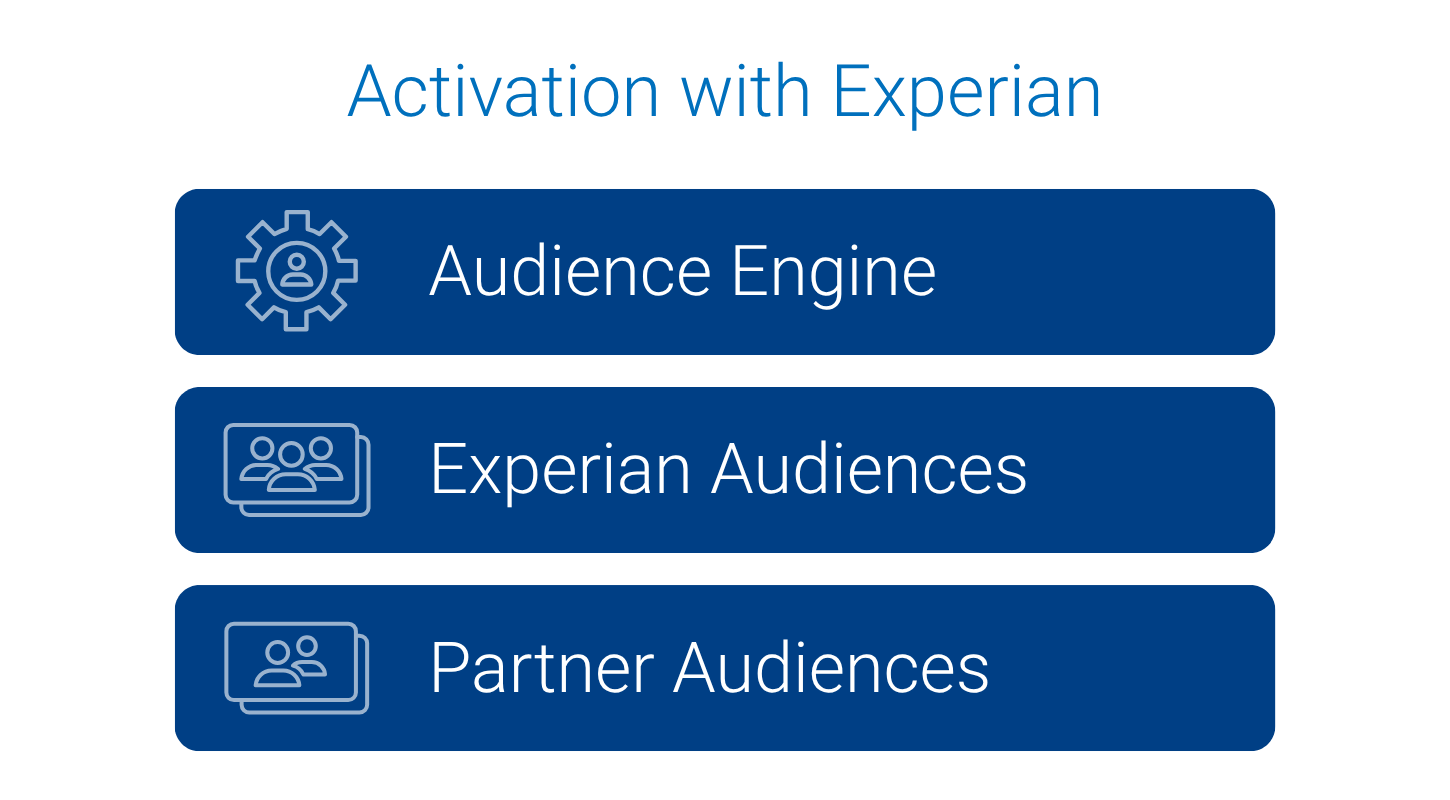
The team selected and activated:
- Apparel and footwear audiences built from Experian and partner data providers
- In-store shopper segments targeting retail behavior signals
- Competitive purchasers to capture likely buyers from other athletic brands
Our data marketplace allowed Yieldmo to combine Experian Audiences with Partner Audiences from providers like Alliant, Circana, Sports Innovation Lab, and Webbula—all in one place. Manual audience creation used to take days. Now, Yieldmo can build and activate campaigns through a streamlined, self-serve workflow.

By working in the Audience Engine platform, Yieldmo was able to avoid multiple contracts and manual requests. They filtered audiences by brand, tailored segments to their goals, and launched without delays.
“Experian’s data marketplace in Audience Engine fills a critical gap—letting us quickly search by brand, build smarter conquest segments, and activate custom audiences fast.”
Abby Littlejohn, Director of Sales Planning, Yieldmo
The results: Expected lift in store visits
While final in-store lift results are pending, the early performance metrics are promising:
- Click-through rates are at and above historical benchmarks across both conquesting and primary shopper segments.
- Using Audience Engine’s self-serve tools, Yieldmo created audiences faster and more easily.
- They reduced their workload by minimizing the need for manual data wrangling.
“We include Experian audience segments in 80% of formal RFPs. Between contract simplicity, data quality, and campaign results, Experian has become our go-to for third-party audience targeting.”
Nelson Montouchet, AVP, Strategic Partnerships, Yieldmo
Bring this to your platform
Whether you’re looking to monetize more effectively, build deeper advertiser relationships, or stand out with sell-side targeting offerings, we designed Experian’s solutions for SSPs to do exactly that.
With our industry-leading Digital Graph, over 2,400 syndicated audiences, partner data, flexible self-serve tools, and outcome-based measurement, SSPs can now move faster and go further—without compromising scale or precision.
Get in touch with our team
Latest posts

Tapad, now a part of Experian, announces The Propeller Program to boost early-stage entrepreneurs
FeaturedFive Norwegian startups selected to establish U.S. presence NEW YORK, Aug. 15, 2016 /PRNewswire/ — Tapad, the leader in cross-device marketing technology and now a part of Experian, has announced its new entrepreneurial mentorship initiative, the Propeller Program. Five early-stage startups from Norway have been chosen by Are Traasdahl, native of Norway and Tapad’s CEO and founder. The selected companies will share Tapad’s New York City workspace, receive C-level guidance and help establish a U.S. presence. The following companies have been selected to participate in the inaugural Propeller Program – a 12-month program beginning September 19, 2016: Bubbly – Developers of a platform that enables in-store customer feedback with dashboards and tools that facilitate real-time store response BylineMe – A marketplace for freelancers, publishers and brands to connect for content creation and distribution services Eventum – A property-sharing group that digitally assists in securing venues for meetings and corporate events Xeneta – A database that organizes the best contracted freight rates in real time and on demand “We are supporting startups that we feel represent the future of service offerings,” said Traasdahl. “It is with incredible pride that we invite these entrepreneurial teams from Norway to join us in New York Citythis year. Mentorship opportunities for early-stage companies are so important, particularly for those based outside the U.S. I look forward to giving the Propeller Program participants access to the expertise of my seasoned team and to our wide network of resources. Hopefully, it will be a game-changing year for many of them.” Contact us today
Tapad, a part of Experian, enters Asia Pacific to service regions’ rapidly expanding marketing technology sector
FeaturedAs partnership deals mount, aggressive hiring underway for unified cross-screen technology leaders NEW YORK, July 19, 2016 /PRNewswire/ — Tapad, the leader in cross-device marketing technology and now a part of Experian, has announced plans for aggressive expansion in the Asia Pacific (APAC) region. This move capitalizes on Tapad’s exceptional performance for brands and marketing technology companies in North America and Europe. With it’s proprietary Tapad Device Graph™, the company will enable global, regional and local clients and partners to understand, monetize and measure marketing to users across screens. The Tapad Device Graph is recognized as the most accurate, scalable cross-screen solution in the market today. The decision to expand into APAC was based on increased demand from global, as well as local, brands and clients, many of which have a strong market presence throughout the region. In addition to expanding its roster of world-class data partners, plans include building a world-class team in Singapore. Over the next few months, Tapad APAC will also establish local entities in additional markets. To accelerate its ramp-up, Tapad APAC is actively recruiting in many areas, ranging from skilled and experienced solutions engineers to seasoned sales and marketing professionals. “Tapad is thrilled to be answering the call for cross-device excellence in APAC,” said Pierre Martensson, GM of Tapad APAC. “Our Device Graph is adding millions of devices daily and achieves unmatched levels of scale and accuracy while protecting consumer privacy. This meets a critical need in the region.” Tapad appointed Martensson as General Manager of Tapad APAC in May, kicking off expansion in the region. Martensson comes to Tapad with nearly a decade of operations experience throughout APAC, having transformed, developed and grown global organizations. To learn more about partnership and employment opportunities available with Tapad in APAC, visit www.experian.com/careers. Contact us today
Tapad, a part of Experian, and Conversion Logic provide a better understanding of customer journey
FeaturedCombined technology gives marketers an enhanced view of the customer for improved planning, targeting and optimization NEW YORK, July 12, 2016/PR Newswire/ – Tapad, the leader in cross-device marketing technology and now a part of Experian, today announced a partnership with Conversion Logic, the martech industry’s most accurate unified marketing attribution provider. Conversion Logic will incorporate unified cross-screen data from Tapad’s Device Graph™ to identify related devices and media exposures to enhance reporting on the path to conversion. By connecting Conversion Logic’s proprietary Ensemble Method, which combines numerous state-of-the-art machine learning algorithms, tuned for each customer use-case for the most accurate results, with Tapad’s unified, cross-device technology, marketers will benefit from a highly scientific approach to assessing advertising effectiveness with full, comprehensive customer insights. Linking these technologies will increase marketers’ real-time ability to optimize brands’ marketing channel spend and creative at a more granular level. During the past six months, Tapad has rapidly grown its data business, doubling the number of companies integrating the Device Graph™ into their platforms and growing the annualized revenue run rate by 210%. Tapad’s highly scalable, cross-device data has been confirmed by Nielsen to be very precise. Tapad augments platforms’ and publishers’ tech stacks with additional scale and relevancy, granting advertisers amplified targeting and analysis options. The growth of the Device GraphTM has allowed Tapad to provide a growing network that benefits all partners with more efficient, effective consumer engagement. “Combining highly accurate data from Tapad with our own user ID technology and understanding how devices may be related at an individual level provides additional visibility into the path to conversion,” said Alison Lohse, COO and co-founder of Conversion Logic. “The more we know about the customer journey, the more effective, efficient and customized marketers can be with marketing efforts. With Tapad, we have achieved a unified customer view that helps us piece together the purchase journey while preserving proven accuracy.” “Conversion Logic’s Ensemble Method delivers singularly customized and precise results that are not just accurate, but actionable,” said Dave Fall, COO of Tapad. “The combination of powerful technology and a user-friendly interface, plus Tapad’s ability to only consider relevant and scalable components in the marketplace, creates a more concentrated and beneficial environment for both its partners and clients.” Contact us today