
Audio platforms that overcome consumer identity challenges are winning new advertisers and driving higher ROAS. In this article, you’ll hear from leading audio platforms that are solving these challenges—and seeing results.
Digital audio is evolving fast. What was once a niche channel of host-read sponsorships and direct buys is now a must-have in the modern media mix. Streaming platforms, podcasts, and digital radio are drawing more ad dollars thanks to audio’s ability to capture attention and connect with listeners.
But with growth comes new pressure. Advertisers expect accuracy, scale, and to see results. At the same time, listeners want more relevant content and more personalized ad experiences. That’s where identity becomes essential.
With Experian’s identity and audience solutions, audio platforms can:
- Bolster addressable audience targeting and personalization capabilities.
- Gain a comprehensive view of listeners’ digital identity to reach audiences across channels.
- Better understand consumer preferences, enabling advertisers to reach audiences with greater accuracy.
- Enhance the listening experience with more relevant content.
Let’s break down the key challenges in audio—and how Experian can help solve them.
Challenge 1: Anonymous listening limits addressability
Most listening happens in environments where people aren’t logged in—via apps, smart speakers, and mobile devices. Without logged-in data, platforms struggle to know who’s listening and advertisers are unable to reach those anonymous listeners who don’t have an addressable ID.
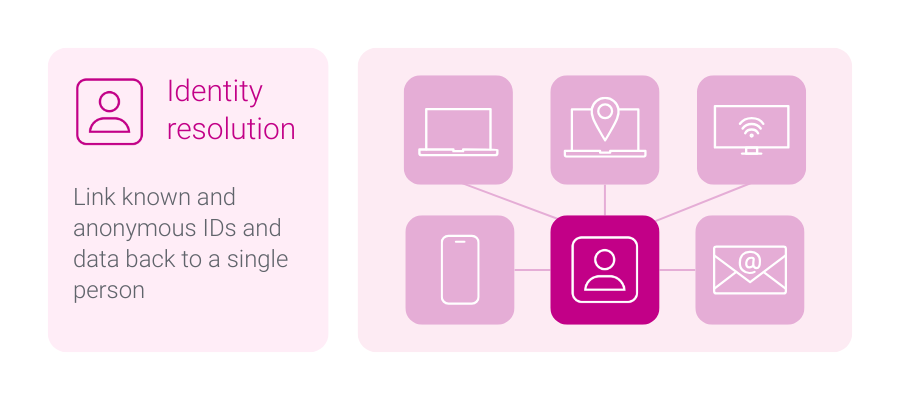
To overcome the identity gap in unauthenticated listening environments, leading audio platforms are turning to partners that connect fragmented signals—like device type, location, and behavioral patterns—to broader household and individual profiles. By using hashed emails and other alternative identifiers, platforms can begin to make anonymous sessions more addressable. This increase in addressability ensures the platform’s entire userbase can be reached, which leads to an increase in revenue.
Experian’s solution
Experian’s identity spine, comprised of our Digital and Offline Graphs, helps you recognize listeners even when they’re outside your ecosystem. Platforms like Audacy are already leading the way. By integrating Experian’s Digital Graph, they’re gaining a more complete view of listeners’ digital identifiers—enhancing the experience across their app and website. With a better audience understanding, Audacy can deliver personalized content while helping advertisers reach specific groups with greater accuracy.
Challenge 2: IP-based targeting falls short
Audio has traditionally relied on IP addresses, but that’s no longer enough. A single IP could represent an entire household—or a public setting like a coffee shop. It’s not precise.
Forward-thinking platforms are moving beyond IP-based targeting by integrating identity resolution technologies that combine household-level data with device-level intelligence. These solutions help distinguish between shared devices and individual listeners, allowing advertisers to serve more relevant messages without over-reliance on a single signal like an IP address. This layered approach improves precision—especially in dynamic listening environments like vehicles or communal spaces.
Experian’s solution
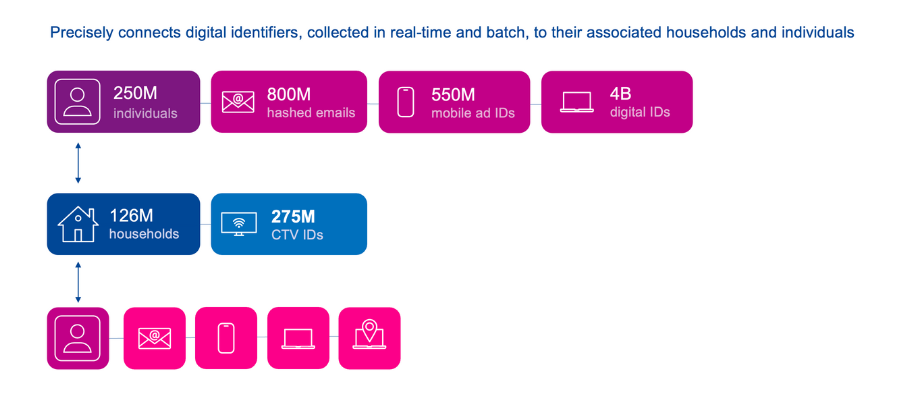
Our identity spine links home IPs to households, then connects them to specific devices and individuals. This helps platforms move beyond basic IPs and target real people based on accurate signals—even in shared listening environments like smart speakers and cars.
We also help platforms and advertisers integrate alternative IDs—like Unified I.D. 2.0 (UID2)—into their programmatic audio campaigns. That means more reach, without compromising consumer trust.
Challenge 3: Audio buying is fragmented
From podcasts to streaming to radio, audio lacks consistency in how inventory is packaged and bought. It’s hard for advertisers to run scaled campaigns across channels—and harder still to measure performance.
Plus, advertisers don’t think in silos—they think in strategies. If audio can’t connect to their display, connected TV (CTV), and social buys, it loses ground. What they need is a way to define audiences once and activate everywhere.
To reduce friction in audio ad buying, platforms are investing in infrastructure that unifies audience insights across formats. By building a centralized view of the listener—regardless of whether they’re tuning in via podcast, stream, or radio—publishers can offer advertisers consistent targeting parameters, clearer reporting, and better campaign orchestration. Identity graphs and audiences are playing a growing role in streamlining this complexity and unlocking scale.
Experian’s solution
Experian helps simplify audio buying. Experian audiences are built on top of our identity graph and are expanded to a deep set of digital identifiers, ensuring accuracy, scale and maximum addressability across channels. Platforms can blend their first-party data with advertiser data and our audiences—then deploy those audiences onsite or activate programmatically across open web and CTV.
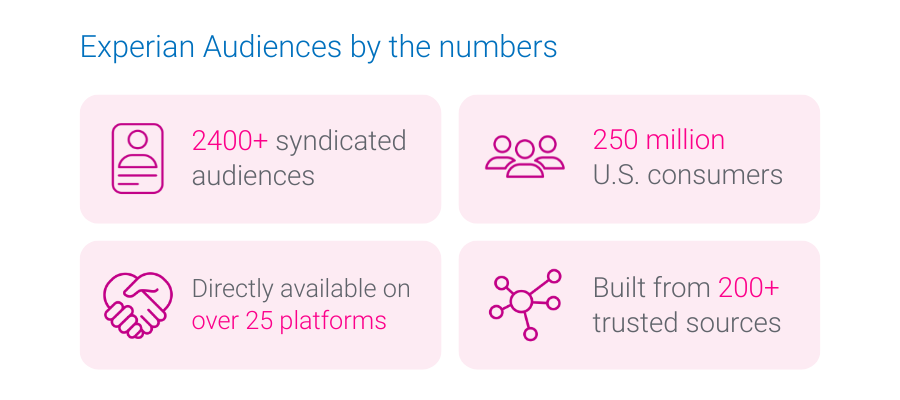
DAX is doing just that. DAX’s partnership with Experian combines Experian’s 2,400+ audiences for targeting and activation with DAX’s innovative audio advertising approach. We’re helping advertisers connect with passionate and engaged listeners nationwide.
“Through our partnership with Experian Marketing Services, advertisers can unlock deeper audience insights and execute more impactful digital audio campaigns. By combining our shared market presence, knowledge, and forward-thinking approach, we’re strengthening our digital audio network offering and delivering value to all our advertising partners.”
Brian Conlan, President of DAX United States
Watch our identity-driven audio panel from our Curated Couch at CES 2026
In addition to integrating Experian’s Digital Graph, Audacy is also integrating Experian’s syndicated audiences to unlock accurate insights like demographics, shopping behavior, and interests – providing listeners with a more personalized advertising experience and advertisers with a higher return on investment.
Privacy is non-negotiable
Everything we do is privacy-forward by design. Backed by Experian’s Global Data Principles and decades as a regulated institution, we rigorously vet every data source to ensure compliance with all federal and state laws.
Build an audio strategy that performs with Experian
Your advertisers want more from their audio investments. With Experian, you can give it to them. We help you:
Audio has always been a powerful way to connect. Now, it’s ready to perform.
Let’s connect
Latest posts

Cross-screen marketing tech firm, Tapad, drove unified campaign; partnered with Statiq to measure cross-screen impact on in-store visits LONDON, March 8, 2016 /PRNewswire/ — Carat North completed the UK’s most comprehensive digital campaign with Tapad, the leader in cross-device marketing technology and now a part of Experian. Coupled with location-based audience data from Statiq, this marks the first time a UK-company has measured the impact of unified, cross-screen campaign on in-store visits. Carat North served display and video ads to grocery shoppers for the leading retailer ASDA from August through October. During the campaign, Tapad utilized Statiq’s audience data to measure which users visited a store after being exposed* to the campaign’s ad on multiple devices. The digital campaign demonstrated a lift of 59% for in-store visits when users were exposed to ads on three devices over people who were shown an ad only on onescreen. Those who engaged with the ad were also 411% more likely to visit an ASDA store. Of those who were exposed to an ad, 248% were more likely to visit a store. Impressions served to mobile devices saw the highest success rate with an in-store visit lift of 67%. The campaign leveraged Tapad’s proprietary technology, The Device Graph™, which Nielsen confirmed Tapad’s cross device accuracy to be 91.2%, to serve ads sequentially on connected devices belonging to the same user. CARAT NORTH: “The ability to know which devices belong to our customer, coupled with the ability to deliver the right ad, and right message, wherever they are and on whatever device they’re using, has been something this industry has long needed,” said Steve Thornton, Digital Account Manager, Carat North. “We’re impressed with the results that have come from the work with Tapad and Statiq for this media-first, and look forward to continuing to offer these solutions to clients like ASDA. Matching unified cross-device capabilities with real insights on campaign performance is an invaluable advantage in the marketing world.” TAPAD: “This campaign is a perfect example of the capabilities of cross-device advertising,” said Are Traasdahl, Founder and CEO, Tapad. “In addition to reaching users across devices, we’re able to analyze campaign results and determine how different combinations of ad exposure, creative type or view frequency affected their decision to visit a location.” STATIQ: “As a location data specialist, Tapad is our ideal partner – they are an industry leader and by working with them we are able to determine the impact unified messaging has on real world consumer behaviours,” said Dean Cussell, Co-Founder of Statiq. “We believe this type of analysis will significantly aid brands in optimising future ad spend.” About Carat North Carat North is a leading independent media planning & buying specialist in digital and non-traditional media solutions. Owned by global media group Dentsu Aegis Network, the Carat network is more than 6,700 people in 130 countries worldwide across 170 cities. Carat defined the sector when established as the world’s first media independent in 1968 and is now Europe’s largest media network, a position held for more than 15 years. For more information visit www.carat.co.uk About Tapad Tapad Inc. is a marketing technology firm renowned for its breakthrough, unified, cross-device solutions. With 91.2% data accuracy confirmed by Nielsen, the company offers the largest in-market opportunity for marketers and technologies to address the ever-evolving reality of media consumption on smartphones, tablets, home computers and smart TVs. Deployed by agency trading desks, publishers and numerous Fortune 500 brands, Tapad provides an accurate, unified approach to connecting with consumers across screens. In 2015, Tapad began aggressively licensing its identity management solution, the Tapad Device Graph™, and swiftly became the established gold-standard throughout the ad tech ecosystem. Tapad is based in New York and has offices in Atlanta, Boston, Chicago, Dallas, Detroit,Frankfurt, London, Los Angeles, Miami, Minneapolis, San Francisco and Toronto. TechCrunch called the powerhouse Tapad team “a hell of a list of entrepreneurs who created some of the most valuable online advertising companies of the last decade.” Among Tapad’s numerous awards: EY Entrepreneur of The Year (East Coast) 2014, among Forbes’ Most Promising Companies two year’s running, Deloitte’s Technology Fast 500, Crain’s Fast 50, Entrepreneur 360, Digiday Signal Award, iMedia ASPY Award, and a MarCom Gold Award. Read the full release here. *Tapad utilized Statiq’s audience data to measure which users visited a store during, or within one month of, being exposed to the campaign’s ad on multiple devices. Contact us today
Welcome emails garner 86 percent higher open rates than regular promotional mailings. What other life cycle marketing programs should you be running?
If information is accurate when collected, loyalty programs have a better chance at engaging consumers and actually seeing the benefit that a loyalty program can provide.