At A Glance
First-party data delivers its greatest value when marketers can activate it. Leading brands are moving beyond data collection by connecting, enriching, and activating their first-party data across channels. With identity as the foundation, first-party data activation improves relevance, efficiency, and measurement. Experian helps marketers turn static records into scalable audiences that perform across media.In this article…
What is first-party data?
First-party data is consented information a brand collects directly through interactions with customers and prospects across its owned touchpoints — unlike third-party data, which is licensed or aggregated from external providers. First-party data can include customer relationship management (CRM) records, purchase history, loyalty program activity, website and app behavior, email engagement, and other information generated through the brand’s relationship with its audience.
In the activation context, first-party data can help you build addressable audiences for paid and owned channels. Identity resolution connects fragmented records and identifiers, enabling more consistent audience creation, activation, and measurement across the media ecosystem. This is likely why, in 2026 and beyond:
- 70% of B2B marketers plan to increase their use of first-party data, more than any other data strategy.
- 67% of brands and 80% of publishers expect to grow their first-party data sets in the next year.
First-party data vs. zero-party, second-party, and third-party data
While it’s often the foundation of an activation strategy, first-party data isn’t the only useful data type. Depending on the campaign goal, other data sources can add declared preferences, extend reach beyond known customers, or provide helpful context for targeting and modeling.
- Zero-party data is information that customers intentionally and proactively share with a brand, such as interests, purchase intentions, or survey responses. It tends to be narrower in scale and coverage than first-party data, but it can still help you personalize messaging and experiences to customers’ stated needs.
- First-party data is what a brand collects through direct customer interactions and observed activity, such as account activity, responses to brand campaigns, customer service encounters, and so on. It helps you build known audiences, suppress existing customers, and support lifecycle and cross-channel campaigns.
- Second-party data is another organization’s first-party data shared through a direct partnership. It can extend audience reach beyond a brand’s known customer base or enrich existing profiles with complementary partner data, while maintaining a connection to the original data source.
- Third-party data comes from external providers and can add demographic, behavioral, lifestyle, and other insights. It helps you enrich first-party audience data, extend reach, support prospecting, and build modeled audiences at a greater scale.
First-party data tends to be the strongest starting point for activation since it provides a broader view of a brand’s direct customer relationships.
Why does activation expand the value of first-party data?
On its own, first-party data can reveal who customers are, how they behave, and what they value. It supports insight, personalization, and engagement through owned touchpoints. But in 2026, you can expand that value by activating first-party data across owned and paid media channels. Activation is how existing data investments scale beyond CRMs into broader audience strategies.
When you resolve fragmented records and create addressable audiences, you can put audience insights to work at a greater scale. However, the value you unlock through activation depends on the quality of the data beneath it. Incomplete, outdated, or duplicate records can weaken match rates, audience accuracy, and measurement.
Accurate data and persistent identity resolution, on the other hand, help you reach the right audiences, reduce waste, and connect activation to outcomes. Once you have a strong data and identity foundation, the next step is activating it across the ecosystem.
How are marketers shifting from data collection to data connection?
As signals fragment, marketers are shifting from data collection to data connection to make first-party data usable across channels. We support this shift by helping you onboard and resolve your data into a clean, connected foundation using our identity graphs.
Connecting offline and online interactions allows you to unify customer data across touchpoints to make it actionable. That connection enables a wider range of use cases, from audience activation and measurement to personalization and cross-channel optimization.
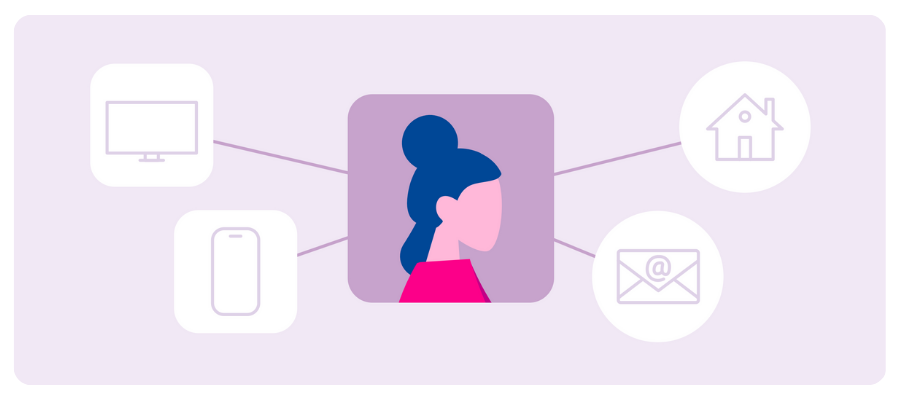
With our identity foundation in place, first-party data becomes more widely usable. You can enrich your first-party data with behavioral, demographic, and lifestyle insights from trusted partner data, then activate it across social, programmatic, and TV from a single environment.
Common challenges in first-party data activation
While building a connected foundation can make first-party data more broadly useful, several factors can also make that foundation difficult to build and maintain, determining how effectively you can activate first-party data across channels.
Disconnected data silos
First-party data often lives across CRM systems, point-of-sale platforms, email tools, websites, apps, and analytics environments. Without a shared identity foundation, those systems may treat the same customer as multiple people, which makes it challenging to create a consistent audience view or coordinate cross-channel activation. We help connect fragmented online and offline signals through identity resolution to give you a more unified data foundation for audience creation, activation, and measurement.
Incomplete or outdated records
Customer data changes over time. Email addresses become inactive, contact details change, and behavioral signals lose relevance. Without ongoing data maintenance and identity resolution, match rates can decline, reducing the accuracy of activated audiences and measurement.
Inconsistent identifiers across channels
Various platforms rely on different identifiers, so a customer recognized in one environment may not be recognized in another. Identity resolution helps connect fragmented signals, reduce duplicate profiles, and improve consistency throughout the activation process.
Limited reach and audience scale
A brand’s first-party data may not be extensive or detailed enough to support every campaign objective. Experian’s Enrichment can add demographic, behavioral, and lifestyle attributes to help you better understand known audiences and create more informed segments. When you need to reach beyond your existing customer base, our syndicated audiences can help extend prospecting reach with relevant, privacy-forward audience data.
Privacy and governance requirements
Activating first-party data requires you to account for permissions, opt-outs, data-use policies, and applicable privacy regulations. Building those considerations into the activation process from the start helps you maintain control of your data while supporting responsible use across partners and platforms.
Fragmented measurement
It can be difficult to connect media exposure and outcomes when audience identity varies across activation and measurement environments. A consistent identity foundation helps link the audiences you activate with the outcomes you measure, supporting more complete, cross-channel performance measurement.
The importance of first-party data in media planning
As media environments fragment, first-party data gives you a more durable foundation for planning audiences, personalizing campaigns, and measuring performance.
At the same time, first-party data isn’t the only input to an effective media strategy. You can combine it with trusted partner and syndicated data to enrich known audiences, extend reach, and fill gaps in your customer insights. We help make those data sources more usable across activation and measurement environments with a consistent identity foundation.
2026 Digital trends and predictions report
Our 2026 Digital trends and predictions report reveals five trends that will define 2026. From curation becoming the standard in programmatic to AI moving from hype to implementation, each trend reflects a shift toward more connected, data-driven marketing. The interplay between them will define how marketers will lead in 2026.
What business impact does first-party data activation deliver?
First-party data activation can improve campaign efficiency and performance by helping you reach more relevant audiences, reduce wasted media spend, and connect marketing activity to measurable business outcomes. It also helps you use existing customer relationships more strategically — for example, by suppressing current customers from acquisition campaigns, personalizing outreach, and prioritizing audiences that are more likely to respond.
That shift can have a meaningful business impact. Research suggests that activating first-party data can reduce customer acquisition costs by up to 50% and drive a 10–15% lift in revenue by helping you prioritize more relevant audiences and avoid spending against people you already know or are unlikely to convert.
Those outcomes depend on making first-party data usable beyond the CRM. When fragmented records are connected into more complete, addressable audiences, you can apply customer insights more consistently across planning, targeting, personalization, activation, and measurement.
Audience Engine helps you put this strategy into practice by bringing together first-party data, audience insights, and activation in a single workflow. You can build custom audiences, activate them across 200+ platforms, and use 3,500+ syndicated audiences and partner data to enrich your strategy or extend reach when needed.

Key channels and strategies for first-party data activation
To drive business impact, you need to activate addressable audiences in the places where you reach and engage customers. First-party data activation can support both paid media and owned experiences. The right mix depends on your audience, campaign objective, available identifiers, and the platforms you use to reach and measure customers.
Email and direct mail
Email and direct mail are core first-party activation channels for retention, loyalty, and lifecycle marketing. You can use customer data to tailor messages, suppress irrelevant outreach, and coordinate communications based on purchase history, engagement, or customer status.
Programmatic display
When you onboard first-party audiences to compatible programmatic platforms for targeting, suppression, and measurement, you can extend customer insights into paid media, reduce wasted spend on existing customers, and support more relevant prospecting strategies.
Connected TV
Identity-resolved first-party data can support audience activation across compatible connected TV (CTV) environments. This gives you another way to reach customers and high-value prospects with more relevant messaging while connecting household-level exposure to broader campaign measurement.
Social platforms
First-party audiences can be matched to supported social platforms for targeting, suppression, audience expansion, and measurement. Used alongside platform signals, first-party data gives you more control over who you reach and how campaigns align with existing customer relationships.
Modeled audiences and prospecting
Use high-value first-party segments, such as repeat purchasers or high-lifetime-value customers, as the foundation for modeled audiences. Partner and syndicated data can add scale and context, helping you identify new prospects who share characteristics with your best customers.
Owned websites and apps
Activation isn’t limited to paid media. First-party data can also inform personalized website and app experiences, product recommendations, offers, and messaging based on known customer behavior and preferences.
The best activation strategies connect these channels through a consistent identity foundation, helping you coordinate audiences, reduce duplication, and support more consistent measurement.
What should marketers plan for first-party data activation in 2026?
Once you know where first-party audiences can be activated, the next question is how to build an activation approach that can scale across those channels.
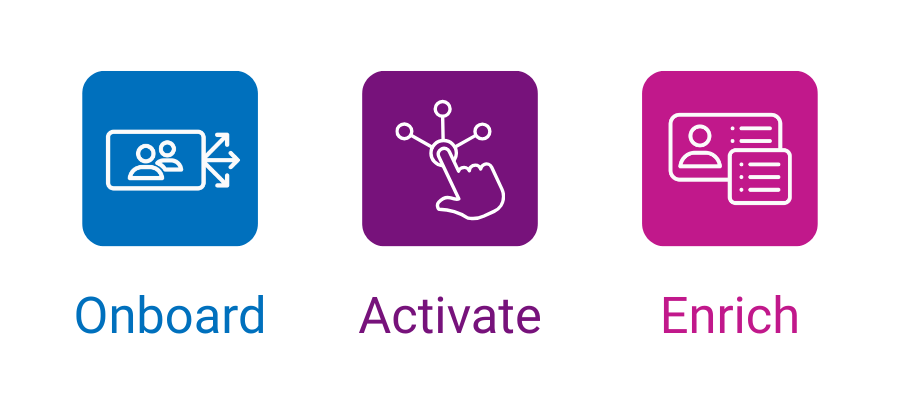
In 2026, it’s important to plan for first-party data to operate across onboarding, activation, and measurement as a connected workflow. Planning now centers on interoperability, scalable activation tools, and privacy-forward enrichment rather than isolated data use cases. Identity underpins each of these shifts.
1. First-party onboarding is table stakes
Onboard CRM and other first-party data into compatible programmatic and connected TV environments to make known audiences more usable across channels. You can then combine those audiences with trusted syndicated and partner data when additional scale is needed.
2. Unified activation tools accelerate execution
A unified activation tool like Audience Engine helps you bring first-party data and partner audiences into a single workflow, supporting first-party data activation across 200+ platforms, including display, connected TV, and social.
This reduces the operational friction of managing separate, platform-specific audience views. With identity-resolved data connected to activation, you can create more complete audiences and apply first-party data targeting more consistently across platforms.
For smaller teams, start with a focused onboarding and test use case, such as customer suppression, retargeting, or prospecting from a high-value customer segment. You can then expand activation as your data, measurement needs, and channel strategy mature.
3. AI-driven enrichment enhances performance
Machine learning can identify patterns, predict behavior, model lookalikes, and uncover actionable insights to increase reach and relevance, even as traditional signals fragment.
With our in-house modeling capabilities, you gain faster access to advanced machine learning and the ability to define your own model parameters. This gives you direct control over how audiences are built and optimized, allowing you to activate insights quickly, iterate as strategies evolve, and avoid the limitations of black-box third parties and long development cycles.
Best practices for getting started with first-party data activation
A successful activation strategy starts with a clear use case, reliable data, and a foundation that can scale over time. You don’t need to activate every record or channel at once. Starting with a focused audience and measurable objective makes it easier to test performance, refine the approach, and confidently expand.
Start with a clear business objective
Define what you want the activation effort to accomplish, whether that’s improving retention, reducing acquisition waste, reaching high-value prospects, or increasing cross-sell performance. Your objective should guide the data, audience, channels, and metrics you prioritize.
Prioritize high-value audiences
Begin with segments tied to a meaningful business outcome, such as repeat purchasers, high-lifetime-value customers, recent converters, or lapsed customers. Starting with a focused audience can produce clearer insights than deploying an entire customer database at once.
Build suppression into prospecting campaigns
Use first-party data to exclude existing customers from acquisition campaigns when appropriate. Suppression can reduce wasted spend, limit repetitive messaging, and protect the customer experience.
Test before expanding
Start with one or two activation destinations and establish benchmarks for reach, engagement, efficiency, or conversion. Use the results to refine audience definitions, messaging, and channel strategy before expanding across the broader media mix.
Refresh audiences regularly
First-party data changes as customer behavior, contact information, and preferences evolve. Review and refresh audiences regularly to keep activation relevant and accurate over time.
Choose a flexible activation approach
Look for partners and tools that can support your first-party data alongside partner and syndicated audiences across the platforms you already use. A flexible, interoperable approach makes it easier to add use cases, extend reach, and connect activation with measurement as your strategy matures.
Why first-party data activation matters to marketers in 2026
First-party data activation turns customer records into connected audiences you can use across the media ecosystem. Audience Engine enables you to onboard, enrich, and activate first-party data through a secure, interoperable platform that supports more relevant targeting and measurable outcomes.
To explore this trend and the others shaping marketing in 2026, download our 2026 Digital trends and predictions report.
Ready to connect with our team?
About the author

Doug McLennan
Sr. Director, Product Management, Experian
Doug McLennan is the Senior Director of Product Management at Experian Marketing Services where he is focused on product strategy for activation. His past work includes managing syndicated audiences at Oracle Data Cloud and building personalized video ad products at an agency. Doug lives in Colorado and skis as much as his family will allow.
Frequently asked questions about first-party data activation
First-party data is information collected directly from a brand’s own audience with consent, including purchase history, CRM records, and site or app behavior. Experian helps marketers resolve this data against our identity graphs for activation.
First-party data matters because it gives marketers a direct, controlled foundation for understanding and engaging their audiences as signals and media environments fragment. While it can support customer insights and personalization on its own, activation and identity resolution make that data usable at scale for audience targeting, suppression, cross-channel engagement, and measurement.
First-party data activation means using a brand’s own customer data to build addressable audiences across paid and owned channels. Our identity spine connects, enriches, and activates that first-party data consistently while preserving control and privacy.
First-party data needs identity to connect customer records across devices, platforms, and environments into a unified view. Experian identity resolution makes it possible to activate, measure, and manage frequency consistently across paid and owned media.
First-party data activation improves efficiency by reducing waste and increasing relevance. Marketers focus spend on known and modeled audiences, suppress existing customers in prospecting, and optimize toward outcomes rather than impressions.
We support first-party data activation by resolving, enriching, and activating customer data using identity as the foundation. Through Audience Engine, we enable onboarding, audience creation, cross-channel activation, and measurement within one environment.
Latest posts

Ensure you understand privacy compliance pitfalls with special attention on shopping cart abandonment emails.

Partnership combines customer connections and cross-device scale to deliver more strategic customer insights NEW YORK AND CHICAGO — March 16, 2017 — Signal, the global leader in customer identity, today announced a partnership with Tapad, now part of Experian and the leading provider of unified, cross-screen marketing technology solutions. This global integration extends device connectivity for Signal’s clients across North America, APAC and EMEA by leveraging Tapad’s proprietary Device GraphTM. With Signal’s Customer Identity Solution, brands benefit from more visibility of known customers, lower costs to reach those customers and decreased expenses and data loss that often results from using multiple vendors. Integrating with Tapad’s Device Graph, which connects billions of devices, enables Signal clients to build an even broader view of their known customers across multiple devices. This integration combines Signal’s customer identity scale with Tapad’s device scale to expand the reach of addressable media channels and enhance customer journey insights across touchpoints. Tapad and Signal were able to drive incremental device connections for more than 65 percent of customer profiles, linking an average of 6.8 browsers and devices per customer. With this combined data set, Signal clients can expand their authenticated view of a customer to all associated devices and realize more strategic insights into their high-value users. The partnership also allows Signal’s clients to integrate in real-time with Tapad’s media platform, Unify. This proprietary technology enables advertisers to make real-time activation and buying decisions with maximum scale, as well as automated reporting and measurement. “Continuously recognizing customers across devices instantly and in a privacy-safe way is essential for marketers to stay competitive,” said Marc Kiven, founder and CRO of Signal. “We are thrilled to enter this unique, global partnership with Tapad, enabling our clients to access their technology and more effectively reach customers in real-time and at scale.” “Being able to leverage a persistent view of customer connections across devices is a huge challenge for brands,” said Pierre Martensson, SVP and GM of Tapad’s global data division. “With Tapad, Signal is now able to connect with the billions of existing data points in our device graph to help clients better understand customer behavior and realize even stronger customer engagement.” Contact us today

Early successes include revenue increases, global partnerships and fundraising NEW YORK, March 16, 2017 /PRNewswire/ — Tapad’s entrepreneurial mentorship initiative, the Propeller Program, has seen extremely positive results since it began in September 2016. The five early-stage startups selected from Norway have gained momentum in establishing a U.S. presence. Tapad, now a part of Experian, is the leader in unified cross-device marketing technology. The company was acquired by the Telenor Group in 2016. Among the successes within Propeller: Xeneta, the leading ocean freight price comparison platform and contracted rate database, has raised an additional $12M in funding since beginning the Propeller Program. Before the end of 2016, the company had exceeded its revenue expectations by nearly 30 percent, proving the European-focused business could succeed in the American market. “Aside from directly impacting our revenue, the Propeller Program has provided us with incredible access to a countless number of external resources, including subject matter experts from the fields of fundraising, public speaking, corporate structuring and immigration law,” said William Di Ieso, GM of North America for Xeneta. “We remain extremely grateful for the opportunity and exposure the program has provided for Xeneta.” Bubbly, an in-store real-time engagement tool for non-buyers, now has clients on four continents. After only a few months in the U.S. market, Bubbly has signed deals with one major retail brand, one major toy manufacturer and a major global consulting firm. The Propeller Program has also opened doors for greater opportunities in Scandinavia and EMEA. After an introduction to Telenor Group’s President and CEO Sigve Brekke, Bubbly is currently piloting its IoT kiosk with the company. “The mentoring sessions have been very valuable and have given us guidance as to how to best enter the U.S. market,” said Marianne Haugland Hindsgaul, Bubbly CEO and co-founder. “Learning to do business in the U.S. is not something you can necessarily learn from a book. The most impactful lessons are based on real-world experience, and that is what the Propeller Program has given us.” BylineMe, a marketplace for freelancers, publishers and brands to connect for content creation and distribution services, has built an extensive network of potential clients and investors. The company has tested its product in the U.S. market and gained valuable feedback for further development. Eventum, a property-sharing group that digitally assists in securing venues for meetings and corporate events, has closed a seed round of funding for nearly $1M. Eventum has also made key hires in the areas of business development and engineering “It is so rewarding to be able to support these Norwegian startups in a meaningful way,” said Are Traasdahl, CEO and founder at Tapad. “Mentor relationships are critical for strategic growth, and I am proud to be able to pay forward the experiences I have gained as an entrepreneur. To me, the Propeller Program is a shining example of the magic that can happen when Norwegian innovation meets American opportunity.” Contact us today