As Earth Day approaches, it’s the perfect opportunity for marketers to explore innovative ways to engage with eco-conscious customers. With a strong and growing interest in sustainable business practices worldwide, green audiences are becoming increasingly influential. In addition to being good for the planet, engaging these customers is great for any brand or organization striving to become more eco-friendly and socially responsible. By taking advantage of this timely event and using appropriate tools, you can create personalized campaigns that will both promote your brand and increase customer loyalty.
Eco-conscious audiences
In this blog post, we’ll cover three eco-conscious audiences to target this Earth Day:
- Solar energy
- GreenAwareTM
- Electric vehicles
Solar energy
Our first eco-conscious audience is Solar energy. Consumers in this audience show an inclination toward harnessing the power of the sun as a clean, renewable energy source. Our audience data can provide valuable insights into the Solar energy consumer base, including their age, education level, occupation, household income, and communication preferences. Let’s explore these metrics to better understand how to reach this group effectively.
Age and living situation
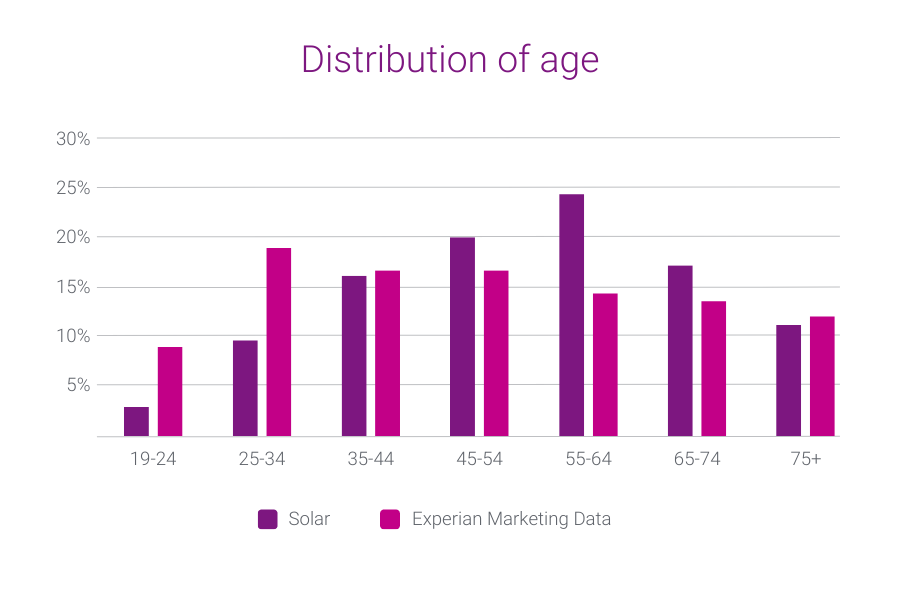
Consumers in our Solar energy audience are more likely to live in a home with two or more adults and are between the ages of 45-74.
Education level and occupation
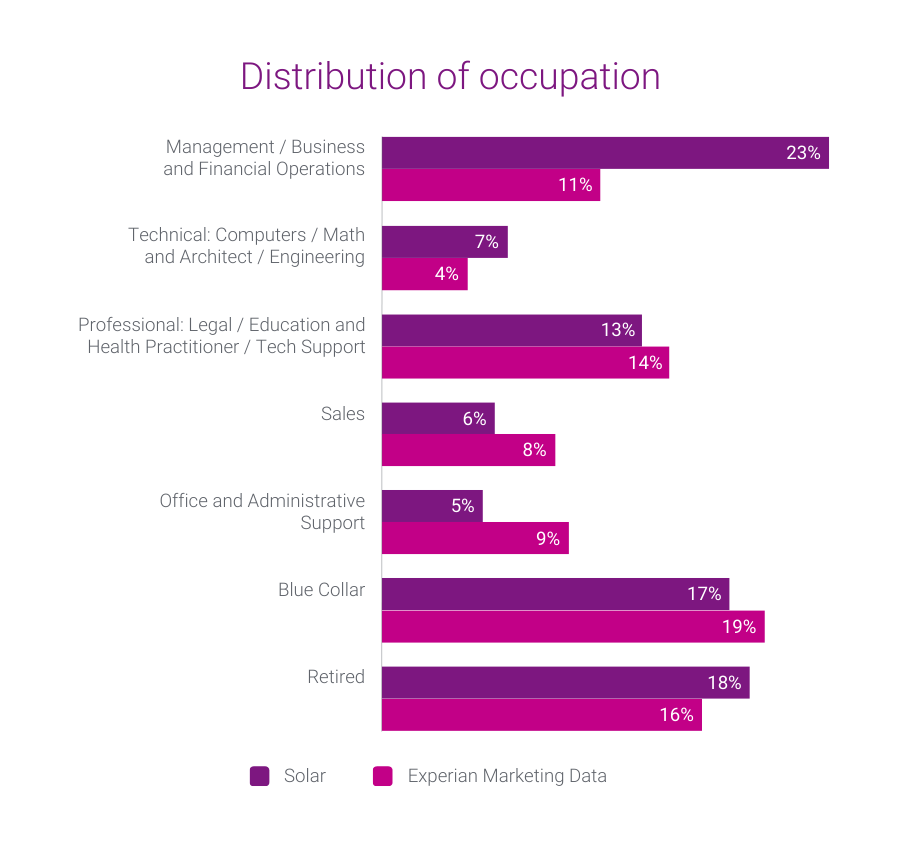
Consumers in our Solar energy audience are more likely to have graduated from college or graduate school and work in management-level occupations.
Household income
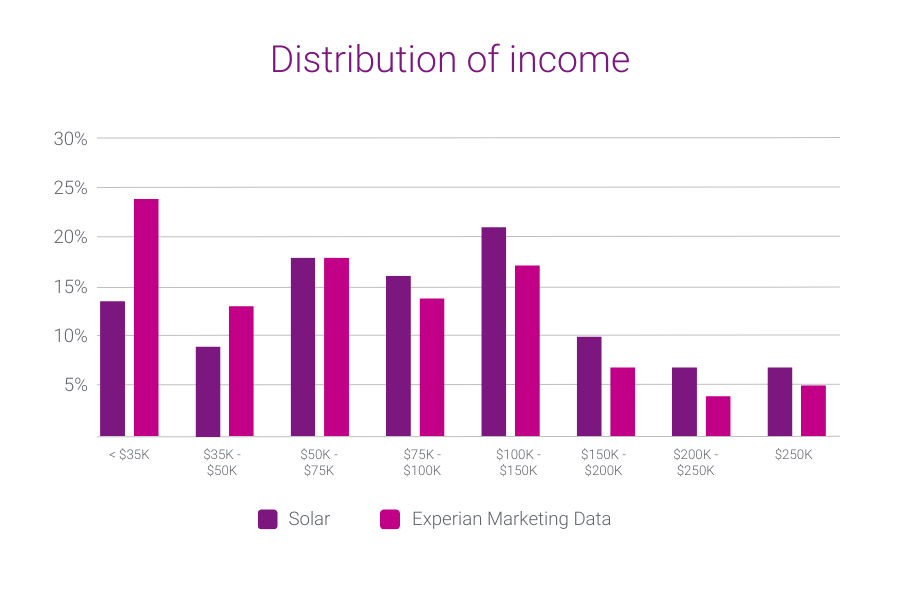
Consumers in our Solar energy audience have household incomes of more than $75,000 and their homes are valued at over $550,000.
Preferred engagement channels
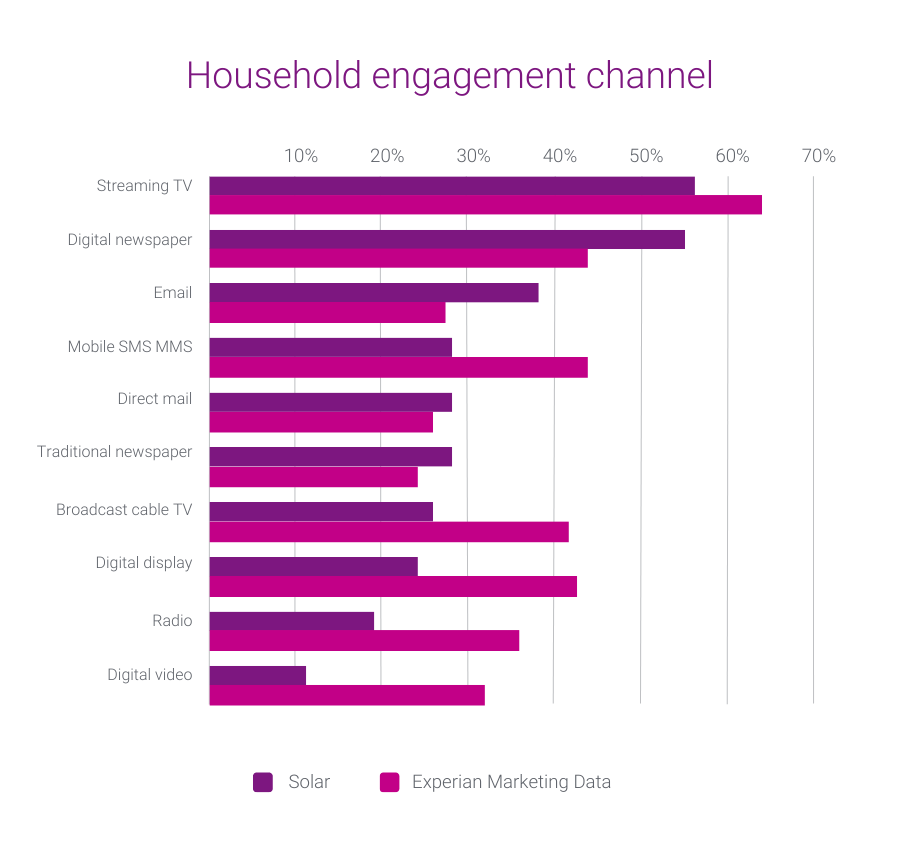
Consumers in our Solar energy audience are most receptive to ads served through digital channels like digital newspapers and email.
Solar energy audience pairings
Consumers in our Solar energy audience also belong to three of our Mosaic® USA groups:
- Power Elite
- Flourishing Families
- Booming with Confidence
Our consumer segmentation portal of 126 million households and 650 lifestyle and interest attributes empowers marketers like you to precisely target your ideal audience and communicate with them on a personal level. Mosaic’s data segments the U.S. into 19 overarching groups and 71 underlying types, giving you the insights needed to anticipate the behavior, attitudes, and preferences of your most profitable customers and communicate with them on their preferred channels, with messaging that resonates.
GreenAware
Our second eco-conscious audience is GreenAware.
GreenAware segments the 126 million U.S. households within Experian Marketing Data into four distinct groups. Each group differs in their attitudes and behaviors toward purchasing products that are environmentally safe and working with companies that are eco-conscious. We created these groups using an enhanced application of traditional statistical clustering techniques based on environmentally relevant measurements in Simmons’ National Consumer Study.
Based on the distinctive mindset of consumers toward the environment, you can learn how environmental concerns fit into their lives through four major consumer segments:
- Eco-Friendly Enthusiasts
- Sustainable Spectators
- Passive Greenies
- Eco Critics
Let’s dive deeper into each group to understand their unique perspective on the environment and how this impacts their attitudes and behaviors.
Eco-Friendly Enthusiasts
This eco-conscious segment prioritizes a green lifestyle and takes pride in avoiding products that harm the planet. With traditional and liberal values, they embrace optimism and prioritize family. With their children out of the house, they take the time for some well-deserved rejuvenation and are committed to a healthy lifestyle. Some members of this group are transitioning into retirement and welcoming a new chapter in their life.
- Mature adults and retirees
- College graduate or more
- Above average income
- May be married or single
- Typically own their homes
Sustainable Spectators
This segment aspires to be more sustainable, but they struggle with translating their green ideas into action. They have a soft spot for a cozy home. While their love for interior design and taking care of their own space is evident, they’re always looking for new experiences and opportunities to learn. Staying healthy and active is a top priority for this group, so it’s no surprise that they’re always looking for ways to stay fit and feel their best.
- Established and mid-life adults
- College graduate or more
- High income
- Typically married
- Likely to own their homes
Passive Greenies
This is the largest and one of the most youthful groups. Known for their love of exploration and self-discovery, they may not have fully embraced eco-conscious behaviors yet, but they are eager to stay current with the latest technology and trends. With their incredible ability to multitask, they’re always on-the-go, and constantly seek the next best thing.
- Mainly young adults and diverse
- Education ranges from high school through some college
- Below average income
- More likely to be single or divorced
- Typically rent
Eco Critics
This group is not likely to be eco-conscious and may have negative attitudes about the environment. They are confident, driven, and focused on their personal growth. They crave instant gratification, seeking out quick and easy solutions to their everyday decisions. They place a high value on entertainment, their social life, and carefully curate their image.
- Young and established adults
- Education ranges from high school through post-graduate studies
- High income
- Married or single
- Typically own their homes
Let’s take a look at how the GreenAware segments stack up against each other in terms of age, household income, education level, and media preference. How do they compare? Let’s find out.
Age
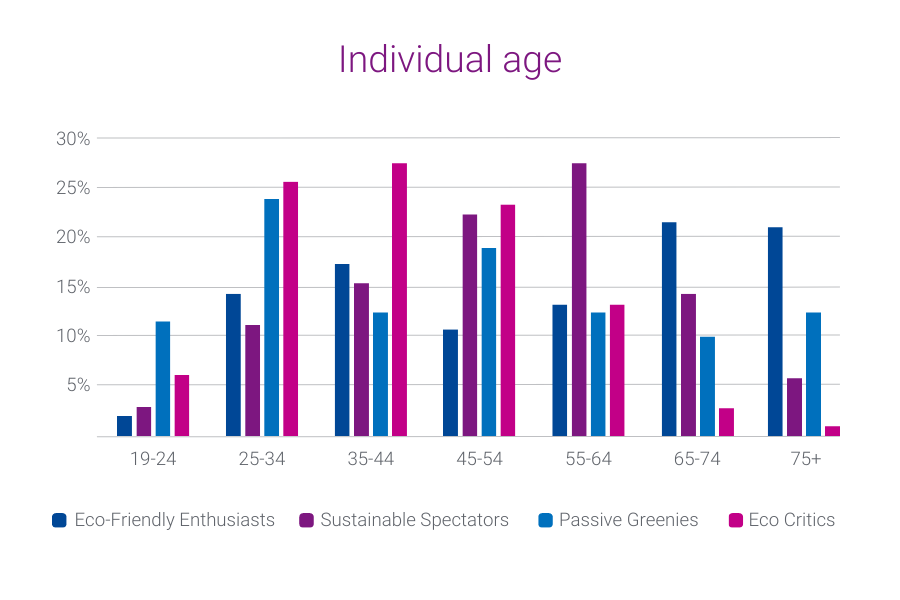
Consumers in the Eco-Friendly Enthusiasts segment are the oldest of the four GreenAware segments – about half of the consumers are 65 or older. Eco Critics are the youngest segment, with over half of consumers in this group between ages 25-44.
Household income
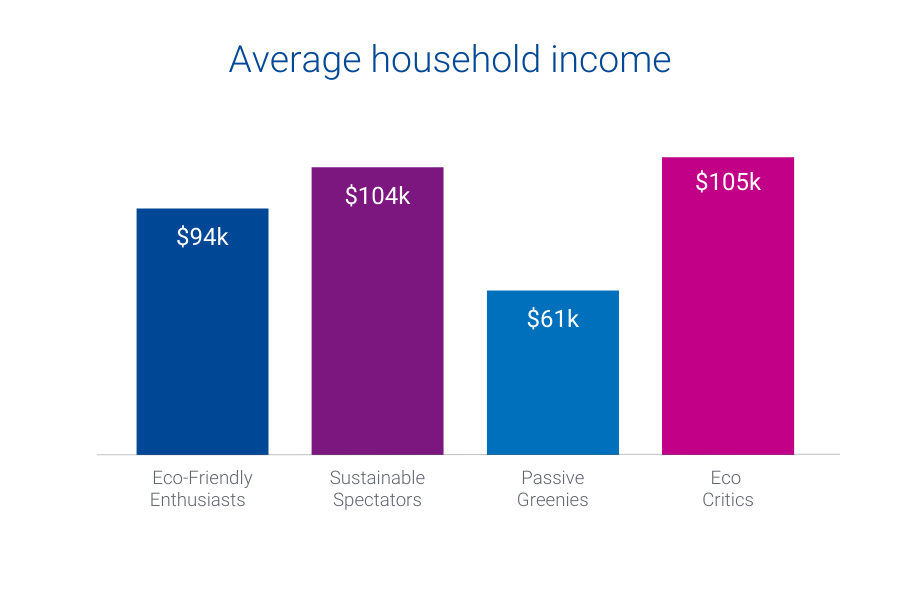
Sustainable Spectators and Eco Critics are the wealthiest GreenAware segments. The average household income of consumers in these segments is above $100,000. Passive Greenies have the lowest household income, with a majority below $50,000.
Education level and occupation
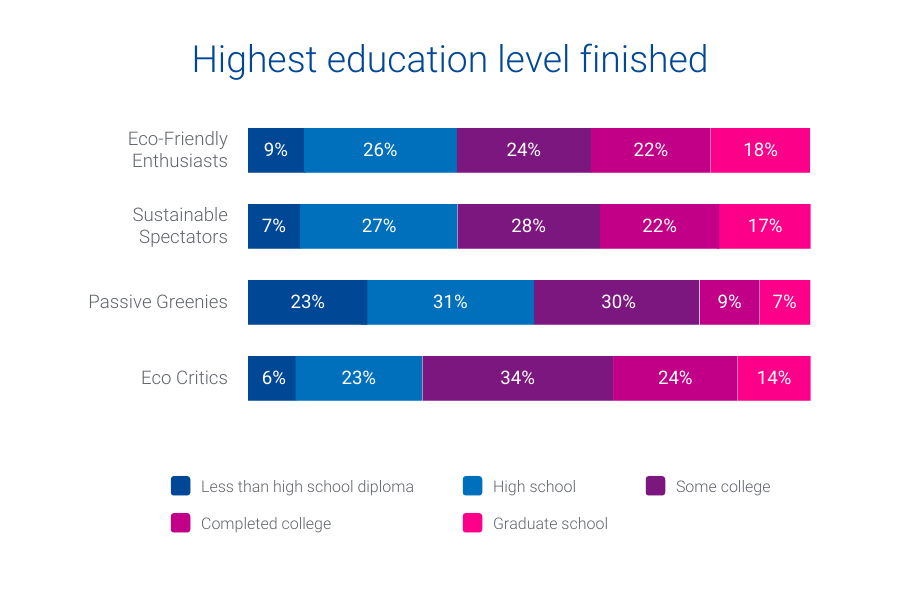
Passive Greenies are more likely to work Blue Collar jobs and have the lowest level of education. As the wealthiest segments, Sustainable Spectators and Eco Critics have the highest levels of college degrees and work in management, business, and financial operations. Eco-Friendly Enthusiasts are the most likely to be retired and out of the workforce.
Preferred engagement channels
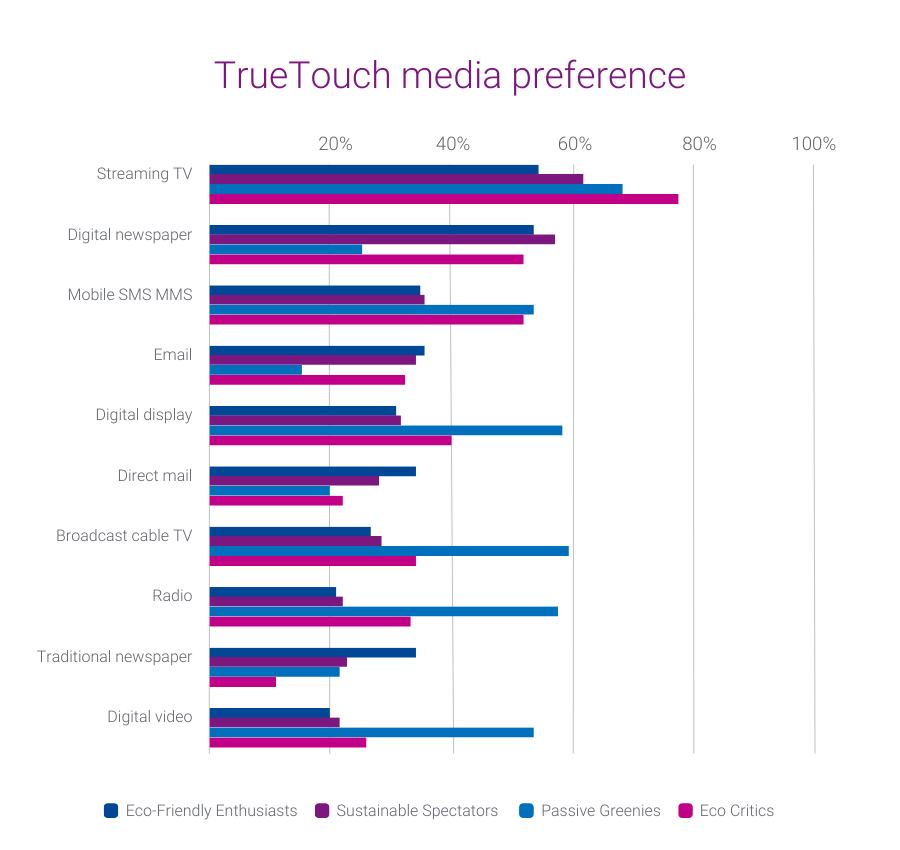
- Streaming TV is the preferred engagement channel for all GreenAware segments.
- Eco-Friendly Enthusiasts prefer digital channels like digital newspapers, mobile SMS, and email. They also engage with traditional channels like direct mail and newspaper.
- Passive Greenies have a high preference for digital display, mobile SMS, digital video, broadcast cable TV, and radio.
- Eco Critics have a high preference for digital channels like digital newspapers, mobile SMS, and digital display.
- Sustainable Spectators strongly prefer digital newspapers. They don’t show as strong of a preference for mobile SMS and digital display as Eco Critics and Passive Greenies.
GreenAware audience pairings
Six of our Mosaic groups have at least one GreenAware segment with 10% or more of the population. For more precise targeting, below are suggested Mosaic audiences you can pair with each GreenAware segment:
| Eco-Friendly Enthusiasts | Sustainable Spectators | Passive Greenies | Eco Critics |
| Booming with Confidence | Power Elite | Singles and Starters | Power Elite |
| Autumn Years | Booming with Confidence | Golden Year Guardians | Suburban Style |
| Golden Year Guardians | Singles and Starters |
Electric vehicles
Our third eco-conscious audience is electric vehicles.
Electric vehicles (EVs) are having a major moment in the automotive industry. This is no surprise given that new EV models are being released and an increasing number of charging stations are popping up around the country. As EVs become more prominent, it’s essential to stay up to date on relevant trends to make informed decisions about what lies ahead.
The demand for electric vehicles (EVs) is on the rise
Consumers are embracing the EV revolution, showing their desire for a cleaner, greener future. Automotive marketers are increasingly looking to reach in-market EV shoppers and current alternative fuel vehicle owners due to the growing availability of electric vehicles, improved infrastructure, and rising popularity. In 2022, EVs charged up the market and accounted for a remarkable 6% of new retail registrations.
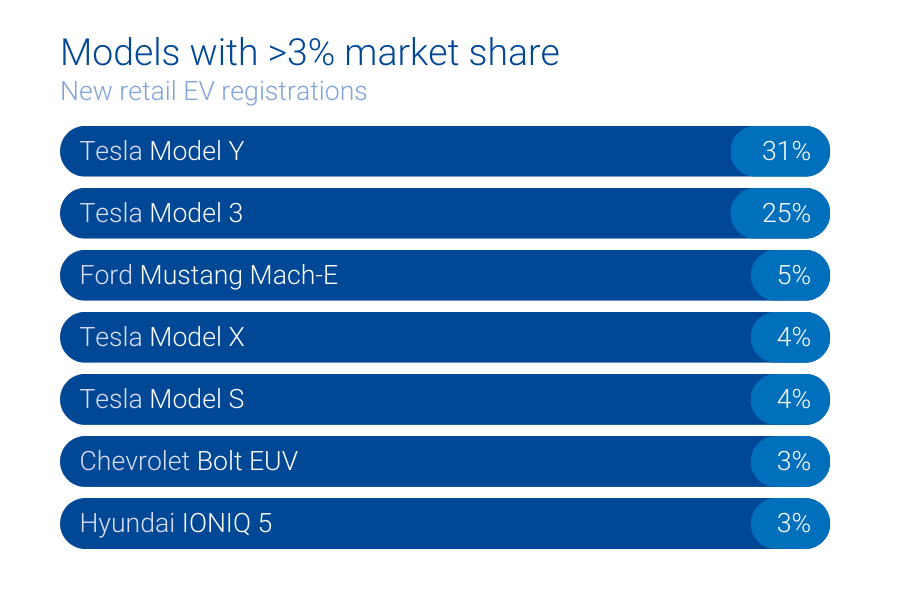
While Tesla continues to dominate the EV market, Ford, Chevrolet, and Hyundai are starting to compete, each holding more than 3% of the market share of new retail EV registrations.
Geography
Where are we seeing the most new retail EV registrations? The top designated market areas (DMAs) for new retail EV registrations are mostly located in heavily populated, coastal cities like Los Angeles, CA and New York, NY.
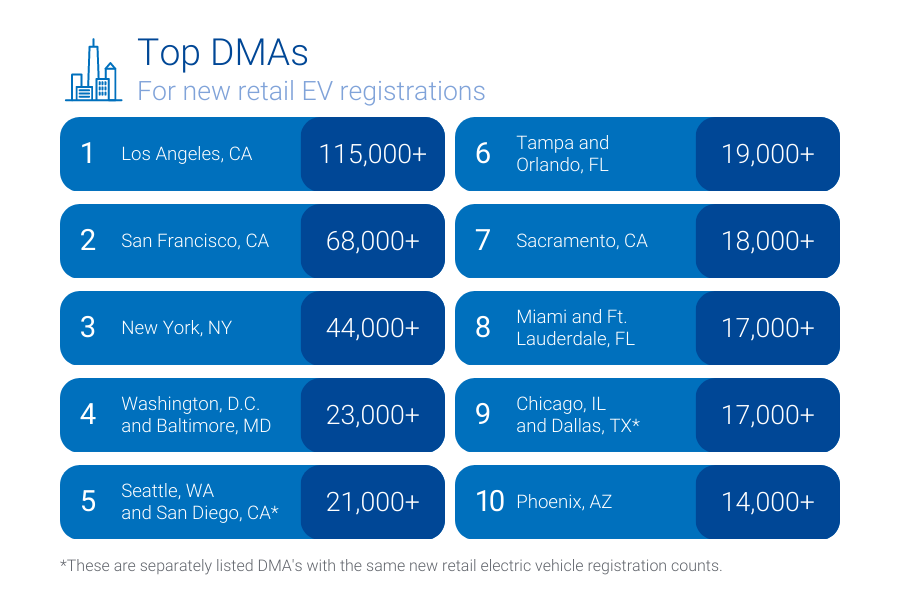
The fastest growing DMAs, however, are in smaller cities like Tucson, AZ and Oklahoma City, OK.
Generational demographics
Gen X and Millennials make up the largest percentage of new retail EV buyers at 37.5% and 34.4%. Gen Z and the Silent generation represent the smallest shares at 5% and 2.1%. Boomers hover between Gen X and Millennials’ share and account for 20.6% of new EV retail purchases.
EV audience pairings
Our top five Mosaic groups for new EV buyers include:
- American Royalty
- Cosmopolitan Achievers
- Philanthropic Sophisticates
- Couples with Clout
- Fast Track Couples
How to target consumers in-market for electric vehicles
We offer 70+ audiences that are focused on likely buyers and owners of EV and plug-in hybrid (PHEV) vehicles. We also offer a subset of 28 audiences focused on individual EV/PHEV vehicle models.
Below is how you can find a few of these audiences on-the-shelf of most trusted advertising platforms:
- Autos, Cars, and Trucks > In Market-Fuel Type > Electric
- Autos, Cars, and Trucks > In Market-Fuel Type > Used Electric
- Autos, Cars, and Trucks > In-Market Make and Models > Tesla
- Autos, Cars, and Trucks > In-Market Make and Models > Chevrolet Bolt EV
We can help you reach eco-conscious consumers
Earth Day is a great opportunity to get creative with your marketing efforts with our three eco-conscious audiences: Solar energy, GreenAware, and electric vehicles. To find out how you can add eco-conscious audiences to your marketing plan, contact us.
Get in touch
Latest posts

It’s been over a year since Google announced they’d be deprecating the third-party cookie and in that time there’s been a major focus on two types of cookieless identity solutions. Identity vendors and marketers are strategizing which of these two future solutions best fits their needs so they can achieve privacy-safe scale once third-party cookies are no longer available for use on Chrome. Let’s break down these solutions and the considerations marketers need to take into account when deciding what partners to move forward with in the future of identity resolution. Authenticated Traffic Solutions Authenticated traffic solutions (ATS) are a type of digital identification that asks the end-user to identify themselves via personal information, most commonly email address. Often, you’ll see self-authentication at the point of entry to a website that asks you to create an account or login immediately to access the content you are seeking. E-commerce sites use authentication to keep track of consumer purchases and inform advertising decisions for that customer; and publishers use it to tailor featured content, or, more importantly for this discussion, leverage it within the ad ecosystem for targeting. While authentication can provide very valuable user data for audience segmenting and targeting, it can be limited in scale for a single publisher to leverage and monetize on their own. That’s why some identity vendors have worked to integrate themselves within as many publisher authentication modules as possible, so that they can create an aggregate of scale for the ad ecosystem to tap into. But, even this isn’t going to deliver the reach marketers truly thirst for. Alternatively, Facebook has the scale for authenticated traffic, but they keep their data inside a walled garden, so the utility of those authenticated users is only valuable within the Facebook ecosystem. So how can authenticated traffic solutions increase scale to broaden the scope of identifiers they can collect and leverage? Hint: a few of the biggest players have already figured it out. It’s the single sign-on. Google is probably the largest purveyor of a single-sign on solution that can directly impact advertising capabilities. Can you think of a site you visit that doesn’t offer a sign-in with your existing Google account? It’s a short list. Google has integrated themselves into so many applications and publishers that “Login with Gmail” is just second nature (you pictured the Gmail logo when you read that, didn’t you?). Now, if you’re about to purchase something you found off an Instagram ad, or perhaps a retailer you buy from regularly, you’ve probably noticed options to proceed with your checkout via “Amazon pay” or “Apple pay”. These are also single-sign ons. You’re authenticating yourself through Amazon or Apple to that retailer in exchange for A- the safety and security that Amazon or Apple provide for your financial information and B- skipping the annoying process of manually entering personal information over and over again at point of sale. It’s starting to sound like there’s a lot of authenticated data out there isn’t it? Well, that’s true, but again, Amazon and Apple are walled gardens. Amazon is working diligently to build out their own ecosystem to leverage their content and retail channel data for a holistic offering. And Apple keeps user data very close to the chest, constantly limiting its utility for themselves and advertisers. So what is identity resolution doing about it? The Trade Desk announced their solution; Unified ID 2.0, which promises to leverage email authenticated identity for a truly scaled solution for publishers via Javascript through Prebid. By handing over UID2.0 to an independent unbiased organization like Prebid, The Trade Desk is creating instant scale and trust in their solution. Unauthenticated Traffic Solutions Unlike ATS, unauthenticated traffic solutions do not rely on a log-in to identify a user, but they also don’t rely on third-party cookies. Instead, unauthenticated solutions (UATS) leverage their existing streams of real-time data through Javascript on publisher sites or an SDK (software development kit used by apps). The type of information UATS solutions can collect via Javascript or SDK vary, but it can include IP address, user agent and device level info. But being able to read this information at the point of entry to a website does not make a quality identifier. The best unauthenticated solutions will have the ability to set or ingest this information into a unique ID through an infrastructure with incredibly fast speed that can process trillions of anonymous data signals across multiple channels and devices. And even more so, be able to interpret those signals into a profile using machine learning– all at the moment a user enters a domain. It sounds complicated because it is, but it also has a lot of potential. The identity space cannot rest solely on authenticated traffic solutions, because, as you can see, it could limit ownership and operability to just a few power players/walled gardens. This doesn’t help the larger ecosystem monetize and personalize ad inventory. The right unauthenticated solution, however, can unify cross-device individuals and households at scale, because they’re integrated on the broadest number of publishers/SDKs across platforms, have the best algorithms to build confident connections between identifiers, and are universally transactable across the most common sell and demand side platforms. Think of it as the perfect partner- speaking a common language that everyone in the ecosystem understands and acts on. Today more than twenty cookieless identifiers are available in market for the ad ecosystem, and Google hasn’t even announced a date of deprecation. It’s important to be on the lookout for differentiators like scale and precision. Most importantly, choosing a truly cross-device partner will be key, especially as more digital devices and IDs grow in adoption, like CTV has this past year. Taking advantage of both What we will come to find, once the third-party cookie is obsolete, is that choosing just one of these solution types, or partners, will be a disadvantage. The more the industry comes together to collaborate on solutions, the more apparent it is that both of them have value, and thus employing both solutions will give marketers the best opportunities. Tapad, now part of Experian, recently announced the launch of Switchboard; a module within our identity solution; The Tapad Graph, to create this agnostic interoperability for identifiers of all types, and choice and control for the ad tech vendors and marketers who want them. By instantly creating the ability to partner with multiple solutions, Tapad + Experian is ensuring that all use cases for the third-party cookie live on in our cookieless future. Get in touch
Tapad launches global privacy-safe solution to provide continuity in the absence of third-party cookies Switchboard, a module within The Tapad Graph, will connect emerging cookieless identifiers to traditional IDs, creating a more holistic view of the consumer and driving value exchange within the advertising ecosystem Tapad, part of Experian, a global leader in cross-device digital identity resolution, and a part of Experian, announced today the launch of Switchboard, a first-of-its-kind solution to help navigate the evolving cookieless landscape. Switchboard, a module within The Tapad Graph, will operate as a global, privacy-safe solution to provide continuity in the absence of third-party cookies by connecting new cookieless identifiers to traditional digital IDs for a comprehensive view of consumers and their digital touchpoints. Switchboard will enable interoperability across the growing number of these digital identifiers and the value exchange between publishers, content creators and consumers. Leading digital identity solutions partnering with Tapad, part of Experian at the launch of Switchboard include Unified ID 2.0, ID5, Lotame Panorama ID, BritePool, Retargetly IDx and Audigent Halo ID. Tapad, part of Experian plans to expand support to additional identity solutions on an ongoing basis. In addition to these identity solutions, early partners across the ecosystem include The Trade Desk, Amobee, Martin, ShareThis, Eyeota and Catalina. “This diverse group of launch partners and testing customers will prove that Switchboard is an important tenet for the future of identity resolution. We’re excited to be proactive in our approach to give marketers time to adapt new solutions and test their function in tandem with the third-party cookie, while continuing to give our customers flexibility and control,” said Mark Connon, General Manager of Tapad, part of Experian. “Facilitating access and usage of 1st party identifiers is crucial to help marketers prepare for the cookieless future. Thanks to Switchboard, ID5's cookieless IDs will be available to a wider audience of brands and agencies and enable them to run effective, data-driven campaigns beyond the third-party cookie,” said Mathieu Roche Co-founder & CEO of ID5. Switchboard provides value across the marketing and advertising ecosystem as the need for the ability to support multiple cookieless ID’s across ad tech increases throughout 2021. With a decade of expertise creating digital identity resolution products, Tapad, part of Experian is poised to solve this challenge through innovation and quality, privacy-safe data-driven solutions. “Interoperability is paramount for brand marketers, agencies, publishers and platforms if we want to support an open and free Internet and break free of the stranglehold of walled gardens,” said Pierre Diennet, Global Partnerships at Lotame. ”Lotame Panorama ID’s participation in Switchboard reflects our steadfast commitment to collaborating across and within the industry and providing value to all of its players.” “As advertisers continue to contemplate the future of identity, Amobee is proud to partner with Tapad, part of Experian on this next-generation solution to provide a comprehensive view of consumers,” says Bryan Everett, Senior Vice President of Global Business Development at Amobee. “With the imminent loss of cookies, advertisers must think creatively in order to respectfully engage consumers in a privacy-compliant way and Switchboard can play an important role in addressing their respective identity needs.” Tapad, part of Experian is welcoming identity solutions and Tapad Graph customer participation in Switchboard throughout 2021. Stayed tuned for more updates and information on Switchboard in the coming months. Get in touch
Adapt with Tapad, a part of Experian Leading browsers have made public announcements and technical deployments to reduce the digital advertising accessibility of third-party cookies for data collection, storage, and sharing due to growing privacy concerns. As a result, there has been growing momentum to find an alternative via cookieless IDs, with the intent to create a replacement that helps ensure continuity across the ecosystem. At Tapad we’ve chosen to approach the market with a solution that provides agnostic interoperability for these cookieless identifiers, so that marketers can continue to work with the identity providers of their choice while maintaining the most holistic view of consumers across digital touchpoints. Introducing switchboard Switchboard is a module within The Tapad Graph that leverages our core capabilities across machine learning and identity management to provide a connection between traditional digital identifiers and the new wave of cookieless IDs that will be utilized in the future. Customers of Tapad can take advantage of its broad ecosystem of identifiers to drive targeting and frequency capping strategies and enable detailed measurement and attribution post-deprecation of the third-party cookie. Our goal is to accelerate the adoption, scale, and utility of cookieless IDs with the release of the Switchboard module within The Tapad Graph, while maintaining an agnostic approach to the market. Switchboard for identity solutions In the evolving landscape agencies and marketers will need to invest, test, and analyze the best combination of cookieless ID partners to meet their objectives. The Switchboard module will increase the utility and value of the cookieless ID space in conjunction with other addressable IDs, by providing a layer of connectivity that will be natively missing with the deprecation of third-party cookies. Identity solutions at launch: Switchboard for graph customers For existing Tapad customers who leverage the Switchboard module in The Tapad Graph, it will provide a seamless way to facilitate interoperability while resolving identity back to a Household or Individual. By providing this translation layer, Tapad will take on the responsibility of encryption and decryption protocols where applicable, which will deliver added functionality to our customers. Tapad + Experian partners at launch: Use cases Resolve existing first-party data with new cookieless solutions through The Tapad Graph to minimize data loss Frequency cap at the Individual and Household level via Cookieless and traditional ID Reach consumers at scale across all touchpoints and IDs Build a more inclusive and holistic view of the consumer journey Run accurate and scalable measurement before and after the formal deprecation of third-party cookies in Chrome Map online data into offline activities Hear why industry leaders are adapting with Tapad + Experian As advertisers continue to contemplate the future of identity, Amobee is proud to partner with Tapad, a part of Experian, on this next-generation solution to provide a comprehensive view of consumers. With the imminent loss of cookies, advertisers must think creatively in order to respectfully engage consumers in a privacy-compliant way and Switchboard can play an important role in addressing their respective identity needs. — Bryan Everett | Senior Vice President of Global Business Development | Amobee Connecting offline and online shopper activity in a privacy-compliant way is fundamental to marketing effectiveness and determining return on ad-spend. That’s why we’re excited to be a launch partner for Tapad + Experian's Switchboard offering; it provides a unified solution for supporting the variety of proprietary and anonymous user ID standards required by advertising demand-side platforms today. — Brian Dunphy | SVP Digital Business and Strategic Partnerships | Catalina As the industry evolves, Tapad + Experian's Switchboard presents a privacy-safe solution that allows for the continued activation of data and an alternative to advertising within walled garden environments. We look forward to collaborating with Tapad and the industry as we collectively transition to support cookieless identity. — Don Lee |SVP of Global Platform Partnerships | Eyeota We are excited to participate in this proactive solution to the sunset of third-party cookies. Switchboard’s agnostic interoperability, with BritePool and other ID providers, will create high-value for marketers as they transition to the era of cookieless web advertising. — David J. Moore | CEO | BritePool Interoperability is paramount for brand marketers, agencies, publishers and platforms if we want to support an open and free Internet and break free of the stranglehold of walled gardens. Lotame Panorama ID’s participation in Switchboard reflects our steadfast commitment to collaborating across and within the industry and providing value to all of its players. — Pierre Diennet | Global Partnerships | Lotame At this pivotal moment in the industry, we are excited to be partnering with Tapad, a part of Experian on their cookieless initiative and making Retargetly IDx available into the Switchboard solution, providing global brands, platforms and publishers with a compliant, cookieless ID solution for the Latin American market; enabling them to target, reach and measure users at scale through the region. — Daniel Czaplinski | CEO and Co-Founder | Retargetly With Audigent’s Halo ID, we’re architecting a cookieless future where clients and partners have confidence in the actionability and interoperability of exclusive 1st party audiences, originated from some of the world’s leading publishers and creators. We see collaboration as being critical to a collective understanding of identity and Tapad, a part of Experian as a trusted partner with solutions such as Switchboard to support continuity for marketers’ addressability. — Drew Stein | CEO and Founder | Audigent Facilitating access and usage of 1st party identifiers is crucial to help marketers prepare for the cookieless future. Thanks to Switchboard, ID5’s cookie-less IDs will be available to a wider audience of brands and agencies and enable them to run effective, data-driven campaigns beyond the third-party cookie. — Mathieu Roche | CEO and Co-Founder | ID5 Addressing the current identity challenge requires transparency and collaboration. We are pleased to align ShareThis data with Tapad + Experian’s growing ecosystem. ShareThis data helps marketers evolve beyond the cookie to complete the picture. Tapad + Experian’s Switchboard offering will support ShareThis’s deep connections to clients and technology platforms, preserving and growing the accessibility of our data. — Michael Gorman | SVP Product and Business Development | ShareThis Get in touch