At A Glance
AdTech can feel overwhelming with all its jargon, but we're breaking it down café-style. From first-party data and identity resolution to clean rooms and ID-free targeting, this guide breaks down the essential terms marketers need to know.In this article…
If you’ve ever sat in a meeting and heard an AdTech term you didn’t understand, you’re not alone. The industry evolves as quickly as a café turns over tables on a busy weekend. Even seasoned regulars can get tripped up by the jargon.
So instead of scratching your head over the “menu,” let’s walk through some of the most common terms: served café-style.
The ingredients: The many flavors of first-party data
Every meal starts with ingredients, and in AdTech, those ingredients are data. First-party data is not just one thing: it’s more like everything your favorite neighborhood café knows about you.
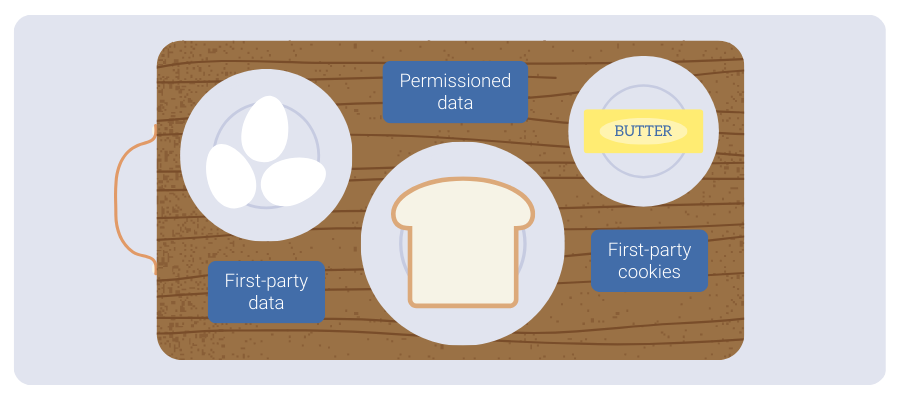
First-party data
The café knows your coffee preferences because you’ve told them directly; whether by ordering at the counter, calling in, or placing an order online. This is information you’ve willingly provided through your interactions, and it belongs only to that café.
First-party cookies
The barista writes down your preferences in a notebook behind the counter, so next time you walk in, they don’t have to ask. First-party cookies remember details to make your experience smoother, but only for that café.
Authenticated identity
A loyalty app that connects online orders to in-person visits. By logging in, you’re saying, “Yes, it’s really me.” Authenticated identity is proof that the customer isn’t just a face in line, but someone with a verified profile.
Persistent identity
Recognizing you whether you order through the app or in person. Persistent identity enables the ability to keep track of someone across different touchpoints, consistently, without confusing them with someone else.
Permissioned data
Agreeing to join the loyalty program and get emails. Permissioned data is a connection to the customer that the customer proactively shared with the café by signing up for their loyalty program or email newsletter.
Each piece comes from direct interactions, stored and used in different ways. That’s what makes first-party data nuanced. The saga of third-party cookie deprecation and changing privacy regulations makes it important to understand which types of data you can collect and use for marketing purposes.
And once you have those ingredients, the next step is making sure you recognize how they fit together, so you can see each customer clearly. That’s where identity resolution comes in.
The recipe: Bringing the ingredients together with identity resolution
At the café, identity resolution is what helps the staff recognize you as the same customer across every interaction. Without it, they might think you’re two different people; one who always orders breakfast and another who sometimes picks up pastries to go.
Matching
The café has a loyalty program, and the pet bakery next door has one too. When they match records across their two data sets, they realize “M. Jones” from the café is the same person as “Michelle Jones” from the bakery. That connection means they can activate a joint promotion, like free coffee with a dog treat, without either business handing over their full customer lists. In marketing, matching works the same way, linking records across data sets for activation so campaigns reach the right people.

Deduplication
Collapses duplicate profiles into a single, clean record, so you don’t get two birthday coupons, even though that would be nice to get.
That’s what Experian does at scale: we connect billions of IDs in a privacy-safe way, so you can get an accurate picture of your audience.
And once you can recognize your customers across touchpoints, the next challenge is collaborating across systems and partners for deeper insights. That’s where the behind-the-counter processes come in.
Behind the counter: Crosswalks and clean rooms
At a café, these terms are like the behind-the-counter processes that keep everything running smoothly. They may sound technical, but they all serve the same purpose: helping data collaborate across different sources, while keeping sensitive information safe. The goal is a better “meal” for the customer, deeper insights, better targeting, and more personalized campaigns. Here’s how they work.
Crosswalks
The café partners with the pet bakery next door. They both serve a lot of the same people, but they track them differently. With a crosswalk, they can use a shared key to recognize the same customer across both businesses, so you get a coffee refill, and your dog gets a treat, without either one handing over their full customer list. A crosswalk is the shared system that lets both know it is really you, without swapping personal details. It’s the bridge connecting two silos of data.

Clean rooms
The café and the pet bakery want to learn more about their shared customers, like whether dog owners are more likely to stop by for brunch on weekends. Instead of swapping their full records, they bring their data into another café’s private back room, a clean room, where they can compare trends safely and privately. Both get useful insights, while customer details stay protected. That’s a clean room: secure collaboration without exposing sensitive data.
Of course, sharing and protecting data is only part of the picture. The real test comes when you need to serve customers in new ways, especially as the industry moves beyond cookies.
Serving customers in new ways: Cookie-free to ID-free
Targeting has evolved beyond cookies, just like cafés no longer rely only on notebooks to remember regulars.
ID-free targeting
The café looks at ordering patterns, like cappuccinos selling on Mondays and croissants on Fridays, without tracking who’s ordering what. Instead of focusing on who the customer is, the café tailors choices based on the context of the situation, like time of day or day of the week. This is like contextual targeting, serving ads based on the environment or behavior in the moment, rather than on personal identity.

ID-agnostic targeting
The café realizes customers show up in all sorts of ways: walk in, online ordering, delivery. Each channel has its own “ID,” a name on the app, a credit card, or a loyalty profile. ID-agnostic targeting means no matter how you order, the café can still serve you without being locked into one system.
Just like cafés no longer rely only on notebooks to keep track of regulars, marketers no longer have to depend solely on cookies. Today, there are multiple paths, cookie-free, ID-free, and ID-agnostic, that can all help deliver better, more relevant experiences.
But even with new ways to reach people, one big question remains: how do you know if it’s actually working? That’s where measurement and outcomes come into play.
Counting tables vs. counting sales
At the café, measurement and outcomes aren’t the same.
Measurement
Tables filled, cups poured, specials ordered.
Outcomes
What it all means: higher revenue, more loyalty sign-ups, or increased sales from a new promotion.
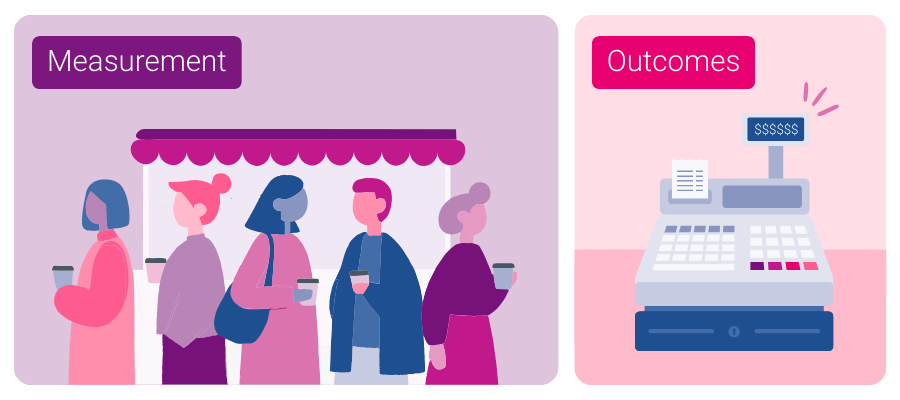
Both matter. Measurement shows whether the café is running smoothly, but outcomes prove whether the promotions and strategies are truly paying off. Together, they help connect day-to-day activity to long-term success.
All of this brings us back to the bigger picture: understanding the menu well enough to enjoy the meal.
From menu to meal
In AdTech, there will always be new terms coming onto the menu. What matters most is understanding them well enough to know how they help you reach your business goals. Just like at the café, asking a question about the specials isn’t foolish. It’s how you make sure you get exactly what you want. The more we, as an industry, understand the “ingredients” of data and identity, the better we can cook up new solutions that serve both brands and consumers. After all, the goal isn’t just to talk about the menu, it’s to enjoy the meal.
At Experian, we help brands turn that menu into action. From identity resolution to privacy-safe data collaboration, our solutions make it easier to connect with audiences, activate campaigns, and measure real outcomes.
If you’re ready to move from decoding the jargon to delivering better customer experiences, we’re here to help
About the author

Brandon Alford
Group Product Manager, Experian
Brandon Alford is a seasoned professional in the AdTech ecosystem with a focus on identity, audience, measurement, and privacy-forward solutions. He has spent his career helping advertisers and publishers navigate the complexities of digital advertising and privacy, bringing a practical and forward-looking perspective to industry challenges and innovation.
AdTech jargon FAQs
First-party data is information a customer shares directly with a brand, like purchase history, preferences, or sign-ups. It’s the most valuable and privacy-safe data marketers can use to build personalized campaigns.
Identity resolution ensures a brand can recognize the same customer across different touchpoints. Matching links records across data sets (e.g., between partners) so campaigns reach the right people without exposing full customer lists.
A crosswalk bridges two data systems with a shared key to recognize the same customer, while a clean room allows partners to analyze data together securely without exposing sensitive details.
Cookie-free and ID-free targeting shift focus away from tracking individuals, instead tailoring ads based on context (like time of day or content being viewed) or allowing flexibility across multiple IDs.
Measurement tracks activity (like clicks or visits), while outcomes prove business impact (like sales, loyalty, or revenue). Both are essential, but outcomes show whether strategies are truly effective.
Experian provides tools for identity resolution, privacy-safe data collaboration, and campaign measurement, helping marketers move from understanding the “menu” of AdTech terms to achieving real results.
Latest posts
Retail media platforms are on the rise. Retail marketers are making advances by focusing on personalized shopping experiences for customers.
Every year, the Experian team attends the Consumer Electronics Show (CES) in Las Vegas, to immerse ourselves in the world's most significant consumer tech showcase and stay at the forefront of the latest technological advancements and innovations that shape the AdTech industry. This year's event was a vibrant melting pot of innovation and vision, from streamers taking a bigger bite of the advertising pie to the emergence of AI-powered solutions and drone delivery services. Amidst these advancements, the dynamic interplay of technology, media, and advertising raised important questions, especially in the context of evolving regulations and cookie deprecation. During CES, we captured insights from various thought leaders, and in the coming months, we'll be sharing these valuable perspectives with you. Watch the video below for full insights coming from our content studio onsite during the event. Or, keep reading for a recap on four key trends from CES and what they mean for your business in 2024! “My first CES was a major success. You could feel the buzz in the air as new ideas and partnerships were being created within and across industries. The intersection of the different players within retail media, connected TV, retail technology, the demand and supply-side, and agencies all in an ever-changing world of regulation and privacy begs for a solution that can maximize a successful outcome for all.”anne passon, sr director, sales, retail & cpg 1. Audience targeting: How first- and third-party data work together A central theme at CES was the importance of audience targeting, highlighting the crucial role of first-party data. However, it’s clear that to maximize its potential, this data needs to be augmented with sophisticated identity solutions and enriched with third-party insights, all while navigating the complexities of privacy regulations. This integrated approach is vital to understanding audiences and for creating more effective marketing strategies that comply with privacy regulations. 2. Standardizing metrics in retail media networks The challenges around retail media networks, particularly in terms of standardizing metrics like incremental return on ad spend (iROAS), were a hot topic at CES. This complexity around this topic underscores the need for neutral, expert third parties to help bring clarity and consensus, aiding businesses in navigating this multifaceted domain. 3. The challenge of switching data solutions Discussions covered the broader challenges associated with transitioning to new data solutions. For businesses, this involves a critical assessment of the benefits versus the costs and complexities of adopting new platforms or systems. This decision-making process is increasingly significant as data strategies become integral to marketing success. 4. Identity solutions in a cookieless future With the industry moving toward a cookieless future, the spotlight at CES was on the importance of robust identity solutions. Understanding the functionality and necessity of various universal IDs is essential to minimize data loss and maintain effective targeting. Investing in flexible and adaptable identity solutions like the Experian Graph is essential to maintain effective targeting and audience engagement in this new landscape. Announcements and advertising innovations at CES 2024 CES was a stage for significant announcements and innovative marketing initiatives: Criteo and Albertsons announced their collaboration in retail media. Instacart's partnership with Google for enhanced shopping ads and AI shopping carts. NBCUniversal's advancements in streamlining programmatic advertising. Brands like Netflix, LG, Freewheel, and Amazon Ads also captured attention with their creative marketing strategies, ranging from unique collaborations to themed promotions and captivating events. These insights from CES provide a glimpse into the future of technology, media, and advertising. They highlight the need for adaptability, innovation, and informed decision-making in these dynamic industries, especially in the context of privacy regulations. Stay tuned for our series of posts where we'll dive deeper into these topics, sharing exclusive insights from industry thought leaders. Follow us on LinkedIn or sign up for our email newsletter for more informative content on the latest industry insights and data-driven marketing. Contact us Latest posts
Short-form video content is becoming more prevalent on video-sharing platforms. Keep up with trends and marketing strategies to stay relevant.