Audigent, a part of Experian, now offers turnkey, outcome-driven deals for brands through Amazon DSP, expanding advertisers’ options for advertising across the open internet.
While buyers continue to activate through established supply paths with Amazon DSP, this collaboration introduces sell-side curation that expands data access and reduces overall buyer costs.
Three paths to activation
With Audigent’s curation services now available through Amazon DSP, buyers have streamlined access to premium open-internet inventory and measurable results.
Advertisers now have three simple ways to build or tap into curated deals:
Data that drives performance
Turnkey curation only works if the data behind it is immediate, precise, and actionable. With Audigent providing curation via Amazon DSP, each deal fuses premium, real-world signals with hand-picked inventory so every impression can move the needle.
How turnkey curation works
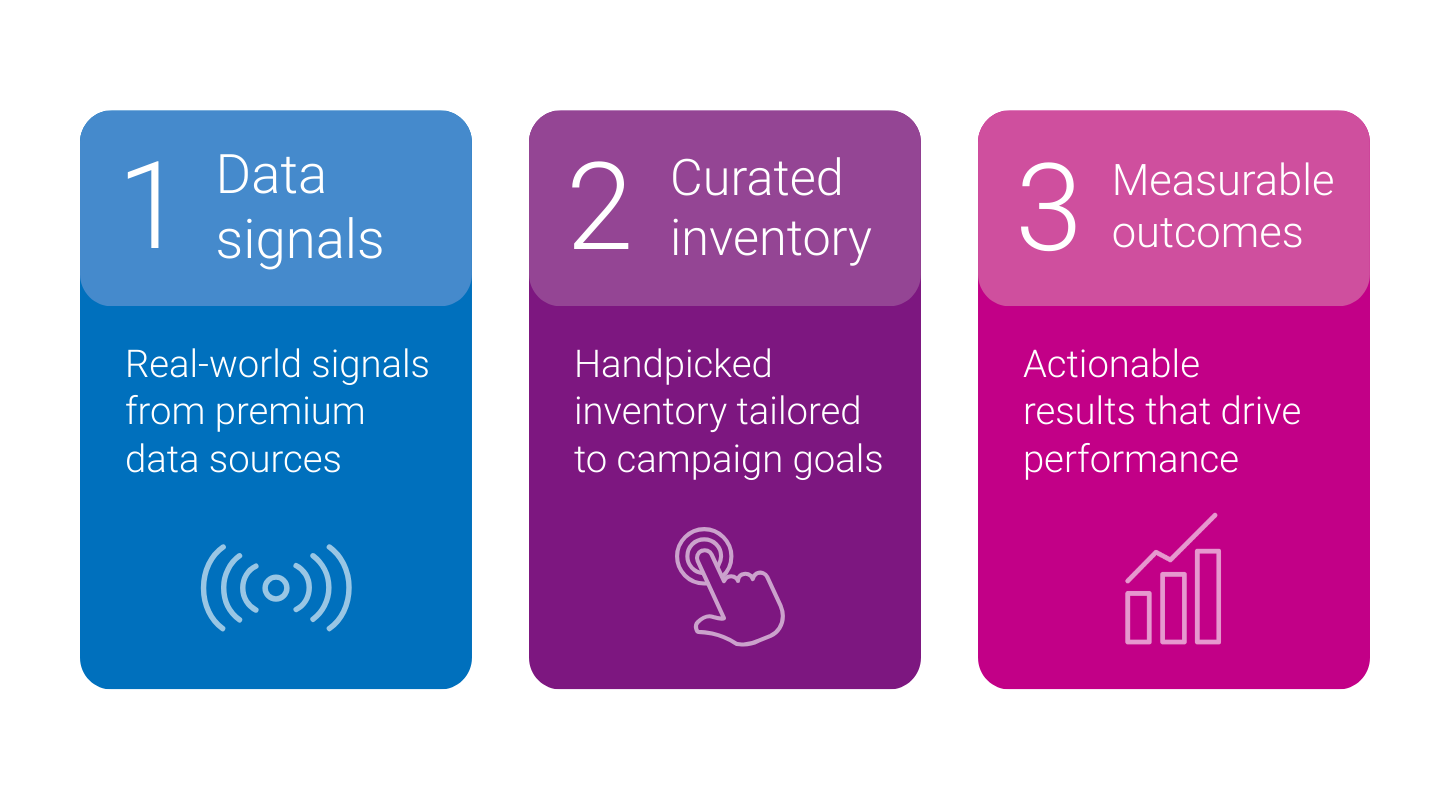
Here are three ready-made examples to spark ideas
1. Weather in real time
When the temperature climbs above 85°F, a beverage brand’s “Hot-Day Hydration” creative can launch automatically. Twenty-four hours before a heavy-rain forecast, big-box retailers can push “Storm-Ready Supplies” for generators and batteries. Weather-triggered audiences from The Weather Company mean you buy only when conditions drive demand.
2. Moments that matter to fans
Live Nation ticket-purchase signals that pinpoint two peak travel-booking windows—right after fans secure out-of-town concert or game tickets and again during the week leading up to the event—so airlines, online travel agencies, and hotels can serve timely seat-sale or last-minute lodging offers when intent (and conversion rates) are highest.
3. Intent you can see
Bombora B2B signals surface companies researching topics like “zero-trust security” or “cloud cost reduction.” A cybersecurity SaaS can reach those accounts with demo ads, and an office-furniture brand can court firms exploring “hybrid-workspace redesign.” Media spend zeroes in on buyers already in-market.
A customer-centric approach
Audigent delivers turnkey, customer-centric solutions across the open internet through Amazon DSP, prioritizing quality over quantity through premium web inventory. As buyers and sellers embrace more direct, transparent, and addressable supply paths, this streamlined approach boosts efficiency and drives meaningful outcomes for brands. Interested in trying this new path with Amazon Ads and Audigent? Email: audigent_sales@experian.com.
What’s next?
Audigent is committed to enhancing our curation services available through Amazon DSP. We’re focusing on:
As the advertising landscape evolves, Audigent will continue to innovate, ensuring our offerings complement and enhance the capabilities available through Amazon DSP.
Ready to cut supply path costs? Connect with us to design your first curated library
Latest posts

Yahoo DSP shares how ConnectID, interoperability, and Blueprint Performance support targeting and measurement, with Experian Audiences in Yahoo DSP.

Learn how retail marketers use Experian Audiences to reach consumers based on shopping patterns, purchase behavior, engagement preferences, and discretionary spend signals.

Commerce media networks have had a strong start. Growth has been fast, demand has been strong, and brands have made it clear they want closer access to commerce-driven audiences. But as more networks mature and enter the space, many are starting to feel the same pressure point: scale. Most commerce media networks were built as managed service businesses. That model works well early on. High-touch, white-glove partnerships make sense when you’re working with a handful of strategic brands. But there’s a ceiling. There are only so many teams, only so much inventory, and only so many advertisers that model can realistically support. It’s one thing for a large retailer to build custom programs for a P&G. It’s another to do that at scale for hundreds or thousands of brands. At some point, growth slows, not because demand disappears, but because the model can’t stretch any further. The scale problem no one likes to talk about That’s where many commerce media leaders find themselves today. Pausing to assess what comes next. For a long time, growth has been measured almost entirely through media dollars. That mindset is understandable. Media is familiar, it's easy to quantify. It shows up clearly in negotiations and revenue reports. But viewing commerce media networks purely as media sales engines creates long-term risk. It can strain brand relationships, limit innovation, and distract from what commerce media networks actually do better than almost anyone else: understand consumers deeply. Signals are the real asset Commerce platforms sit close to decision-making. They see what people search for, what they consider, what they buy, and when those behaviors change. Those signals are incredibly powerful. And yet, most networks only activate them inside their own walled environments. That’s a missed opportunity. Curation represents the next area of growth for commerce media networks, and it doesn’t require replacing or diminishing existing media revenue. In fact, it complements it. No single commerce media network has all the data needed to give advertisers the scale and reach they're looking for. And no advertiser wants to recreate the same audience in dozens of disconnected platforms. That friction creates inefficiency and slows decision-making. Why collaboration supports sustainable growth The opportunity is to look beyond first-party data alone and start thinking about collaboration. Second-party data. Data partnerships. Signal sharing done responsibly and transparently. Imagine an advertiser defining an audience once and being able to understand and reach that audience across multiple commerce environments. Not through a series of disconnected buys, but through a more consistent approach built on shared understanding leading to increased reach and more impactful campaigns. That’s easier for advertisers to manage, and it creates an additional revenue stream for commerce media networks that complements media sales rather than competing with them. Curation strengthens media, it doesn't replace it Media will always play an important role. There is clear value in custom experiences tied directly to a commerce environment. Think buyouts, sponsored experiences, custom creative integrations. Those are situations where brands want to work closely with the network itself. But the signals commerce media networks hold don’t need to be limited to those moments. Those signals can be monetized independently through data products, co-ops, and partnerships that extend their value into other channels. That’s how curation adds value without undercutting existing revenue. A practical path forward for commerce media leaders For commerce media leaders thinking about their next phase of growth, the focus should be on sustainability. Building a massive media operation takes time and investment. Data-driven revenue streams can be introduced more quickly, require fewer internal resources, and provide steadier margins. It’s a practical approach. Use signal-based revenue to fund growth. Let that revenue support investment in tooling, talent, and media innovation over time. Bootstrapping, in the truest sense. Why transparency matters early There’s also a broader responsibility here. In many advertising channels, transparency followed growth, often after pressure from the market. Commerce media networks have an opportunity to do this differently. To lead with transparency from the start. To be clear with brands and consumers about how data is used, how signals are created, and how value flows through the ecosystem. Because the reality is this: commerce media networks are holding some of the most valuable intent signals in the market today. But those signals don’t retain their value in isolation. If they aren’t enhanced, combined, and made accessible in the right ways, someone else will step in to do it. And when that happens, control shifts away from the source. The bottom line The next chapter of commerce media isn’t just about selling more media alone. It’s about recognizing the value of the signals already in hand, working together to make them more useful, and building additional revenue streams that support long-term growth. That’s how commerce media networks grow without eating their own lunch. About the author Kevin Dunn Chief Revenue Officer, Experian Kevin Dunn joins Experian Marketing Services with more than 20 years of leadership experience across marketing and advertising technology, most recently serving as Senior Vice President of Brands and Agencies at LiveRamp. In that role, he led growth across retail, CPG, travel, hospitality, financial services, and healthcare, overseeing new business, account expansion, and channel partnerships. Kevin is known for building cohesive, accountable teams and leading with optimism, clarity, and a strong sense of shared purpose. His leadership philosophy centers on empowering people, driving positive outcomes for clients and fostering a culture where teams can grow, take smart risks, and succeed together. Latest posts