At A Glance
Psympl shares how financial institutions can use audience motivations to inform targeting, messaging, channel selection, and customer engagement. In this Q&A, Brent Walker explains how Psympl Financial Segmentation, the Consumer Console™, Psymplifier™, and Experian data support practical financial marketing applications during the Great Wealth Transfer.In our Ask the Expert series, we interview leaders from our partner organizations who are helping lead their brands to new heights in AdTech. Today’s interview is with Brent Walker, Co-Founder and Chief Strategy Officer at Psympl.
Psympl helps financial institutions understand the motivations behind consumer financial decisions and put those insights to work across targeting, messaging, channel planning, and customer engagement. This conversation focuses on how Psympl applies those insights in financial services. For a broader explanation of how marketers group audiences based on attitudes, values, interests, and lifestyles, read our guide to psychographic segmentation.
What value does psychographic data add to financial marketing?
Demographic data tells financial marketers WHO a consumer is (like age, gender, or income), but it doesn’t predict decisions. Behavioral data shows WHAT a consumer does, but people can take the same action for different reasons. Understanding these reasons helps marketers engage consumers more effectively.
Psychographics reveal people’s attitudes, values, lifestyles, and personalities, the core of their motivations. This layer helps marketers understand WHY people act, anticipate needs, and connect in more meaningful ways.
This matters now as the “Great Wealth Transfer” unfolds: $124 trillion will be transferred from older to younger generations by the 2040s. Psychographics vary widely across generations, and up to 80% of heirs may switch financial institutions.
Using psychographic insights gives financial marketers a competitive edge during this historic wealth shift.
How can marketers apply Psympl Financial Segmentation?
Psympl Financial Segmentation groups households into five psychographic profiles, each with distinct approaches to money, investing, and engagement with financial advisors.
Psympl’s platform, the Consumer ConsoleTM, offers reference materials for understanding and engaging each Financial Segment, as well as access to extensive market research data conducted with Ipsos on the Segments to inform marketing strategy and campaign planning.
Psympl collaborates with Experian to map psychographic segments for all U.S. adults over 18. This allows financial services brands to enrich their consumer databases and find target customers based on psychographic, demographic, and socioeconomic profiles.
Experian Marketing Data also powers Psympl’s Geo-Targeting tool, which heatmaps the U.S. by psychographic segments down to the zip code, with filters for demographics, socioeconomic factors, and household counts.
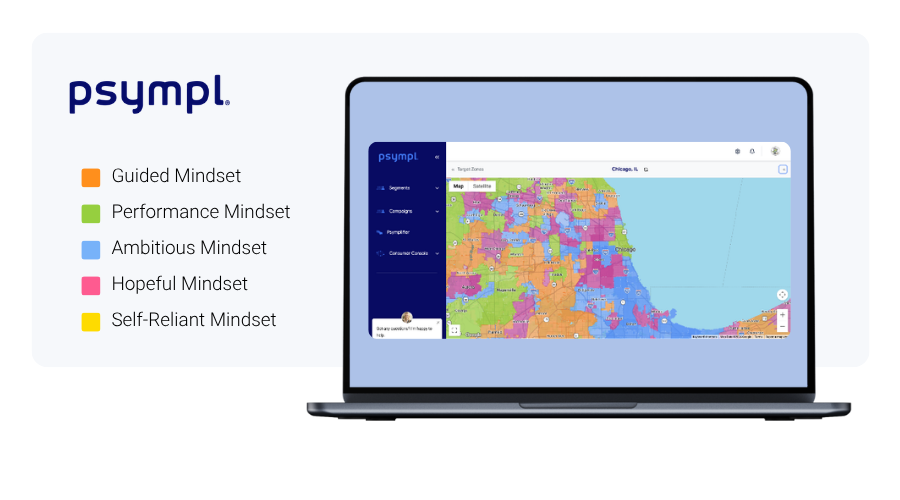
Psympl’s platform also includes the PsymplifierTM, which uses Psychographic AITM to create, analyze, and rewrite marketing content tailored to specific segments or generate new content from simple prompts.
How do Psympl and Experian aid targeting strategies?
Psympl and Experian support targeting strategies by connecting psychographic insight with consumer data, geography, and channel preferences. That combination gives financial institutions a more actionable view of who to target, where to reach them, and what message is likely to resonate.
By connecting psychographic insights with consumer data, geography, and channel preferences, Psympl and Experian show financial institutions who to target, where to reach them, and what message will resonate, forming the foundation for effective targeting.
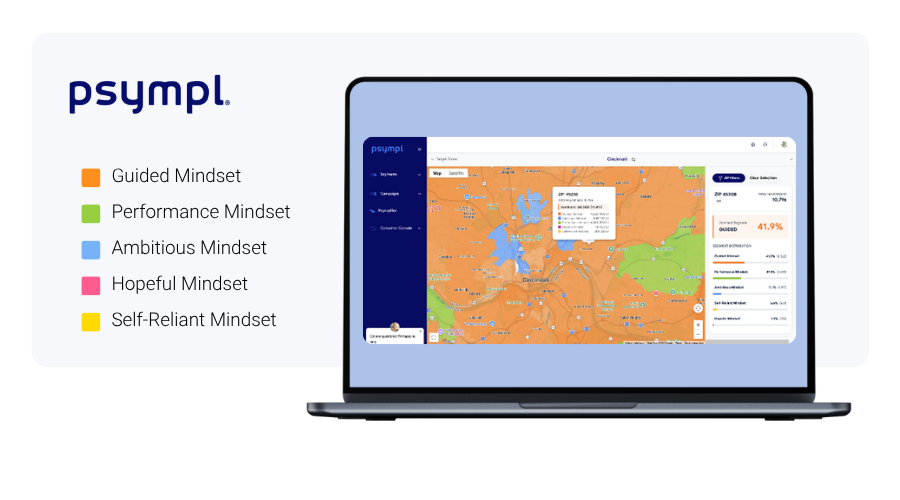
For example, a bank can pinpoint areas with consumers who prefer in-person service. Psympl’s Consumer Console™ highlights the Guided Mindset segment, those seeking expert financial help with $250,000+ in assets, as prime prospects. Psympl’s Geo-Targeting feature, powered by Experian Marketing Data, heat-maps where Guided Mindset households with $250,000+ in assets are concentrated.
In this example, one location stands out with a high representation (41.9%) and concentration (10,796 households) of the targeted Guided Mindset segment with $250,000+ in investable assets, shown in orange on the heat map. While nearby areas are dominated by Ambitious Mindset (blue) or Performance Mindset (green), the data suggests that ZIP code 45208 is an excellent candidate for a new branch, supported by targeted print, outdoor, or digital marketing.
Beyond location, Psympl’s research and Experian TrueTouch help firms choose the best channels for each segment and predict responses to direct mail, email, digital, and broadcast channels. Enriching customer databases with Psympl segments lets firms tailor messages—like notifying Guided Mindset customers about new locations, and use the Psymplifier™ to quickly generate targeted marketing content.
How are financial marketers using Psympl profiles across the customer lifecycle?
By addressing customer motivations and priorities at every stage, organizations drive consistency, align communications, and deliver on customer expectations, whether acquiring, retaining, or upselling clients.
Relationships with Baby Boomer clients often do not carry over to younger heirs, who typically have Ambitious and Hopeful Mindsets instead of the Guided, Performance, and Self-Reliant Mindsets more common among older generations. Psychographics reveal these generational differences, distinct needs, values, and engagement preferences, so firms can anticipate, address, and communicate more effectively across generations.
Tools like Psympl’s Consumer Console and Psymplifier, combined with Experian TrueTouch Engagement data, equip financial professionals to tailor interactions and marketing content to each segment’s unique preferences, maximizing impact and receptivity.
Firms that fail to adapt to the needs and preferences of younger generations will inevitably lose AUM. The Psympl platform, enhanced by Experian data, positions organizations to turn The Great Wealth Transfer into an opportunity rather than a threat.
How can financial institutions get started with Psympl Financial Segmentation?
After 20 years leading psychographic initiatives at Procter & Gamble, I wish I’d had Experian’s data and capabilities; they make planning and measurement much easier.
To start, enrich your CRM with Psympl psychographic Financial Segments from Experian. Analyze your customers to see which segments are over- or under-represented, revealing strengths and growth opportunities. Identify which segments most use specific products to target Prime Prospects. Then set a campaign goal and test psychographic messaging against a control group or with pre- and post-measures. Start small, earn, and adapt as you go.
Once you see results with relevant, psychographic-based content, expand this approach to prospecting, customer experience, and other applications.
Where can readers learn more?
I appreciate this opportunity! To learn more, readers can visit the psympl.com website, and more specifically, the Resources Page on the website, which includes videos, whitepapers, and guides for utilizing the Psympl psychographic Financial Segments for customer acquisition, retention, and enhanced engagement.
Contact us
Click here to view Experian’s U.S. Consumer Data Privacy Notice.
This site is protected by reCAPTCHA and the Google Privacy Policy and Terms of Service apply.
About our expert

Brent Walker, Co-Founder and Chief Strategy Officer, Psympl
Brent Walker is Co-Founder and Chief Strategy Officer for Psympl, helping wealth management firms, banks, credit unions, and financial services enhance customer acquisition, retention, and cross-sell initiatives. Brent started his career in Brand Management at Procter & Gamble, and over 20 years he led teams in product management, customer marketing, and psychographic segmentation initiatives. In 2012, he cofounded his first company focused on psychographics in healthcare, which saw a series of multiple acquisitions. Brent has delivered a variety of publications covering critical marketing topics, featured in Forbes, The Ohio Bankers League, The Commonwealth Fund, and Healthcare Finance.
Latest posts

With the long-term effects to the economy unknown, many consumers are feeling the financial impact, while others are looking for opportunities, resulting in a transformational shift in spending. Some brands are experiencing decreased or paused marketing budgets, and you may be trepidatious about making the right decisions in your efforts to grow share of wallet. Recent events have been an impetus for change and we’re seeing brands make modifications to traditional marketing strategies. Some are developing innovative technologies and utilizing new sources of data and analytics. As we look at how these changes impact marketing results, we see the gap grow between those brands who are equipped to pivot and implement new strategies quickly, versus those who are not. So what steps can your organization implement now to make the smartest choices for both your customers and your business to secure more share of wallet? Here are four ideas to accelerate the success of your next financial marketing campaign: 1. Meet your customers wherever they are: Digital-first strategies have never been more relevant than they are right now. While consumers have fully embraced online engagement, marketers are even more focused on reaching high-value segments in the channels they utilize. By using an informed, data-driven strategy that includes preferred marketing communication channels and decision-making styles, engagement increases across those channels your target audience frequents the most. For example, are they heavy social media users? Do they prefer streaming TV? Or do they tend to rely on financial advice vs. performing their own research? To drive take rates, your audience must be exposed to a tailored message, in the right channel, and possibly multiple times. 2. Use messaging that resonates: As consumers refocus priorities, their expectations of brands with whom they do business are ever-increasing. Reflecting an understanding of the current needs and interests of your customers and prospects is an undertone that can only help strengthen their view of your brand. Consumer behavior has changed and is unlikely to revert to what was, so you want to be relevant, but you also do not want to be seen as ‘tone deaf’. As a result, consider revising your segmentation strategy to leverage predictive insights, such as household economic indicators, financial behaviors, lifestyle propensities and interests to help shape your message into one that truly makes an impact. 3. Prove the worth of your campaign: New consumer journeys are being formulated and showing ROI is imperative as your marketing budget is scrutinized. Having the right industry-relevant metrics and reports to analyze and share with leadership are key. Demonstrate that your campaigns are contributing to bottom-line success—and justify future campaigns—by using data-driven measurement insights collected across multiple reads and countless touchpoints. Marketing budgets are being scrutinized now more than ever, so showing ROI is critical. Having the right metrics and reports to analyze and share with leadership are key. 4. Follow government regulations—leverage Fair Lending-friendly audiences: Whether you’re cross-selling or prospecting, now is the time to identify the right audiences with rich data insights to not only execute impactful campaigns but adhere to government regulations that protect consumers and your organization. Trusting that the data you are activating follows Fair Lending Laws, including the Equal Credit Opportunity Act (“ECOA”) and the Fair Housing Act (“FHA”) is crucial. The Federal ECOA prohibits creditors from discriminating against credit applicants on the basis of several prohibited factors. Developing people-based segments that are not derived using these factors positions you to follow these regulations. Check out our previous blog post about Fair Lending-friendly audiences here. As you transition to new operating models, access to current and accurate consumer data can provide confidence in campaign potential, help you avoid business risk, enable you to respond to market changes and make better decisions. Experian can help you implement these strategies and put your brand unique position for growth. From start to finish, we provide the marketing solutions you need to plan, build and execute successful, Fair Lending-friendly campaigns to cross-sell to existing customers and acquire new customers. *Experian Fair Lending-friendly audiences do not constitute legal advice or otherwise assure compliance with the FHA, ECOA, or any other applicable laws. It’s recommended to seek legal advice with respect to the use of data in connection with lending decisions or application and compliance with applicable laws. Contact us today

Cross-device matching and pixel-based foot traffic attribution reporting empower digital marketers with greater control of location-based campaigns.RALEIGH, N.C. (PRWEB) AUGUST 04, 2020 Tapad, part of Experian a global leader in digital identity resolution, and Reveal Mobile, a leader in location-based marketing, today announced a collaboration that combines Tapad’s digital cross-device matching technology and pixel-based attribution features with Reveal Mobile’s VISIT Local, the software that hundreds of digital agencies and brands use for location-based analytics. The partnership is designed to drive improved performance by optimizing ad targeting and messaging for location-based campaigns. Powered by Tapad’s privacy-safe cross device matching, marketers using VISIT Local to power location-based campaigns can enhance how they reach shoppers. When one member of a household shops for groceries, clothes, household goods or any other consumer item, a conversation between multiple members of the household typically takes place beforehand. With cross device matching, marketers can reach everyone who has influence over what to buy and where to buy it. VISIT Local users can expand location-based services with a single click to include devices that share the same household, including targeting across multiple devices owned by the same user, allowing advertisers to maximize messaging and increase their share of wallet among consumers. “VISIT Local has always given our customers access to high-intent location-based audiences. With the addition of cross device matching from Tapad, advertisers can boost audience sizes up to 300 percent while maintaining full confidence in quality and relevance,” says Brian Handly, CEO of Reveal Mobile. “VISIT Local users can now apply multiple criteria and attributes to a single location-based audience, giving them the advanced control and transparency they need.” As reliable attribution becomes increasingly complex for marketers and ad buyers who need to prove value, the addition of Tapad’s pixel-based foot traffic attribution to VISIT Local enables the measurement of actual campaign effectiveness by tying ad views to in-store foot traffic. This new feature, which will be available in VISIT Local this fall, lets Reveal Mobile customers understand who visited a retail location as a result of being served an ad, providing a more accurate view into return on ad spend during and after advertising campaigns. “Tapad’s goal is to empower marketers with digital advertising efficiencies at scale across devices,” says Mark Connon, COO of Tapad. “With cross device matching and pixel-based foot traffic attribution, marketers using VISIT Local can better address the consumer’s preferences and habits, and deliver them consistently actionable information on user behavior. These capabilities advance location-based advertising in ways marketers need and want.” In addition to these new features, VISIT Local’s location-based audience builder now enables marketers to create custom audiences made up of people who have visited different places on different dates. This gives VISIT Local users the ability to segment and create the most highly targeted audiences possible. For example, a marketer who wants to advertise for a chain of restaurants can easily target visitors of different competitors in different cities. Or a marketer who wants to advertise vacation destinations can target people who have been to various resorts at different times of year. Or a marketer who wants to advertise the release of new music can target people who have been to concert venues in different cities on different dates. “Many of our customers need to create highly custom audiences so they can run experiments, test messaging, and run increasingly competitive campaigns,” says Handly. “Everyone who uses VISIT Local can now apply multiple criteria and attributes to a single location-based audience, giving them the advanced control and transparency they need.”To learn more about Tapad’s digital identity resolution products, visit our identity solution page. To learn more about Reveal Mobile’s location-based marketing offerings, visit http://www.revealmobile.com. About TapadTapad, Inc. is a global leader in digital identity resolution. The Tapad Graph, and its related solutions, provide a transparent, privacy-safe approach connecting brands to consumers through their devices globally. Our one-of-a-kind Graph Select offering enables marketers the flexibility and freedom of choice to correlate devices to varied objectives, driving campaign effectiveness and business results. Tapad is recognized across the industry for its product innovation, workplace culture and talent, and has earned numerous awards including One World Identity’s 2019 Top 100 Influencers in Identity Award. Headquartered in New York, Tapad also has offices in Chicago, London, Oslo, Singapore and Tokyo. About Reveal MobileReveal Mobile is a leader in location-based marketing, analytics, audiences, and attribution. Creator of VISIT Local, VISIT Match and VISIT Data, the company’s products help digital agencies, brands and retailers of any size leverage location data to understand and reach the right audiences. Reveal Mobile is CCPA compliant and a member of the Network Advertising Initiative, which conducts an annual privacy certification. The company is based in Raleigh, NC. For more information, visit https://revealmobile.com. Contact us today
Overview Chartable leverages The Tapad Graph to improve cross-device attribution rates and remove non-addressable IPs for clients. Challenge Chartable needs to differentiate between consumer and potential business IP addresses to provide accurate household modeling and reduce excess data for their customers. Podcasting generally only has access to IP addresses as a form of digital ID which limits its ability to connect activity to individuals and extend it across all devices. The Tapad + Experian solution Using Tapad, now a part of Experian, Chartable is able to cut through the noise of IP data and discard any addresses deemed a shared IP or business. Then, Tapad + Experian connects individual users to their other digital IDs and users in their household; creating a richer attribution model for Chartable customers. Increase in podcast attribution rates Contact us today