At A Glance
Psympl shares how financial institutions can use audience motivations to inform targeting, messaging, channel selection, and customer engagement. In this Q&A, Brent Walker explains how Psympl Financial Segmentation, the Consumer Console™, Psymplifier™, and Experian data support practical financial marketing applications during the Great Wealth Transfer.In our Ask the Expert series, we interview leaders from our partner organizations who are helping lead their brands to new heights in AdTech. Today’s interview is with Brent Walker, Co-Founder and Chief Strategy Officer at Psympl.
Psympl helps financial institutions understand the motivations behind consumer financial decisions and put those insights to work across targeting, messaging, channel planning, and customer engagement. This conversation focuses on how Psympl applies those insights in financial services. For a broader explanation of how marketers group audiences based on attitudes, values, interests, and lifestyles, read our guide to psychographic segmentation.
What value does psychographic data add to financial marketing?
Demographic data tells financial marketers WHO a consumer is (like age, gender, or income), but it doesn’t predict decisions. Behavioral data shows WHAT a consumer does, but people can take the same action for different reasons. Understanding these reasons helps marketers engage consumers more effectively.
Psychographics reveal people’s attitudes, values, lifestyles, and personalities, the core of their motivations. This layer helps marketers understand WHY people act, anticipate needs, and connect in more meaningful ways.
This matters now as the “Great Wealth Transfer” unfolds: $124 trillion will be transferred from older to younger generations by the 2040s. Psychographics vary widely across generations, and up to 80% of heirs may switch financial institutions.
Using psychographic insights gives financial marketers a competitive edge during this historic wealth shift.
How can marketers apply Psympl Financial Segmentation?
Psympl Financial Segmentation groups households into five psychographic profiles, each with distinct approaches to money, investing, and engagement with financial advisors.
Psympl’s platform, the Consumer ConsoleTM, offers reference materials for understanding and engaging each Financial Segment, as well as access to extensive market research data conducted with Ipsos on the Segments to inform marketing strategy and campaign planning.
Psympl collaborates with Experian to map psychographic segments for all U.S. adults over 18. This allows financial services brands to enrich their consumer databases and find target customers based on psychographic, demographic, and socioeconomic profiles.
Experian Marketing Data also powers Psympl’s Geo-Targeting tool, which heatmaps the U.S. by psychographic segments down to the zip code, with filters for demographics, socioeconomic factors, and household counts.
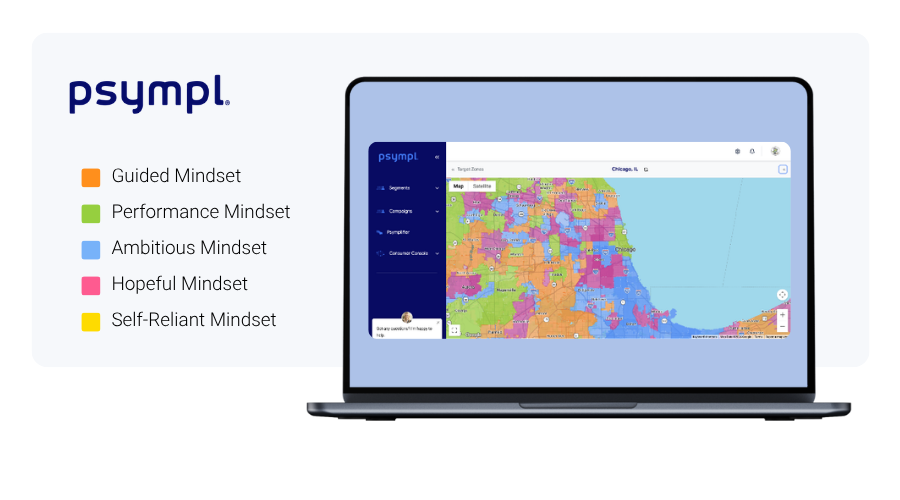
Psympl’s platform also includes the PsymplifierTM, which uses Psychographic AITM to create, analyze, and rewrite marketing content tailored to specific segments or generate new content from simple prompts.
How do Psympl and Experian aid targeting strategies?
Psympl and Experian support targeting strategies by connecting psychographic insight with consumer data, geography, and channel preferences. That combination gives financial institutions a more actionable view of who to target, where to reach them, and what message is likely to resonate.
By connecting psychographic insights with consumer data, geography, and channel preferences, Psympl and Experian show financial institutions who to target, where to reach them, and what message will resonate, forming the foundation for effective targeting.
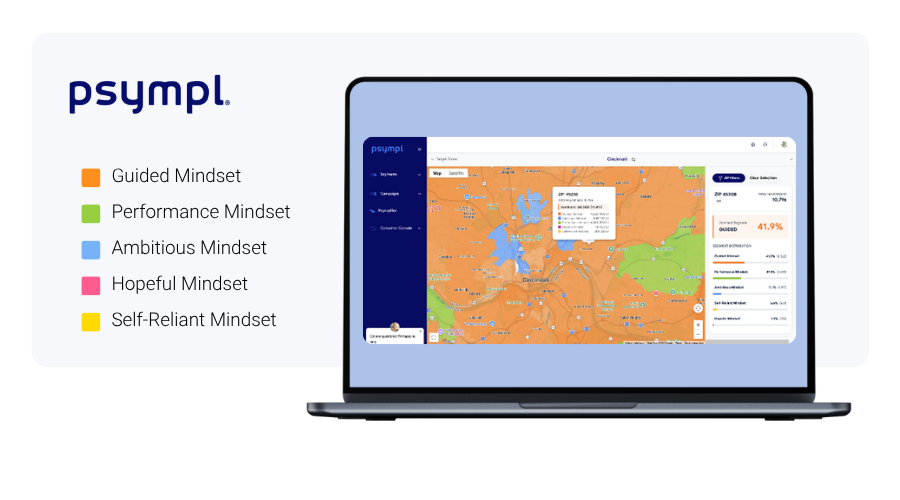
For example, a bank can pinpoint areas with consumers who prefer in-person service. Psympl’s Consumer Console™ highlights the Guided Mindset segment, those seeking expert financial help with $250,000+ in assets, as prime prospects. Psympl’s Geo-Targeting feature, powered by Experian Marketing Data, heat-maps where Guided Mindset households with $250,000+ in assets are concentrated.
In this example, one location stands out with a high representation (41.9%) and concentration (10,796 households) of the targeted Guided Mindset segment with $250,000+ in investable assets, shown in orange on the heat map. While nearby areas are dominated by Ambitious Mindset (blue) or Performance Mindset (green), the data suggests that ZIP code 45208 is an excellent candidate for a new branch, supported by targeted print, outdoor, or digital marketing.
Beyond location, Psympl’s research and Experian TrueTouch help firms choose the best channels for each segment and predict responses to direct mail, email, digital, and broadcast channels. Enriching customer databases with Psympl segments lets firms tailor messages—like notifying Guided Mindset customers about new locations, and use the Psymplifier™ to quickly generate targeted marketing content.
How are financial marketers using Psympl profiles across the customer lifecycle?
By addressing customer motivations and priorities at every stage, organizations drive consistency, align communications, and deliver on customer expectations, whether acquiring, retaining, or upselling clients.
Relationships with Baby Boomer clients often do not carry over to younger heirs, who typically have Ambitious and Hopeful Mindsets instead of the Guided, Performance, and Self-Reliant Mindsets more common among older generations. Psychographics reveal these generational differences, distinct needs, values, and engagement preferences, so firms can anticipate, address, and communicate more effectively across generations.
Tools like Psympl’s Consumer Console and Psymplifier, combined with Experian TrueTouch Engagement data, equip financial professionals to tailor interactions and marketing content to each segment’s unique preferences, maximizing impact and receptivity.
Firms that fail to adapt to the needs and preferences of younger generations will inevitably lose AUM. The Psympl platform, enhanced by Experian data, positions organizations to turn The Great Wealth Transfer into an opportunity rather than a threat.
How can financial institutions get started with Psympl Financial Segmentation?
After 20 years leading psychographic initiatives at Procter & Gamble, I wish I’d had Experian’s data and capabilities; they make planning and measurement much easier.
To start, enrich your CRM with Psympl psychographic Financial Segments from Experian. Analyze your customers to see which segments are over- or under-represented, revealing strengths and growth opportunities. Identify which segments most use specific products to target Prime Prospects. Then set a campaign goal and test psychographic messaging against a control group or with pre- and post-measures. Start small, earn, and adapt as you go.
Once you see results with relevant, psychographic-based content, expand this approach to prospecting, customer experience, and other applications.
Where can readers learn more?
I appreciate this opportunity! To learn more, readers can visit the psympl.com website, and more specifically, the Resources Page on the website, which includes videos, whitepapers, and guides for utilizing the Psympl psychographic Financial Segments for customer acquisition, retention, and enhanced engagement.
Contact us
Click here to view Experian’s U.S. Consumer Data Privacy Notice.
This site is protected by reCAPTCHA and the Google Privacy Policy and Terms of Service apply.
About our expert

Brent Walker, Co-Founder and Chief Strategy Officer, Psympl
Brent Walker is Co-Founder and Chief Strategy Officer for Psympl, helping wealth management firms, banks, credit unions, and financial services enhance customer acquisition, retention, and cross-sell initiatives. Brent started his career in Brand Management at Procter & Gamble, and over 20 years he led teams in product management, customer marketing, and psychographic segmentation initiatives. In 2012, he cofounded his first company focused on psychographics in healthcare, which saw a series of multiple acquisitions. Brent has delivered a variety of publications covering critical marketing topics, featured in Forbes, The Ohio Bankers League, The Commonwealth Fund, and Healthcare Finance.
Latest posts

Tapad launches global privacy-safe solution to provide continuity in the absence of third-party cookies Switchboard, a module within The Tapad Graph, will connect emerging cookieless identifiers to traditional IDs, creating a more holistic view of the consumer and driving value exchange within the advertising ecosystem Tapad, part of Experian, a global leader in cross-device digital identity resolution, and a part of Experian, announced today the launch of Switchboard, a first-of-its-kind solution to help navigate the evolving cookieless landscape. Switchboard, a module within The Tapad Graph, will operate as a global, privacy-safe solution to provide continuity in the absence of third-party cookies by connecting new cookieless identifiers to traditional digital IDs for a comprehensive view of consumers and their digital touchpoints. Switchboard will enable interoperability across the growing number of these digital identifiers and the value exchange between publishers, content creators and consumers. Leading digital identity solutions partnering with Tapad, part of Experian at the launch of Switchboard include Unified ID 2.0, ID5, Lotame Panorama ID, BritePool, Retargetly IDx and Audigent Halo ID. Tapad, part of Experian plans to expand support to additional identity solutions on an ongoing basis. In addition to these identity solutions, early partners across the ecosystem include The Trade Desk, Amobee, Martin, ShareThis, Eyeota and Catalina. “This diverse group of launch partners and testing customers will prove that Switchboard is an important tenet for the future of identity resolution. We’re excited to be proactive in our approach to give marketers time to adapt new solutions and test their function in tandem with the third-party cookie, while continuing to give our customers flexibility and control,” said Mark Connon, General Manager of Tapad, part of Experian. “Facilitating access and usage of 1st party identifiers is crucial to help marketers prepare for the cookieless future. Thanks to Switchboard, ID5’s cookieless IDs will be available to a wider audience of brands and agencies and enable them to run effective, data-driven campaigns beyond the third-party cookie,” said Mathieu Roche Co-founder & CEO of ID5. Switchboard provides value across the marketing and advertising ecosystem as the need for the ability to support multiple cookieless ID’s across ad tech increases throughout 2021. With a decade of expertise creating digital identity resolution products, Tapad, part of Experian is poised to solve this challenge through innovation and quality, privacy-safe data-driven solutions. “Interoperability is paramount for brand marketers, agencies, publishers and platforms if we want to support an open and free Internet and break free of the stranglehold of walled gardens,” said Pierre Diennet, Global Partnerships at Lotame. ”Lotame Panorama ID’s participation in Switchboard reflects our steadfast commitment to collaborating across and within the industry and providing value to all of its players.” “As advertisers continue to contemplate the future of identity, Amobee is proud to partner with Tapad, part of Experian on this next-generation solution to provide a comprehensive view of consumers,” says Bryan Everett, Senior Vice President of Global Business Development at Amobee. “With the imminent loss of cookies, advertisers must think creatively in order to respectfully engage consumers in a privacy-compliant way and Switchboard can play an important role in addressing their respective identity needs.” Tapad, part of Experian is welcoming identity solutions and Tapad Graph customer participation in Switchboard throughout 2021. Stayed tuned for more updates and information on Switchboard in the coming months. Get in touch
Adapt with Tapad, a part of Experian Leading browsers have made public announcements and technical deployments to reduce the digital advertising accessibility of third-party cookies for data collection, storage, and sharing due to growing privacy concerns. As a result, there has been growing momentum to find an alternative via cookieless IDs, with the intent to create a replacement that helps ensure continuity across the ecosystem. At Tapad we’ve chosen to approach the market with a solution that provides agnostic interoperability for these cookieless identifiers, so that marketers can continue to work with the identity providers of their choice while maintaining the most holistic view of consumers across digital touchpoints. Introducing switchboard Switchboard is a module within The Tapad Graph that leverages our core capabilities across machine learning and identity management to provide a connection between traditional digital identifiers and the new wave of cookieless IDs that will be utilized in the future. Customers of Tapad can take advantage of its broad ecosystem of identifiers to drive targeting and frequency capping strategies and enable detailed measurement and attribution post-deprecation of the third-party cookie. Our goal is to accelerate the adoption, scale, and utility of cookieless IDs with the release of the Switchboard module within The Tapad Graph, while maintaining an agnostic approach to the market. Switchboard for identity solutions In the evolving landscape agencies and marketers will need to invest, test, and analyze the best combination of cookieless ID partners to meet their objectives. The Switchboard module will increase the utility and value of the cookieless ID space in conjunction with other addressable IDs, by providing a layer of connectivity that will be natively missing with the deprecation of third-party cookies. Identity solutions at launch: Switchboard for graph customers For existing Tapad customers who leverage the Switchboard module in The Tapad Graph, it will provide a seamless way to facilitate interoperability while resolving identity back to a Household or Individual. By providing this translation layer, Tapad will take on the responsibility of encryption and decryption protocols where applicable, which will deliver added functionality to our customers. Tapad + Experian partners at launch: Use cases Resolve existing first-party data with new cookieless solutions through The Tapad Graph to minimize data loss Frequency cap at the Individual and Household level via Cookieless and traditional ID Reach consumers at scale across all touchpoints and IDs Build a more inclusive and holistic view of the consumer journey Run accurate and scalable measurement before and after the formal deprecation of third-party cookies in Chrome Map online data into offline activities Hear why industry leaders are adapting with Tapad + Experian As advertisers continue to contemplate the future of identity, Amobee is proud to partner with Tapad, a part of Experian, on this next-generation solution to provide a comprehensive view of consumers. With the imminent loss of cookies, advertisers must think creatively in order to respectfully engage consumers in a privacy-compliant way and Switchboard can play an important role in addressing their respective identity needs. — Bryan Everett | Senior Vice President of Global Business Development | Amobee Connecting offline and online shopper activity in a privacy-compliant way is fundamental to marketing effectiveness and determining return on ad-spend. That’s why we’re excited to be a launch partner for Tapad + Experian’s Switchboard offering; it provides a unified solution for supporting the variety of proprietary and anonymous user ID standards required by advertising demand-side platforms today. — Brian Dunphy | SVP Digital Business and Strategic Partnerships | Catalina As the industry evolves, Tapad + Experian’s Switchboard presents a privacy-safe solution that allows for the continued activation of data and an alternative to advertising within walled garden environments. We look forward to collaborating with Tapad and the industry as we collectively transition to support cookieless identity. — Don Lee |SVP of Global Platform Partnerships | Eyeota We are excited to participate in this proactive solution to the sunset of third-party cookies. Switchboard’s agnostic interoperability, with BritePool and other ID providers, will create high-value for marketers as they transition to the era of cookieless web advertising. — David J. Moore | CEO | BritePool Interoperability is paramount for brand marketers, agencies, publishers and platforms if we want to support an open and free Internet and break free of the stranglehold of walled gardens. Lotame Panorama ID’s participation in Switchboard reflects our steadfast commitment to collaborating across and within the industry and providing value to all of its players. — Pierre Diennet | Global Partnerships | Lotame At this pivotal moment in the industry, we are excited to be partnering with Tapad, a part of Experian on their cookieless initiative and making Retargetly IDx available into the Switchboard solution, providing global brands, platforms and publishers with a compliant, cookieless ID solution for the Latin American market; enabling them to target, reach and measure users at scale through the region. — Daniel Czaplinski | CEO and Co-Founder | Retargetly With Audigent’s Halo ID, we’re architecting a cookieless future where clients and partners have confidence in the actionability and interoperability of exclusive 1st party audiences, originated from some of the world’s leading publishers and creators. We see collaboration as being critical to a collective understanding of identity and Tapad, a part of Experian as a trusted partner with solutions such as Switchboard to support continuity for marketers’ addressability. — Drew Stein | CEO and Founder | Audigent Facilitating access and usage of 1st party identifiers is crucial to help marketers prepare for the cookieless future. Thanks to Switchboard, ID5’s cookie-less IDs will be available to a wider audience of brands and agencies and enable them to run effective, data-driven campaigns beyond the third-party cookie. — Mathieu Roche | CEO and Co-Founder | ID5 Addressing the current identity challenge requires transparency and collaboration. We are pleased to align ShareThis data with Tapad + Experian’s growing ecosystem. ShareThis data helps marketers evolve beyond the cookie to complete the picture. Tapad + Experian’s Switchboard offering will support ShareThis’s deep connections to clients and technology platforms, preserving and growing the accessibility of our data. — Michael Gorman | SVP Product and Business Development | ShareThis Get in touch
With the emergence of email addresses as a currency for brands to communicate with their consumers offline; attaching email data to in-store purchases lays the groundwork for future advertising strategies. However, this advantage in having an additional digital touchpoint also creates a new challenge for marketers. How do they connect what they know about their customers via offline data and PII, or personally identifiable information, with what they want to know about their online behaviors and interactions? Taken a step further, how can they create actionable strategies that connect these two streams of consumer insights in order to drive them to make more future purchases; and even become loyalists? At a time when the shift from traditional to online shopping feels more like a landslide; connecting online and offline data has never been more valuable or more urgent. The solution for these marketers lies in the framework of identity resolution; and a key capability called hashed email onboarding. Hashed email onboarding is a privacy-safe way to connect consumer email addresses to their related digital devices and other digital identifiers. The methodology prevents the consumers actual email address from being readable; while still providing marketers a connection between those emails and other touchpoints for an individual. Instead of understanding the customer journey in two distinct parts; how they interact with a brand or company offline and separately how they interact with a brand online; hashed email onboarding allows for the two parts to be woven together in a holistic view of that consumer. The power of connecting these data sets can be seen when combining offline and online attribution and measurement to improve frequency capping and look-alike modeling. It’s important to note that not all identity resolution vendors that onboard hashed emails function in the same way or provide the same level of data. Some connect only to desktop or only to mobile devices; while others don’t actually make direct linkages at all- they simply provide the hashed emails as a targetable digital audience for upload. While hashed email onboarding and the connection between offline and online data is a powerful strategy; it needs to be as structured as possible across the most data available to reveal truly efficient targeting and measurement strategies. Tapad, a part of Experian has built a hashed email product feature that works with the existing flexibility of The Tapad Graph to deliver the most holistic consumer view in the structure that works best for your business objectives. Get in touch