At A Glance
Experian’s Digital Graph and Marketing Attributes joint solution connects digital identifiers with rich consumer attributes. Our joint solution supports identity resolution, cross-channel media activation, analytics, and measurement, helping marketers unify fragmented signals and drive greater reach and insight.What is Experian’s Digital Graph and Marketing Attributes?
Experian’s Digital Graph and Marketing Attributes joint solution is a unified identity and data framework that connects digital identifiers with rich consumer attributes.
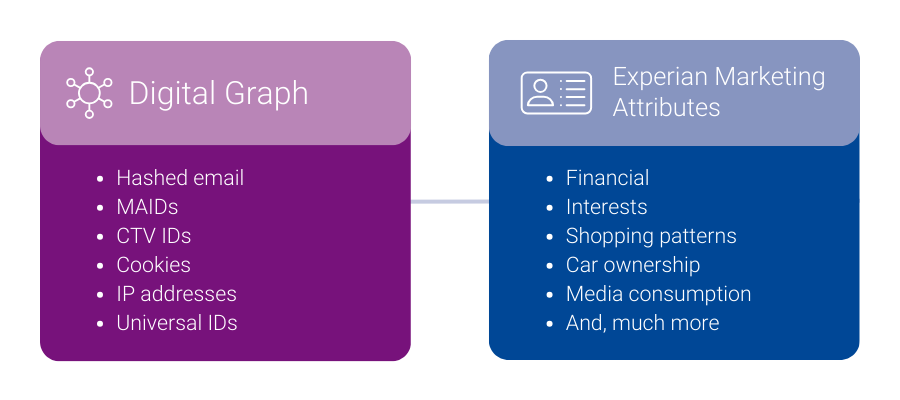
Experian’s Digital Graph connects digital identifiers to people and households, while Experian’s Marketing Attributes add depth, including demographics, interests, shopping behavior, and media preferences. Together, they help marketers and platforms with the insights and connectivity they need to understand who their customers are and reach them across digital channels.
How signal fragmentation and omnichannel are reshaping audience connection
Signal fragmentation and third-party cookie uncertainty are reshaping how our industry reaches consumers. At the same time, omnichannel media consumption spreads engagement across platforms, creating a broader but more complex view of consumer behavior. Together, these shifts are pushing marketers and platforms to rethink how they connect insights, activation, and reach across channels, opening the door to more unified approaches.
How Experian’s joint solution helps marketers and platforms address signal fragmentation and omnichannel behavior
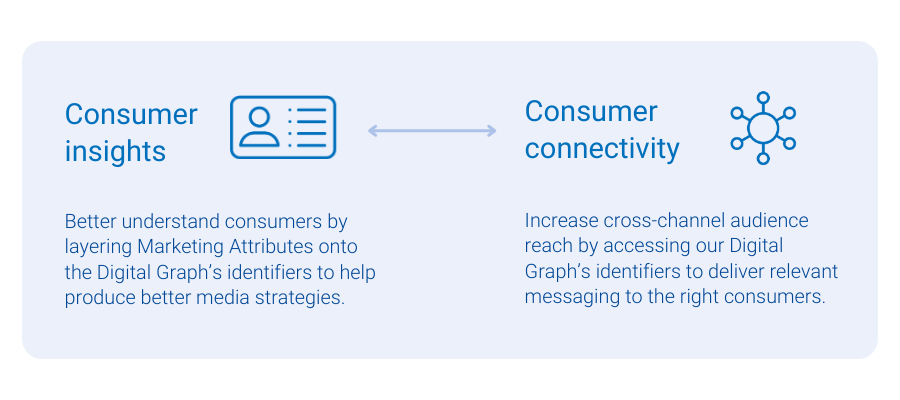
Our Digital Graph and Marketing Attributes joint solution helps marketers and platforms navigate signal fragmentation and omnichannel behavior by providing identifiers for seamless cross-channel engagement. By adding Marketing Attributes to our Digital Graph, like demographic and behavioral data, marketers and platforms can gain a better understanding of their consumers. Our joint solution uses Experian’s identity keys, the Living Unit ID (LUID) and Person ID (PID), to combine offline and digital data, giving you deeper insights into consumer behavior, greater audience reach, and improved cross-channel visibility.
What are the benefits of Experian’s Digital Graph and Marketing Attributes joint solution?
Our Digital Graph and Marketing Attributes joint solution brings identity and insight into a single framework, supporting the following benefits:
Four ways to use Digital Graph and Marketing Attributes
When our Digital Graph and Marketing Attributes come together, you get a 360-degree view of your consumers, powering four critical use cases:
How OpenX uses Experian’s Digital Graph and Marketing Attributes joint solution
OpenX is an independent omni-channel supply-side platform (SSP) focused on audience and identity-based targeting across CTV, mobile, app, and desktop environments.
OpenX licenses Experian’s Digital Graph to support one of the largest independent supply-side identity graphs. The addition of Experian Marketing Attributes enriched this graph with consumer-level insight tied to IPs, MAIDs, and client identifiers.
This approach has supported greater addressability and insight for buyers and improved monetization opportunities for publishers during ongoing signal fragmentation.
“We built on our long-term partnership with Experian to enrich our digital IDs with Experian’s Marketing Attributes, which help provide buyers better insights to audiences, thereby helping our publishers monetize their inventory. With partners like Experian, OpenX effectively facilitates the value exchange between demand and supply, ensuring our partners are able to drive results for their business in the era of signal fragmentation”
OpenXCraig Golaszewski, Sr. Director of Strategic Partnerships
How StackAdapt uses Experian’s Digital Graph and Marketing Attributes joint solution
StackAdapt is the multi-channel programmatic advertising platform used by marketers for campaign execution, insights, and measurement.
StackAdapt licenses Experian’s Digital Graph alongside Experian Audiences, which provides them with the level of information they want. Our Digital Graph supports first-party data onboarding, and Experian Audiences support segmentation for activation.
This product combination supports cross-channel reach, segmentation, and campaign measurement within the StackAdapt platform.
“StackAdapt has been recognized as the most trusted programmatic platform by marketers, and with the integration of Experian’s Digital Graph and Audiences, we are strengthening our leadership in the space. This partnership improves our ability to deliver precise cross-channel segmentation, reach, and measurement, helping advertisers run more successful campaigns. Our collaboration with Experian allows us to offer a differentiated solution in the market and ensure our clients can deliver the most precise and impactful ads to their audiences.”
StackAdaptDenis Loboda, Senior Director of Data
We recently announced a new collaboration with StackAdapt, bringing the power of Experian’s identity graph, syndicated and custom audiences directly to the StackAdapt platform.
How Experian supports cross-channel marketing strategies with our Digital Graph and Marketing Attributes joint solution
Our Digital Graph and Marketing Attributes joint solution helps marketers and platforms connect identity to insight so they can create, activate, and measure cross-channel media campaigns.
Connect with us to learn how our Digital Graph and Marketing Attributes joint solution can support your cross-channel strategy.
Get in touch with us
FAQs
Experian’s Digital Graph and Marketing Attributes joint solution supplies marketers and platforms with the insights and connectivity they need to understand who their customers are and reach them across digital channels.
Experian’s Digital Graph unifies digital identity signals into a single, privacy-safe view of households and individuals.
Experian’s Marketing Attributes are consumer-level descriptors that include demographics, interests, shopping behavior, and media usage.are consumer-level descriptors that include demographics, interests, shopping behavior, and media usage.
Experian’s Digital Graph and Marketing Attributes joint solution links digital identifiers with attribute data, allowing platforms and marketers to understand and engage audiences across channels.
Marketers, publishers, supply-side platforms, and demand-side platforms use Digital Graph and Marketing Attributes joint solution for analytics, activation, and measurement.
Experian’s Digital Graph and Marketing Attributes joint solution addresses signal fragmentation by reducing reliance on a single identifier type by supporting multiple digital identifiers within one identity framework.
Latest posts

As partnership deals mount, aggressive hiring underway for unified cross-screen technology leaders NEW YORK, July 19, 2016 /PRNewswire/ – Tapad, the leader in cross-device marketing technology and now a part of Experian, has announced plans for aggressive expansion in the Asia Pacific (APAC) region. This move capitalizes on Tapad's exceptional performance for brands and marketing technology companies in North America and Europe. With it's proprietary Tapad Device Graph™, the company will enable global, regional and local clients and partners to understand, monetize and measure marketing to users across screens. The Tapad Device Graph is recognized as the most accurate, scalable cross-screen solution in the market today. The decision to expand into APAC was based on increased demand from global, as well as local, brands and clients, many of which have a strong market presence throughout the region. In addition to expanding its roster of world-class data partners, plans include building a world-class team in Singapore. Over the next few months, Tapad APAC will also establish local entities in additional markets. To accelerate its ramp-up, Tapad APAC is actively recruiting in many areas, ranging from skilled and experienced solutions engineers to seasoned sales and marketing professionals. "Tapad is thrilled to be answering the call for cross-device excellence in APAC," said Pierre Martensson, GM of Tapad APAC. "Our Device Graph is adding millions of devices daily and achieves unmatched levels of scale and accuracy while protecting consumer privacy. This meets a critical need in the region." Tapad appointed Martensson as General Manager of Tapad APAC in May, kicking off expansion in the region. Martensson comes to Tapad with nearly a decade of operations experience throughout APAC, having transformed, developed and grown global organizations. To learn more about partnership and employment opportunities available with Tapad in APAC, visit www.experian.com/careers. Contact us today
Combined technology gives marketers an enhanced view of the customer for improved planning, targeting and optimization NEW YORK, July 12, 2016/PR Newswire/ - Tapad, the leader in cross-device marketing technology and now a part of Experian, today announced a partnership with Conversion Logic, the martech industry's most accurate unified marketing attribution provider. Conversion Logic will incorporate unified cross-screen data from Tapad's Device Graph™ to identify related devices and media exposures to enhance reporting on the path to conversion. By connecting Conversion Logic's proprietary Ensemble Method, which combines numerous state-of-the-art machine learning algorithms, tuned for each customer use-case for the most accurate results, with Tapad's unified, cross-device technology, marketers will benefit from a highly scientific approach to assessing advertising effectiveness with full, comprehensive customer insights. Linking these technologies will increase marketers' real-time ability to optimize brands' marketing channel spend and creative at a more granular level. During the past six months, Tapad has rapidly grown its data business, doubling the number of companies integrating the Device Graph™ into their platforms and growing the annualized revenue run rate by 210%. Tapad's highly scalable, cross-device data has been confirmed by Nielsen to be very precise. Tapad augments platforms' and publishers' tech stacks with additional scale and relevancy, granting advertisers amplified targeting and analysis options. The growth of the Device GraphTM has allowed Tapad to provide a growing network that benefits all partners with more efficient, effective consumer engagement. "Combining highly accurate data from Tapad with our own user ID technology and understanding how devices may be related at an individual level provides additional visibility into the path to conversion," said Alison Lohse, COO and co-founder of Conversion Logic. "The more we know about the customer journey, the more effective, efficient and customized marketers can be with marketing efforts. With Tapad, we have achieved a unified customer view that helps us piece together the purchase journey while preserving proven accuracy." "Conversion Logic's Ensemble Method delivers singularly customized and precise results that are not just accurate, but actionable," said Dave Fall, COO of Tapad. "The combination of powerful technology and a user-friendly interface, plus Tapad's ability to only consider relevant and scalable components in the marketplace, creates a more concentrated and beneficial environment for both its partners and clients." Contact us today
B2B marketers can now deliver the right message to the right user at the right time across devices and channels NEW YORK, NY–(Marketwired – Jun 1, 2016) - Madison Logic, one of the world's fastest growing companies dedicated to solving the digital needs of B2B marketers, is partnering with Tapad, the leading provider of unified and now a part of Experian, cross-screen marketing technology solutions. Now business-to-business (B2B) marketers can power targeted advertising and content syndication programs across all channels, including smartphones, computers and tablets. The increasing shift in content consumption across mobile devices makes cross-device identification and attribution a top priority for B2B marketers. The Madison Logic and Tapad partnership gives B2B marketers unprecedented reach and scale with the ability to run always-on, cross-device, account-based marketing programs targeting decision makers who are actively researching similar products and services. "Screens are everywhere and so is the B2B buyer," said Vin Turk, SVP of Audience Development for Madison Logic. "This partnership allows marketers to harness the power of Madison Logic's intent data and combine it with Tapad's cross-device solutions to connect with the most-likely-to-convert prospects with hyper-relevant content wherever and whenever they're doing their research." "Relevance is essential to the success of B2B marketers, particularly now, when breaking through the clutter is difficult," said Dave Fall, COO of Tapad. "This partnership with Madison Logic allows marketers to leverage their existing customers while identifying and reaching new audiences with messaging tailored to every device." For more information about Madison Logic's account-based marketing platform, please visit https://www.madisonlogic.com/account-based-marketing/. For more information about Tapad's cross-platform advertising solutions, please visit https://www.experian.com/marketing/consumer-sync. Contact us today