Experian, the leader in powering data-driven advertising through connectivity, is thrilled to unveil our latest solution, Digital Graph and Marketing Attributes. This joint solution supplies marketers and platforms with the insights and connectivity needed to understand who their customers are and reach them across digital channels.
The uncertainty around third-party cookies in Chrome and the overall decline in signal complicates the industry’s ability to reach the right consumer. Omnichannel media consumption results in scattered data, making it harder for marketers and platforms to understand consumer behavior and reach them across channels. These challenges call for a comprehensive solution.
Our Digital Graph and Marketing Attributes solution addresses these challenges by providing identifiers for seamless cross-channel engagement. By adding Marketing Attributes, like demographic and behavioral data, marketers and platforms also gain a better understanding of their customers. This solution uses Experian’s Living Unit ID (LUID) to combine offline and digital data, giving customers deeper insights into consumer behavior, greater audience reach, and improved cross-channel visibility.
Benefits of Digital Graph and Marketing Attributes
Both our Digital Graph and Marketing Attributes provide value to clients as standalone products. When clients license our Digital Graph and Marketing Attributes joint solution, they have more data at their fingertips, unlocking:
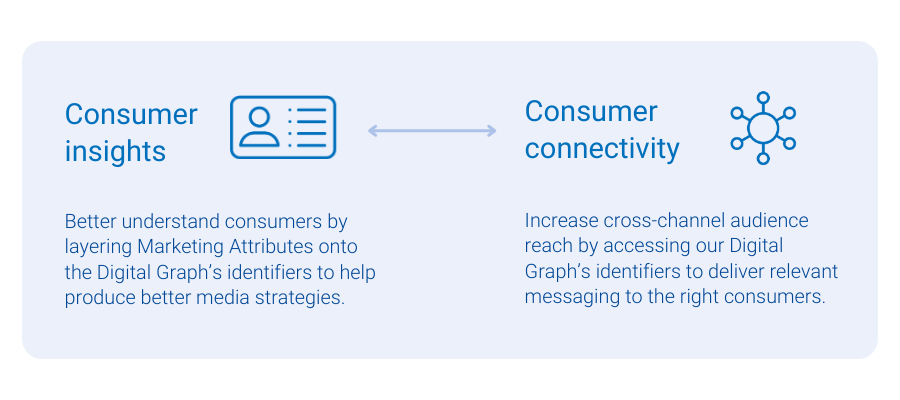
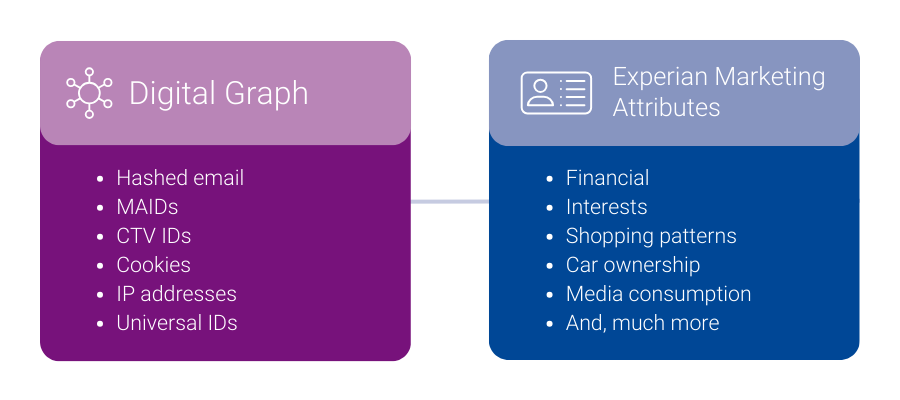
- Consumer connectivity: When clients license Experian’s Digital Graph, they get access to digital identifiers like mobile ad IDs (MAIDs), connected TV (CTV) IDs, hashed emails (HEMs), and universal IDs so they can target the right consumers with the relevant messages across all digital media channels.
- Consumer insights: Experian’s 5,000 Marketing Attributes provide our clients with detailed consumer information and insights, such as age, gender, purchase behaviors, and content consumption habits. Marketing Attributes help clients create more relevant messaging and informed audience segmentation.

Client examples
How OpenX offers richer targeting and more connectivity with Experian
OpenX is an independent omni-channel supply-side platform (SSP) and a global leader in audience, data, and identity-targeting. With industry-leading technology, exceptional client service, and extensive scalability across all formats, including CTV, app, mobile web, and desktop, OpenX has a legacy of innovating products that enhance buyer outcomes and publisher revenue while addressing complex challenges in programmatic.
In recent years, OpenX has licensed Experian’s Digital Graph with identifiers, contributing to the SSP’s largest independent supply-side identity graph, which offers advanced audiences to buyers and improved data resolution to content owners.
More recently, OpenX licensed Experian’s Marketing Attributes to enrich its supply-side identity graph, which includes IPs, MAIDs, and client IDs, with a variety of attributes. This strategic move has helped OpenX’s clients benefit from enhanced consumer insights and addressability, in turn delivering greater reach to the demand side and higher revenue for publishers, despite industry signal loss.
“We built on our long-term partnership with Experian to enrich our digital IDs with Experian’s Marketing Attributes, which help provide buyers better insights to audiences, thereby helping our publishers monetize their inventory. With partners like Experian, OpenX effectively facilitates the value exchange between demand and supply, ensuring our partners are able to drive results for their business in the era of signal loss”
Craig Golaszewski, Sr. Director of Strategic Partnerships, OpenX
How StackAdapt licenses our product bundle to address three different use cases
StackAdapt is the multi-channel programmatic advertising platform trusted by marketers to deliver exceptional campaigns. They drive superior results through a variety of solutions, like contextual and first-party targeting, brand lift measurement, and optimization through insights.
StackAdapt licensed a similar yet unique product combination, our Digital Graph and our Audiences. StackAdapt uses the Digital Graph to allow clients to onboard their first-party data in a seamless, self-serve manner that allows them to further segment their data using Experian Audiences.
“StackAdapt has been recognized as the most trusted programmatic platform by marketers, and with the integration of Experian’s Digital Graph and Audiences, we are strengthening our leadership in the space. This partnership improves our ability to deliver precise cross-channel segmentation, reach, and measurement, helping advertisers run more successful campaigns. Our collaboration with Experian allows us to offer a differentiated solution in the market and ensure our clients can deliver the most precise and impactful ads to their audiences.”
Denis Loboda, Senior Director of Data, StackAdapt
We recently announced a new partnership with StackAdapt. This collaboration brings the power of Experian’s identity graph, syndicated and custom audiences directly to the StackAdapt platform. Read the full details in our press release here.
Four ways to use Digital Graph and Marketing Attributes
When these two products come together, our clients have a 360-degree view of their consumers, which helps them power four critical use cases:
- Analytics and insights: Learn more about your consumers by connecting our Marketing Attributes with our Digital Graph’s identifiers. For example, a retailer can discover that their recent customers over-index as pickleball fans and players, leading the retailer to sponsor a professional pickleball event.
- Inventory monetization: When supply-side partners know their audience better, they can attract advertisers in search of that audience. For example, a publisher might find out that their audience is full of pickleball fans, leading them to reach out to brands that want to reach this audience.
- Activation: Companies with access to more digital identifiers from our Digital Graph can reach more people, while controlling frequency across channels. A company might know that they want to reach pickleball fans. Now, they have the digital identifiers needed to reach pickleball fans across all digital channels where they consume content, leading to increased reach.
- Measurement and attribution: Use the Digital Graph’s support for various digital identifiers to understand all consumer touchpoints, from media impressions to conversions. Then, lean on our Marketing Attributes to determine who your messaging resonated with. For example, a company uses our Digital Graph to know if it was the same individual who was exposed to an ad on CTV and converted via e-commerce. On top of that, the company can use our Marketing Attributes data to find out that the people who purchased were overwhelmingly pickleball fans.
Connect with us to learn more about how our Digital Graph and Marketing Attributes joint solution can provide the data and insights you need to create, activate, and measure cross-channel media campaigns.
Get in touch with us
Latest posts

Over the last few months, Experian has released new syndicated audiences to most major platforms supporting retail and travel. In this blog post, we’ll highlight some of these new audiences and how they can be used with other data from Experian to build the perfect audience to reach your customers and prospects. What separates Experian's syndicated audiences Experian’s 2,400+ syndicated audiences are available directly on over 30 leading television, social, programmatic advertising platforms, and directly within Audigent for activation within private marketplaces (PMPs). Reach consumers based on who they are, where they live, and their household makeup. Experian ranked #1 in accuracy by Truthset for key demographic attributes. Access to unique audiences through Experian’s Partner Audiences available on Experian’s data marketplace, within Audigent for activation in PMPs and directly on platforms like DirectTV, Dish, Magnite, OpenAP, and The Trade Desk. Household Expenditure audiences We’ve created new predictive audiences to help retailers reach consumers across 35 categories likely to spend within that category. A few categories include Apparel, DIY, Health, and more. With the launch of these new audiences, we will retire our existing Household Consumer Expenditure, Online and Retail category audiences in the November Digital Master update. Who these audiences are for Our Household Expenditure audiences use data from multiple sources, providing brands with highly accurate purchase predictions and data that scales for digital execution. Household Expenditure audiences are an excellent solution for brands with new product lines or where targeting based on historical purchases lack signal brands seek. Building data from multiple data sources helps ensure high performance and accuracy and can illuminate trends in consumer shopping patterns. These trends can be used to help predict future shopping behaviors. How to refine our Household Expenditure audiences To refine your audience, you can combine this data with Experian’s demographic and household expenditure audiences to ensure you are reaching consumers. For example, suppose you’re an apparel brand launching a new line aimed toward women over the age of 40. In that case, you can use Experian’s demographic data to reach those women and layer in our household expenditure purchase predictor segment for women's apparel to reach their new target audience. Mobile Location audiences We’ve expanded our location database to include more locations and points of interest. With this new data, we could strengthen our existing mobile location audiences to broaden the reach, improve accuracy, and increase performance. We’ve created 11 new mobile location audiences with our new dataset that supports the retail and travel verticals. These new audiences include new shopping behaviors, including high-income and high-end shoppers and travel and entertainment behaviors, including visiting sporting arenas like MLB, NBA, NFL, and university stadiums. Who these audiences are for These audiences are for brands that want to reach consumers based on their location behaviors. Often valid for retail, travel, and entertainment brands, Mobile Location audiences provide brands with highly accurate data that shows previous intent and interest in critical locations. How to refine our Mobile Location audiences To refine your audience, you can combine your Mobile Location audience with Lifestyle and Interest data. For example, if you are creating an advertising campaign for a hotel near a university stadium for the largest game in the season, you could combine university stadium visitors with sports enthusiasts and in-market for travel to find consumers most likely to be interested in your campaign and staying at the hotel. Purchase-Based Transaction audiences For use cases where predictive audiences aren’t the best fit to reach the right consumer, such as targeting consumer’s historical purchases, we’ve created new purchase-based transaction audiences that utilize opt-in consumer transaction data across 29 retail categories, including apparel, home, lifestyle, health, food and beverage, and more. Who these audiences are for These audiences are a perfect fit for brands trying to reach consumers based on previous purchases. These audiences can be broken out by their spending patterns – frequency of purchase and high spenders – and their response to advertising, including direct mail, email, inserts, and digital. How to refine our Purchase-Based Transaction audiences Combine these new audiences with Mosaic to fine-tune your audience based on their purchasing and lifestyle patterns. Suppose you are a brand with a new line of home décor products launching and will utilize influencers to endorse your product line. In that case, you can use Experian’s purchase-based transaction audiences for high spenders in home décor and layer our Mosaic audience Influenced by Influencers to find consumers who are most likely to purchase and trust an influencer. We can help you discover and activate your perfect audience Our audiences are available in most major data and execution platforms. Visit our partner page for more information. Don’t see our audiences on your platform of choice? We can help you build and activate an Experian audience on the platform of your choice. Contact us Latest posts

The AdTech industry is buzzing with discussions about cookie deprecation and effective strategies to tackle it. One of the commonly suggested solutions is the utilization of clean rooms alongside responsibly sourced first-party data. Above all else, the industry recognizes the importance of respecting consumer data and complying with all privacy laws. Additionally, the industry acknowledges the need for a change in our historical practices. This shift benefits everyone involved, as consumer data is more secure than ever. Tremendous investments have been made to ensure the utmost security of consumer information. Clean rooms are one of the tools that enable companies to use data securely, ensuring the content that you see is as relevant as possible. Two ways the AdTech industry is addressing cookie deprecation The days of sending data directly to partners for usage or for using only third-party data for marketing efforts are gone. Now, the emphasis is on responsibly collecting first-party data and using clean rooms to enrich first-party data to enhance marketing efforts. First-party data The industry is starting to lean into first-party data gained through transparent means. This valuable information provides organizations with deeper insights into their customers, allowing for more personalized and effective interactions. By embracing the power of first-party data, either on its own or enriched via partner collaboration, you can cultivate stronger relationships, build trust, and deliver tailored experiences that resonate with your customers on a deeper level. Clean rooms Many data lakes and warehouses offer this service, ensuring their clients can not only store their data with them but can connect it with other partners in a secure environment and extract more information through the combined data sets versus their data on its own. Brands and their partners recognize that they need to work together, and a clean room provides a secure environment to share their first-party data without exposing their sensitive data to their partner. So, while we're losing third-party cookies, brands and partners can still get value from first-party data by using a clean room to generate audience insights, segmentation strategies, personalized experiences and offers, media plans, and measurement and attribution. Three ways data clean rooms can improve Data clean rooms are a great way to facilitate data collaboration while ensuring sensitive data is not exposed. Data clean rooms are not yet easy to use nor are they inexpensive. They require investment, both financially and resource allocation-wise, and you are not guaranteed to yield great match results. Let’s dive into three areas for data clean room improvement. High cost According to the IAB's State of Data 2023, nearly two-thirds of data clean room users spent at least $200K on the technology in 2022. In addition, one-third of data clean room users expect the price of data clean rooms to rise in 2023. The high cost of this solution can make it inaccessible to smaller companies in the advertising space. Resource intensive Nearly half of the companies using data clean rooms have a team of six or more dedicated to the technology, according to the IAB’s State of Data 2023, while nearly a third of companies using data clean rooms have 11 or more employees focused on the technology. Data clean rooms are not turnkey solutions. Inefficient matching Even if companies are using clean rooms does not mean that they are automatically going to achieve great success. Identity fragmentation, data hygiene, and differing identifiers can suppress client match rates in clean rooms, leading to significant investment and a lackluster output. How to get the most return on your clean room investment The finish line for data collaboration in clean rooms is not just having a relationship with a clean room. Instead, you should incorporate an identity resolution solution in your clean room. By adding an identity solution to your clean room, you can: Resolve and match all your identity data, regardless of the identity data that you or your partner have, giving you a larger data foundation to analyze. Generate more valuable insights and information, leading to a better experience for your customers. Join data sets to create smarter activation and targeting strategies and produce more holistic measurement. Experian can help you get started with identity resolution and data clean rooms If you are investing in data clean rooms, that means you are committed to the best in data practices. Experian recommends going the extra step and that you also invest in finding an identity resolution solution. By doing this, you can see better match rates. Experian offers this capability and has existing relationships with three clean room partners, Amazon Web Services, InfoSum, and Snowflake. In addition to collaborating in clean rooms, we offer collaboration in two other secure environments. Contact us today to discuss how we enable identity resolution in clean rooms or to chat about our other collaboration capabilities. Get in touch Latest posts

Ongoing signal loss is driving marketers, agencies, and platforms to turn to supply-side advertising. By using first-party data from publishers and platforms, supply-side advertising has the potential to deliver high-quality audience and context for more effective ad targeting. The supply-side refers to the publishers and platforms that sell advertising inventory. These companies have access to first-party data about their users, which can be used to target ads more effectively. By tapping into supply-side advertising, you can overcome the challenges of signal loss and target ads more effectively. To shed light on this topic, we hosted a panel discussion at Cannes, featuring industry leaders from Audigent, Captify, Newsweek, Pubmatic, Truthset, and Experian. In this blog post, we'll explore how partnerships between supply-side channels and publishers are working to enhance advertising opportunities while balancing the need for transparency and control in programmatic ad buying. Shift toward supply-side advertising Traditionally, the demand-side dominated the programmatic media buying chain due to an abundance of supply. However, with the emergence of finite data and its interpretation, collaboration between supply-side technology companies and publishers is required to redefine these economics. It's no longer sufficient for the demand-side to blindly negotiate prices based on limited knowledge. Marketers can still define their target audience, but effective communication is key. This presents an opportunity for premium journalistic outlets to guide the industry's understanding of how data from the supply-side impacts media buying economics in the future. "Supply-side technology partnerships with publishers are now in a position to shape the economics of programmatic media buying as there is a finite amount of data. It’s crucial for supply-side technology companies to collaborate with publishers to shape these new economics. This presents an opportunity for premium journalistic outlets to provide guidance on how data from the supply-side can affect the future of media buying." matthew papa, svp, business & corporate development, captify Democratizing data from the supply-side Cookies haven't brought significant benefits to premium publishers. They mainly serve to retarget users from sites like The Wall Street Journal to advertising sites. This approach primarily serves the purpose of generating revenue. The elimination of third-party cookies presents an opportunity for premium publishers to shift this dynamic. By using their knowledge of first-party audiences, and using identifiers like Experian's LUID, publishers can own and understand their audience data, which can then be modeled. Here’s how publishers can win Establishing a connection with consumers and emphasizing the value exchange is essential to building trust. Determining what incentives and benefits consumers find meaningful will be crucial in gaining their opt-in. With consumers The Apple tracking transparency initiative, specifically the deprecation of IDFA signals, had significant implications for mobile app developers. Overnight, opt-in rates plummeted, causing a drastic decline in iOS ad monetization. To combat this, developers focused on demonstrating the value exchange to consumers—better ad experiences and personalized content. By articulating the benefits over a couple of years, opt-in rates increased from 10-15% to 30-40%. The key takeaway is the need to effectively communicate the value exchange to consumers. With partners Trust plays a crucial role in planning your first-party data strategy. Publishers, advertisers, and data partners highly value their proprietary data. However, there are concerns about how it's used, mishandled, or leaked in the ecosystem. Building trust between partners is essential. It's important to work with trustworthy partners who are agnostic, committed to innovative solutions, and globally oriented. These partners can help navigate the complexities of laws and regulations. Choosing the right partners is crucial in a world where first-party data is a key asset. "Power is shifting toward brands that have strong relationships with customers and possess first-party data. As the ownership of customer data becomes more important, it is crucial to establish a first-party data strategy to better serve customers and adapt to changing market dynamics."chip russo, president, truthset Balance probabilistic and deterministic data Focus on building trust with consumers and collaborating with reliable companies to share data. However, it's important to remember that achieving a 100% opt-in rate is unlikely. The cookie, which has become omnipresent, requires us to shift our strategic thinking. We need to consider both deterministic and probabilistic approaches instead of viewing them as mutually exclusive. The landscape will be fragmented, with some consumers opting in and others not. "Probabilistic and predictive audience data holds immense potential. With the power of AI, we can expect enhanced performance and efficacy in media campaigns. At Audigent, we firmly believe that this data will outperform deterministic data, making it an integral part of our strategy." drew stein, ceo, audigent Premium content Trust plays a crucial role in leading to premium content. By placing trust in the best media brands, data, and technology partners, we can expect to see improvements in media, journalism, and advertising. This shift may have a direct impact on the long tail of free natural resources, making it more challenging for them to thrive. However, this change is ultimately beneficial since it promotes higher-quality media experiences overall. "The homepage surface is making a comeback in the publishing industry, proving its value in establishing a direct connection with readers. While we acknowledge the importance of technology partnerships for addressability and identity, our core competency as a publisher remains outstanding journalism that captures and engages great audiences." kevin gentzel, cco, newsweek Watch our Cannes panel for more on supply-side advertising We hosted a panel in Cannes that covered supply-side advertising. Check out the full recording below to hear what leaders from Audigent, Captify, Newsweek, Pubmatic, Truthset, and Experian had to say. Watch now Check out more Cannes content: Our key takeaways from Cannes Lions 2023 Insights from a first-time attendee Four new marketing strategies for 2023 Exploring the opportunities in streaming TV advertising The future of identity in cookieless advertising Follow us on LinkedIn or sign up for our email newsletter for more informative content on the latest industry insights and data-driven marketing. Contact us today Latest posts