
Buyers can now put Experian’s audience and contextual intelligence to work in Google Ad Manager Curation in two ways: through off-the-shelf solutions available directly in Google Ad Manager, or through Custom Curation packages that Experian builds using Google Ad Manager’s inventory supply. Together, these options bring Experian’s consumer data foundation closer to the Google supply agencies already buy, with the flexibility to choose between a ready-to-use solution and an Experian package tailored to specific campaign goals.
Why targeting at the source matters
Many audience strategies still apply targeting on the buy side, which means signals pass through multiple systems before an impression is evaluated. Each step can shrink the pool of requests where the audience is still recognizable, so a carefully built strategy can reach the auction at a fraction of the scale it started with.
Google Ad Manager Curation moves segment evaluation closer to the ad request. When a request matches the selected Experian segment, Ad Manager sends the bid request with the associated Deal ID to the buyer’s DSP. This more direct path can support stronger match and deal-transaction rates, more accurate forecasting, and better access to the audience defined in the strategy.
As AI shapes more media decisions, the quality and provenance of the data feeding those systems matter more. Evaluating audience or contextual criteria closer to the source helps preserve the connection between the strategy and the impression being considered.
Two ways to get started
The right entry point depends on how much customization the campaign requires. Buyers can access Experian solutions off-the-shelf directly in Google Ad Manager or work with Experian to build a Custom Curation package using Google Ad Manager inventory supply.
Start off-the-shelf
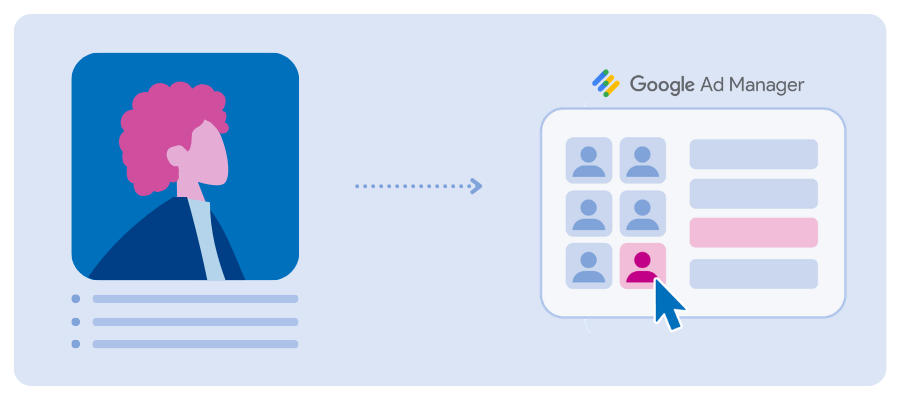
For buyers who want direct, self-service access to Experian audience and contextual solutions. Experian solutions are available off-the-shelf in Google Ad Manager, giving buyers a straightforward way to select the data or contextual strategy that fits their campaign and create packages through Google Ad Manager’s Curation capabilities.
Experian also offers Predictive Indexed, which uses Experian audiences to predict the contextual categories and pages to target based on the likelihood that consumers visiting those environments fall within the selected audience. This gives buyers an audience-informed way to approach contextual activation without requiring identity at the point of activation.
Build a Custom Curation package

For buyers who need a strategy tailored to specific audience, contextual, and inventory requirements.
Experian can build Custom Curation packages using Google Ad Manager’s inventory supply based on the targeting criteria that matter for a campaign. Where off-the-shelf solutions draw on Experian data, custom packages can also incorporate partner audiences and a brand’s own first-party audiences. Packages can combine Experian audiences, partner audiences, a brand’s own first-party audiences, contextual signals, and inventory or site criteria.
Experian applies those criteria against Google Ad Manager inventory supply and brings the data, targeting, and inventory together into a single curated deal. This gives buyers a way to combine audience and supply decisions rather than managing each component separately.
The approach can be tailored to the campaign. A buyer might start with a defined audience and add contextual or inventory criteria, bring a brand’s established first-party audience into the strategy, or build around specific supply and audience-quality requirements.
Choose the path that fits the campaign
Both paths do the same underlying thing: they move the audience or contextual decision closer to the ad request, before signal loss builds across the path. Whether a campaign calls for something ready to use or a package built to spec, the result is a more direct line from strategy to impression.
Ready to get started? Explore Experian solutions available off-the-shelf in Google Ad Manager or contact your Experian representative to request a Custom Curation package.
Latest posts

With the emergence of email addresses as a currency for brands to communicate with their consumers offline; attaching email data to in-store purchases lays the groundwork for future advertising strategies. However, this advantage in having an additional digital touchpoint also creates a new challenge for marketers. How do they connect what they know about their customers via offline data and PII, or personally identifiable information, with what they want to know about their online behaviors and interactions? Taken a step further, how can they create actionable strategies that connect these two streams of consumer insights in order to drive them to make more future purchases; and even become loyalists? At a time when the shift from traditional to online shopping feels more like a landslide; connecting online and offline data has never been more valuable or more urgent. The solution for these marketers lies in the framework of identity resolution; and a key capability called hashed email onboarding. Hashed email onboarding is a privacy-safe way to connect consumer email addresses to their related digital devices and other digital identifiers. The methodology prevents the consumers actual email address from being readable; while still providing marketers a connection between those emails and other touchpoints for an individual. Instead of understanding the customer journey in two distinct parts; how they interact with a brand or company offline and separately how they interact with a brand online; hashed email onboarding allows for the two parts to be woven together in a holistic view of that consumer. The power of connecting these data sets can be seen when combining offline and online attribution and measurement to improve frequency capping and look-alike modeling. It’s important to note that not all identity resolution vendors that onboard hashed emails function in the same way or provide the same level of data. Some connect only to desktop or only to mobile devices; while others don’t actually make direct linkages at all- they simply provide the hashed emails as a targetable digital audience for upload. While hashed email onboarding and the connection between offline and online data is a powerful strategy; it needs to be as structured as possible across the most data available to reveal truly efficient targeting and measurement strategies. Tapad, a part of Experian has built a hashed email product feature that works with the existing flexibility of The Tapad Graph to deliver the most holistic consumer view in the structure that works best for your business objectives. Get in touch
To our valued customers and partners, it’s been an exciting week here at Tapad! As announced in a press release this morning, Tapad is now a member of the Experian family. We’re thrilled to continue to grow as a leader in identity resolution under the umbrella of a global expert in data, analytics and technology. Tapad and Experian are deeply connected by our commitment to serving the needs of our customers; and with a focus on quality of the data we provide, we have a common goal for the future of identity in the advertising ecosystem. As part of this announcement, we wanted to assure you, our valued customer, that we remain deeply committed to serving you today just as we always have. Nothing will change in your daily operations with Tapad. Experian immediately recognized that the success and growth of Tapad was directly tied to the strength and depth of its team members. As such, the acquisition will not result in any changes to day-to-day contacts at Tapad, or processes with weekly graph deliveries and other product support. Experian’s faith and investment in Tapad’s future and the future of identity resolution underscores what we’ve always believed our products could achieve and that we will be able to continue serving brands, advertisers, publishers, and the advertising and marketing ecosystem for years to come. On a personal note, I am excited to be transitioning my role as Chief Operating Officer of Tapad to the General Manager position of a global business that’s achieved exponential growth over the past several years; culminating in this strategic acquisition that will no doubt bring even more value to our customers in the future. We remain committed to open communication and welcome any questions you may have. Thank you,Mark Connon | General Manager, Tapad Contact us today
Addressable TV has been through a transformation in the past year. Streaming content has become the most coveted space for creators and advertisers with the rise of new apps and platforms; but the influx of stay-at-home orders around the country have shifted television viewership as we know it, and streaming apps are popping up in droves to take advantage. So, how can you? With no shortage of opportunities to advertise on addressable TV and CTV, how does it fit into the media mix? And furthermore, how can you attribute this household-level device into your overall strategy? Tying it all together Layering addressable TV within digital ad campaigns couldn’t be easier today — but applying the right targeting and cadence between all of your digital efforts; and tying them together in attribution takes the right kind of data. Marketers can use CTV identifiers coupled with other device identifiers available in The Tapad Graph to not only target impressions but also map addressable TVs within the consumer journey; and unify strategies between household decision makers to better personalize messaging. 1 The Trade Desk Q2 2020 Earnings Call Transcript, August 2020; 2 iSpot Report, via Deadline, July 2020; 3 Flixed.io, January 2020 Contact us today