
Buyers can now put Experian’s audience and contextual intelligence to work in Google Ad Manager Curation in two ways: through off-the-shelf solutions available directly in Google Ad Manager, or through Custom Curation packages that Experian builds using Google Ad Manager’s inventory supply. Together, these options bring Experian’s consumer data foundation closer to the Google supply agencies already buy, with the flexibility to choose between a ready-to-use solution and an Experian package tailored to specific campaign goals.
Why targeting at the source matters
Many audience strategies still apply targeting on the buy side, which means signals pass through multiple systems before an impression is evaluated. Each step can shrink the pool of requests where the audience is still recognizable, so a carefully built strategy can reach the auction at a fraction of the scale it started with.
Google Ad Manager Curation moves segment evaluation closer to the ad request. When a request matches the selected Experian segment, Ad Manager sends the bid request with the associated Deal ID to the buyer’s DSP. This more direct path can support stronger match and deal-transaction rates, more accurate forecasting, and better access to the audience defined in the strategy.
As AI shapes more media decisions, the quality and provenance of the data feeding those systems matter more. Evaluating audience or contextual criteria closer to the source helps preserve the connection between the strategy and the impression being considered.
Two ways to get started
The right entry point depends on how much customization the campaign requires. Buyers can access Experian solutions off-the-shelf directly in Google Ad Manager or work with Experian to build a Custom Curation package using Google Ad Manager inventory supply.
Start off-the-shelf
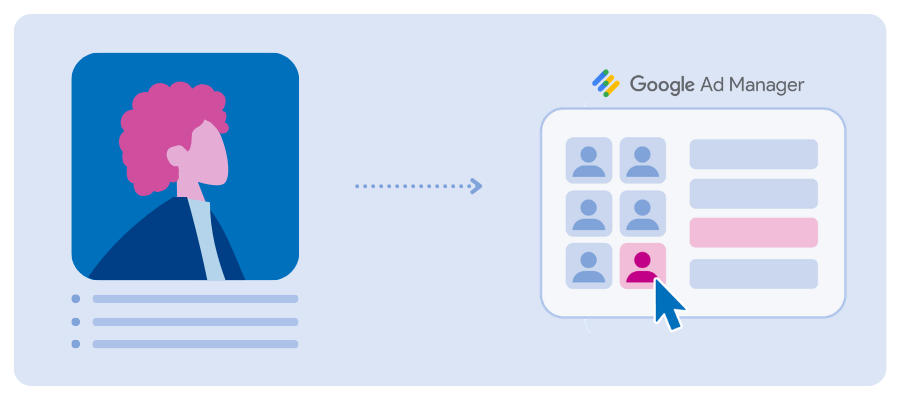
For buyers who want direct, self-service access to Experian audience and contextual solutions. Experian solutions are available off-the-shelf in Google Ad Manager, giving buyers a straightforward way to select the data or contextual strategy that fits their campaign and create packages through Google Ad Manager’s Curation capabilities.
Experian also offers Predictive Indexed, which uses Experian audiences to predict the contextual categories and pages to target based on the likelihood that consumers visiting those environments fall within the selected audience. This gives buyers an audience-informed way to approach contextual activation without requiring identity at the point of activation.
Build a Custom Curation package

For buyers who need a strategy tailored to specific audience, contextual, and inventory requirements.
Experian can build Custom Curation packages using Google Ad Manager’s inventory supply based on the targeting criteria that matter for a campaign. Where off-the-shelf solutions draw on Experian data, custom packages can also incorporate partner audiences and a brand’s own first-party audiences. Packages can combine Experian audiences, partner audiences, a brand’s own first-party audiences, contextual signals, and inventory or site criteria.
Experian applies those criteria against Google Ad Manager inventory supply and brings the data, targeting, and inventory together into a single curated deal. This gives buyers a way to combine audience and supply decisions rather than managing each component separately.
The approach can be tailored to the campaign. A buyer might start with a defined audience and add contextual or inventory criteria, bring a brand’s established first-party audience into the strategy, or build around specific supply and audience-quality requirements.
Choose the path that fits the campaign
Both paths do the same underlying thing: they move the audience or contextual decision closer to the ad request, before signal loss builds across the path. Whether a campaign calls for something ready to use or a package built to spec, the result is a more direct line from strategy to impression.
Ready to get started? Explore Experian solutions available off-the-shelf in Google Ad Manager or contact your Experian representative to request a Custom Curation package.
Latest posts

Overview Chartable leverages The Tapad Graph to improve cross-device attribution rates and remove non-addressable IPs for clients. Challenge Chartable needs to differentiate between consumer and potential business IP addresses to provide accurate household modeling and reduce excess data for their customers. Podcasting generally only has access to IP addresses as a form of digital ID which limits its ability to connect activity to individuals and extend it across all devices. The Tapad + Experian solution Using Tapad, now a part of Experian, Chartable is able to cut through the noise of IP data and discard any addresses deemed a shared IP or business. Then, Tapad + Experian connects individual users to their other digital IDs and users in their household; creating a richer attribution model for Chartable customers. Increase in podcast attribution rates Contact us today

With the growth of digital marketing and the targeting capabilities associated with online outreach, many predicted that this would mark the end of direct mail advertising. But if Millennials have anything to say about it, that’s not going to happen anytime soon. Yes, believe it or not, Millennials are driving the resurgence of direct mail advertising, and many leading brands are now pivoting their omnichannel marketing plans to include direct mail. And with the USPS reporting more than 75.7 billion in marketing mail volume in 2019, this trend shows no sign of slowing down. Including direct mail in your plans may give your brand a better chance of reaching your audience. Why? 1. Millennials actually like getting mail.While most of us have decried “junk mail” as being environmentally unfriendly or just a pain to deal with, Millennials actually enjoy physical mail. Valassis recently cited research from USPS Customer & Market Insights stating that Millennials spend the most time sorting mail (about six minutes compared to the average, which is four minutes), plus they’re opening mail and reading it (at eight minutes versus the average of seven minutes). Valassis also conducted a study that showed that 68% of Millennials read print ads or inserts from retailers, and 64% prefer getting them through the mail. So, while digital outreach may be convenient, it hasn’t completely decimated the desire for that old-school, hands-on experience of opening and reading something that’s addressed to you. 2. Millennials respond to a multi-channel approach.Oftentimes, marketers think of omnichannel as being a combination of digital and TV, but when you add print into the mix, it can make an even bigger impact on Millennial audiences. Valassis found that 60% of consumers are more likely to make a purchase after seeing an ad when it’s presented across both offline and online channels, while 72% of Millennial parents say print ads encourage them to go online and make a purchase from that retailer. 3. Millennials think physical mail makes for a more personal approach.You’d think that e-mail would feel more personal, but with the influx of spam most people get, that’s just not the case. In fact, 67% of people see physical mail as being more personal than an e-mail, with seven out of 10 saying they prefer receiving actual mail over digital mail. And for marketers looking to make a one-to-one connection, this is music to their ears. With changing marketing plans, the mailbox has less competition than the inbox. Getting a catalog at their door with the perfect offer at the perfect time helps the marketer make the direct connection. 4. Direct mail lasts longer than digital mail.That may seem like an obvious statement, but there’s more to it than you think. When an e-mail arrives in someone’s inbox, it’s easy to ignore it, read the subject line and forget about it, or even just randomly delete it, if spam filters don’t take care of that on their own. But the average lifespan of a piece of direct mail is 17 days, which may account for how direct mail generates purchases five times larger than e-mail campaigns. It’s harder to ignore when it’s in your house and you have to physically handle it as opposed to just clicking a mouse to get rid of it. 5. Millennials trust direct mail.It’s true—research shows that 90% of Millennials think direct mail advertising is reliable. Plus, Millennials are 24% more likely to show mail to others, compared to 19% of non-Millennials… which means if they find a deal they like in the mail, they’re probably going to spread the word. Contact us today
Marketers are always looking for creative ways to get the most out of their digital marketing investments. While there may be different paths to optimization, reducing media spend and cutting costs without sacrificing ROI is ideal. We empower marketers to take back control of their budgets and reinvent their media strategies by leveraging the right data at the right time. And, given today’s challenging climate, there’s no better time. Every Business Has Different Deeds Whether you’re a direct-to-consumer brand building a loyal customer base or a financial service simply letting customers know you’re here for them during a challenging time– identity resolution is essential to connecting with your audience without breaking the bank. That’s why we have built solutions that provide flexibility and control when you need it most. Putting Data Into Action Experian’s “Tapad Graph” is a global, privacy-safe cross device graph is one powerful file. Updated weekly, and containing customized device IDs and digital attributes, The Tapad Graph enables smarter targeting strategies and a reduction of wasted impressions. What that means is more marketing efficiency and a stronger ROI for your business. Saving resources and money sound good to you? This guide breaks down four ways you can implement cost savings measures without sacrificing performance or prohibiting KPIs. Frequency Capping and Suppression Clustering device IDs by the individual and household means you have access to more ways to reach consumers, but it doesn’t always mean you should be using all of them across every campaign. Hone in on the channels and devices where consumers make most of their lower funnel decisions and purchases – and cap brand-awareness level placements or aspirational media that requires more exposure to generate engagement. This doesn’t mean limiting the devices you target, but being more aware of how often you’re targeting the same person across those devices. If you’ve successfully begun, or heck, even completed the consumer journey with an individual, congratulations. Now, you may want to consider what to do with the rest of the digital devices and users in that same household. Sure, there’s a time for conquesting an entire home of purchasers, but that’s not always the most effective way to maximize your media. That’s why The Tapad Graph is built to be flexible, providing a holistic view of all individuals and their associated devices and digital IDs – so you can suppress them once you’ve conquested the household decision maker or achieved the desired lower funnel activity. Save those impressions for someone else and save money for yourself. The great thing is whether you’re uploading this data into a DMP or a DSP, you can segment your target audience with a frequency cap threshold or suppress them entirely. Not only can you apply these tactics across traditional digital media, but we can include Connected TVs for OTT targeting as well, making your media strategy as holistic as your identity resolution tactics. Cross-Device Targeting and Attribution Consumer behavior and device trends are changing these days, so shouldn’t your digital marketing change too? Desktop usage is now up as much as 22%* as more people are working and learning from home. And remember that old iPad? With more people at home, we’re dusting off more devices and tablet activity is increasing more than 30%*. Sure, people are still constantly on mobile– but it might be time to consider implementing cross-device targeting and optimization for those dayparts when their focus is elsewhere. Identity resolution should be a key element of customer journey mapping and attribution in order to truly give credit to the right channels and build a baseline for the right cost-per modelling. Coupling The Tapad Graph with raw events data can granularly attribute engagement, actions and conversions at the digital ID, device, and even user-level – thereby teaching you more about your customer’s preferences. Leverage these insights to create more tailored messaging and promotions on your owned and operated channels, to funnel impressions to specific screens and platforms, and to target users based on where they are in the purchase funnel. Data That Gives You Control If you’re already implementing cross-device, have you started suppressing the devices where engagement with your brand isn’t happening? That’s right, you can use The Tapad Graph after-the-fact as well. Weekly graph updates with 60-day look-backs enable weekly campaign optimizations. That gives you the flexibility and control to avoid devices and platforms where users aren’t as active. You can only make decisions based on the data you have in front of you, so make sure you’re partnering with the right solutions for your business. Does identity resolution sound like something you need? Contact us and we can help you get started with all that The Tapad Graph has to offer. Contact us today