At A Glance
Infillion and Experian collaborate to help advertisers connect with audiences across devices and channels, as cookies and mobile identifiers disappear. By integrating Experian's Digital Graph and Offline Identity Resolution, Infillion strengthens identity connections, improves campaign reach, and enhances audience engagement across CTV, mobile, and web.In our Ask the Expert Series, we interview leaders from our partner organizations who are helping lead their brands to new heights in AdTech. Today’s interview is with Ben Smith, VP of Product, Data Products at Infillion.
Adapting to signal loss
What does the Experian–Infillion integration mean for advertisers looking to reach audiences as signals fade?

As cookies and mobile identifiers disappear, brands need a new way to find and reach their audiences. The Experian integration strengthens Infillion’s XGraph, a cookieless, interoperable identity graph that supports all major ID frameworks, unifying people and households across devices with privacy compliance, by providing a stronger identity foundation with household- and person-level data. This allows us to connect the dots deterministically and compliantly across devices and channels, including connected TV (CTV). The result is better match rates on your first-party data, more scalable reach in cookieless environments, and more effective frequency management across every screen.
Connecting audiences across channels
How does Experian’s Digital Graph strengthen Infillion’s ability to deliver addressable media across channels like CTV and mobile?
Experian strengthens the household spine of XGraph, which means we can accurately connect CTV impressions to the people and devices in that home – then extend those connections to mobile and web. This lets us plan, activate, and measure campaigns at the right level: household for CTV, and person or device for mobile and web. The outcome is smarter reach, less waste from over-frequency, and campaigns that truly work together across channels.
The value of earned attention
Infillion has long championed “guaranteed attention” in advertising. How does that philosophy translate into measurable outcomes for brands?
Our engagement formats, such as TrueX, are based on a simple principle: attention should be earned, not forced. Viewers choose to engage with the ad and complete an action, which means every impression represents real, voluntary attention rather than passive exposure. Because of that, we consistently see stronger completion rates, deeper engagement, and clearer downstream results – like lower acquisition costs, improved on-site behavior, and measurable brand lift.
To take that a step further, we measure attention through UpLift, our real-time brand lift tool. UpLift helps quantify how exposure to a campaign influences awareness, consideration, or purchase intent, providing a more complete picture of how earned attention translates into business impact.
Creative innovation and location insights
Beyond identity resolution, what are some of Infillion’s capabilities, like advanced creative formats or location-based insights, that set you apart in the market?

One key area is location intelligence, which combines privacy-safe geospatial insights with location-based targeting through our proprietary geofencing technology. This allows us to build custom, data-driven campaigns that connect media exposure to real-world outcomes – like store visits and dwell time – measured through Arrival, our in-house footfall attribution product.
We also build custom audiences using a mix of zero-party survey data, first-party location-based segments, and bespoke audience builds aligned to each advertiser’s specific strategy.
Then there’s creative innovation, which is a major differentiator for us. Our high-impact formats go beyond static display, such as interactive video units that let viewers explore products through hotspots or carousels, rich-media ads that feature polls, quizzes, dynamic distance, or gamified elements, and immersive experiences that encourage active participation rather than passive viewing. These creative formats not only capture attention but also generate deeper engagement and stronger performance for a variety of KPIs.
Future ready media strategies
How does Infillion’s ID-agnostic approach help brands future-proof their media strategies amid ongoing privacy and tech changes?
We don’t put all our eggs in one basket. XGraph securely unifies multiple durable identifiers alongside our proprietary TrueX supply to strengthen CTV household reach. This agnostic design allows us to adapt as platforms, regulations, and browsers evolve – so you can preserve reach and measurement capabilities without getting locked into a single ID or losing coverage when the next signal deprecates.
Raising the bar for media accountability
Looking ahead, how is Infillion evolving its platform to meet the next wave of challenges in audience engagement and media accountability?
From an engagement standpoint, we’re expanding our ability to support the full customer journey, offering ad experiences that move seamlessly from awareness to consideration to conversion. That includes smarter creative that adapts to context, intelligent targeting and retargeting informed by real data, and formats designed to drive measurable outcomes rather than just impressions.
When it comes to accountability, we’re ensuring that measurement is both flexible and credible. In addition to our proprietary tools, we partner with leading third-party measurement providers to validate results and give advertisers confidence that their investment is truly performing. Within our DSP, we emphasize full transparency and log-level data access, ensuring advertisers can see exactly what’s happening on every impression.
All of this builds toward the next era of agentic media buying – one enabled by our MCP suite and modular, component-based tools. This evolution brings greater accountability and next-generation audience engagement to an increasingly automated, intelligent media landscape. Our goal is to help brands connect more meaningfully with audiences while holding every impression – and every outcome – to a higher standard of transparency and effectiveness.
Driving impact across the funnel
What is a success story or use cases that demonstrate the impact of the Experian–Infillion integration?
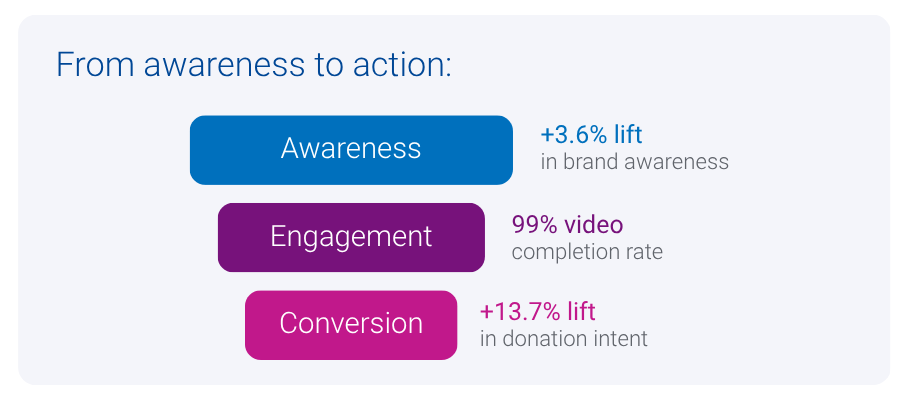
We recently partnered with a national veterans’ organization to raise awareness of its programs for injured or ill veterans and their families. Using the Experian integration, we combined persistent household- and person-level identifiers with cross-device activation to reach veteran and donor audiences more precisely across CTV, display, and rich media. The campaign achieved standout results – industry-leading engagement rates, a 99% video completion rate, and measurable lifts in both brand awareness (3.6 % increase) and donation consideration (13.7% lift). It’s a clear example of how stronger identity and smarter activation can drive meaningful outcomes across the full funnel.
Contact us
Identity resolution FAQs
Identity resolution ensures accurate connections between devices, households, and individuals. Experian’s Offline Identity Resolution and Digital Graph strengthen these connections for improved targeting and consistent measurement across CTV, mobile, and web.
Solutions like Experian’s Digital Graph enable brands to connect first-party data to household and person-level identifiers, ensuring scalable reach and compliant audience targeting legacy signals fade.
Focusing on earned attention (where audiences actively choose to engage) leads to stronger completion rates, improves on-site behavior, and drives measurable increases in brand awareness and consideration.
By linking CTV impressions to households and extending those connections to mobile and web, Experian’s identity solutions ensure campaigns work together seamlessly, reducing over-frequency and improving overall reach.
About our expert

Ben Smith
VP Product, Data Products, Infillion
Ben Smith leads Infillion’s Data Products organization, delivering identity, audience, and measurement solutions across the platform. Previously, he was CEO and co-founder of Fysical, a location intelligence startup acquired by Infillion in 2019.
About Infillion

Infillion is the first fully composable advertising platform, built to solve the challenges of complexity, fragmentation, and opacity in the digital media ecosystem. With MediaMath at its core, Infillion’s modular approach enables advertisers to seamlessly integrate or independently deploy key components—including demand, data, creative, and supply. This flexibility allows brands, agencies, commerce and retail media networks, and resellers to create tailored, high-performance solutions without the constraints of traditional, all-or-nothing legacy systems.
Latest posts

The AdTech industry is buzzing with discussions about cookie deprecation and effective strategies to tackle it. One of the commonly suggested solutions is the utilization of clean rooms alongside responsibly sourced first-party data. Above all else, the industry recognizes the importance of respecting consumer data and complying with all privacy laws. Additionally, the industry acknowledges the need for a change in our historical practices. This shift benefits everyone involved, as consumer data is more secure than ever. Tremendous investments have been made to ensure the utmost security of consumer information. Clean rooms are one of the tools that enable companies to use data securely, ensuring the content that you see is as relevant as possible. Two ways the AdTech industry is addressing cookie deprecation The days of sending data directly to partners for usage or for using only third-party data for marketing efforts are gone. Now, the emphasis is on responsibly collecting first-party data and using clean rooms to enrich first-party data to enhance marketing efforts. First-party data The industry is starting to lean into first-party data gained through transparent means. This valuable information provides organizations with deeper insights into their customers, allowing for more personalized and effective interactions. By embracing the power of first-party data, either on its own or enriched via partner collaboration, you can cultivate stronger relationships, build trust, and deliver tailored experiences that resonate with your customers on a deeper level. Clean rooms Many data lakes and warehouses offer this service, ensuring their clients can not only store their data with them but can connect it with other partners in a secure environment and extract more information through the combined data sets versus their data on its own. Brands and their partners recognize that they need to work together, and a clean room provides a secure environment to share their first-party data without exposing their sensitive data to their partner. So, while we're losing third-party cookies, brands and partners can still get value from first-party data by using a clean room to generate audience insights, segmentation strategies, personalized experiences and offers, media plans, and measurement and attribution. Three ways data clean rooms can improve Data clean rooms are a great way to facilitate data collaboration while ensuring sensitive data is not exposed. Data clean rooms are not yet easy to use nor are they inexpensive. They require investment, both financially and resource allocation-wise, and you are not guaranteed to yield great match results. Let’s dive into three areas for data clean room improvement. High cost According to the IAB's State of Data 2023, nearly two-thirds of data clean room users spent at least $200K on the technology in 2022. In addition, one-third of data clean room users expect the price of data clean rooms to rise in 2023. The high cost of this solution can make it inaccessible to smaller companies in the advertising space. Resource intensive Nearly half of the companies using data clean rooms have a team of six or more dedicated to the technology, according to the IAB’s State of Data 2023, while nearly a third of companies using data clean rooms have 11 or more employees focused on the technology. Data clean rooms are not turnkey solutions. Inefficient matching Even if companies are using clean rooms does not mean that they are automatically going to achieve great success. Identity fragmentation, data hygiene, and differing identifiers can suppress client match rates in clean rooms, leading to significant investment and a lackluster output. How to get the most return on your clean room investment The finish line for data collaboration in clean rooms is not just having a relationship with a clean room. Instead, you should incorporate an identity resolution solution in your clean room. By adding an identity solution to your clean room, you can: Resolve and match all your identity data, regardless of the identity data that you or your partner have, giving you a larger data foundation to analyze. Generate more valuable insights and information, leading to a better experience for your customers. Join data sets to create smarter activation and targeting strategies and produce more holistic measurement. Experian can help you get started with identity resolution and data clean rooms If you are investing in data clean rooms, that means you are committed to the best in data practices. Experian recommends going the extra step and that you also invest in finding an identity resolution solution. By doing this, you can see better match rates. Experian offers this capability and has existing relationships with three clean room partners, Amazon Web Services, InfoSum, and Snowflake. In addition to collaborating in clean rooms, we offer collaboration in two other secure environments. Contact us today to discuss how we enable identity resolution in clean rooms or to chat about our other collaboration capabilities. Get in touch Latest posts

Ongoing signal loss is driving marketers, agencies, and platforms to turn to supply-side advertising. By using first-party data from publishers and platforms, supply-side advertising has the potential to deliver high-quality audience and context for more effective ad targeting. The supply-side refers to the publishers and platforms that sell advertising inventory. These companies have access to first-party data about their users, which can be used to target ads more effectively. By tapping into supply-side advertising, you can overcome the challenges of signal loss and target ads more effectively. To shed light on this topic, we hosted a panel discussion at Cannes, featuring industry leaders from Audigent, Captify, Newsweek, Pubmatic, Truthset, and Experian. In this blog post, we'll explore how partnerships between supply-side channels and publishers are working to enhance advertising opportunities while balancing the need for transparency and control in programmatic ad buying. Shift toward supply-side advertising Traditionally, the demand-side dominated the programmatic media buying chain due to an abundance of supply. However, with the emergence of finite data and its interpretation, collaboration between supply-side technology companies and publishers is required to redefine these economics. It's no longer sufficient for the demand-side to blindly negotiate prices based on limited knowledge. Marketers can still define their target audience, but effective communication is key. This presents an opportunity for premium journalistic outlets to guide the industry's understanding of how data from the supply-side impacts media buying economics in the future. "Supply-side technology partnerships with publishers are now in a position to shape the economics of programmatic media buying as there is a finite amount of data. It’s crucial for supply-side technology companies to collaborate with publishers to shape these new economics. This presents an opportunity for premium journalistic outlets to provide guidance on how data from the supply-side can affect the future of media buying." matthew papa, svp, business & corporate development, captify Democratizing data from the supply-side Cookies haven't brought significant benefits to premium publishers. They mainly serve to retarget users from sites like The Wall Street Journal to advertising sites. This approach primarily serves the purpose of generating revenue. The elimination of third-party cookies presents an opportunity for premium publishers to shift this dynamic. By using their knowledge of first-party audiences, and using identifiers like Experian's LUID, publishers can own and understand their audience data, which can then be modeled. Here’s how publishers can win Establishing a connection with consumers and emphasizing the value exchange is essential to building trust. Determining what incentives and benefits consumers find meaningful will be crucial in gaining their opt-in. With consumers The Apple tracking transparency initiative, specifically the deprecation of IDFA signals, had significant implications for mobile app developers. Overnight, opt-in rates plummeted, causing a drastic decline in iOS ad monetization. To combat this, developers focused on demonstrating the value exchange to consumers—better ad experiences and personalized content. By articulating the benefits over a couple of years, opt-in rates increased from 10-15% to 30-40%. The key takeaway is the need to effectively communicate the value exchange to consumers. With partners Trust plays a crucial role in planning your first-party data strategy. Publishers, advertisers, and data partners highly value their proprietary data. However, there are concerns about how it's used, mishandled, or leaked in the ecosystem. Building trust between partners is essential. It's important to work with trustworthy partners who are agnostic, committed to innovative solutions, and globally oriented. These partners can help navigate the complexities of laws and regulations. Choosing the right partners is crucial in a world where first-party data is a key asset. "Power is shifting toward brands that have strong relationships with customers and possess first-party data. As the ownership of customer data becomes more important, it is crucial to establish a first-party data strategy to better serve customers and adapt to changing market dynamics."chip russo, president, truthset Balance probabilistic and deterministic data Focus on building trust with consumers and collaborating with reliable companies to share data. However, it's important to remember that achieving a 100% opt-in rate is unlikely. The cookie, which has become omnipresent, requires us to shift our strategic thinking. We need to consider both deterministic and probabilistic approaches instead of viewing them as mutually exclusive. The landscape will be fragmented, with some consumers opting in and others not. "Probabilistic and predictive audience data holds immense potential. With the power of AI, we can expect enhanced performance and efficacy in media campaigns. At Audigent, we firmly believe that this data will outperform deterministic data, making it an integral part of our strategy." drew stein, ceo, audigent Premium content Trust plays a crucial role in leading to premium content. By placing trust in the best media brands, data, and technology partners, we can expect to see improvements in media, journalism, and advertising. This shift may have a direct impact on the long tail of free natural resources, making it more challenging for them to thrive. However, this change is ultimately beneficial since it promotes higher-quality media experiences overall. "The homepage surface is making a comeback in the publishing industry, proving its value in establishing a direct connection with readers. While we acknowledge the importance of technology partnerships for addressability and identity, our core competency as a publisher remains outstanding journalism that captures and engages great audiences." kevin gentzel, cco, newsweek Watch our Cannes panel for more on supply-side advertising We hosted a panel in Cannes that covered supply-side advertising. Check out the full recording below to hear what leaders from Audigent, Captify, Newsweek, Pubmatic, Truthset, and Experian had to say. Watch now Check out more Cannes content: Our key takeaways from Cannes Lions 2023 Insights from a first-time attendee Four new marketing strategies for 2023 Exploring the opportunities in streaming TV advertising The future of identity in cookieless advertising Follow us on LinkedIn or sign up for our email newsletter for more informative content on the latest industry insights and data-driven marketing. Contact us today Latest posts

The digital advertising landscape has undergone a seismic shift in recent years. Privacy-conscious consumers, transformative regulations, and emerging technologies are converging to redefine how addressability — the ability to accurately reach a specific audience — functions in this new era. Addressability is a cornerstone of digital advertising, and its evolution presents both challenges and opportunities for publishers and advertisers alike. The need for enhancing addressability is driven by a complex set of factors. More consumers are opting out of data sharing or disabling cookie-tracking, leading to a drastic reduction in the reach of traditional programmatic advertising. Nearly 70 percent of consumers are now unreachable through these conventional methods, creating an 'addressability gap' that publishers and advertisers are eager to bridge. The landscape is further complicated by privacy regulations such as General Data Protection Regulation (GDPR) and California Consumer Privacy Act (CCPA), which mandate solutions that balance user privacy with advertisers' needs. Contributing to this intricate mix is the growing shift toward video and connected TV (CTV). These platforms have long operated in a cookie-less environment and are witnessing rising demand due to their engaging nature and broad reach. However, the attractiveness of these mediums to advertisers hinges on effective addressability, highlighting the urgent need for innovative audience identification and targeting methods. The emergence of data enablers and collaborative initiatives Data enablers like Experian are stepping up to meet this need. These companies are providing robust, privacy-compliant data resources to improve addressability. Experian's unique approach to identification, the Living Unit ID (LUID), is a key tool in bridging the current gap in reach. How Experian and Microsoft Advertising are redefining addressability We recently expanded our collaboration with Microsoft, to make our extensive data resources available through Microsoft Advertising’s data marketplace. This collaborative initiative represents a significant move, offering a compelling model of how data enablers and buy-side and sell-side platforms can work together to redefine addressability. The benefits of this arrangement extend to all stakeholders in the ecosystem. Advertisers using Microsoft Invest can now access Experian's audience data. This not only enhances the granularity of their audience targeting but also broadens the reach of their campaigns. Experian's identity spine also serves as a robust framework to extend the value and reach of advertisers' first-party data. For publishers, the accessibility of Experian data on Microsoft Advertising’s data marketplace opens the door to greater addressability in their inventory, enabling them to offer advertisers more addressable impressions. This then amplifies the value of their inventory, potentially increasing their overall yield. For advertisers, this integration facilitates access to highly relevant audiences while simplifying campaign setup and respecting user privacy. We can help you carve a new path toward addressability In the ever-evolving landscape of digital advertising, such collaborative efforts are becoming critical to ensure that advertising remains effective for brands, profitable for publishers, and respectful of consumer privacy. This model of cooperation and innovation is essential to navigate the challenges of a privacy-centric, cookie-less world and unlock the true potential of every media channel. With collaborative initiatives and innovative solutions, the industry is set to transform these challenges into opportunities, carving a new path toward addressability that respects privacy and delivers value for all stakeholders. Connect with us to learn more about how you can access our data in Microsoft Advertising’s data marketplace. To learn more about our partner Microsoft Advertising, visit their website. Contact us Latest posts