At A Glance
The Advertising Research Foundation’s DASH TV Universe Study provides a projectable view of how Americans connect to and consume TV across households, devices, and services. In this Q&A, Jim Meyer, General Manager, DASH, and Samantha Zhang, Senior Data Scientist, at the ARF explain what DASH measures, who uses it, why MRC accreditation matters, and how Experian combines DASH with its data to build audience segments for advertisers and agencies.In our Ask the Expert series, we interview leaders from our partner organizations who are helping lead their brands to new heights in AdTech. Today’s interview is with Samantha Zhang, Senior Data Scientist, and Jim Meyer, General Manager of the DASH TV Universe Study at the Advertising Research Foundation (ARF). DASH is an annual tracking study conducted by the ARF to define and better understand TV audience behavior and household dynamics.
What does DASH measure, and how does it help the industry understand TV consumption today?
By capturing hundreds of individual- and household-level data points from each respondent in a rigorous and nationally projectable sample, DASH creates a comprehensive picture of U.S. consumer TV “infrastructure” – how America watches.
| Core elements in DASH | Elements that create context in DASH |
| TV sets Location | brand | smartness | service modes | sources | Demographics |
| Connected devices Game consoles |video players | streaming devices | Yesterday viewing Daypart | TV/device genre | Out-of-home viewing |
| Mobile devices Owners | sharing users | Shopping Online and in-store | Exposure to major RMNs |
| Internet service Modes | ISPs | connectivity by device | Streaming audio |
| Streaming TV SVOD/AVOD tiers and sharing | FAST | Email accounts and apps |
| Live TV Modes of access | including casting from devices | Social media |
For example, DASH gathers:
- Data on every TV set, including brand, room location, age, “smartness,” and connection devices and modes
- Household connectivity and video service data, even in homes with no TV set
- Internet Service Providers (ISP) and TV service usage, including Multichannel Video Programming Distributors (MVPDs), virtual vMVPDs, streamers (ad-supported and premium), and Free Ad-Supported Television (FAST) channels
- Person-level ownership and usage of video-capable mobile devices, including smartphones, tablets, and laptops
- Measures of viewing and co-viewing across dayparts, devices, and services
- Additional modules covering shopping and retail media networks, streaming audio, social media, email, and apps
Broad coverage and granularity make DASH a uniquely robust source of truth for practitioners across the industry, including measurement experts and ad programming strategists. DASH also reports regularly (and publicly) on key industry dynamics. DASH identified a growing segment of device-only viewers – now nearly 9 million households that watch TV, but do not own a TV set – and highlighted the implications of that trend for traditional ratings systems based only on households with TV sets.
| Households (HHs – million) | 2025 HHs (M) | U.S. penetration | Change vs. 2024 (M) |
| Total US | 134.8 | 100% | +2.7 |
| Connected TV (CTV) | 114.6 | 85% | +2.1 |
| TV (Set) | 124.2 | 92.2% | +1.1 |
| Device-only | 8.8 | 6.6% | +1.6 |
| TV-Accessible | 133.1 | 98.7% | +2.7 |
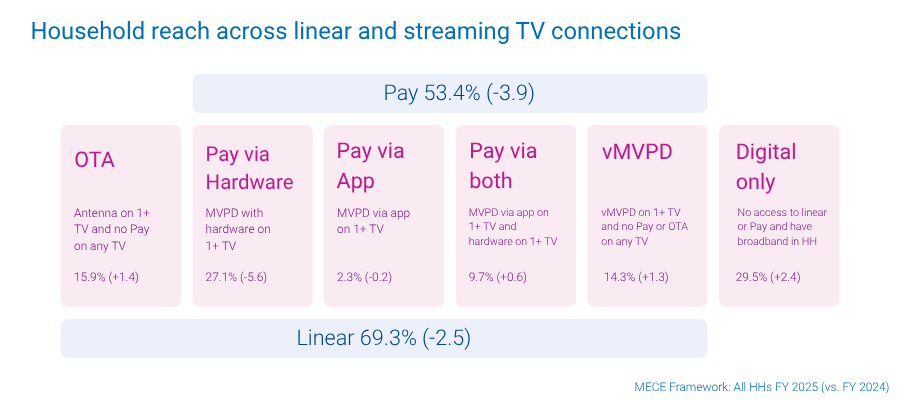
DASH called out the rise in app-based pay TV and proposed a new connection framework that better represents the modern TV world, in which linear and streaming overlap.
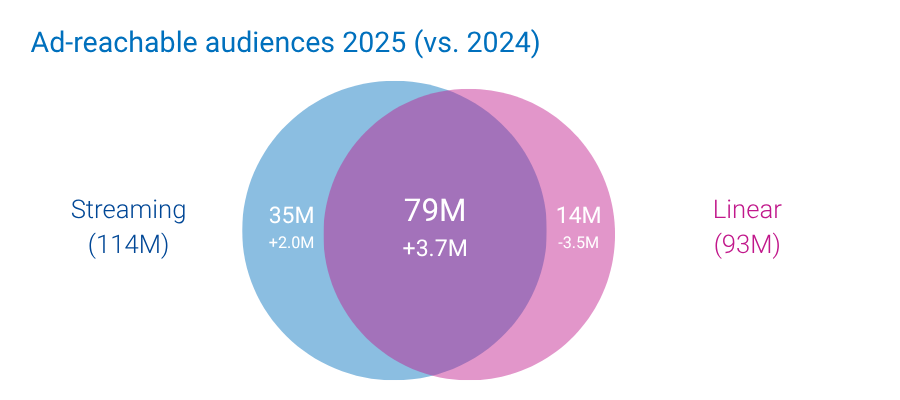
DASH also defines the universes of households reachable with advertising. This graphic, for example, shows how all ad-supported linear and streaming properties in aggregate define the true scale of TV advertising. While 35 million households (and growing) are reachable only with streaming ads and 13 million (and falling) only with linear ads, most households are reachable with both, underscoring the importance of understanding the “overlap.”
Who uses DASH data, and what decisions does it help inform?
There are three primary users of DASH, each with its own use cases:
The recent accreditation of DASH by the Media Rating Council (MRC) and adoption by Nielsen as an input to its TV ratings have generated interest from a broad range of companies. We are actively pursuing new licensees and partners to make DASH more useful within, and even outside, the TV ecosystem.
What does MRC accreditation signify, and why is it meaningful for DASH?
MRC accreditation means DASH passed a rigorous audit conducted by Ernst & Young over many months, which validated our methodology, controls, and data quality. MRC accreditation establishes that DASH is an industry-standard dataset.
While the service provider normally announces its own accreditation, the MRC took the unusual step of issuing its own release on DASH, announcing the accreditation of DASH for TV universe estimation and endorsing the study for broader, cross-media use.
How does Experian use DASH data to build audiences?
The segments combine specific TV usage habits and behaviors from DASH with Experian data on demographics, spending, and other contextual inputs to create a fuller view of consumer viewing behavior. They are designed to be valuable to advertisers in many categories and planning contexts – and to be customizable to fit advertisers’ media targets. The segments can be used to:
- Apply or suppress audiences to improve target coverage across a campaign
- Better align media and creative
- Reach elusive but high-value viewers, such as Ad Avoiders
- Drive valuable consumer behavior
- Achieve specific advertising objectives
What are some practical use cases for DASH-based audiences?
Here are some practical use cases for four different kinds of DASH segments in five different advertiser categories.
Thanks for the interview. Where can readers learn more about DASH?
We started work on DASH seven years ago, and it’s been fun to watch it “grow up.” Our partnership with Experian is a big step toward putting DASH to work for advertisers and agencies. To learn more, visit our site at https://theARF.org/DASH or contact us at DASH@theARF.org.
Contact us
About our experts

Samantha Zhang, Senior Data Scientist at ARF
Samantha Zhang is a Senior Data Scientist at the Advertising Research Foundation working on the DASH TV Universe Study, with additional research spanning areas including attention measurement, digital privacy, and artificial intelligence.

Jim Meyer, General Manager, DASH, at ARF
JimMeyer is general manager and co-founder of the ARF DASH TV Universe Study and managing partner of Golden Square, LLC, which advises media and research technology companies on growth strategy and development.
Latest posts

Tapad’s digital identity resolution offering enables Gimbal’s platform to provide expanded insights for campaign optimization to U.S. brand and agency clients NEW YORK, Feb. 11, 2020 /PRNewswire/ — Tapad, part of Experian and a global leader in digital identity resolution, announced their partnership with Gimbal, a leader of location-powered marketing and advertising solutions. Gimbal now leverages Tapad’s global, privacy-safe digital cross-device solution, The Tapad Graph, to further enhance its footfall attribution solution, Arrival. Arrival delivers dwell-based attribution for in-store foot traffic and by leveraging the Tapad Graph, Gimbal provides customers with a more holistic, attributable understanding of consumers across multiple devices, like desktop, smartphone, and tablet. With this, Gimbal’s clients are enabled to make more informed media planning decisions for programmatic activations across the web, and mobile apps. “With the number of devices per individual rapidly increasing, understanding the customer decision journey is becoming more complex,” said Kyle Wendling, SVP of Product at Gimbal. “We’re excited to partner with Tapad to continue engaging consumers across multiple devices.” To learn more about Tapad and our digital identity resolution products, visit our identity solutions page. About TapadTapad, Inc. is a global leader in digital identity resolution. The Tapad Graph, and its related solutions, provide a transparent, privacy-safe approach connecting brands to consumers through their devices globally. Tapad is recognized across the industry for its product innovation, workplace culture, and talent, and has earned numerous awards including One World Identity’s 2019 Top 100 Influencers in Identity Award. Headquartered in New York, Tapad also has offices in Chicago, Denver, London, Oslo, Singapore, and Tokyo. About GimbalGimbal translates location data into intent, measurement, and insights to help organizations transform their businesses, maximize marketing relevance, and humanize messaging for consumers. Gimbal is headquartered in Los Angeles and provides advertising and marketing technologies to the world’s leading brands and retailers interested in understanding the physical world. To learn more, visit https://gimbal.com. Contact us today
Tapad, part of Experian, integrates with AcuityAds’ current offering will complement cross-channel capabilities for brands and agencies in the U.S. and Canada NEW YORK, Jan. 23, 2020 /PRNewswire/ — Tapad, a global leader in digital identity resolution, has partnered with AcuityAds, a technology leader that provides targeted digital media solutions for advertisers to connect intelligently with audiences. The partnership will enhance AcuityAds’ existing cross-device solution, especially with respect to its cross-channel Connected TV offering. Tapad’s global, privacy-safe digital cross-device solution, The Tapad Graph, will compliment AcuityAds’ own cross-device data set for enhanced marketing capabilities across their Demand Side Platform (DSP). For AcuityAds, this provides customers with unduplicated reach across desktop, tablet, mobile and CTV devices – while augmenting their video offering. Tom Woods, Vice President of Products at AcuityAds commented, “With increasing marketing complexities, consumer device usage and new data regulations, our decision regarding the partnership was an important one. The Tapad Graph’s privacy-safe identifiers for consumer notice and choice, as well as the ability to opt-out at any point, were critical factors in our decision who to partner with.” To learn more about Tapad and our digital identity resolution capabilities, visit our identity page. About Tapad Tapad, Inc. is a global leader in digital identity resolution. The Tapad Graph and its related solutions provide a transparent, privacy-safe approach connecting brands to consumers through their devices globally. Tapad is recognized across the industry for its product innovation, workplace culture, and talent, and has earned numerous awards including One World Identity’s 2019 Top 100 Influencers in Identity Award. Headquartered in New York, Tapad also has offices in Chicago, London, Oslo, Singapore, and Tokyo. About AcuityAds AcuityAds is a leading technology company that provides marketers a powerful and holistic solution for digital advertising across all ad formats and screens to amplify reach and Share of Attention® throughout the customer journey. Via its unique, data-driven insights, real-time analytics and industry-leading activation platform based on proprietary Artificial Intelligence technology, AcuityAds leverages an integrated ecosystem of partners for data, inventory, brand safety and fraud prevention, offering unparalleled, trusted solutions that the most demanding marketers require to be successful in the digital era. AcuityAds is headquartered in Toronto with offices throughout the U.S., Europe and Latin America. For more information, visit AcuityAds.com. Disclaimer in regards to Forward-looking Statements Certain statements included herein constitute “forward-looking statements” within the meaning of applicable securities laws. Forward-looking statements are necessarily based upon a number of estimates and assumptions that, while considered reasonable by management at this time, are inherently subject to significant business, economic and competitive uncertainties and contingencies. Investors are cautioned not to put undue reliance on forward-looking statements. Except as required by law, AcuityAds does not intend, and undertakes no obligation, to update any forward-looking statements to reflect, in particular, new information or future events. Contact us today
Tapad, a part of Experian and the future of cookies Earlier this week, Google announced plans to create “.. a path towards making third-party cookies obsolete”; which will result in the phasing out of support for third-party cookies in its Chrome browser within two years. While there has been much discussion and debate on the future of the third-party cookie, an announcement from Google has been anticipated for some time. As many have said this week, the use of cookies and other identifiers has and will continue to evolve. What will never change is the value exchange between publishers and consumers that is enabled by relevant advertising. Notably, the need for independent companies to develop solutions that enable this value exchange has never been greater to ensure that publishers, consumers, and advertisers derive the most value from their relationship. We are well-positioned for the future From the start, Tapad, a part of Experian has led with a consumer-first, privacy-centric approach to technology as the use and proliferation of devices and global privacy regulations continue to evolve. Over the past two years, Tapad, a part of Experian has gone through a technical overhaul. Calling on almost ten years of expertise in identity resolution, we have created a modern platform that is flexible in terms of identity input as well as output. Anticipated change in the identity landscape was the driver behind our architecture decisions and what enables us to be responsive to a dynamic market. Consumer behavior and device use continue to change, bringing additional digital IDs into the equation – namely across the mobile and CTV environments. Our technology, however, is not tied to any specific type of identifier, but rather is focused on associating disparate identifiers at the individual and household level. Where do we go from here? Google’s announcement has been characterized as a conversation starter, but we see it more as a call to action. With a timeline set, there is a need to converge on one or more solutions that can scale across the web. In a post cookie world, publishers and advertisers will continue to require ways to create fair marketplaces across platforms and devices. Further, the platforms that currently power the programmatic advertising ecosystem will need to be able to invest and differentiate to bring value to their customers. Scaled privacy-safe identity solutions will be needed not only for classic targeting, attribution, measurement, and frequency capping use cases but also to carry consumer preferences and consent. Tapad, a part of Experian will continue to play a leading role here. However, we are not going to do this alone. As solutions around Google’s Chrome browser evolve, we will continue to take a leadership position and will work with Google, key industry groups, partners and customers to meet current and future needs for an independent identity solution at scale. In the meantime, we will continue to support an independent ecosystem where consumers come first and privacy standards are a priority. It’s business as usual…for now. There will not be any changes to our graph products or services as a result of Google’s announcement in the near term. Any changes related to the Chrome third-party cookie will evolve and will no doubt be subject to significant industry participation and feed-back, indeed at the invitation of Google. We will proactively communicate any changes and product updates during this time period. We look forward to the opportunities resulting from these changes and ushering in a new era of identity resolution in digital advertising. Contact us today