
Agencies, platforms, and marketers stand at the crossroads of transformation, as privacy regulations tighten, technology accelerates, and consumer behaviors evolve. Yet these challenges also present extraordinary opportunities.
Our 2025 Digital trends and predictions report highlights five trends that will shape 2025 and digs into:
- What’s changing in the market
- How to keep learning about your customers
- How to reach your customers in different places
- How to measure what’s really working along the way
In this blog post, we’ll give you a sneak peek of three of these trends — from cracking the code of signal loss to tapping into the buzz around connected TV (CTV) and stepping up your omnichannel game. Think of it as a taste test before the main course. Ready for the full menu? Download our report to get the lowdown on all five trends.
1. Signal loss: A rich appetizer of alternate ingredients
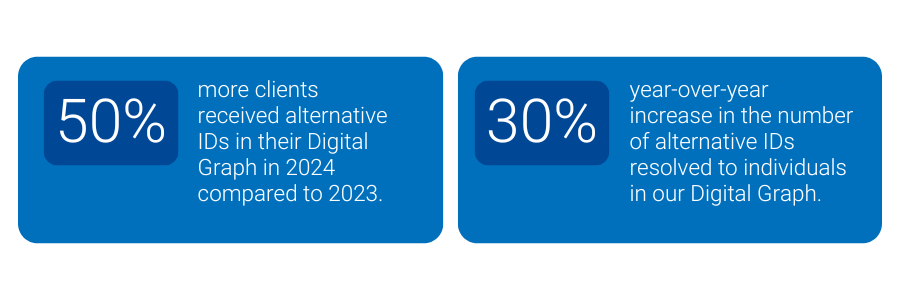
As traditional cookies crumble, marketers need fresh ingredients to keep the flavor coming. Already, about 40% of browser traffic doesn’t support third-party cookies, and marketers are spicing things up with first-party data, alternative identifiers like Unified I.D. 2.0 (UID2) and ID5, and contextual targeting strategies. In fact, 50% more of our clients received alternative IDs (UID2, ID5, Hadron ID) in their Digital Graph in 2024 compared to 2023. The number of alternative IDs resolved to individuals in our Digital Graph increased by 30% year-over-year – as everyone looks beyond the cookie jar.
There is no secret sauce to replace cookies. Instead, expect a multi-ID recipe that brings together different identifiers, unified by an identity graph. This approach turns a fragmented pantry of data into a cohesive meal, giving you a complete view of your customer on every plate.
2. The rising power of CTV: A hearty entrée of opportunities
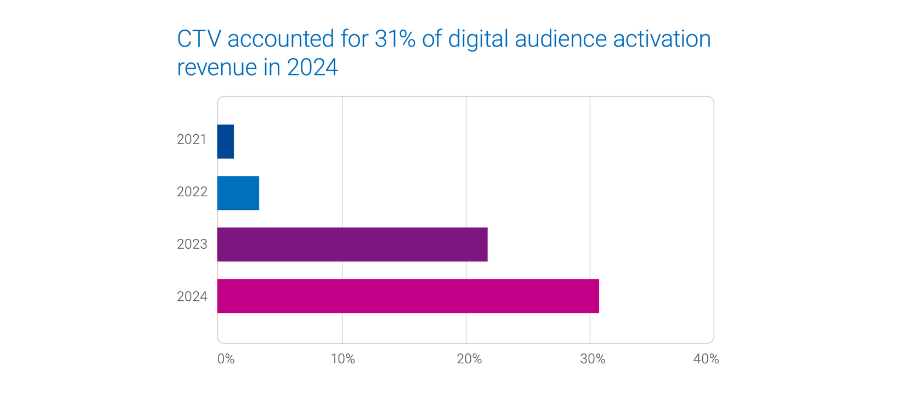
CTV is quickly becoming the main dish on the streaming menu, as viewers load up on their favorite shows. While CTV is slated to make up 20% of daily U.S. media consumption by 2026, advertisers are still holding back on pouring in the ad spend. To unlock its full flavor, marketers need to whip up solutions like frequency capping and unified audience activation.
Although CTV will account for 20% of daily U.S. media consumption by 2026, it’s projected to command only 8.1% of ad spend. Frequency capping and unified audience activation solutions will be key to unlocking CTV’s full potential.
By 2025, nearly half of CTV “diners” will choose free ad-supported streaming TV (FAST). Marketers need strategies to prevent ad overexposure. With 50% of U.S. consumers avoiding products due to ad overload, and 30% of marketers willing to increase their CTV spend if frequency capping improves, unified identity solutions help ensure every impression is served just right.
3. Omnichannel: A flavorful fusion plate
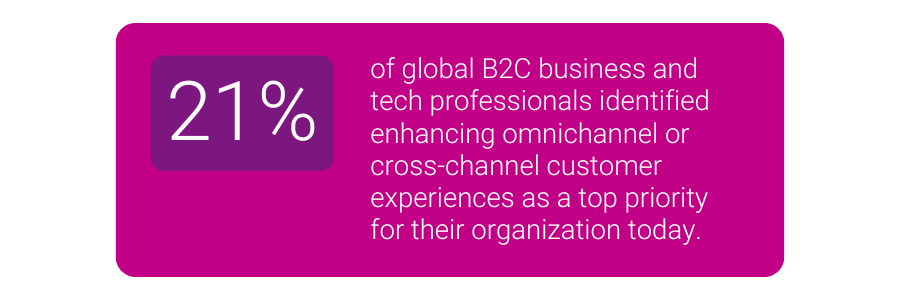
No one likes a one-flavor meal. Marketers are moving beyond single-channel “side dishes” to omnichannel “fusion feasts” that blend direct mail, digital, CTV, and retail media networks (RMNs) into a truly cohesive culinary experience. Even though only 21% of global B2C professionals currently put omnichannel at the top of their shopping list, the growing demand for seamless, audience-first campaigns is heating up.
In 2025, having an audience-first approach will be like having a perfect pairing for every course. Unified identity solutions act as your master sommelier, ensuring that each channel complements the next, and every customer enjoys a well-rounded, memorable journey.
Vertical trends: A dessert sampler from four unique kitchens
Different markets have their own signature flavors.
- In Auto, crossover utility vehicles (CUVs) claim 51% of new vehicle registrations, and consumers in the 35-54 age group and families are the primary buyers. Automotive marketers should prioritize CUV advertising with a strong focus on family-oriented and income-appropriate messaging
- In Financial Services, marketers need to anticipate shifts in consumer behavior tied to economic conditions, such as increasing demand for deposit products when interest rates are high. For insurance, aligning campaigns with life events, like new home purchases or marriage, can maximize engagement.
- In Healthcare, advertisers are prioritizing personalized, regulation-compliant campaigns that address social determinants of health (SDOH).
- In Retail, advertisers are increasingly activating on both CTV and social platforms, with many managing their own in-house campaigns. While larger brands often rely on media agencies, a shift toward in-house media buying is emerging among some bigger players, offering more control over audience targeting and performance metrics.
Our report covers each vertical’s unique menu, helping you select the right “ingredients” for your customers. With the top Experian Audiences on hand, you can create feasts that delight, nourish, and convert.
Download our new 2026 Digital trends and predictions report
Marketing in 2026 will be defined by connection: between activation and measurement, data and AI, platforms and outcomes. These connections are what turn innovation into impact, and they’re where Experian helps marketers lead with confidence.
What you’ll learn
- AI is only as good as its data : Find out why the marketers who shape how AI works, with high-integrity, human-centered data, will be the ones who lead.
- Activation and measurement are coming together: Explore how marketers are shifting from reporting after the fact to guiding performance in the moment.
- First-party data activation is becoming a foundational capability: See how it’s now possible to onboard and activate privacy-compliant audiences across channels, all from a single system.
- Commerce media is no longer just a retail play: Understand why auto, CPG, financial services, and travel brands are now adopting retail-style models to connect data, media, and sales outcomes.
- Curation is the new programmatic standard: Learn how curation brings identity, quality, and control together, allowing marketers to target confidently across connected TV (CTV), audio, and the open web.
Experian’s U.K. 2025 advertising trends
This article highlights the major advertising trends set to shape the U.S. market in 2025, but significant industry changes are happening on a global scale. For a more comprehensive look at worldwide trends, check out Experian’s U.K. 2025 advertising trends.
Contact us
Latest posts

With Tapad, part of Experian, technology, AdsWizz AudioMatic is the first Audio buying platform to offer cross-device identity resolution across the U.S. and EMEA NEW YORK and LONDON, July 17, 2019 /PRNewswire/ — Tapad, part of Experian and a global leader in digital identity resolution, today announced a new joint capability with AdsWizz , the leading technology provider for digital audio advertising solutions. The partnership combines Tapad's digital cross-device technology with AdsWizz's AudioMatic buying platform, enabling the ability to connect audio ad experiences across screens. AudioMatic, AdsWizz's audio-centric buying platform, supports programmatic audio buying and entirely new audio ad experiences for listeners. The integration of The Tapad Graph onto its platform enables new opportunities for marketers to reach, engage and measure each interaction with their desired consumers on digital radio and podcasts channels, and across devices. This partnership makes AdsWizz the first audio buying platform to offer this enhanced cross-device identity capability in the US and EMEA markets. "Marketers need privacy-safe digital identity resolution to reach their consumers," says Tom Rolph, VP of EMEA at Tapad. "With audio becoming an increasingly powerful medium for engagement, it's important that our technology extends to this channel, which is why we are excited to announce our integration with AdsWizz's AudioMatic platform." Digital audio is experiencing high growth, with 84% of advertisers and agencies saying it will play a bigger role in their media plans in the future. Today, 60% of digital audio is consumed via a mobile device.* The Tapad Graph is the largest digital identity resolution graph with differentiated global scale. The partnership enables audio advertisers to leverage The Tapad Graph for enhanced attribution, analytics, and targeting. Alexis van der Wyer, CEO at AdsWizz, added, "Digital audio is increasingly becoming ubiquitous in our media consumption and in our daily digital interactions, and because of that, audio advertising offers tremendous opportunity to personally interact with consumers in every moment of their daily lives. By integrating with Tapad, we enable our advertising partners to increase the effectiveness and the relevance of their marketing messages across audio channels." To learn more about Tapad and our digital identity resolution products, visit our identity solutions page. *Digital Audio Exchange, "The Rise of Digital Audio Advertising," https://thisisdax.com/wp-content/uploads/2019/07/DAX-Whitepaper.pdf About Tapad Tapad, Inc. is a global leader in digital identity resolution. The Tapad Graph, and its related solutions, provide a transparent, privacy-safe approach connecting brands to consumers through their devices globally. Our one-of-a-kind Graph Select offering enables marketers the flexibility and freedom of choice to correlate devices to varied objectives, driving campaign effectiveness and business results. Tapad is recognized across the industry for its product innovation, workplace culture and talent, and has earned numerous awards including One World Identity's 2019 Top 100 Influencers in Identity Award. Headquartered in New York, Tapad also has offices in Chicago, London, Oslo, Singapore and Tokyo. About AdsWizz: AdsWizz has created the end-to-end technology platform that is powering the digital audio advertising ecosystem. AdsWizz powers well-known music platforms, podcasts and broadcasting groups worldwide with a comprehensive digital audio software suite of solutions that connect audio publishers to the advertising community. From dynamic ad insertion to advanced programmatic platforms to innovative new audio formats, AdsWizz efficiently connects buyers and sellers in digital audio. AdsWizz is headquartered in San Mateo, California, with an IT Development hub in Bucharest, Romania, and presence in 39 markets around the world. About AudioMatic: AdsWizz Demand Side, audio-centric DSP and audio buying platform, AudioMatic, enables programmatic audio buying and entirely new audio ad experiences that are proven to be more engaging and more effective, and have delivered measurable results for agencies and their brands all over the world. All the biggest ad agencies have used our programmatic trading platform, including Omnicom, GroupM, Havas, Publicis, Mobext, and more. Contact us today

Sixty-Nine Percent Organic Sales Growth Spurred by Expanded Business and Continued Investment in The Tapad Graph™ NEW YORK, May 7, 2019 /PRNewswire/ — Tapad, a part of Experian, a global leader in digital identity resolution, today announced a record start to the year, following its highest earning year in the company's history. Since January, Tapad has experienced a 69 percent organic increase in global revenue; with strategic investments in talent, continued high retention rates, and an expanded range of clients across global markets. Globally, Tapad increased its client base across multiple categories and verticals, catering to agencies, brands, telecoms, and data providers. The Tapad Graph™'s varied use cases and differentiated global scale have been instrumental to the company's overall success to-date. With an ongoing investment in product, and expected feature releases slated for 2019, the company anticipates these accomplishments to continue. "Since the inception of our business, Tapad has heavily focused on enabling marketers to boost the performance of their campaigns with the help of our advanced digital identity resolution technologies," said Sigvart Voss Eriksen, CEO at Tapad. "While we continue to grow, creating privacy-safe solutions that solve marketers evolving needs remains integral to our evolution. As pioneers in cross-device, we're constantly innovating and pushing ourselves to be at the forefront of industry change. Our leadership in the space is recognized across the industry, as is evident by our current success." In addition to partner expansions, Tapad also invested in new talent. In February, Tapad announced Ajit Thupil as the company's first Senior Vice President of Identity, deepening the company's commitment to creating ground-breaking digital identity resolution products for brands, agencies and platforms. Tapad's investment in talent has been recognized by One World Identity's 2019 Top 100 Influencers in Identity Award and by ClickZ's 2019 Marketing Technology Awards. To learn more about Tapad and our digital identity resolution products, visit Experian.com Open job opportunities across the globe can be found on Tapad's career page here: https://www.experian.com/careers/ About Tapad Tapad, Inc. is a global leader in digital identity resolution. The Tapad Graph™, and related solutions, provide a privacy-safe approach to connecting device identifiers to brand and marketer data, thereby allowing marketers around the world to maximize campaign effectiveness. Tapad is recognized across the industry for its innovation, growth and workplace culture, and has earned numerous awards, including the TMCnet Tech Culture Award. Based in New York, Tapad also has offices in Chicago, London, Oslo, Singapore and Tokyo, and is a wholly owned subsidiary of Telenor Group. Contact us today
The UK digital advertising market is worth £13.44bn, an increase year-on-year of 15%, reveals the 2018 IAB UK & PwC Digital Adspend Study. Report highlights The majority of all growth is coming from smartphone advertising, which has increased by £1.65bn (35%) from 2017. Smartphone advertising now represents 51% of all UK digital ad spend, up from 45% in 2017. Video is now the largest display format (£2307m), overtaking standard display banners (£1486m). Outstream/social in-feed has increased its majority in total video spend, now occupying a share of 57%, up from 52% in 2017. Social revenue now represents 23% of all digital ad spend. Growth is predicted to slow during 2019, with 5% estimated growth (+9% digital, +11% display, +9% search) compared to 15% in 2018. 2018 marks the tipping point towards a mobile-first ecosystem “For the past few years, industry commentators have been hailing the year of mobile. Each January the predictions come and the waiting commences for evidence to mark a tipping point, a shift to a mobile-first digital ad ecosystem. Well, drumroll… it was 2018! The latest Adspend report from IAB UK and PwC reveals that spend on smartphones outstripped spend on desktop for the first time last year. Brands spent 51% of total spend (which stands at £13.44 billion) on smartphones in 2018, up from 45% in 2017 – a significant milestone in the evolution of digital advertising. “This evidence shows that advertisers are increasingly thinking mobile-first. Growth in investment has historically lagged behind the amount of time spent on the device and we expect to see growth continue at a rapid pace to keep up with audience behaviour – two thirds of time spent online is now on mobile, according to UKOM. Other areas of growth highlighted by the report include video, which accounts for 44% of the total display market, while mobile video now makes up 51% of smartphone display. This is no doubt down to bigger mobile screens, better 4G and more readily available WiFi making video ads an increasingly attractive option. “Across the board, advertisers are investing in digital for longer-term brand building as well as short-term activation, with the direct-to-consumer market helping to drive this trend. What’s more, digital continues to be an accessible and popular route to market for businesses of all sizes, from leading advertisers to SMEs.” Tim Elkington, Chief Digital Officer, IAB UK Content & context crucial for attracting audiences “As people spend more and more of their time on mobile, it’s comes as no surprise that advertisers will follow where audiences are with their marketing spend. “Video has been the driving force in this growth, indicating that engaging visual content is still key in helping brands to achieve great results and to capture consumer attention in a vast sea of digital noise. “Video still has a way to go if it is to reach the level of effectiveness of traditional formats like cinema, but it will be interesting to see how the format develops over the next year or so. Ultimately, brilliant content and properly considered context are crucial for advertisers hoping to attract relevant audiences and build strong brands long term.” Kathryn Jacob OBE, CEO, Pearl & Dean Mobile-first approach driving investment in user experience “As a mobile-first approach has become the norm for many businesses, we’ve seen significant innovation and investment in the user experience that has fuelled the rise in mobile commerce. “Yet, for some years, limitations in the technology and formats available have meant that mobile advertising couldn’t always keep pace with changing consumer behaviours – delivering weaker performance when compared to desktop. “Fortunately, mobile has made huge strides in recent years. Mobile advertising affords great targeting opportunities for brands and a more interactive and immersive experience for consumers. “There is no reason to doubt this trend will continue as advertisers design their media, creative, and targeting strategy with mobile at the heart – optimising performance, enhancing the customer experience, and delivering the best results.” James Cragg, UK Managing Director, Tug New technologies to improve investment efficiency “The UK digital ad market has continued to grow despite the various challenges that the market has faced, including the current socioeconomic climate and general changes in the industry. As spend increases, it’s important to look at how media buying can be made as efficient as possible, minimising waste and maximising the return on investment. “Marketers will start to look to new technologies, like AI, to offer an impartial and more efficient approach to media buying, allowing marketers to measure effectiveness of campaigns and allocate spend accordingly.” Carl Erik Kjaersgaard, Chief Executive, Blackwood Seven Industry going from strength to strength “This significant growth in ad spend is great to see and shows that our industry is going from strength to strength. It’s especially good to see that as advertisers invest more and more in digital advertising, they’re becoming more considered in where they’re spending their money – with a large portion of the growth coming from companies that are part of IAB’s Gold Standard. “At The Trade Desk, we’ve long been ambassadors for the importance of transparency. These findings show that it isn’t just the right thing to do, but makes good business sense as advertisers increasingly choose partners who are demonstrating a commitment to best practice.” Anna Forbes, UK General Manager, The Trade Desk Advertisers embracing mobile “As consumers spend more of their time online, it’s no surprise that digital ad spend has continued its rise, up 15% to £13.4bn. With digital, in every sense, becoming further embedded in our daily lives, it is inevitable that this number is set to rise further next year. “Given the vast majority of people using their smartphone as their primary digital device, evident from site traffic stats we see across the board, the IAB report shows that advertisers have started to fully embrace this shift by following with ad spend. Over the last few years, a combination of faster wireless connectivity along with more capable devices has made it the go-to device for consumers to get online. This is set to continue over the next few years with 5G and even faster, more capable smartphones arriving (i.e. foldables) that will further cement ‘mobile’ as the main digital device to reach consumers.” Wajid Ali, Head of Paid Search, ForwardPMX Budgets must go to professionally produced content “In the IAB’s latest ‘Digital Adspend Study’ it is positive to see that outstream continues to dominate video spend, showing close to a 10% year-on-year increase. “Unsurprisingly, the study highlights that mobile is the most important distribution device (76% of all video spend is on the smartphone), and it’s great to see the format we invented dominating that space. “However, it’s now more pertinent than ever that clients and agencies invest their outstream budgets into professionally produced content and not social infeeds. Budgets must go where content is being produced, rather than aggregators and distributors, where the content is read rather than where a click happened. “We must remember how important local, national, and vertical press are to the global digital ecosystem. By unifying the best publishers at scale, delivering mobile-optimised creativity and outcome-orientated distribution, we are fighting to ensure publishers are getting their fair share of revenue in comparison to the social platforms.” Justin Taylor, UK MD, Teads UK market in robust health “The latest IAB digital ad spend report shows encouraging signs that the UK digital advertising market is in robust health, with mobile advertising continuing its upward trend. “The rise of up-and-coming ad formats like Shopping Ads, Google’s Responsive Search Ads, and Facebook Messenger Ads show that advertisers are looking for ways to capture consumer attention in the evolving digital landscape. As a result, the lines across search, social, and e-commerce are more blurred than ever with the introduction of features like Checkout for Instagram and Shopping ads on Google Images. Furthermore, with the rapid growth of Amazon’s ads business, e-commerce has quickly emerged as a third pillar of digital advertising, making it vital for marketers to have a complete view of the customer journey across channels and devices, if they hope to more accurately understand campaign performance and attribution.” Wesley MacLaggan, SVP of Marketing, Marin Software Digital identity resolution essential in understanding customer journey “Last year’s figures show that UK ad spend is starting to mirror the behaviour of consumers who, according to UKOM data, spend two-thirds of their time online on a smartphone. The fact that mobile ad spend now surpasses that of ad spend on desktop highlights marketers’ understanding that digital identity resolution is essential, not a nice-to-have. “Appreciating the cross-device behaviours of consumers allows brands to gain a better understanding of the customer journey and build stronger relationships with their audiences long term.” Tom Rolph, VP EMEA, Tapad, a part of Experian. Contact us today