
Agencies, platforms, and marketers stand at the crossroads of transformation, as privacy regulations tighten, technology accelerates, and consumer behaviors evolve. Yet these challenges also present extraordinary opportunities.
Our 2025 Digital trends and predictions report highlights five trends that will shape 2025 and digs into:
- What’s changing in the market
- How to keep learning about your customers
- How to reach your customers in different places
- How to measure what’s really working along the way
In this blog post, we’ll give you a sneak peek of three of these trends — from cracking the code of signal loss to tapping into the buzz around connected TV (CTV) and stepping up your omnichannel game. Think of it as a taste test before the main course. Ready for the full menu? Download our report to get the lowdown on all five trends.
1. Signal loss: A rich appetizer of alternate ingredients
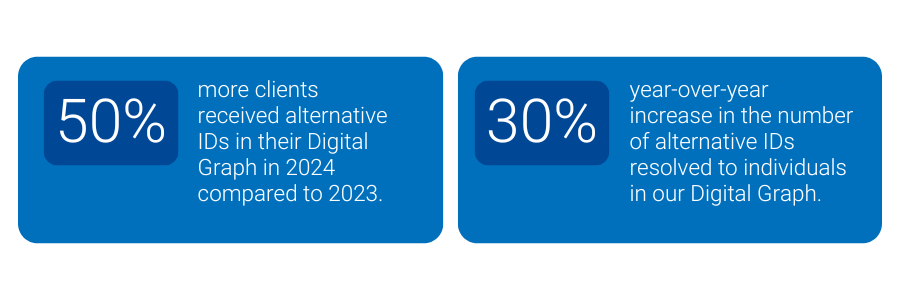
As traditional cookies crumble, marketers need fresh ingredients to keep the flavor coming. Already, about 40% of browser traffic doesn’t support third-party cookies, and marketers are spicing things up with first-party data, alternative identifiers like Unified I.D. 2.0 (UID2) and ID5, and contextual targeting strategies. In fact, 50% more of our clients received alternative IDs (UID2, ID5, Hadron ID) in their Digital Graph in 2024 compared to 2023. The number of alternative IDs resolved to individuals in our Digital Graph increased by 30% year-over-year – as everyone looks beyond the cookie jar.
There is no secret sauce to replace cookies. Instead, expect a multi-ID recipe that brings together different identifiers, unified by an identity graph. This approach turns a fragmented pantry of data into a cohesive meal, giving you a complete view of your customer on every plate.
2. The rising power of CTV: A hearty entrée of opportunities
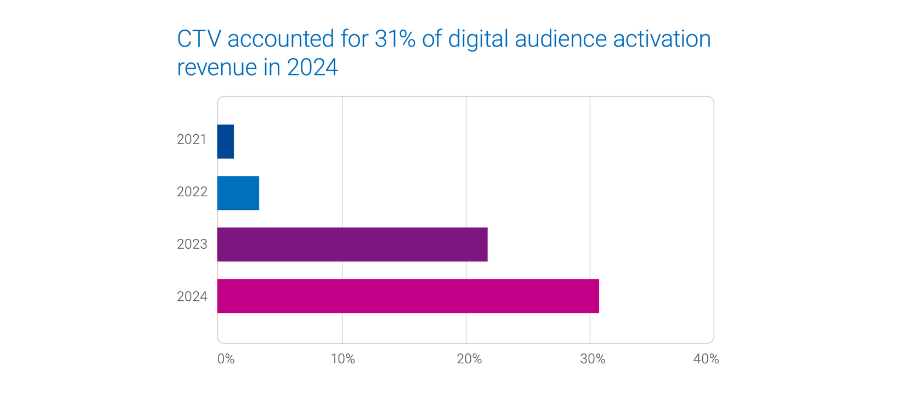
CTV is quickly becoming the main dish on the streaming menu, as viewers load up on their favorite shows. While CTV is slated to make up 20% of daily U.S. media consumption by 2026, advertisers are still holding back on pouring in the ad spend. To unlock its full flavor, marketers need to whip up solutions like frequency capping and unified audience activation.
Although CTV will account for 20% of daily U.S. media consumption by 2026, it’s projected to command only 8.1% of ad spend. Frequency capping and unified audience activation solutions will be key to unlocking CTV’s full potential.
By 2025, nearly half of CTV “diners” will choose free ad-supported streaming TV (FAST). Marketers need strategies to prevent ad overexposure. With 50% of U.S. consumers avoiding products due to ad overload, and 30% of marketers willing to increase their CTV spend if frequency capping improves, unified identity solutions help ensure every impression is served just right.
3. Omnichannel: A flavorful fusion plate
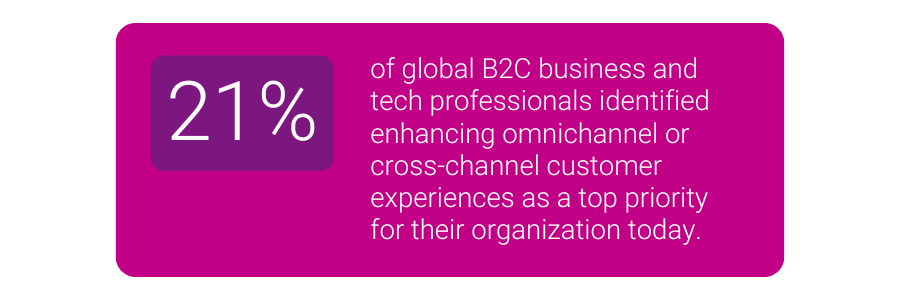
No one likes a one-flavor meal. Marketers are moving beyond single-channel “side dishes” to omnichannel “fusion feasts” that blend direct mail, digital, CTV, and retail media networks (RMNs) into a truly cohesive culinary experience. Even though only 21% of global B2C professionals currently put omnichannel at the top of their shopping list, the growing demand for seamless, audience-first campaigns is heating up.
In 2025, having an audience-first approach will be like having a perfect pairing for every course. Unified identity solutions act as your master sommelier, ensuring that each channel complements the next, and every customer enjoys a well-rounded, memorable journey.
Vertical trends: A dessert sampler from four unique kitchens
Different markets have their own signature flavors.
- In Auto, crossover utility vehicles (CUVs) claim 51% of new vehicle registrations, and consumers in the 35-54 age group and families are the primary buyers. Automotive marketers should prioritize CUV advertising with a strong focus on family-oriented and income-appropriate messaging
- In Financial Services, marketers need to anticipate shifts in consumer behavior tied to economic conditions, such as increasing demand for deposit products when interest rates are high. For insurance, aligning campaigns with life events, like new home purchases or marriage, can maximize engagement.
- In Healthcare, advertisers are prioritizing personalized, regulation-compliant campaigns that address social determinants of health (SDOH).
- In Retail, advertisers are increasingly activating on both CTV and social platforms, with many managing their own in-house campaigns. While larger brands often rely on media agencies, a shift toward in-house media buying is emerging among some bigger players, offering more control over audience targeting and performance metrics.
Our report covers each vertical’s unique menu, helping you select the right “ingredients” for your customers. With the top Experian Audiences on hand, you can create feasts that delight, nourish, and convert.
Download our new 2026 Digital trends and predictions report
Marketing in 2026 will be defined by connection: between activation and measurement, data and AI, platforms and outcomes. These connections are what turn innovation into impact, and they’re where Experian helps marketers lead with confidence.
What you’ll learn
- AI is only as good as its data : Find out why the marketers who shape how AI works, with high-integrity, human-centered data, will be the ones who lead.
- Activation and measurement are coming together: Explore how marketers are shifting from reporting after the fact to guiding performance in the moment.
- First-party data activation is becoming a foundational capability: See how it’s now possible to onboard and activate privacy-compliant audiences across channels, all from a single system.
- Commerce media is no longer just a retail play: Understand why auto, CPG, financial services, and travel brands are now adopting retail-style models to connect data, media, and sales outcomes.
- Curation is the new programmatic standard: Learn how curation brings identity, quality, and control together, allowing marketers to target confidently across connected TV (CTV), audio, and the open web.
Experian’s U.K. 2025 advertising trends
This article highlights the major advertising trends set to shape the U.S. market in 2025, but significant industry changes are happening on a global scale. For a more comprehensive look at worldwide trends, check out Experian’s U.K. 2025 advertising trends.
Contact us
Latest posts

Marketers are under more pressure than ever before to prove ROI and efficiency of marketing activities in relation to business performance. On top of that, there are new privacy regulations and uncertainty around what new technologies will have to be implemented in order to replace the granular level targeting and measurement the industry historically has used third-party cookies for. It’s clear marketers are going to need the right tech stack and partners to continue to prove their team’s efficacy. We recently partnered with Forrester Consulting to evaluate the current state of customer data-driven marketing and surveyed over 300 global marketing decision makers at the brand and agency levels. We found that marketing is facing increased demands today, insights from the study include:Consumers expect brands to deliver engaging experiences across highly fragmented journeys. Seventy-two percent of decision-makers reported that customers demand more relevant, personalized experiences at the time and place of their choosing. Marketing runs on data, but the rules governing customer data usage are changing quickly. More than 70% of study participants stated that consumer data is the lifeblood of their marketing strategies, fueling the personalized, omnichannel experiences customers demand. These demands paint a challenging picture. Just as marketers are poised (and tasked) with delivering greater value to their organizations and customers, the ground rules are changing and threatening their ability to deliver. Indeed, 62% of respondents said that the forces of data deprecation will have either a “Significant” (40%) or “Critical” (21%) impact on their marketing strategies over the next two years. Effective identity resolution can help brands prepare for data deprecation challenges Marketers face a daunting landscape, but they can leverage the data, technology, and processes that comprise identity resolution to address business objectives, combat ecosystem complexity, and future-proof customer engagement efforts. By utilizing identity resolution, marketers will be able to match and connect multiple identifiers across devices and touchpoints. This allows for a cohesive, omnichannel view that enables brands to continue to deliver personalized and contextually relevant messages throughout the customer journey and without the use of cookies. The identity graph is the underlying infrastructure that defines connections between the numerous, fluid, and disparate identifiers created during moments of consumer engagement, turning disparate signals into addressable and actionable steps. These connections enable brands to bolster their ability to gain deeper customer insights and power audience building, attribution, and connected measurement. Identity resolution encompasses a wide range of capabilities that support an equally diverse set of marketing use cases. These include the targeting, personalization, and measurement of both known and pseudonymous audiences in the offline and digital worlds, which enables marketers to improve customer data management, drive more effective personalization, and gain insights and efficiencies through measurement across touchpoints. By taking the time to vet the privacy procedures and data collection processes of identity solutions you can reduce your regulatory risk and maintain customer trust. In an open-ended survey response, a marketer shared, “We’ve found that users are willing to volunteer data when they understand what it’s being used for and are asked for clear consent.” Finding the right partners to help navigate the changes The scramble to find an alternative to third-party cookies has slowed down since Google announced they will be delaying their cookie removal until late 2023. However, this gives marketers a unique opportunity to take advantage of the additional time and feel more prepared and confident in their solutions. With the delay, marketers can now test ID solutions and compare apples to apples with data from the third-party cookie while it’s still active and addressable. Test and find a solution that works now, so there are no surprises once cookies have finally made their way out the door in 2023. At Tapad, a part of Experian, we’ve developed a solution that provides agnostic interoperability for the myriad of cookieless identifiers emerging in the market. As a new module in the Tapad Graph, Switchboard will connect traditional digital identifiers to cookieless IDs to support the entire ad ecosystem with privacy-safe future-proof identity resolution. Get in touch
Email hashing was originally intended to be used as an email security feature that has ended up being a very powerful marketing tool. A hashed email is a cryptographic function that changes an email address to a random code which can be used as an anonymous customer identifier. This code is privacy-safe and cannot be traced back to the customer’s email address. However, this hashed email can function like a digital passport that traces every behavior and action a customer takes when logged into an account that is authenticated with an email, making hashed emails a goldmine for customer data. Today emails are used across traditional publishers and within the CTV ecosystem; tying them to more consumer touch points than ever before. Why the emphasis now? Cookies are on their way out the door and have been the primary way that many marketers have tracked their existing and potential customers. In order to replace this granular level of data, marketers are likely going to need multiple solutions. With so many cookieless solutions and IDs appearing in the marketplace, the mapping of the customer journey is bound to be fragmented. Relying on first-party data, such as hashed email, is just one way to reduce that fragmentation; as it can serve as an authenticated starting point for cross-device identity resolution that can be leveraged for targeting, personalization and measurement. How can Tapad + Experian help? Tapad + Experian's Hashed Email Onboarding is a privacy-safe way to connect consumer email addresses to their related digital devices and other digital identifiers through high precision probabilistic identity. By onboarding hashed emails and incorporating them within your Tapad Graph file you can: Build a more holistic view of individuals and households and their relationship to email addresses in your first-party data set Leverage these relationships for increased cross-device scale for targeting Employ personalization tactics at the household or individual level across devices Create new audience segments and look-alike models for cross-channel activation Design more inclusive measurement and attribution for customer journey mapping Tapad, a part of Experian has built a hashed email onboarding product feature that works with the existing flexibility of The Tapad Graph to deliver the most holistic consumer view, combined with the attributes you need, in the structure that works best for your business objectives. Get in touch
The result of epic shifts from traditional cable to streaming television, the CTV ecosystem is experiencing compounded fragmentation, making it challenging for marketers to leverage in the most effective way for both activation and measurement. Heralded as the hot new household level device for highly engaged viewers, CTV brings massive opportunities for brands to move users down the funnel and incorporate CTV into their attribution modeling post-campaign. Leveraging CTV IDs within a cross-device identity resolution strategy can yield big benefits if you know how to do it right. Check out our breakdown of today’s CTV landscape to help you better understand how and what you can leverage for activation and measurement in the streaming-verse today. CTV Ecosystems as identifiers (for illustrative purposes only) This is just a small peak at the players and complexities of CTV IDs available for marketers today, but it illustrates the need to understand what IDs can benefit your strategies and where you can use them. Addressability and attribution Not all CTV devices and IDs are addressable; or have ad slots for biddable inventory for advertisers. For example, Apple TV devices and Apple TV + are not ad supported, but could still appear within an identity graph for measurement purposes; helping understand customer behavior and habits, which can inform marketing strategies. Having a household to individual view that's as inclusive as possible can provide valuable insights. CTV identity strategy Whether or not CTV devices or apps are addressable for advertisers, they can bring immense value when leveraged as part of a holistic identity resolution strategy. As a household level device with user authentication it can provide marketers a top-down view; unlocking household:individual targeting opportunities and unification of IDs at both levels for frequency management and customer journey mapping Get started with us Tapad, part of Experian, offers CTV ID onboarding and extension to our CTV ID Universe as a part of The Tapad Graph suite of products.