
As we approach 2024, marketers must grasp the evolving landscape of digital activation. Understanding emerging audience trends and activation strategies is key to developing impactful marketing initiatives and positioning your brand for success.
In Experian’s 2024 Digital audience trends and predictions report you’ll find:
- Data-driven insights that will empower you to confidently develop marketing strategies that resonate with your audience and drive meaningful results.
- Insights from Experian experts and our industry-leading data.
- Our outlook for 2024 marketing trends.
In this blog post, we’ll provide a sneak peek of the 2024 marketing trends you can expect in our full report.
Digital activation
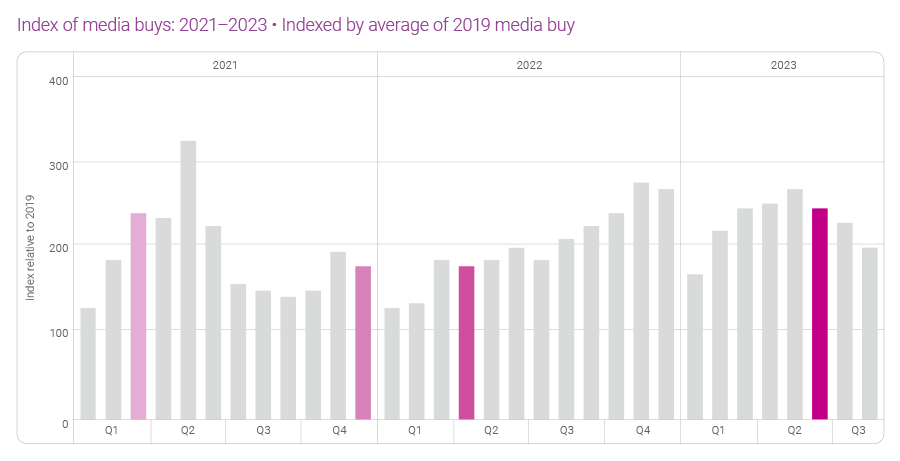
Digital activation grew by 63% between 2022 and 2023. We expect digital activation to increase in 2024 but at a slower rate than in 2023 due to economic uncertainty caused by high-interest rates, recent state privacy regulations, and work stoppages in the entertainment and automotive industries.
Top digital audiences
Which digital audiences are advertisers purchasing from Experian?
We are seeing growth in four major data categories: Automotive, Demographics, Lifestyle and Interests, and Retail Shoppers: Purchase Based audiences. Here are a few audiences within these categories that you can activate on-the-shelf of your preferred platform:
- Automotive: Autos, Cars, and Trucks > In Market-Make and Models
- Demographics: Demographics > Homeowners/Renters > Renter
- Lifestyle and Interests: Lifestyle and Interests (Affinity) > Activities and Entertainment > Wine Lovers
- Retail Shoppers: Purchase Based: Retail Shoppers: Purchase Based > Food and Drink > Restaurants: Fast Food/QSR Chicken Frequent Spenders
Top digital audiences by industry
What are the top digital audiences being activated by industry? Download our 2024 Digital audience trends and predictions report to discover the top digital audiences in the following industries:
- Automotive
- Health
- Financial Services
- Retail & CPG
Download our new 2026 Digital trends and predictions report
Marketing in 2026 will be defined by connection: between activation and measurement, data and AI, platforms and outcomes. These connections are what turn innovation into impact, and they’re where Experian helps marketers lead with confidence.
What you’ll learn
- AI is only as good as its data : Find out why the marketers who shape how AI works, with high-integrity, human-centered data, will be the ones who lead.
- Activation and measurement are coming together: Explore how marketers are shifting from reporting after the fact to guiding performance in the moment.
- First-party data activation is becoming a foundational capability: See how it’s now possible to onboard and activate privacy-compliant audiences across channels, all from a single system.
- Commerce media is no longer just a retail play: Understand why auto, CPG, financial services, and travel brands are now adopting retail-style models to connect data, media, and sales outcomes.
- Curation is the new programmatic standard: Learn how curation brings identity, quality, and control together, allowing marketers to target confidently across connected TV (CTV), audio, and the open web.
Contact us
Click here to view Experian’s U.S. Consumer Data Privacy Notice.
This site is protected by reCAPTCHA and the Google Privacy Policy and Terms of Service apply.
Latest posts

See how AdRoll and Experian combine audience data, identity, and CTV measurement to help marketers reach, prove, and grow their funnel.

Buyers can now put Experian’s audience and contextual intelligence to work in Google Ad Manager Curation in two ways: through off-the-shelf solutions available directly in Google Ad Manager, or through Custom Curation packages that Experian builds using Google Ad Manager’s inventory supply. Together, these options bring Experian’s consumer data foundation closer to the Google supply agencies already buy, with the flexibility to choose between a ready-to-use solution and an Experian package tailored to specific campaign goals. Why targeting at the source matters Many audience strategies still apply targeting on the buy side, which means signals pass through multiple systems before an impression is evaluated. Each step can shrink the pool of requests where the audience is still recognizable, so a carefully built strategy can reach the auction at a fraction of the scale it started with. Google Ad Manager Curation moves segment evaluation closer to the ad request. When a request matches the selected Experian segment, Ad Manager sends the bid request with the associated Deal ID to the buyer’s DSP. This more direct path can support stronger match and deal-transaction rates, more accurate forecasting, and better access to the audience defined in the strategy. As AI shapes more media decisions, the quality and provenance of the data feeding those systems matter more. Evaluating audience or contextual criteria closer to the source helps preserve the connection between the strategy and the impression being considered. Two ways to get started The right entry point depends on how much customization the campaign requires. Buyers can access Experian solutions off-the-shelf directly in Google Ad Manager or work with Experian to build a Custom Curation package using Google Ad Manager inventory supply. Start off-the-shelf For buyers who want direct, self-service access to Experian audience and contextual solutions. Experian solutions are available off-the-shelf in Google Ad Manager, giving buyers a straightforward way to select the data or contextual strategy that fits their campaign and create packages through Google Ad Manager’s Curation capabilities. Experian Audiences Experian Audiences draw on a deterministic offline identity foundation that represents more than 250 million U.S. consumers and 126 million U.S. households. Buyers can choose from Experian’s Audiences spanning demographics, lifestyle, financial signals, media habits, and household characteristics. That depth adds real-world consumer context beyond digital behavior alone. Contextual Experian contextual solutions give buyers a way to reach relevant environments without relying on identity. Buyers can select contextual audiences aligned to specific interests, categories, and content to inform where media appears. Experian also offers Predictive Indexed, which uses Experian audiences to predict the contextual categories and pages to target based on the likelihood that consumers visiting those environments fall within the selected audience. This gives buyers an audience-informed way to approach contextual activation without requiring identity at the point of activation. Build a Custom Curation package For buyers who need a strategy tailored to specific audience, contextual, and inventory requirements. Experian can build Custom Curation packages using Google Ad Manager’s inventory supply based on the targeting criteria that matter for a campaign. Where off-the-shelf solutions draw on Experian data, custom packages can also incorporate partner audiences and a brand’s own first-party audiences. Packages can combine Experian audiences, partner audiences, a brand’s own first-party audiences, contextual signals, and inventory or site criteria. Experian applies those criteria against Google Ad Manager inventory supply and brings the data, targeting, and inventory together into a single curated deal. This gives buyers a way to combine audience and supply decisions rather than managing each component separately. The approach can be tailored to the campaign. A buyer might start with a defined audience and add contextual or inventory criteria, bring a brand’s established first-party audience into the strategy, or build around specific supply and audience-quality requirements. Choose the path that fits the campaign Both paths do the same underlying thing: they move the audience or contextual decision closer to the ad request, before signal loss builds across the path. Whether a campaign calls for something ready to use or a package built to spec, the result is a more direct line from strategy to impression. Ready to get started? Explore Experian solutions available off-the-shelf in Google Ad Manager or contact your Experian representative to request a Custom Curation package. Latest posts

See how Experian helped FanThreeSixty clean, match, and enrich 7.6 million fan records through data enrichment and identity resolution.