At A Glance
Holiday spending is starting earlier, shifting further online, and holding steady year-over-year. Experian’s 2023 Holiday spending trends and insights report shows promotions pulling demand into October and November, steady consumer intent across the season, and growing overlap between online and in-store journeys. For marketers, that means planning sooner, connecting channels more deliberately, and measuring performance across the full holiday window.Holiday shopping no longer starts in December. Consumers are responding to earlier promotions, moving fluidly between online and physical stores, and maintaining consistent spending despite economic uncertainty. Experian’s 2023 Holiday spending trends and insights report breaks down what’s changing and how marketers can respond.
Here are three holiday spending insights shaping the 2023 holiday season.
1. Holiday spending is starting earlier
Holiday momentum now builds well before December. Promotions tied to Cyber Week and early online deals are shifting spending into October and November, extending the window for planning and activation.
Holiday sales by month vs. holiday sales (October-December)
| October | November | December | |
| 2022 | 31% | 33% | 36% |
| 2021 | 30% | 32% | 38% |
| 2020 | 31% | 32% | 37% |
| 2019 | 30% | 33% | 38% |
Cyber Week alone accounts for 8% of total holiday spending. Early activity rewards brands that show up sooner with relevant offers and consistent messaging. Marketers that plan for earlier holiday spending stay visible throughout the entire purchase cycle.
How can you apply these holiday spending insights to your campaigns?
Reach the right shoppers with your promotions with sell-side targeting. This approach gives you control over where ads appear while supporting visibility through direct publisher connections across mobile, web, and connected TV (CTV). Earlier reach helps keep your brand present as shoppers move from browsing to buying.
2. Online holiday spending continues to grow
Shoppers are increasingly researching, comparing prices, and planning purchases online. Online holiday spending increased 1% year-over-year, while in-store activity saw a 1% year-over-year decrease.
Online vs. in-store sales in 2022 by month (October-December)
| October | November | December | |
| Online | 29% | 34% | 38% |
| In-store | 32% | 32% | 36% |
Online sales still represent about one-third of total holiday shopping, but growth opportunities remain strong, especially in categories like electronics, office supplies, and gaming. Even when purchases happen in-store, online activity often plays a role earlier in the journey.
How can you apply these holiday spending insights to your campaigns?
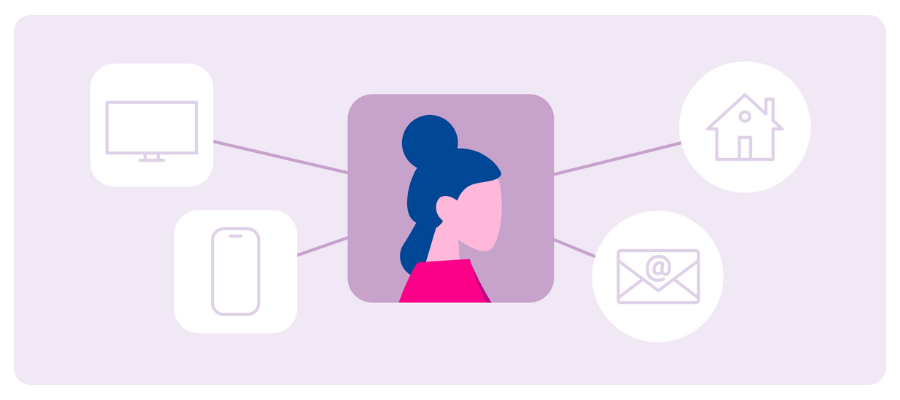
Support omnichannel shopping behavior with an agnostic identity graph. By connecting device and media signals, you can bring together online and offline activity, gain a clearer view of your audience, and make informed decisions about channel mix and budget allocation.
3. Holiday spending remains steady year-over-year
Holiday spending in 2023 is tracking closely with 2022, signaling consistent consumer intent throughout the season. Last year’s early promotional response in October was followed by steady spending through year end.
Year-over-year change on average consumer spending
| October | November | December | |
| 2020 vs. 2019 | 14% | 12% | 10% |
| 2021 vs. 2020 | 6% | 8% | 5% |
| 2022 vs. 2021 | 7% | 3% | 2% |
Overall holiday spending increased by 2% in 2022. That stability gives marketers room to focus on optimization and measurement, rather than reacting to short-term swings. When conditions remain consistent, it becomes easier to tie media decisions to meaningful business outcomes.
How can you apply these holiday spending insights to your campaigns?
Strengthen your strategy with data enrichment. Adding deeper insight into shopper preferences and behaviors helps tailor messaging and maintain consistency across channels, supporting stronger connections throughout the season.
Key takeaways
Get ready for the 2025 holiday season
2025 Holiday spending trends and insights report
Download Experian’s 2025 Holiday spending trends and insights report, in collaboration with GroundTruth. Inside you’ll find:
- When shoppers plan to buy
- Why stores still drive results
- Where marketers are placing their bets
- How AI is shaping discovery
Access our full set of predictions and plan your next holiday season now.
Connect with us
FAQs
Experian’s 2023 holiday spending analysis shows shoppers starting earlier, engaging more through digital channels, and maintaining steady year-over-year spend. These behaviors extend the season and reward brands that activate sooner. For marketers, this creates a longer runway to influence demand and measure impact.
Experian uses identity as the foundation to connect digital exposure with in-store and online purchase behavior. This approach allows marketers to see how holiday spending unfolds across channels rather than treating each interaction separately. The result is a clearer view of how media drives outcomes throughout the season.
Latest posts

Tapad, now a part of Experian, partners with Resonate to enhance audience analytics for mobile app brands
FeaturedLeading data insights and cross-device-powered services bridge mobile insights with connectivity to drive real-time consumer intelligence NEW YORK, May 17, 2017 /PRNewswire/ — Tapad, now a part of Experian, the leader in cross-device marketing technology, has partnered with Resonate, a leading provider of real-time consumer intelligence and activation SaaS solutions. Through this partnership, Resonate will leverage the Tapad Device Graph™ to capture a deeper understanding of its mobile app audiences and provide brands with a more direct connection to their intended consumers. The integration of Resonate and Tapad’s technologies equips mobile app brands with insights into their consumers’ values, beliefs, motivations and purchase drivers. As a result, mobile app brands will better understand how to tailor messaging, drive advertising engagement, increase lift in performance across mobile consumers and ultimately boost revenue and returns. Utilizing the advanced data that the Tapad Device Graph™ provides, Resonate will create an Identity Service that connects mobile IDs to Resonate IDs for reporting insights both in-platform and out. To date, Tapad and Resonate have already driven incremental device connections for nearly 60 percent of customer profiles with an amplification rate of more than 120 percent, resulting in more than 400 million net new IDs within Resonate’s user base. “After testing multiple partners over the course of 12 months, it was clear that Tapad was the partner for us, given their ability to provide cross-device connectivity for more than one billion unique IDs against our consumer base,” said Joel Pulliam, SVP and chief product officer at Resonate. “In addition, Resonate customers have an inherent trust in Tapad’s mix of probabilistic and deterministic mobile connectivity data to provide a unified understanding of their mobile audiences.” “Partnering with Resonate will not only provide its brands with a more in-depth and actionable understanding of its consumers, but it will also allow our clients to connect with mobile consumers on a deeper level,” said Pierre Martensson, SVP and GM of Tapad’s global data division. “Resonate is not just answering the question of ‘how’ consumers are making purchases, but also tackling the more difficult question of ‘why’ they make certain buying decisions to best inform mobile brands about their audiences.” Contact us today
Tapad, a part of Experian, and Innovid partner to enhance cross-device video personalization
FeaturedPartnership leverages industry-leading Tapad Device Graph™ for more effective video marketing across all connected devices NEW YORK, April 11, 2017 /PRNewswire/ — Tapad, a part of Experian, the leading provider of privacy-safe, cross-device marketing technology solutions, has announced its partnership with Innovid, the world’s leading video marketing platform. This integration enables Innovid to bring cross-device personalization and a more unified viewer experience to its video marketing clients including Bank of America, L’Oréal, Microsoft and Procter & Gamble. Innovid’s proprietary technology is the only platform optimized for video, enabling marketers to thrive in an ever-changing digital television landscape. Since its launch last year, Innovid’s Marketing Cloud Suite has helped marketers increase message relevance and the opportunity to drive conversions, retention and acquisition through video personalization. By leveraging the Tapad Device GraphTM, Innovid’s marketers can now benefit from the ability to drive consistent, personalized user experiences across all devices, creating more impactful connections with consumers and increasing ROI. “Personalization is a must for every data-driven marketer and really needs to happen across all devices to ensure a unified customer journey,” says Ronnie Lavi, SVP of product at Innovid. “At Innovid, we recognize one size does not fit all when it comes to video. As an open platform, we are always looking to add best-of-breed capabilities through integrations and partnerships, and we’ve chosen Tapad because of its superior cross-device expertise.” “Innovid has long paved the way for effective personalization in the video marketing space,” says Pierre Martensson, GM of Tapad’s data division. “As video continues to gain popularity across digital formats, we’re excited to see how our technology empowers Innovid to bring that renowned personalization to more customers across all of their devices.” Contact us today

Tracey Scheppach’s new marketing and media practice leverages Tapad’s device-level data to help clients achieve “marketing nirvana” NEW YORK and CHICAGO, April 5, 2017 /PRNewswire/ — Today, Tapad, now part of Experian, is the leading provider of unified, cross-screen marketing technology solutions, and Matter More, a next generation marketing and media practice with deep experience in the advanced TV space, announced a strategic partnership to bring together world class digital data and audience development expertise to help marketers improve how they connect with consumers. As consumer behavior continues to expand across multiple devices, today’s marketers need robust, comprehensive data solutions to accurately engage the people who matter most to their brands. At the same time, the TV industry has reached an advertising tipping point, capitalizing on the power of device-level data. “Achieving unduplicated reach and frequency across all channels with true addressability, and the ability to measure outcomes, is marketing nirvana,” says Tracey Scheppach, CEO and co-founder of Matter More, a new agency built for the modern age. “The best opportunity to deliver ‘marketing nirvana,’ at scale, is by partnering with Tapad and using their world-class Device Graph to help our clients simply matter more to the people they care about most.” “By leveraging our access to rich TV data, we can now measure the actual performance of media across channels,” says Marshall Wong, SVP, TV for Tapad. Tapad’s proprietary Device Graph™ unifies consumer behavior data across all devices, uncovering the interests, passions and behaviors of the audiences who matter most. As with any data solution, privacy, transparency and trust are crucial to bringing marketers a solid offering that delivers results. “Tapad is excited to partner with Matter More to tap into their knowledge base and experience working with some of the largest brands on TV today,” says Kate O’Loughlin, SVP and GM of Tapad’s media division. “The time has come to truly unleash the power of device-level data at scale.” Contact us today