At A Glance
Holiday spending is starting earlier, shifting further online, and holding steady year-over-year. Experian’s 2023 Holiday spending trends and insights report shows promotions pulling demand into October and November, steady consumer intent across the season, and growing overlap between online and in-store journeys. For marketers, that means planning sooner, connecting channels more deliberately, and measuring performance across the full holiday window.Holiday shopping no longer starts in December. Consumers are responding to earlier promotions, moving fluidly between online and physical stores, and maintaining consistent spending despite economic uncertainty. Experian’s 2023 Holiday spending trends and insights report breaks down what’s changing and how marketers can respond.
Here are three holiday spending insights shaping the 2023 holiday season.
1. Holiday spending is starting earlier
Holiday momentum now builds well before December. Promotions tied to Cyber Week and early online deals are shifting spending into October and November, extending the window for planning and activation.
Holiday sales by month vs. holiday sales (October-December)
| October | November | December | |
| 2022 | 31% | 33% | 36% |
| 2021 | 30% | 32% | 38% |
| 2020 | 31% | 32% | 37% |
| 2019 | 30% | 33% | 38% |
Cyber Week alone accounts for 8% of total holiday spending. Early activity rewards brands that show up sooner with relevant offers and consistent messaging. Marketers that plan for earlier holiday spending stay visible throughout the entire purchase cycle.
How can you apply these holiday spending insights to your campaigns?
Reach the right shoppers with your promotions with sell-side targeting. This approach gives you control over where ads appear while supporting visibility through direct publisher connections across mobile, web, and connected TV (CTV). Earlier reach helps keep your brand present as shoppers move from browsing to buying.
2. Online holiday spending continues to grow
Shoppers are increasingly researching, comparing prices, and planning purchases online. Online holiday spending increased 1% year-over-year, while in-store activity saw a 1% year-over-year decrease.
Online vs. in-store sales in 2022 by month (October-December)
| October | November | December | |
| Online | 29% | 34% | 38% |
| In-store | 32% | 32% | 36% |
Online sales still represent about one-third of total holiday shopping, but growth opportunities remain strong, especially in categories like electronics, office supplies, and gaming. Even when purchases happen in-store, online activity often plays a role earlier in the journey.
How can you apply these holiday spending insights to your campaigns?
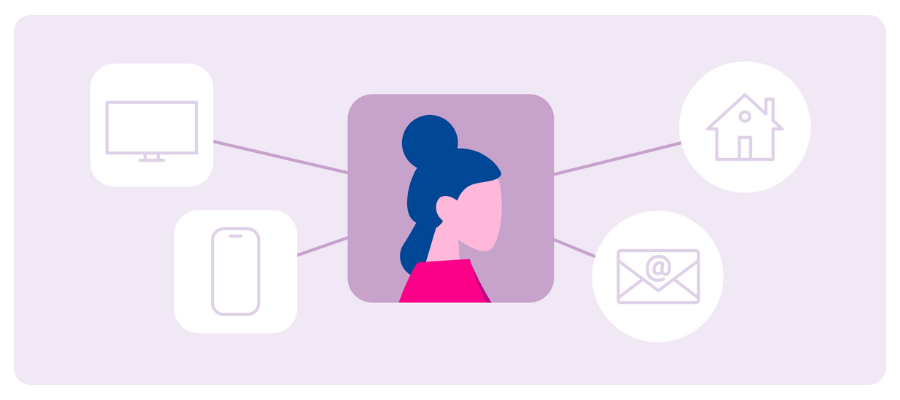
Support omnichannel shopping behavior with an agnostic identity graph. By connecting device and media signals, you can bring together online and offline activity, gain a clearer view of your audience, and make informed decisions about channel mix and budget allocation.
3. Holiday spending remains steady year-over-year
Holiday spending in 2023 is tracking closely with 2022, signaling consistent consumer intent throughout the season. Last year’s early promotional response in October was followed by steady spending through year end.
Year-over-year change on average consumer spending
| October | November | December | |
| 2020 vs. 2019 | 14% | 12% | 10% |
| 2021 vs. 2020 | 6% | 8% | 5% |
| 2022 vs. 2021 | 7% | 3% | 2% |
Overall holiday spending increased by 2% in 2022. That stability gives marketers room to focus on optimization and measurement, rather than reacting to short-term swings. When conditions remain consistent, it becomes easier to tie media decisions to meaningful business outcomes.
How can you apply these holiday spending insights to your campaigns?
Strengthen your strategy with data enrichment. Adding deeper insight into shopper preferences and behaviors helps tailor messaging and maintain consistency across channels, supporting stronger connections throughout the season.
Key takeaways
Get ready for the 2025 holiday season
2025 Holiday spending trends and insights report
Download Experian’s 2025 Holiday spending trends and insights report, in collaboration with GroundTruth. Inside you’ll find:
- When shoppers plan to buy
- Why stores still drive results
- Where marketers are placing their bets
- How AI is shaping discovery
Access our full set of predictions and plan your next holiday season now.
Connect with us
FAQs
Experian’s 2023 holiday spending analysis shows shoppers starting earlier, engaging more through digital channels, and maintaining steady year-over-year spend. These behaviors extend the season and reward brands that activate sooner. For marketers, this creates a longer runway to influence demand and measure impact.
Experian uses identity as the foundation to connect digital exposure with in-store and online purchase behavior. This approach allows marketers to see how holiday spending unfolds across channels rather than treating each interaction separately. The result is a clearer view of how media drives outcomes throughout the season.
Latest posts

The Tapad Graph Now Offered in Adobe Audience Manager, part of Adobe Analytics Cloud New York, NY — August 7, 2018 — Tapad, now part of Experian, is advancing personalization for the modern marketer, announced today that its proprietary Tapad Graph is now integrated with Adobe Audience Manager, part of Adobe Analytics Cloud, helping marketers expand their view of consumers and boost results through Tapad’s probabilistic solution. Tapad has been working closely with the Adobe Audience Manager team on this integration. With the Tapad Graph integration, customers based in the U.S. and Canada can use the Tapad Device Graph to expand the reach of audiences defined and activated in Adobe Audience Manager to extend first- and third-party data and deliver personalization across paid, earned and owned channels, publisher sites, programmatic, and more. Tapad worked closely with Adobe to develop the integration, allowing marketers to enable first-party data that has been previously tied to cookies and mobile. This offering has been beta-tested by leading organizations across retail, financial services, telecom providers, and more. Tapad has repeatedly proven its ability to provide marketers with a unified view of the customer across channels and screens. With the Tapad Graph, a global identity graph that currently supports more than 100 enterprise customers and 200 integration partners, marketers can extend their reach and customize messages based on user and household-level data. Contact us today
Tapad, part of Experian, partners with Twine Data to bring portable CRM onboarding capabilities to its best-in-class cross device solution
FeaturedMarketers Can Now Harness The Tapad Graph In Concert With Twine’s Vetted, Verified TrueData™ Identity Graph. Los Angeles and New York – August 2, 2018 – Tapad, now part of Experian, is reinventing personalization for the modern marketer, today announced that it is partnering with mobile data leader Twine Data (now TrueData) to bring Twine’s hundreds of millions of deterministic mobile identity connections to The Tapad Graph. Together, the two companies will create one of the largest portable identity graph & CRM onboarding services in the U.S., through the integration of Tapad’s best in class cross-device capability and Twine’s deterministic identity graph. At the core of one-to-one marketing and true personalization is identity resolution. For marketers, the ability to accurately and safely connect customer activity across desktop/laptop, mobile, CTV, tablets, as well as CRM and offline touchpoints is ultimately what enables informed and personalized future conversations with each customer. Tapad is known for the precision, accuracy, and scale of their cross device connections, setting them up as an ideal partner for Twine’s TrueData deterministic identity graph. “We believe that by combining Tapad’s renowned cross-device connectivity and our deterministic identity graph, marketers will finally be able to seamlessly segment users based on digital and offline behaviors as well as easily distribute those audiences to both DMP and DSP environments for personalized messaging,” said Elliott Easterling, CEO of Twine Data. With this partnership, Tapad will build a client’s cross-device graph off of identities onboarded by Twine from a client’s offline CRM. The resulting identity graph can either be delivered directly to brands looking to host their own identity graph, or can be leveraged in a managed fashion for marketers looking for simple connectivity of their offline CRM audiences to their DSPs. To date, Twine & Tapad have seen full connectivity rates* for CRM segments from advertisers at between 259 percent and 322 percent at major DSPs. *Full Connectivity Rate is defined as {total unique desktop, laptop, and mobile devices active at DSP} / {unique CRM users in original audience post cleansing}. It represents the final match rate of the clean audience in CRM format to onboarded audience at a client’s DSP instance. This metric encompasses Twine’s onboarding & linkage validation and Tapad’s cross-device amplification. About TapadTapad, Inc. is the marketing technology company reinventing personalization for the modern marketer through its identity-driven solutions. The company’s signature Tapad Graph connects millions of consumers across billions of devices. The world’s largest brands and most effective marketers entrust Tapad to provide an accurate, privacy-conscious and unified approach to connecting with consumers across screens. In 2018, Tapad introduced its Tapad Customer Data Platform (CDP), purpose-built to offer marketers a highly personalized and privacy-safe platform to convert first-, second- and third-party data into actionable, results-driven campaigns. Tapad is based in New York and has offices in Chicago, London, Oslo, Singapore and Tokyo. Tapad’s numerous awards include: Forbes’ Most Promising Companies, Deloitte’s Technology Fast 500, Crain’s Fast 50, TMCnet Tech Culture Award and Global Startup Award’s “Startup Founder of the Year.” Tapad was acquired by the Telenor Group in 2016. Telenor Group is one of the world’s largest mobile operators across Scandinavia and Asia. About TwineTwine is a mobile data platform that believes true, honest, accurate data is the fuel that helps our partners grow their businesses efficiently and effectively; Twine’s TrueData is used by brands, agencies, and ad tech partners across the country and across the globe. Twine’s app publisher partners generate revenue while maintaining control over their data; their marketer partners get comprehensive, high quality mobile targeting and intelligence. To learn more about Twine, visit their website. Contact us today

Centro integrates with Tapad, a part of Experian, for Cross-Device advertising performance on programmatic platform
FeaturedMarketers Using Centro’s DSP Basis Can Leverage Tapad’s Technology for Extended Cross-device Reach Chicago – May 15, 2018 – Centro, a provider of enterprise-class software for digital advertising, today announced that its Basis programmatic ad platform has licensed cross-device marketing technology from Tapad, a part of Experian, the company reinventing personalization for the modern marketer. Media professionals using Basis can now drive better performance by identifying a person across the different devices he or she uses, serving ads in the most optimum environment, then analyzing performance to see what ad worked best based on creative, device, location and time of day. Today’s digital media ecosystem is fragmented. People consume content on their multiple devices from multiple locations. According to digital analytics firm GlobalWebIndex, a typical consumer owns three digital devices and has seven digital ID’s active in the last 60 days. Advertising technology that treats every device as a single user would not be able to guide customers down the marketing funnel according to how users jump from one device to the next. Furthermore, they wouldn’t see when conversions occur on a device different from that in which the ad was first shown to the user. The Tapad Graph identifies the point of conversion across all screens – smartphones, tablets, home computers, and smart TVs – so that marketers can better gauge the efficiency and return on ad spend. Centro’s Basis enables advertisers to plan, buy and analyze real-time bidding (RTB), direct, search and social campaigns in a single platform. It is the only platform that combines all of these elements with cross-device conversion attribution and advanced reporting features in a DSP. With the Tapad Graph integrated into Basis, marketers can now identify consumers across all of their devices during any point of the consumer journey. This can help marketers determine ad spend effectiveness for optimizing campaigns in real-time or for the future. Other cross-device marketing capabilities for Basis users include: Frequency Capping: Apply frequency caps at a unique person-level rather than at a device-level to prevent saturating users with ads and showing them more impressions than desired. Audience extension: Expand the reach of a campaign by learning what other devices a single user may have, then deliver ads to single users’ other devices. Reporting insights: Learn how users interact with ads across their devices. Gain insight about how consumers respond on devices to improve targeting parameters. Conversion attribution: Record conversions on devices different from that in which the ad was displayed to learn the true effectiveness of advertising efforts. “Cross-device analytics and optimization aligns with our vision that converging the different parts of digital media to create a holistic view of campaigns will drive performance,” said Katie Risch, EVP of customer experience, Centro. “Having Tapad’s powerful capability of personalized marketing gives our advertisers high-quality data to cultivate relationships with customers, wherever they are in digital channels.” About Tapad Tapad Inc. is the marketing technology company reinventing personalization for the modern marketer through its identity-driven solutions. The company’s signature Tapad Graph connects millions of consumers across billions of devices. The world’s largest brands and most effective marketers entrust Tapad to provide an accurate, privacy-conscious and unified approach to connecting with consumers across screens. In 2018, Tapad introduced its Tapad Customer Data Platform (CDP), purpose-built to offer marketers a highly personalized and privacy-safe platform to convert first and third-party data into actionable, results-driven campaigns. Tapad is based in New York and has offices in Chicago, London, Oslo, Singapore and Tokyo. Tapad’s numerous awards include: Forbes’ Most Promising Companies, Deloitte’s Technology Fast 500, Crain’s Fast 50, TMCnet Tech Culture Award and Global Startup Award’s “Startup Founder of the Year.” Tapad was acquired by the Telenor Group in 2016. Telenor Group is one of the world’s largest mobile operators. About Centro Centro is a provider of enterprise-class software for digital advertising organizations. Its technology platform, Basis, is the first of its kind SaaS advertising solution unifying programmatic and direct media buying, along with workflow automation, cross-channel campaign planning, universal reporting and business intelligence. It boosts media, team and business performance by enabling advertisers to plan, buy and analyze real-time bidding (RTB), direct, search and social campaigns in a single platform. Contact us today