At A Glance
Holiday spending is starting earlier, shifting further online, and holding steady year-over-year. Experian’s 2023 Holiday spending trends and insights report shows promotions pulling demand into October and November, steady consumer intent across the season, and growing overlap between online and in-store journeys. For marketers, that means planning sooner, connecting channels more deliberately, and measuring performance across the full holiday window.Holiday shopping no longer starts in December. Consumers are responding to earlier promotions, moving fluidly between online and physical stores, and maintaining consistent spending despite economic uncertainty. Experian’s 2023 Holiday spending trends and insights report breaks down what’s changing and how marketers can respond.
Here are three holiday spending insights shaping the 2023 holiday season.
1. Holiday spending is starting earlier
Holiday momentum now builds well before December. Promotions tied to Cyber Week and early online deals are shifting spending into October and November, extending the window for planning and activation.
Holiday sales by month vs. holiday sales (October-December)
| October | November | December | |
| 2022 | 31% | 33% | 36% |
| 2021 | 30% | 32% | 38% |
| 2020 | 31% | 32% | 37% |
| 2019 | 30% | 33% | 38% |
Cyber Week alone accounts for 8% of total holiday spending. Early activity rewards brands that show up sooner with relevant offers and consistent messaging. Marketers that plan for earlier holiday spending stay visible throughout the entire purchase cycle.
How can you apply these holiday spending insights to your campaigns?
Reach the right shoppers with your promotions with sell-side targeting. This approach gives you control over where ads appear while supporting visibility through direct publisher connections across mobile, web, and connected TV (CTV). Earlier reach helps keep your brand present as shoppers move from browsing to buying.
2. Online holiday spending continues to grow
Shoppers are increasingly researching, comparing prices, and planning purchases online. Online holiday spending increased 1% year-over-year, while in-store activity saw a 1% year-over-year decrease.
Online vs. in-store sales in 2022 by month (October-December)
| October | November | December | |
| Online | 29% | 34% | 38% |
| In-store | 32% | 32% | 36% |
Online sales still represent about one-third of total holiday shopping, but growth opportunities remain strong, especially in categories like electronics, office supplies, and gaming. Even when purchases happen in-store, online activity often plays a role earlier in the journey.
How can you apply these holiday spending insights to your campaigns?
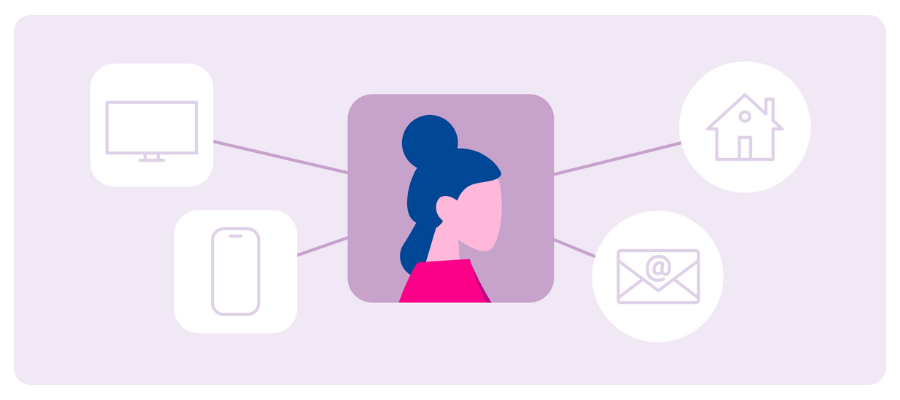
Support omnichannel shopping behavior with an agnostic identity graph. By connecting device and media signals, you can bring together online and offline activity, gain a clearer view of your audience, and make informed decisions about channel mix and budget allocation.
3. Holiday spending remains steady year-over-year
Holiday spending in 2023 is tracking closely with 2022, signaling consistent consumer intent throughout the season. Last year’s early promotional response in October was followed by steady spending through year end.
Year-over-year change on average consumer spending
| October | November | December | |
| 2020 vs. 2019 | 14% | 12% | 10% |
| 2021 vs. 2020 | 6% | 8% | 5% |
| 2022 vs. 2021 | 7% | 3% | 2% |
Overall holiday spending increased by 2% in 2022. That stability gives marketers room to focus on optimization and measurement, rather than reacting to short-term swings. When conditions remain consistent, it becomes easier to tie media decisions to meaningful business outcomes.
How can you apply these holiday spending insights to your campaigns?
Strengthen your strategy with data enrichment. Adding deeper insight into shopper preferences and behaviors helps tailor messaging and maintain consistency across channels, supporting stronger connections throughout the season.
Key takeaways
Get ready for the 2025 holiday season
2025 Holiday spending trends and insights report
Download Experian’s 2025 Holiday spending trends and insights report, in collaboration with GroundTruth. Inside you’ll find:
- When shoppers plan to buy
- Why stores still drive results
- Where marketers are placing their bets
- How AI is shaping discovery
Access our full set of predictions and plan your next holiday season now.
Connect with us
FAQs
Experian’s 2023 holiday spending analysis shows shoppers starting earlier, engaging more through digital channels, and maintaining steady year-over-year spend. These behaviors extend the season and reward brands that activate sooner. For marketers, this creates a longer runway to influence demand and measure impact.
Experian uses identity as the foundation to connect digital exposure with in-store and online purchase behavior. This approach allows marketers to see how holiday spending unfolds across channels rather than treating each interaction separately. The result is a clearer view of how media drives outcomes throughout the season.
Latest posts

Tapad, a part of Experian and the future of cookies Earlier this week, Google announced plans to create “.. a path towards making third-party cookies obsolete”; which will result in the phasing out of support for third-party cookies in its Chrome browser within two years. While there has been much discussion and debate on the future of the third-party cookie, an announcement from Google has been anticipated for some time. As many have said this week, the use of cookies and other identifiers has and will continue to evolve. What will never change is the value exchange between publishers and consumers that is enabled by relevant advertising. Notably, the need for independent companies to develop solutions that enable this value exchange has never been greater to ensure that publishers, consumers, and advertisers derive the most value from their relationship. We are well-positioned for the future From the start, Tapad, a part of Experian has led with a consumer-first, privacy-centric approach to technology as the use and proliferation of devices and global privacy regulations continue to evolve. Over the past two years, Tapad, a part of Experian has gone through a technical overhaul. Calling on almost ten years of expertise in identity resolution, we have created a modern platform that is flexible in terms of identity input as well as output. Anticipated change in the identity landscape was the driver behind our architecture decisions and what enables us to be responsive to a dynamic market. Consumer behavior and device use continue to change, bringing additional digital IDs into the equation – namely across the mobile and CTV environments. Our technology, however, is not tied to any specific type of identifier, but rather is focused on associating disparate identifiers at the individual and household level. Where do we go from here? Google’s announcement has been characterized as a conversation starter, but we see it more as a call to action. With a timeline set, there is a need to converge on one or more solutions that can scale across the web. In a post cookie world, publishers and advertisers will continue to require ways to create fair marketplaces across platforms and devices. Further, the platforms that currently power the programmatic advertising ecosystem will need to be able to invest and differentiate to bring value to their customers. Scaled privacy-safe identity solutions will be needed not only for classic targeting, attribution, measurement, and frequency capping use cases but also to carry consumer preferences and consent. Tapad, a part of Experian will continue to play a leading role here. However, we are not going to do this alone. As solutions around Google’s Chrome browser evolve, we will continue to take a leadership position and will work with Google, key industry groups, partners and customers to meet current and future needs for an independent identity solution at scale. In the meantime, we will continue to support an independent ecosystem where consumers come first and privacy standards are a priority. It’s business as usual…for now. There will not be any changes to our graph products or services as a result of Google’s announcement in the near term. Any changes related to the Chrome third-party cookie will evolve and will no doubt be subject to significant industry participation and feed-back, indeed at the invitation of Google. We will proactively communicate any changes and product updates during this time period. We look forward to the opportunities resulting from these changes and ushering in a new era of identity resolution in digital advertising. Contact us today
Tapad's integration with Knorex's XPO™ platform will complement cross-channel optimization capabilities for brands and agencies in the U.S. and APAC markets NEW YORK and SINGAPORE, Dec. 10, 2019 /PRNewswire/ — Tapad, part of Experian and a global leader in digital identity resolution, has partnered with Knorex, a leading provider of digital performance marketing. Knorex's self-service online advertising platform, Knorex XPO™, enables marketers to advertise globally in real-time across different media channels, formats, platforms and devices. Tapad's global, privacy-safe digital cross-device solution, The Tapad Graph, will compliment Knorex XPO™'s own device data set for enhanced marketing capabilities. For Knorex, the integration enables their brand direct and agency customers to gain a more accurate understanding of consumers across devices to reduce campaign inefficiencies and duplication, and to effectively manage frequency capping and attribution. Abhishek Kumar, VP of Engineering at Knorex commented, "Today's digital consumer is raising the bar for marketers. With increasing marketing complexities and consumer device usage, this integration enables marketers to understand the consumer decision journey with heightened ease. Our combined offering will empower agencies in the APAC and US markets, providing an improved marketing solution that will help to streamline their efforts." Abhay Doshi, Head of APAC at Tapad added: "The Tapad Graph, when integrated with the Knorex XPO platform, should not only help U.S. and APAC marketers optimize campaign performance through cross device marketing – but also increase the opportunity for brands to reach out to their target customers within a desired time." To learn more about Tapad and our digital identity resolution capabilities, visit https://www.experian.com/marketing/consumer-sync. About TapadTapad, Inc. is a global leader in digital identity resolution. The Tapad Graph and its related solutions provide a transparent, privacy-safe approach connecting brands to consumers through their devices globally. Tapad is recognized across the industry for its product innovation, workplace culture, and talent, and has earned numerous awards including One World Identity's 2019 Top 100 Influencers in Identity Award. Headquartered in New York, Tapad also has offices in Chicago, London, Oslo, Singapore, and Tokyo. About KnorexKnorex provides programmatic advertising products and technologies to advertising buyers worldwide. With its cloud-based online advertising platform, Knorex XPO™ enables ad buyers to self-serve and advertise real-time across the globe regardless of the media channels (social, search, OTT/CTV, video, web/mobile etc.), ad formats (display, native, search, social, video etc) and devices (desktop, laptop, smartphones and tablets) to deliver personalized marketing messages to the target audience in an automated way, powered by machine learning/AI. Underpinned by a multi-layered data-driven approach, XPO simplifies the execution and optimization of marketing campaigns, while delivering measurable and attributable performance. Contact us today
Tapad, now part of Experian, technology now powers Lifesight's real world intelligence platform with cross-device and reach expansion in the Asia Pacific Region SINGAPORE, Nov. 20, 2019 /PRNewswire/ — Tapad, part of Experian and a global leader in digital identity resolution, today announced a new partnership with Lifesight, a leading provider of real world intelligence for advertisers in the Asia Pacific region (APAC). With the combined offering of The Tapad Graph, Tapad's global, privacy-safe digital cross-device solution, and Lifesight's real world intelligence platform, brands and agencies across APAC can benefit from better consumer targeting, expanded reach for targeted audiences and web-to-mobile footfall attribution. Through this multi-layered offering, Lifesight's brand and agency partners can access an omnichannel view of consumers' paths to purchase, thereby enabling them to increase the reach, measurability and ROI of their advertising campaigns. Rohit Maheswaran, Co-founder of Lifesight commented, "The consumer journey is getting increasingly more complex with ever changing digital and physical world behaviours, making it difficult for marketers to make strategic marketing spend decisions. That's why it's our mission at Lifesight to empower the brands and agencies within the APAC market to achieve better targeting and measurement capabilities, and our partnership with Tapad will help further this cause." Abhay Doshi, Head of APAC at Tapad added, "The Tapad Graph, which enables a unified view of consumers across their multiple digital devices, has a reach of 1 billion devices across the APAC market today. Paired with Lifesight's consumer insights of more than 500 million unique devices, this valuable partnership will offer the market extended consumer reach and prove beneficial to brands and advertisers across APAC who have historically struggled with resolving attribution." To learn more about Tapad and our digital identity resolution capabilities, visit www.experian.com/marketing/consumer-sync About Tapad Tapad, Inc. is a global leader in digital identity resolution. The Tapad Graph, and its related solutions, provide a transparent, privacy-safe approach connecting brands to consumers through their devices globally. Our one-of-a-kind Graph Select offering enables marketers the flexibility and freedom of choice to correlate devices to varied objectives, driving campaign effectiveness and business results. Tapad is recognized across the industry for its product innovation, workplace culture and talent, and has earned numerous awards including One World Identity's 2019 Top 100 Influencers in Identity Award. Headquartered in New York, Tapad also has offices in Chicago, London, Oslo, Singapore and Tokyo. About Lifesight Lifesight is Asia's leading real world intelligence company that helps marketers understand, target, and measure consumers based on their real world behaviour. Lifesight's robust platform and data solutions power business decisioning, audience activation, footfall measurement, and in-depth location analytics for leading brands and enterprises. The company is headquartered in Singapore with a rapidly expanding footprint in the Asia Pacific region operating in India, Malaysia, Indonesia, UAE, Saudi Arabia, Thailand, Philippines, Vietnam, Japan, Australia and New Zealand. To learn more, visit https://www.lifesight.io/. Contact us today