Financial Services
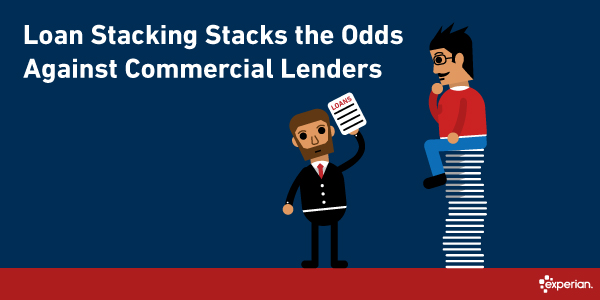
Loan stacking is a small but serious problem for Online Marketplace Lenders (OMLs). Often invisible to the issuers of commercial capital, businesses that engage in this insidious practice are significantly more likely to become delinquent on their payments and even default entirely on their obligations. If you manage a company that issues commercial credit, you need to be diligent in weeding out these bad players to protect not only yourself but your industry as a whole. What is Loan Stacking? Simply put, loan stacking is the opening of multiple credit lines within a short period of time. (Sometimes as little as 24 or 48 hours.) Because there is a natural lag in credit reporting, the lenders involved usually are unaware that other companies are transacting with the same customer. On the personal credit side, loan stacking is a potential problem for borrowers who run their multiple credit lines near – or up to – their maximums and then find they can no longer meet all of their monthly obligations. However, it’s not uncommon for individuals to carry multiple credit cards, and most credit card companies already have reliable systems in place to ensure borrowers don’t get more credit than their incomes justify. Things are different on the commercial side. Today, a lot of short-term borrowing occurs online through Merchant Cash Advances (MCAs). Repayment takes the form of weekly or even daily debits against the businesses’ cash receipts pulled directly from the borrower's checking account. For example, a restaurant may take out a $10,000 cash advance, the lender then taking five percent of that restaurant’s daily receipts until the advance is repaid – with interest. MCAs are not technically considered “loans,” and thus are not subject to the same regulations and oversight as traditional commercial lending. Such advances usually cover a period of four to eight months. Some can go as long as 12 months, but rarely do they go longer. MCAs are most popular among retail stores and have helped many small businesses get funding when needed. However, problems arise when a business takes out several cash advances at the same time. Instead of paying, say, 5 percent of daily receipts to a single lender, the restaurant loses perhaps 20 percent to four lenders simultaneously. At this rate, the business becomes unsustainable and defaults. Not only is commercial loan stacking a risky practice, it can be legally problematic. Many MCA providers are now placing anti-stacking language in their contracts that require borrowers to pledge not to promise their receipts to any other companies. Stacking loans violates this provision and thus may be tantamount to fraud. How common is commercial loan stacking? Based on our research and analysis, we believe that between five and six percent of all merchant cash advances are stacked. In 2013, the MCA market accounted for about $3 billion in transactions. By December 2016, that number had probably doubled. That means that between $150 million and $360 million in commercial loans are stacked. Granted, that's a drop in the bucket for the $1.9 trillion commercial lending industry, but for a small company just getting in the business of making such credit advances, it could be a serious threat to their portfolio's health. Why loan stacking occurs Why do MCA lenders allow themselves to be pitted against each other in this fashion? Blame the internet. The same internet that gives us the benefits of virtually instantaneous credit applications, reviews and approvals also makes it possible for businesses to easily make multiple applications within a 24- or 48-hour period. Many commercial credit reporting companies may provide updates as quick as 24 hours in some cases, a commercial MCA lender receiving a cash advance application may experience a slight delay in knowing if other lenders are working with the same customer. As for borrowers, most don't stack because they are not intending to commit fraud or otherwise game the system. They're doing so because, at the time, they believe they have no choice. Running a small business is difficult. Businesses often operate on thin margins and owners may, at times, struggle to make payroll. If there's a sudden setback or cash flow suddenly stalls, an owner may need a sizeable cash infusion just to keep the doors open. Being an optimistic lot, most owners who get multiple MCA loans do so in the belief they can quickly get over the hump, recover their losses, rapidly pay back what they owe and no one will be any the wiser. Sometimes, this strategy works. But too often, it does not. And that's when things get nasty. How to avoid loan stacking customers If you are an MCA lender and wish to avoid loan stacking customers, you have three tools at your disposal: Before making a cash advance, ask to see a full year of checking account activity. If you see a pattern of weekly or daily debits in a similar dollar range, this could be a sign that the business already has an MCA in place. If the business is relatively new, check their credit report for a high number of UCC (Uniform Commercial Code) filings. A large number of hard credit inquiries often indicates the owner is doing a lot of loan shopping, and this can indicate loan stacking. Sign up for Experian's custom short-term industry specific risk model consulting services. Signs of loan stacking, particularly in young companies with excessive UCC filings, can often be spotted using this service. For MCAs and all other forms of commercial lending to work, all parties have to play by the rules. Discouraging loan stacking not only benefits lenders, but also the borrowers who depend on the services these lenders provide.

I sat down with Gavin Harding, Sr. Business Consultant with Experian who is attending American Banker’s Marketplace Lending & Investing Conference in New York City this week to get his perspectives. Interview with Gavin Harding Gary: Hello and good evening my name is Gary Stockton and I’m with Experian Business Information Services in Costa Mesa. I’m joined by Gavin Harding who is with our global consulting practice. Gavin is at the Marketplace Lending and Investing show in New York, Gavin how are you doing in New York? Gavin: Good evening Gary it’s good to be here. It’s a tremendous show this year. Very high-energy, very dynamic a little different to some conferences that we’ve participated in over the last couple of years. So some evolving themes. Two years ago, three years ago at this type of conference it was all about growth. Maybe a year ago it became more about regulation and compliance, kind of a more pragmatic approach. And this year it has evolved one more time into a core question of sustainability. How can marketplace lenders build a solid foundation that incorporates compliance, growth, risk, basic core principles of governance to make sure they become profitable and that they are still here in 3 to 5 years? So it’s really interesting to see those themes emerge over the last couple of years. Gary: So marketplace lenders it seems like they are getting their houses in order right? We’ve had a few things happen in the last six eight months that kind of rattled the industry but I think a lot of them have taken a step back from that rapid growth pace to get you know compliance and things like that in order, and a lot of them are pursuing partnerships with lenders right? Gavin: That’s right. So, some of the key drivers have changed over the last year have been some things in the news that kind of shook the industry up a little bit, caused both marketplace lenders themselves and the investment community and the banks and bank partners to stand back a little bit and pause, and address some really key fundamental questions. So, one of the questions, I want to take this from a bank perspective. There was a great program this morning. Four panelists - one banker and three marketplace lending lawyers, and the question was about the interaction between banks and marketplace lenders, and it was really interesting questions that were asked and one of them was, if every marketplace lender has its core competency, it’s target market, the thing it does differently and better than anybody else the differentiator, the key question for the bank partner is how real is that? How do we know? How do we document that? So there’s definitely more of a, it’s great to share the story with the bank partner, now the bank partner is saying that’s great I like the story, now let me show or let me see some evidence how it works, show me that you are adhering to your model consistently. Show me that you were documenting what you’re doing. Show me that you are being fair and disciplined in your credit decisions. Prove to me that when you say your portfolio is grade A+, that it actually is grade A+. So, not so much a skepticism, more a real life pragmatism to fully engage with the marketplace lender and to understand their model down to a granular level in terms of process, in terms of business governance, management practices and so on. So I see it as a convergence of the new innovative approaches of marketplace lenders, and the more traditional approaches of banking. So I see the two as coming together being more engaged and aligning more closely and again that overall pragmatic approach is prevailing. Gary: Are you seeing, last year there were a lot of international companies starting to come on the scene there were a number of Chinese marketplace lending companies, is that kind of still the case or is it pretty much domestic US marketplace lenders? Gavin: So with this particular event this year it seems it’s mainly U.S. based however there are some global players. I’m not seeing a lot of participants and attendees from Asia for instance where at prior events we would have seen more of them. Gary: And so looking at the agenda are there any sessions that you personally are looking forward to? Gavin: Today the one that really resonated with me was the session on bank partnerships, exactly how they can work and the one theme that was a central core statement from that is, compliance is now a price of entry. Compliance is not a want to have. The marketplace lender has to have solid documented procedures in place to have a conversation with a bank. This doesn’t mean that there needs to be an exact mirroring of the bureaucracy and really deep compliance processes in a bank, but it means that the marketplace lender has to understand the banks perspective, has to speak the banks language and needs to understand the regulations with which the bank is complying. That’s now the expectation from banks of their marketplace lending partners. And that changes the world significantly for them. There is a demand for better alignment and mutual understanding, high levels of transparency and the application of fundamental principles of management and good governance so for me that session today resonated. I think it was a long time coming, and it was good for the group to hear that. Gary: That’s great so you’re there tomorrow and you’re speaking at the conference right? Gavin: Tomorrow afternoon we have a session that should be pretty interesting, it’s a panel session and it is centered on building sustainability in your portfolio. Let me tell you kind of where that comes from and why we’re talking about this. So there has been over the last year and a half, a tightening in terms of the availability of capital for marketplace lenders, a heightening in the demand from investors and from bank partners and others, heightening in the demand for additional information and more granular data on what’s in the portfolio, portfolio content, predictive performance, risk profiles and so on and so forth. To continue to address those needs marketplace lenders need to look within their portfolio to add components in terms of reporting, in terms of upfront origination discipline, ongoing management so that as they approach partners to look at these portfolios and invest in them, the partners can gain a level of confidence that the portfolios are as presented. So tomorrow I will be speaking with two other panelists, one from the world of regulation compliance in an advisory capacity working for a law firm in DC with a long history of working in the regulatory and supervisory market. And the perspective of the other panelist is from a firm that assesses portfolios, stress tests portfolios, establishes valuations and so forth, again related to our conversation on investment, the investment community, the reduced availability in capital of capital and the demand for more information and then I’ll be giving some examples of some work we’ve done with clients in terms of trying to understand the portfolio. Of presenting the portfolio in industry-standard approaches, industry-standard scores, industry-standard analytical approaches that can help bridge a portfolio to the investment community, and help that investment community gain a level of comfort that they need. So I think it will be a lively discussion, I think we got some great diversity in the panelists, and from what I saw today I think the audience is going to be very engaged and ask some tough questions. Gary: That’s great so do you think you might have time tomorrow to give us another recap from the event? Gavin: I’d look forward to that. Gary: OK. Well I want to thank you for taking time out I know that you very busy there it’s in the evening so thanks for staying back and giving us your update and we’ll look forward to another chat tomorrow around the same time. Gavin: You’re welcome thank you Gary.
According to the U.S. Small Business Administration (SBA), small businesses account for 99.7 percent of U.S. employer firms and 64 percent of new private-sector jobs. So it stands to reason that the way small businesses go, the economy probably follows suit. One of the biggest challenges for small businesses, however, is the ability to access capital. In order for them to grow, they need money. Many of these smaller firms have limited to no credit history on file. For that reason, it is imperative for lenders and trade creditors to leverage comprehensive data sources (both financial and non-financial), enabling them to make smarter business decisions and help small businesses access credit. It is Experian’s core belief that an open and secure data sharing program is crucial to helping small businesses get the credit they deserve, and it's Small Business Credit Share® program is at the center of this ideal. Small Business Credit Share℠ is a Credit Data Sharing "Club" Small Business Credit Share℠ (SBCS) is a consortium of banks, credit card companies, leasing agencies and other companies that have agreed to provide financial and non-financial data in exchange for exclusive access to data from other contributors. By gaining access to this database, lenders and trade creditors can make more informed decisions, while also promoting financial inclusion and spurring growth within the small business segment. Currently, six of the nation's top ten financial institutions are members, as well as several telecommunications and utilities companies. Small Business Credit Share℠ offers more aggregates (data elements) than any other service of its type. Whereas many lenders rely primarily on summary data (e.g., a credit score and reports of missed payments over the past year), Small Business Credit Share reports include a vast array of detailed credit, financial and non-financial data. As a requirement of membership, members must contribute at least 10 pieces of data on each small business account, such as account types, highest credit utilized, total account balance and payment history profiles. Together, these aggregates provide a much deeper, more meaningful view of a small business than was ever possible when drawing from just a handful of sources. They have also proven to be a far more accurate predictor of credit risk than any other service Membership Provides Benefits to Financial Institutions and Borrowers Alike Small Business Credit Share℠ provides significant benefits to member institutions as well as to the customers they serve. For example, Small Business Credit Share allows members to see the obligations an applicant already has to other lenders. With this knowledge, a lender can make sure an applicant does not become overextended and thus jeopardize their ability to pay back the loans already outstanding. A lender can also generate reports that, when shared with a customer, help ensure that paying back that lender becomes a priority so as to strengthen their credit score. Small Business Credit Share can also help members achieve SBA compliance, as the SBA mandates reporting to "bureaus" for all SBA-backed loans (SOP 50 57). To Get More, Give More As in life, what you can get out of the Small Business Credit Share℠ tends to be directly proportional to what you put into it. The more data members share, the clearer the picture of their small business borrowers becomes, and the smarter credit decisions they are able to make. Watch our Small Business Credit Share Program Overview Video We're encouraged by the overwhelmingly positive reception the Small Business Credit Share has received from the financial industry as a whole and from our member companies in particular. We remain committed to the idea that financial inclusion provides a strong value proposition to the Financial Services community, and believe Small Business Credit Share aligns with that ideal. Small Business Credit Share

Imagine for a moment a young parent who has been laid off from their job. After months of looking for work they still have not found a job. To make ends meet they start doing landscape work for neighbors in the area, eventually jump-starting a landscaping business to provide for their family. With some hard work, they start to build up a clientele in the local neighborhood. While they are starting to get back on their feet slowly, they realize at the current rate, the business will not completely meet the needs of their young family. If they could borrow just $3,000 to buy some more mowers and trimmers, however, they could hire two friends and double the size of the business. With that in mind, let’s assume that they have a mediocre credit score, their credit card has a credit limit of $1,000 and they are maxed out. Furthermore, they don’t own a home to borrow against, and the loan size they are seeking is too small for a bank to even consider. However, if they could get a $3,000 loan, they could expand their business, create two new jobs and better provide for their family. There are folks just like the person described above all across the country looking for help. But where do they turn? Alternative financing options provide an avenue for entrepreneurs and other small business owners looking for commercial funding, who are otherwise turned down from more traditional financial institutions, such as banks and credit unions. By leveraging business credit data from credit bureaus, such as Experian, as well as other data sources, alternative financers are able to make lending decisions and extend credit to this segment of small business owners, enabling them to finance their company’s growth, ultimately stimulating the economy. One example of an alternative financer using such data to help open opportunity for small businesses is Opportunity Fund, a non-profit micro lender in California. Otherwise known as Community Development Financial Institutions, these micro lenders aim to create economic opportunity for underprivileged businesses in the U.S. And the need for these alternative financial institutions in California is critical. Despite recent upticks in our economy nationwide, things are still very tough in the Golden State. New data released by the Corporation for Enterprise Development (CFED) show many Californians are still struggling to gain a foothold in the economic recovery. CFED’s 2015 Assets & Opportunity Scorecard ranked California 50th among all states and the District of Columbia, for its large number (15.8 percent) of underemployed workers, 49th for both its home ownership and housing affordability rates, and dead last (51st) for high school degree attainment. Source: Corporation for Enterprise Development (CFED) Needless to say, there are a number of small business owners in California looking for financing to help grow their business. Organizations like Opportunity Fund help these business owners find affordable funding, and educate them on what they need to know about expanding. How alternative financers are helping? Opportunity Fund CEO, Eric Weaver & Rosa Funes A prime example of how alternative finance options are helping small businesses is the story of Paradise Flowers and Gifts. In Opportunity Fund’s most recent video, CEO Eric Weaver describes first meeting Rosa Funes, and how she described her longtime love of flowers. As a loan officer at the time, Eric described going to Rosa’s home and knocking on her door. She needed $500 to start a flower business. The amount was smaller than they had ever considered, but Eric was so moved by her story and her drive that he looked at her and said “Yes”, and told her “Rosa, you have a dream, don’t stop.” Alternative finance options, like Opportunity Fund are working hard every day to help small business owners and entrepreneurs gain the financial footing they need to succeed. After all, they are the backbone of our economy. The work that Opportunity Fund and other alternative financers have done will create a powerful ripple effect to drive economic opportunity across California, and the rest of the country. It’s the perfect example of how data can be used for the betterment of society and helps these smaller entrepreneurs grow.