The January 28, 2025, Commercial Pulse Report reveals fascinating insights into the evolving U.S. economy, with a spotlight on the transportation and warehousing sector—a critical backbone of global trade and supply chains.
Watch Our Commercial Pulse Update
Over the past year, this industry has experienced steady growth, largely fueled by younger businesses. Companies less than two years old now account for a remarkable 50% of new commercial credit accounts in the sector. This entrepreneurial surge reflects the industry’s role as a magnet for new opportunities amid expanding global trade.
Rising Credit Risks Amid Growth
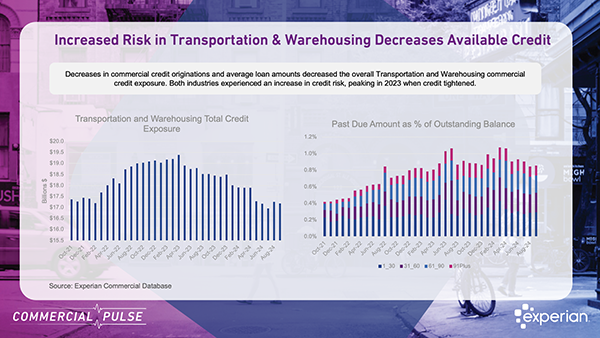
While the sector’s growth is a promising trend, it has come with challenges. Credit risk for transportation and warehousing businesses peaked in 2023, prompting lenders to tighten underwriting standards. This shift has led to a noticeable reduction in the total volume of commercial credit granted within the sector, making it harder for businesses to access the funding they need.
Source: Experian Commercial Pulse Report
Global Trade and Its Influence
The broader trade environment has also played a role in shaping this industry. Global trade expanded by 3.3% in 2024, with services trade leading the way at a 7% increase. However, the U.S. trade deficit widened to $78.2 billion in November, driven by rising imports and geopolitical uncertainties. Tariff adjustments under President Trump’s administration could further impact this industry, introducing a layer of unpredictability for 2025.
Looking Ahead
The transportation and warehousing sector stands at a crossroads, balancing opportunities for growth with mounting credit constraints and external pressures from the global trade landscape. Businesses operating in this space will need to stay agile, exploring innovative strategies to navigate financial challenges and capitalize on expanding trade networks.
For more insights into how these trends are shaping the small business economy download the Commercial Pulse Report, visit Experian’s Commercial Insights Hub or reach out to your Experian account team to explore customized solutions for your business.
Experian Commercial Pulse Report Explores Implications of Rising Premiums
As the year draws to a close, one issue looms large for millions of small business owners: the rising cost of healthcare. According to the latest Experian Commercial Pulse Report, small business survival may soon hinge on a single factor — whether enhanced Affordable Care Act (ACA) subsidies are extended into 2026.
Watch the Commercial Pulse Update
The Clock Is Ticking on ACA Subsidies
The American Rescue Plan and Inflation Reduction Act temporarily expanded ACA subsidies, helping make coverage more affordable for millions. But those enhancements are set to expire at the end of 2025 — a policy shift that could unleash a wave of economic strain.
The Kaiser Family Foundation estimates that if these subsidies lapse, individuals who purchase insurance through the ACA marketplace could see a 75% increase in premiums.
Why does this matter so much for small businesses? Because half of all ACA marketplace enrollees are small business owners, entrepreneurs, or their employees.
Coverage Is Shrinking, and Costs Keep Climbing
Smaller businesses have historically been less likely to offer health insurance benefits than their larger counterparts. In 2025, only 64% of businesses with 25 to 49 employees offer health benefits — the lowest level ever recorded.
And while large employers are still required by the ACA to offer coverage to full-time workers, they too are feeling the pressure. Since 2010, employers have gradually reduced the share of healthcare premiums they cover, even as deductibles have risen by 164% for single coverage plans.
The result? Business owners are being squeezed from both sides — by rising insurance costs and a more financially stressed workforce.
The Ripple Effects Could Be Widespread
If enhanced subsidies aren’t renewed, many small businesses may have no choice but to:
Shut down operations
Cut staff
Shift jobs into larger organizations that can offer coverage
That would be a blow not only to small business dynamism but also to broader economic sectors. Reduced consumer spending could hit industries like retail, real estate, and manufacturing, while healthcare providers face payment cuts and job losses due to shrinking coverage pools.
What’s Next?
With Congress set to vote on subsidy extensions before the end of the year, the stakes couldn’t be higher. The outcome will likely define affordability, access, and entrepreneurship for years to come.
For small business owners, now is the time to assess your coverage plans, understand your employee needs, and prepare for potential cost increases. For policymakers and industry leaders, it’s a critical moment to ensure healthcare reforms continue to support the backbone of the U.S. economy — small businesses.
Experian continues to provide actionable data to help businesses, lenders, and policymakers navigate uncertainty. To access the full Commercial Pulse Report and explore more insights on small business credit and sector-specific performance:
✔ Visit our Commercial Insights Hub for in-depth reports and expert analysis.
✔ Subscribe to our YouTube channel for regular updates on small business trends.
✔ Connect with your Experian account team to explore how data-driven insights can help your business grow.
Download the Commercial Pulse Report
Visit Commercial Insights Hub
Related Posts
The latest insight, tips, and trends on all things related to commercial risk by the team at Experian Business Information Services. Please follow us on social media.
Stay informed by subscribing to this blog
Sign up for email notifications when new content has been published by Experian Business Information Services.