Every year, I look forward to sharing Experian’s Future of Fraud Forecast because it’s more than just a report — it serves as a trusted guide for the industry and a way to cut through the noise to spotlight the trends that will matter most over the next year. Fraud isn’t just a business problem. It’s also a human problem that impacts real people. Every time we stop fraudsters, we protect people’s identities, their financial security, and their trust in the digital world. That’s the mission that drives me.
As we head into 2026, the fraud landscape is evolving in ways we couldn’t have predicted 20 years ago. We’re entering an era where AI is making fraud more sophisticated, autonomous and scalable than it was even just 12 months ago. For example, agentic AI can help book a vacation with just a single prompt. Meanwhile, tried and true schemes that have been around for years are still happening and are being accelerated by AI. This isn’t science fiction, it’s happening now and requires modern fraud mitigation strategies to combat. If we fail to act, businesses and consumers will face risks that are harder to detect and easier to exploit, leaving millions vulnerable.
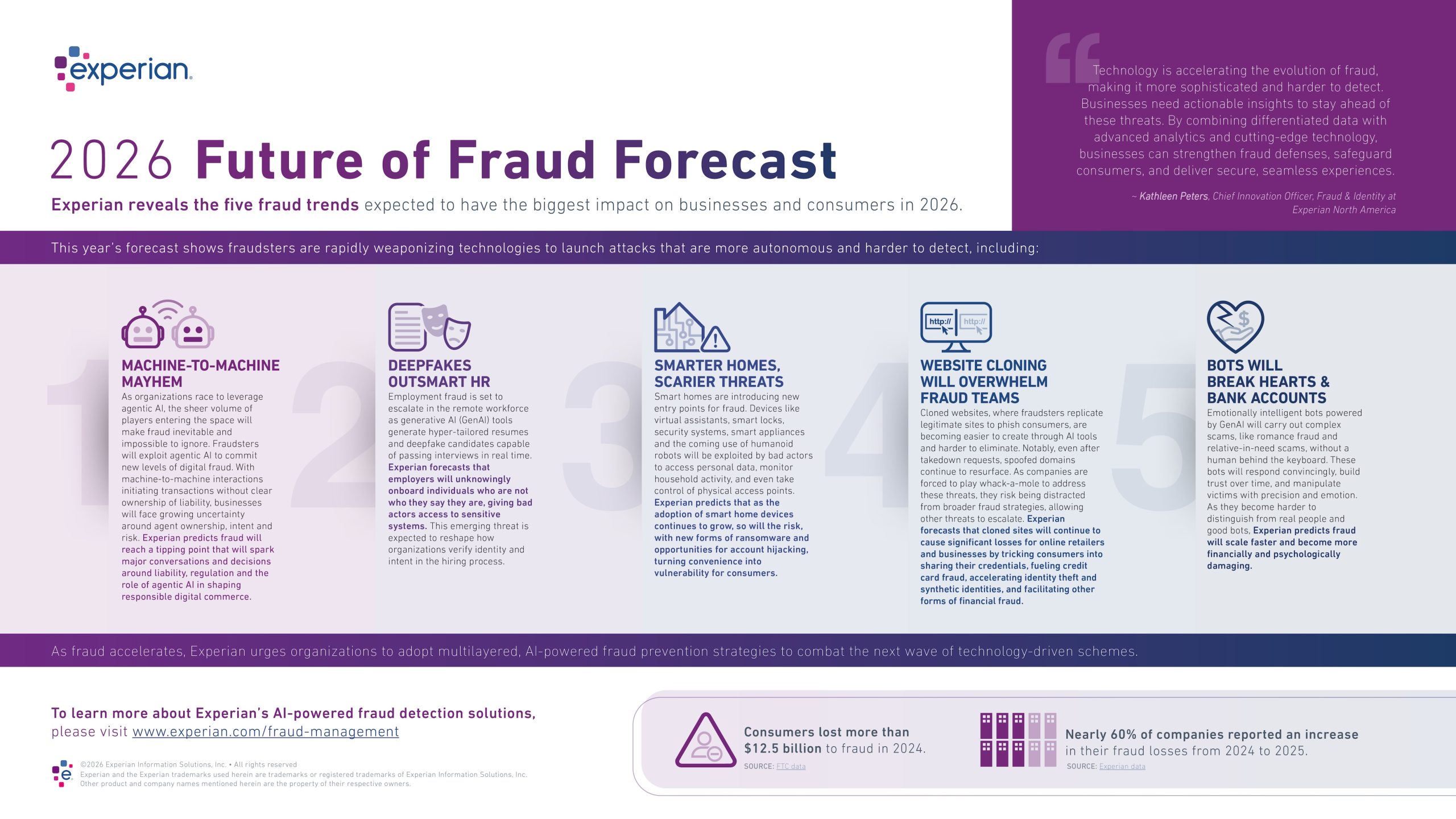
This year, our forecast highlights five fraud threats including:
- Machine-to-machine mayhem: As organizations race to leverage agentic AI, the sheer volume of players entering the space will make fraud inevitable and impossible to ignore. Fraudsters will exploit agentic AI to commit new levels of digital fraud. With machine-to-machine interactions initiating transactions without clear ownership of liability, businesses will face growing uncertainty around agent ownership, intent and risk. Experian predicts fraud will reach a tipping point that will spark major conversations and decisions around liability, regulation and the role of agentic AI in shaping responsible digital commerce.
- Deepfakes outsmart HR: Employment fraud is set to escalate in the remote workforce as generative AI (GenAI) tools generate hyper-tailored resumes and deepfake candidates capable of passing interviews in real time. Experian forecasts that employers will unknowingly onboard individuals on a much larger scale who aren’t who they say they are, giving bad actors access to sensitive systems. This emerging threat is expected to reshape how organizations verify identity and intent in the hiring process.
- Smarter homes, scarier threats: Smart homes are introducing new entry points for fraud. Devices like virtual assistants, smart locks, security systems, smart appliances and the coming use of humanoid robots will be exploited by bad actors to access personal data, monitor household activity and even take control of physical access points. Experian predicts that as the adoption of smart home devices continues to grow, so will the risk, with new forms of ransomware and opportunities for account hijacking, turning convenience into vulnerability for consumers.
- Website cloning will overwhelm fraud teams: Cloned websites, where fraudsters replicate legitimate sites to phish consumers, are becoming easier to create through AI tools and harder to eliminate. Notably, even after takedown requests, spoofed domains continue to resurface. As companies are forced to play whack-a-mole to address these threats, they risk being distracted from broader fraud strategies, allowing other threats to escalate. Experian forecasts that cloned sites will continue to cause significant losses for online retailers and businesses by tricking consumers into sharing their credentials, fueling credit card fraud, accelerating identity theft and synthetic identities, and facilitating other forms of financial fraud.
- Bots will break hearts and bank accounts: Emotionally intelligent bots powered by GenAI will accelerate the scale of their complex scams, like romance fraud and relative-in-need scams, without a human behind the keyboard. These bots will respond convincingly, build trust over time, and manipulate victims with precision and emotion. As they become harder to distinguish from real people and good bots, Experian predicts fraud will scale faster and become more financially and psychologically damaging.
Fraud is becoming more adaptive, autonomous, and intelligent. But the good news is we can fight back. At Experian, we’re committed to helping businesses outpace these threats by combining differentiated data, advanced analytics, and AI-powered technology. Together, we can protect consumers without sacrificing experience and make a real difference in people’s lives.
Learn more about Experian’s fraud prevention solutions here.