
Achieving Top Workplace recognition for 12 consecutive years is no small feat, yet Experian North America has done just that. Named a Top Workplace by the Orange County Register once again, this milestone reflects not just policies or benefits but what truly makes Experian exceptional: our people.
As Hiq Lee, Chief People Officer at Experian North America, notes, this honor is a testament to the remarkable contributions of our team. Experian’s employees shape an environment where innovation, inclusivity, and purpose thrive.
More Than Work
What sets Experian apart is our engagement with the world and community. Through initiatives like the Experian Volunteer Leadership Network and partnerships with organizations such as the Octane Foundation for Innovation and the Hispanic Chamber of Commerce of Orange County Education Foundation, our impact extends beyond the workplace.
In 2024, we earned additional recognitions, including being named one of the World’s Best Workplaces™ by Fortune and Great Place to Work®. We were also recognized as one of the Best Workplaces for Parents, Millennials, and in Technology.
The Secret to Success
Our success lies in focusing on people. Experian is a place where careers are built, ideas are encouraged, and employees feel valued. Initiatives such as, Employee Resource Groups foster belonging, Mental Health First Aiders provide support, and technology hackathons inspire creativity.
Innovation at the Core
Innovation continues to drive our success. By leveraging technologies like artificial intelligence and machine learning, we are redefining decision-making and fraud prevention. This commitment to innovation empowers businesses and consumers worldwide, aligning with our mission to promote financial inclusivity.
Looking Ahead
For Experian, being a Top Workplace for more than a decade isn’t a finish line—it’s a springboard. With an ongoing commitment to our employees and communities, we continue to evolve, creating better experiences for our team, clients, and the world.
Related Posts

When consumers apply for credit, lenders want to make the most informed decision possible. And consumers want to know they’re being considered based on a more complete financial picture that reflects where they are today. Credit data is foundational to lending decisions, providing a proven view of how consumers have managed credit over time. But we know credit data doesn’t tell the full story for everyone, and millions of consumers face challenges accessing credit. According to recent research from the Federal Reserve Bank of New York[1], nearly one in five consumers lacks access to mainstream credit or has damaged credit. Our own research shows 60% of consumers who’ve previously been denied credit or received less favorable terms than expected believe the outcome would’ve been different if lenders had considered their recent income and banking activity alongside their credit history.[2] Consumer-permissioned cash flow data can complement credit information with a more current view of income, expenses and financial activity. These insights can help businesses better understand consumers and approve up to 30% more applicants on average – without adjusting their risk tolerance. But what about before a consumer applies for a financial product? Cash flow insights can create value at many points across the consumer journey, including helping people find financial products that fit their needs and financial circumstances. Putting cash flow insights to work earlier in the journey We have direct relationships with more than 90 million members who come to Experian for tools and resources to help improve their financial health. As part of that experience, our members have access to Experian Marketplace, a leading consumer comparison-shopping platform for credit cards[3], personal loans[4] and auto insurance[5]. Now, we’re bringing cash flow insights directly into that experience. With our Marketplace platform Activate, we’re bringing together credit data, advanced analytics, AI and consumer-permissioned financial information to help create more personalized offer matching so consumers can receive more offers they are qualified for that could meet their needs. For consumers who choose to connect their bank accounts, participating lenders can incorporate our Cashflow Attributes into decisions alongside traditional credit information. This can help lenders identify consumers who may be a good fit for their products while helping consumers discover offers that better reflect where they are today. This is an important step in how we think about the potential of cash flow data. Its value doesn’t begin and end with underwriting decisions. From helping consumers find relevant financial products to giving lenders additional information to make more informed decisions, cash flow insights can help create a more connected experience. And Experian is uniquely positioned to bring those pieces together. Millions of consumers trust us to help them understand and improve their financial health, while businesses rely on our data, analytics and technology to make important decisions every day. Connecting those two sides of the financial ecosystem gives us an opportunity to put cash flow insights to work in ways that can benefit both. Building what’s next At Experian, we’re continuing to invest in ways to make cash flow insights more actionable for businesses and more valuable for consumers. That includes expanding how we use consumer-permissioned data, developing new cash flow capabilities and finding more ways to bring these insights into the experiences where financial decisions are being made. Ultimately, this is about helping businesses see more of the consumer and helping consumers get recognized for more of their financial story. As we continue to expand where and how cash flow insights are used, we see significant opportunity to create more informed decisions for businesses and more relevant experiences for consumers. [1] https://www.newyorkfed.org/medialibrary/media/images/v5/library/community-development/household-financial-stability/2026/the-market-for-credit-building-demand-product-characteristics-and-consumer-uses [2] Methodology: Experian commissioned Atomik Research to conduct an online survey of 2,000 adults age 18+ in the United States. The margin of error for the overall sample is +/- 2.2 percentage points with a confidence level of 95 percent. Fieldwork took place between July 16 and July 21, 2026. [3] Results will vary. Based on FICO® Score 8 model. Offers and approvals not guaranteed. Eligibility requirements and terms apply. Application is subject to a credit check, which may impact your credit scores. Offers not available in all states. See experian.com for details. [4] Results will vary. Based on FICO® Score 8 model. Offers and approval not guaranteed. Eligibility requirements and terms apply. Application is subject to a credit check which may impact your credit scores. Offers not available in all states. Marketplace Licenses and Disclosures. [5] Results will vary and some may not see savings.

Recently, I had the opportunity to sit down with Congresswoman Young Kim (CA-40), co-chair of the Financial Literacy and Wealth Creation Caucus, to talk about something that affects millions of people every day: financial access. In that conversation, one thing became clear: broadening access to financial resources starts with equipping people with financial knowledge. When people understand how the financial system works, including how lending decisions are made and what options are available, they’re better positioned to make informed choices and plan for the future. But that’s not always easy. Families today are navigating real affordability pressures, from everyday expenses to finding fair and affordable financial options. And as we discussed, many consumers learn by doing, often making decisions without fully understanding the long-term impact. I’ve seen that firsthand, and it reinforces why access to clear, timely information is so important. That’s why financial literacy isn’t just important, it’s foundational. It also has to be practical. Effective financial education starts with meeting consumers where they are. Every person begins their financial journey in a different place, and the right tools at the right time can make a meaningful difference, whether someone is building credit, managing expenses, or planning for the future. We also discussed the need to modernize how we think about financial data. Today, many consumers demonstrate responsible financial behavior every day, such as paying rent, utilities, and other recurring bills, but not all of that activity is reflected in traditional systems. Expanding the way we look at financial behavior can help create a more complete picture — one that allows more consumers to access the financial tools and opportunities they need to move forward. If there’s one takeaway from our conversation, it’s this: talking about money matters. Too often, those conversations are avoided. But when we normalize them, we help people build confidence, ask better questions, and make more informed decisions. At Experian, we’re focused on helping make those conversations easier, helping more people feel informed, supported, and equipped to move forward with confidence.
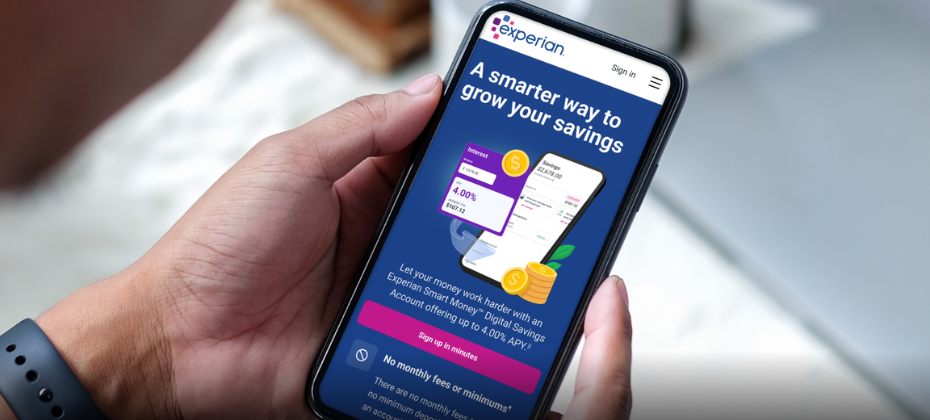
We’re starting the year strong by reaffirming our promise to empower consumers on their financial journeys. At Experian, everything we do is driven by our mission to bring Financial Power to All™—helping people not only understand where they stand but confidently move forward. That’s why I’m pleased to introduce the new high-yield Experian Smart Money™ Digital Savings Account[1], designed to make saving effortless, accessible, and more meaningful than ever before. This new offering is more than just a savings account—it represents an important evolution in how Experian supports financial progress. For years, we’ve helped tens of millions of consumers monitor their credit, improve their credit scores, and protect their identities. Now, by adding a high-yield digital savings account to our existing suite of financial health tools, we’re able to anchor that progress to something tangible: real balances and real momentum. With the ability to save built directly into the Experian ecosystem, members can track their savings growth alongside credit improvements, creating a clearer picture of their overall financial health. Positive financial behaviors—like paying down debt, making on-time payments, or improving utilization—can now be experienced in parallel with cash accumulation and stronger financial resilience, all in one trusted place. The Experian Smart Money™ Digital Savings Account offers up to 4.00% variable Annual Percentage Yield[2] (APY), which is nearly 10 times the national average savings rate[3], with no minimum balance or direct deposit requirement. It’s seamlessly integrated into the Experian membership experience, making it easier for consumers to take action the moment insight appears. This launch builds on the success of our Experian Smart Money™ Digital Checking Account & Debit Card introduced in 2023 and reflects our continued commitment to creating products that meet consumers wherever they are on their financial journey. We believe saving is a foundational financial behavior—and one that plays a powerful, often underappreciated role in credit outcomes. Strong credit health isn’t just about borrowing; it’s closely tied to liquidity, cash flow stability, and financial resilience. Having accessible savings can help consumers stay current on bills during income disruptions, build buffers that reduce reliance on higher-cost credit, and create flexibility that can support long-term credit improvement. In this way, a high-yield digital savings account becomes more than a place to store money—it becomes a practical tool for building healthier financial habits. Whether it’s emergency savings, goal-based saving, or smoothing cash flow, an Experian Smart Money Digital Savings Account enables consumers to turn good intentions into consistent action. This launch also reflects our broader evolution beyond a traditional credit bureau. Today, Experian membership provides access to credit monitoring and improvement tools, identity protection, a credit card marketplace, auto insurance comparison shopping, and personalized guidance through our AI-powered virtual assistant, EVA. Adding a high-yield digital savings account allows us to take the next step with our members—bridging the gap between insight and action. Instead of stopping at “here’s where you stand,” Experian can now help consumers actively build positive financial momentum. We’re extending our role as consumers’ BFF—Big Financial Friend—by making it easier to save, plan, and grow within the same ecosystem they already trust. By innovating and delivering products that truly make a difference in people’s everyday financial lives, we’re continuing to advance our mission and help consumers turn knowledge into progress. Learn more at experian.com/smartmoney. [1] The Experian Smart Money™ Debit Card is issued by Community Federal Savings Bank (CFSB), pursuant to a license from Mastercard International. Banking services provided by CFSB, Member FDIC. Experian is a Program Manager, not a bank. See Experian.com/legal. [2] The Annual Percentage Yield (APY) is 2.00%, 3.00% or 4.00% as of today’s date based on the Experian membership status. The APY may change at any time before or after your account is opened. Changes to the Experian membership can impact the APY, interest rate, and features. The interest rate and APY may be lower during membership trial periods. No minimum deposit to open account. Balance must be at least $0.01 to earn APY. Learn more. [3] As of Dec. 15, 2025, the national average rate for savings accounts was 0.39%, according to the FDIC.