At A Glance
Pharma marketers need privacy-first identity workflows that keep DTC and HCP paths separate while connecting activation and measurement. Experian’s pharma marketing playbook shows how brands can prepare audiences, coordinate approved destinations, and build measurement into the workflow so teams can connect media exposure to trusted outcomes.From onboarding to outcomes
Pharma marketing teams need identity workflows that can support accurate audience creation, governed activation, and partner-enabled measurement without combining DTC and HCP identity paths.
Download our pharma marketing playbook to help your team:
- Plan DTC and HCP identity strategies with clearer separation
- Prepare audiences for activation across approved channels and partners
- Evaluate audience quality, usable reach, and governance

Pharma marketers need to build more meaningful relationships with patients (DTC), caregivers, and healthcare professionals (HCP) across a health journey that spans many channels, partners, and decision moments.
That creates an operational challenge. Data, activation, and measurement often sit with different vendors, each with its own rules, IDs, and handoffs. DTC and HCP campaigns need separate identity paths, but both still need to support the same brand objective. Pharma marketing teams need a clearer way to connect audience strategy, media exposure, and outcomes without adding risk or confusion. That starts with identity, not as a single system for every audience, but as a governed workflow that keeps DTC and HCP paths separate and coordinated.
In our pharma marketing playbook, “From onboarding to outcomes: The privacy-first independent identity workflow for pharma marketing,” we show pharma brands how to build privacy-first workflows that connect identity, activation, and measurement across the healthcare ecosystem.
Here are three priorities pharma marketing teams can use to build more governed, measurable engagement.
1. Why should pharma marketers keep DTC and HCP identity workflows separate?
Pharma marketers should keep DTC and HCP identity workflows separate because each audience requires different data signals, activation paths, and measurement methods. Separate workflows give teams clearer governance controls while helping DTC and HCP campaigns support the same brand objective.

DTC and HCP campaigns often support the same brand objective, but they need separate ways to manage data, reach audiences, and measure results. That’s where identity plays a central role. It gives pharma teams a governed way to keep DTC and HCP data, activation, and measurement separate while coordinating both toward the same goal, like driving drug awareness and impacting prescribing behavior.
The missing layer in pharma marketing. Watch our Q&A
DTC activation depends on privacy-safe identity, which can include tokenization, aggregated audience logic, and non-clinical consumer context. This helps brands better understand patients and caregivers as people, not only as condition-defined audiences.
HCP activation depends on a different foundation. It may use signals such as National Provider Identifier (NPI), specialty, practice location, partner identifiers, and other verified attributes. When DTC and HCP workflows are treated as one system, you can create governance risk, weaken audience logic, and make measurement harder to defend. Keeping them separate gives teams clearer controls, audience planning, and a stronger way to show how both efforts support the same brand goal.
2. How can pharma marketing teams make audiences activation-ready with privacy-safe identity?
Pharma teams can make audiences activation-ready by translating fragmented inputs into governed audience workflows that can be matched, activated, separated, and measured. Privacy-safe identity helps prepare DTC and HCP audiences for approved channels and partners while maintaining the separation each workflow requires.
Privacy-safe identity helps prepare DTC and HCP audiences for approved channels and partners while maintaining the separation each workflow requires.
After separating DTC and HCP data, activation, and measurement, the next step is making each audience ready to use across approved channels and partners. Pharma audiences rarely start in a format that is ready for activation across platforms, publishers, and partners. Inputs may come from partner audiences, platform identifiers, CRM systems, privacy-safe consumer signals, HCP attributes, or partner-provided data.
Those inputs need to be translated into usable audiences through governed identity workflows. For DTC campaigns, activation readiness may include cohort construction, non-clinical enrichment, caregiver logic, tokenized matching, and exclusion rules. For HCP campaigns, it may include verified identity inputs such as NPI, specialty, practice location, and professional address.
A strong workflow answers four questions:
- Can the audience be matched accurately?
- Can it be activated across approved destinations?
- Can DTC and HCP separation be maintained?
- Can the audience connect back to verification and measurement?
When the answer is yes, pharma brands have a stronger foundation for audience quality, usable reach, and cross-channel activation.
3. Why should pharma marketers build measurement into the workflow from the start?
Pharma marketers should build measurement into the workflow from the start because campaign exposure needs to connect back to permitted identity frameworks and partner-held outcomes. Planning measurement before activation gives teams a clearer, more explainable way to evaluate how audience strategy, media exposure, and outcomes work together.
Making audiences ready for activation is only one part of the job. Pharma teams also need a clear way to connect media exposure to outcomes, and that measurement plan needs to be in place before a campaign goes live.
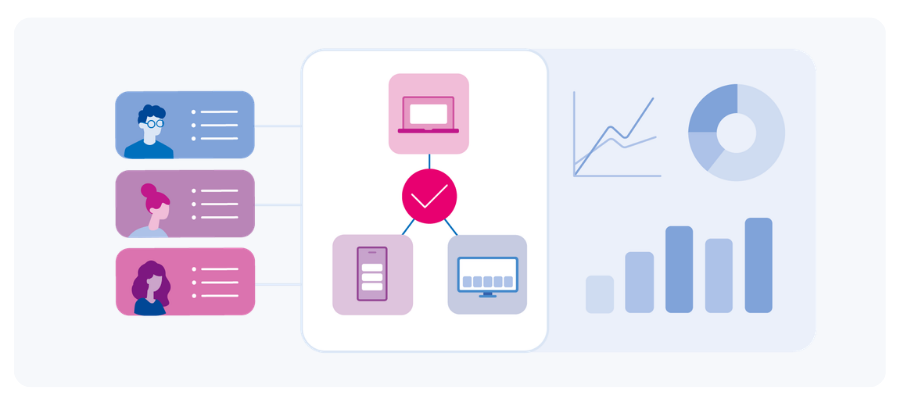
Pharma measurement requires more than knowing whether media ran. Brands need to connect exposure signals to permitted identity frameworks and partner-held outcomes in a way that is accurate, governed, and explainable. Those outcomes may include script lift, qualified HCP engagement, audience quality, and exposure-based HCP reporting where appropriate.
Clean rooms and partner-enabled workflows can help connect exposure, identity, and outcomes in a governed way. For DTC campaigns, this may involve linking tokenized audience or exposure data to a measurement partner environment. For HCP campaigns, this may involve resolving exposure back to HCP identity using NPI, professional address, specialty, practice location, partner identifiers, or measurement partner IDs.
When measurement is planned before activation begins, teams gain a clearer view of how audience strategy, media exposure, identity, and outcomes connect.
How does Experian help pharma marketing teams connect identity, activation, and measurement?
Experian helps pharma marketing teams connect identity, activation, and measurement by serving as a neutral, interoperable workflow layer across data, onboarding, approved destinations, and measurement partners. Experian helps teams keep DTC and HCP identity paths separate while preserving the connection between activation and outcomes. Our role centers on three practical needs. We help teams:
As a neutral, interoperable identity, data, and workflow layer, we help brands translate fragmented inputs into activation-ready audiences, connect those audiences to approved destinations, and preserve the structure needed to evaluate performance.
Download Experian’s pharma marketing playbook
These three priorities give pharma teams a place to start. Our full pharma marketing playbook goes deeper into how pharma brands can build privacy-first workflows across onboarding, activation, sequencing, and partner-enabled measurement. Inside the playbook, you’ll find a more detailed look at how to:
- Keep DTC and HCP identity strategies separate
- Prepare audiences for activation across channels
- Evaluate audience quality and governance
- Connect exposure to trusted outcomes through partner-enabled measurement
For pharma marketers working across fragmented data, platforms, and partner ecosystems, our playbook offers a framework for moving from fragmented inputs to more governed activation and stronger measurement readiness. Download our full playbook to learn how privacy-first identity workflows can help pharma brands connect onboarding, activation, and outcomes.
FAQs
Pharma marketers need separate DTC and HCP identity workflows because patients, caregivers, and healthcare professionals require different data signals, activation paths, and measurement methods. Keeping those paths separate helps teams maintain governance while coordinating both efforts toward the same brand objective.
Privacy-safe identity helps pharma marketers translate audience inputs into activation-ready audiences without treating DTC and HCP workflows as one system. It can support tokenized matching, cohort construction, verified HCP identity inputs, and the separation needed to connect activation with trusted outcomes.
Experian helps pharma brands connect data, identity, onboarding, activation, and measurement across a fragmented partner ecosystem. Experian’s identity foundation and workflow connectivity help teams prepare audiences for approved destinations while preserving the structure needed to evaluate trusted outcomes.
Measurement planning should happen before activation begins. When pharma teams define measurement early, they can connect audience strategy, media exposure, identity, and partner-held outcomes in a more accurate, governed, and explainable way.
Pharma marketers should look for audiences that can be matched accurately, activated across approved destinations, kept separate across DTC and HCP workflows, and connected back to verification and measurement. This gives teams a stronger foundation for audience quality, usable reach, and cross-channel activation.
Latest posts

With Tapad, part of Experian, technology, AdsWizz AudioMatic is the first Audio buying platform to offer cross-device identity resolution across the U.S. and EMEA NEW YORK and LONDON, July 17, 2019 /PRNewswire/ — Tapad, part of Experian and a global leader in digital identity resolution, today announced a new joint capability with AdsWizz , the leading technology provider for digital audio advertising solutions. The partnership combines Tapad’s digital cross-device technology with AdsWizz’s AudioMatic buying platform, enabling the ability to connect audio ad experiences across screens. AudioMatic, AdsWizz’s audio-centric buying platform, supports programmatic audio buying and entirely new audio ad experiences for listeners. The integration of The Tapad Graph onto its platform enables new opportunities for marketers to reach, engage and measure each interaction with their desired consumers on digital radio and podcasts channels, and across devices. This partnership makes AdsWizz the first audio buying platform to offer this enhanced cross-device identity capability in the US and EMEA markets. “Marketers need privacy-safe digital identity resolution to reach their consumers,” says Tom Rolph, VP of EMEA at Tapad. “With audio becoming an increasingly powerful medium for engagement, it’s important that our technology extends to this channel, which is why we are excited to announce our integration with AdsWizz’s AudioMatic platform.” Digital audio is experiencing high growth, with 84% of advertisers and agencies saying it will play a bigger role in their media plans in the future. Today, 60% of digital audio is consumed via a mobile device.* The Tapad Graph is the largest digital identity resolution graph with differentiated global scale. The partnership enables audio advertisers to leverage The Tapad Graph for enhanced attribution, analytics, and targeting. Alexis van der Wyer, CEO at AdsWizz, added, “Digital audio is increasingly becoming ubiquitous in our media consumption and in our daily digital interactions, and because of that, audio advertising offers tremendous opportunity to personally interact with consumers in every moment of their daily lives. By integrating with Tapad, we enable our advertising partners to increase the effectiveness and the relevance of their marketing messages across audio channels.” To learn more about Tapad and our digital identity resolution products, visit our identity solutions page. *Digital Audio Exchange, “The Rise of Digital Audio Advertising,” https://thisisdax.com/wp-content/uploads/2019/07/DAX-Whitepaper.pdf About Tapad Tapad, Inc. is a global leader in digital identity resolution. The Tapad Graph, and its related solutions, provide a transparent, privacy-safe approach connecting brands to consumers through their devices globally. Our one-of-a-kind Graph Select offering enables marketers the flexibility and freedom of choice to correlate devices to varied objectives, driving campaign effectiveness and business results. Tapad is recognized across the industry for its product innovation, workplace culture and talent, and has earned numerous awards including One World Identity’s 2019 Top 100 Influencers in Identity Award. Headquartered in New York, Tapad also has offices in Chicago, London, Oslo, Singapore and Tokyo. About AdsWizz: AdsWizz has created the end-to-end technology platform that is powering the digital audio advertising ecosystem. AdsWizz powers well-known music platforms, podcasts and broadcasting groups worldwide with a comprehensive digital audio software suite of solutions that connect audio publishers to the advertising community. From dynamic ad insertion to advanced programmatic platforms to innovative new audio formats, AdsWizz efficiently connects buyers and sellers in digital audio. AdsWizz is headquartered in San Mateo, California, with an IT Development hub in Bucharest, Romania, and presence in 39 markets around the world. About AudioMatic: AdsWizz Demand Side, audio-centric DSP and audio buying platform, AudioMatic, enables programmatic audio buying and entirely new audio ad experiences that are proven to be more engaging and more effective, and have delivered measurable results for agencies and their brands all over the world. All the biggest ad agencies have used our programmatic trading platform, including Omnicom, GroupM, Havas, Publicis, Mobext, and more. Contact us today

Sixty-Nine Percent Organic Sales Growth Spurred by Expanded Business and Continued Investment in The Tapad Graph™ NEW YORK, May 7, 2019 /PRNewswire/ — Tapad, a part of Experian, a global leader in digital identity resolution, today announced a record start to the year, following its highest earning year in the company’s history. Since January, Tapad has experienced a 69 percent organic increase in global revenue; with strategic investments in talent, continued high retention rates, and an expanded range of clients across global markets. Globally, Tapad increased its client base across multiple categories and verticals, catering to agencies, brands, telecoms, and data providers. The Tapad Graph™’s varied use cases and differentiated global scale have been instrumental to the company’s overall success to-date. With an ongoing investment in product, and expected feature releases slated for 2019, the company anticipates these accomplishments to continue. “Since the inception of our business, Tapad has heavily focused on enabling marketers to boost the performance of their campaigns with the help of our advanced digital identity resolution technologies,” said Sigvart Voss Eriksen, CEO at Tapad. “While we continue to grow, creating privacy-safe solutions that solve marketers evolving needs remains integral to our evolution. As pioneers in cross-device, we’re constantly innovating and pushing ourselves to be at the forefront of industry change. Our leadership in the space is recognized across the industry, as is evident by our current success.” In addition to partner expansions, Tapad also invested in new talent. In February, Tapad announced Ajit Thupil as the company’s first Senior Vice President of Identity, deepening the company’s commitment to creating ground-breaking digital identity resolution products for brands, agencies and platforms. Tapad’s investment in talent has been recognized by One World Identity’s 2019 Top 100 Influencers in Identity Award and by ClickZ’s 2019 Marketing Technology Awards. To learn more about Tapad and our digital identity resolution products, visit Experian.com Open job opportunities across the globe can be found on Tapad’s career page here: https://www.experian.com/careers/ About Tapad Tapad, Inc. is a global leader in digital identity resolution. The Tapad Graph™, and related solutions, provide a privacy-safe approach to connecting device identifiers to brand and marketer data, thereby allowing marketers around the world to maximize campaign effectiveness. Tapad is recognized across the industry for its innovation, growth and workplace culture, and has earned numerous awards, including the TMCnet Tech Culture Award. Based in New York, Tapad also has offices in Chicago, London, Oslo, Singapore and Tokyo, and is a wholly owned subsidiary of Telenor Group. Contact us today
The UK digital advertising market is worth £13.44bn, an increase year-on-year of 15%, reveals the 2018 IAB UK & PwC Digital Adspend Study. Report highlights The majority of all growth is coming from smartphone advertising, which has increased by £1.65bn (35%) from 2017. Smartphone advertising now represents 51% of all UK digital ad spend, up from 45% in 2017. Video is now the largest display format (£2307m), overtaking standard display banners (£1486m). Outstream/social in-feed has increased its majority in total video spend, now occupying a share of 57%, up from 52% in 2017. Social revenue now represents 23% of all digital ad spend. Growth is predicted to slow during 2019, with 5% estimated growth (+9% digital, +11% display, +9% search) compared to 15% in 2018. 2018 marks the tipping point towards a mobile-first ecosystem “For the past few years, industry commentators have been hailing the year of mobile. Each January the predictions come and the waiting commences for evidence to mark a tipping point, a shift to a mobile-first digital ad ecosystem. Well, drumroll… it was 2018! The latest Adspend report from IAB UK and PwC reveals that spend on smartphones outstripped spend on desktop for the first time last year. Brands spent 51% of total spend (which stands at £13.44 billion) on smartphones in 2018, up from 45% in 2017 – a significant milestone in the evolution of digital advertising. “This evidence shows that advertisers are increasingly thinking mobile-first. Growth in investment has historically lagged behind the amount of time spent on the device and we expect to see growth continue at a rapid pace to keep up with audience behaviour – two thirds of time spent online is now on mobile, according to UKOM. Other areas of growth highlighted by the report include video, which accounts for 44% of the total display market, while mobile video now makes up 51% of smartphone display. This is no doubt down to bigger mobile screens, better 4G and more readily available WiFi making video ads an increasingly attractive option. “Across the board, advertisers are investing in digital for longer-term brand building as well as short-term activation, with the direct-to-consumer market helping to drive this trend. What’s more, digital continues to be an accessible and popular route to market for businesses of all sizes, from leading advertisers to SMEs.” Tim Elkington, Chief Digital Officer, IAB UK Content & context crucial for attracting audiences “As people spend more and more of their time on mobile, it’s comes as no surprise that advertisers will follow where audiences are with their marketing spend. “Video has been the driving force in this growth, indicating that engaging visual content is still key in helping brands to achieve great results and to capture consumer attention in a vast sea of digital noise. “Video still has a way to go if it is to reach the level of effectiveness of traditional formats like cinema, but it will be interesting to see how the format develops over the next year or so. Ultimately, brilliant content and properly considered context are crucial for advertisers hoping to attract relevant audiences and build strong brands long term.” Kathryn Jacob OBE, CEO, Pearl & Dean Mobile-first approach driving investment in user experience “As a mobile-first approach has become the norm for many businesses, we’ve seen significant innovation and investment in the user experience that has fuelled the rise in mobile commerce. “Yet, for some years, limitations in the technology and formats available have meant that mobile advertising couldn’t always keep pace with changing consumer behaviours – delivering weaker performance when compared to desktop. “Fortunately, mobile has made huge strides in recent years. Mobile advertising affords great targeting opportunities for brands and a more interactive and immersive experience for consumers. “There is no reason to doubt this trend will continue as advertisers design their media, creative, and targeting strategy with mobile at the heart – optimising performance, enhancing the customer experience, and delivering the best results.” James Cragg, UK Managing Director, Tug New technologies to improve investment efficiency “The UK digital ad market has continued to grow despite the various challenges that the market has faced, including the current socioeconomic climate and general changes in the industry. As spend increases, it’s important to look at how media buying can be made as efficient as possible, minimising waste and maximising the return on investment. “Marketers will start to look to new technologies, like AI, to offer an impartial and more efficient approach to media buying, allowing marketers to measure effectiveness of campaigns and allocate spend accordingly.” Carl Erik Kjaersgaard, Chief Executive, Blackwood Seven Industry going from strength to strength “This significant growth in ad spend is great to see and shows that our industry is going from strength to strength. It’s especially good to see that as advertisers invest more and more in digital advertising, they’re becoming more considered in where they’re spending their money – with a large portion of the growth coming from companies that are part of IAB’s Gold Standard. “At The Trade Desk, we’ve long been ambassadors for the importance of transparency. These findings show that it isn’t just the right thing to do, but makes good business sense as advertisers increasingly choose partners who are demonstrating a commitment to best practice.” Anna Forbes, UK General Manager, The Trade Desk Advertisers embracing mobile “As consumers spend more of their time online, it’s no surprise that digital ad spend has continued its rise, up 15% to £13.4bn. With digital, in every sense, becoming further embedded in our daily lives, it is inevitable that this number is set to rise further next year. “Given the vast majority of people using their smartphone as their primary digital device, evident from site traffic stats we see across the board, the IAB report shows that advertisers have started to fully embrace this shift by following with ad spend. Over the last few years, a combination of faster wireless connectivity along with more capable devices has made it the go-to device for consumers to get online. This is set to continue over the next few years with 5G and even faster, more capable smartphones arriving (i.e. foldables) that will further cement ‘mobile’ as the main digital device to reach consumers.” Wajid Ali, Head of Paid Search, ForwardPMX Budgets must go to professionally produced content “In the IAB’s latest ‘Digital Adspend Study’ it is positive to see that outstream continues to dominate video spend, showing close to a 10% year-on-year increase. “Unsurprisingly, the study highlights that mobile is the most important distribution device (76% of all video spend is on the smartphone), and it’s great to see the format we invented dominating that space. “However, it’s now more pertinent than ever that clients and agencies invest their outstream budgets into professionally produced content and not social infeeds. Budgets must go where content is being produced, rather than aggregators and distributors, where the content is read rather than where a click happened. “We must remember how important local, national, and vertical press are to the global digital ecosystem. By unifying the best publishers at scale, delivering mobile-optimised creativity and outcome-orientated distribution, we are fighting to ensure publishers are getting their fair share of revenue in comparison to the social platforms.” Justin Taylor, UK MD, Teads UK market in robust health “The latest IAB digital ad spend report shows encouraging signs that the UK digital advertising market is in robust health, with mobile advertising continuing its upward trend. “The rise of up-and-coming ad formats like Shopping Ads, Google’s Responsive Search Ads, and Facebook Messenger Ads show that advertisers are looking for ways to capture consumer attention in the evolving digital landscape. As a result, the lines across search, social, and e-commerce are more blurred than ever with the introduction of features like Checkout for Instagram and Shopping ads on Google Images. Furthermore, with the rapid growth of Amazon’s ads business, e-commerce has quickly emerged as a third pillar of digital advertising, making it vital for marketers to have a complete view of the customer journey across channels and devices, if they hope to more accurately understand campaign performance and attribution.” Wesley MacLaggan, SVP of Marketing, Marin Software Digital identity resolution essential in understanding customer journey “Last year’s figures show that UK ad spend is starting to mirror the behaviour of consumers who, according to UKOM data, spend two-thirds of their time online on a smartphone. The fact that mobile ad spend now surpasses that of ad spend on desktop highlights marketers’ understanding that digital identity resolution is essential, not a nice-to-have. “Appreciating the cross-device behaviours of consumers allows brands to gain a better understanding of the customer journey and build stronger relationships with their audiences long term.” Tom Rolph, VP EMEA, Tapad, a part of Experian. Contact us today