At A Glance
Pharma marketers need privacy-first identity workflows that keep DTC and HCP paths separate while connecting activation and measurement. Experian’s pharma marketing playbook shows how brands can prepare audiences, coordinate approved destinations, and build measurement into the workflow so teams can connect media exposure to trusted outcomes.From onboarding to outcomes
Pharma marketing teams need identity workflows that can support accurate audience creation, governed activation, and partner-enabled measurement without combining DTC and HCP identity paths.
Download our pharma marketing playbook to help your team:
- Plan DTC and HCP identity strategies with clearer separation
- Prepare audiences for activation across approved channels and partners
- Evaluate audience quality, usable reach, and governance

Pharma marketers need to build more meaningful relationships with patients (DTC), caregivers, and healthcare professionals (HCP) across a health journey that spans many channels, partners, and decision moments.
That creates an operational challenge. Data, activation, and measurement often sit with different vendors, each with its own rules, IDs, and handoffs. DTC and HCP campaigns need separate identity paths, but both still need to support the same brand objective. Pharma marketing teams need a clearer way to connect audience strategy, media exposure, and outcomes without adding risk or confusion. That starts with identity, not as a single system for every audience, but as a governed workflow that keeps DTC and HCP paths separate and coordinated.
In our pharma marketing playbook, “From onboarding to outcomes: The privacy-first independent identity workflow for pharma marketing,” we show pharma brands how to build privacy-first workflows that connect identity, activation, and measurement across the healthcare ecosystem.
Here are three priorities pharma marketing teams can use to build more governed, measurable engagement.
1. Why should pharma marketers keep DTC and HCP identity workflows separate?
Pharma marketers should keep DTC and HCP identity workflows separate because each audience requires different data signals, activation paths, and measurement methods. Separate workflows give teams clearer governance controls while helping DTC and HCP campaigns support the same brand objective.

DTC and HCP campaigns often support the same brand objective, but they need separate ways to manage data, reach audiences, and measure results. That’s where identity plays a central role. It gives pharma teams a governed way to keep DTC and HCP data, activation, and measurement separate while coordinating both toward the same goal, like driving drug awareness and impacting prescribing behavior.
The missing layer in pharma marketing. Watch our Q&A
DTC activation depends on privacy-safe identity, which can include tokenization, aggregated audience logic, and non-clinical consumer context. This helps brands better understand patients and caregivers as people, not only as condition-defined audiences.
HCP activation depends on a different foundation. It may use signals such as National Provider Identifier (NPI), specialty, practice location, partner identifiers, and other verified attributes. When DTC and HCP workflows are treated as one system, you can create governance risk, weaken audience logic, and make measurement harder to defend. Keeping them separate gives teams clearer controls, audience planning, and a stronger way to show how both efforts support the same brand goal.
2. How can pharma marketing teams make audiences activation-ready with privacy-safe identity?
Pharma teams can make audiences activation-ready by translating fragmented inputs into governed audience workflows that can be matched, activated, separated, and measured. Privacy-safe identity helps prepare DTC and HCP audiences for approved channels and partners while maintaining the separation each workflow requires.
Privacy-safe identity helps prepare DTC and HCP audiences for approved channels and partners while maintaining the separation each workflow requires.
After separating DTC and HCP data, activation, and measurement, the next step is making each audience ready to use across approved channels and partners. Pharma audiences rarely start in a format that is ready for activation across platforms, publishers, and partners. Inputs may come from partner audiences, platform identifiers, CRM systems, privacy-safe consumer signals, HCP attributes, or partner-provided data.
Those inputs need to be translated into usable audiences through governed identity workflows. For DTC campaigns, activation readiness may include cohort construction, non-clinical enrichment, caregiver logic, tokenized matching, and exclusion rules. For HCP campaigns, it may include verified identity inputs such as NPI, specialty, practice location, and professional address.
A strong workflow answers four questions:
- Can the audience be matched accurately?
- Can it be activated across approved destinations?
- Can DTC and HCP separation be maintained?
- Can the audience connect back to verification and measurement?
When the answer is yes, pharma brands have a stronger foundation for audience quality, usable reach, and cross-channel activation.
3. Why should pharma marketers build measurement into the workflow from the start?
Pharma marketers should build measurement into the workflow from the start because campaign exposure needs to connect back to permitted identity frameworks and partner-held outcomes. Planning measurement before activation gives teams a clearer, more explainable way to evaluate how audience strategy, media exposure, and outcomes work together.
Making audiences ready for activation is only one part of the job. Pharma teams also need a clear way to connect media exposure to outcomes, and that measurement plan needs to be in place before a campaign goes live.
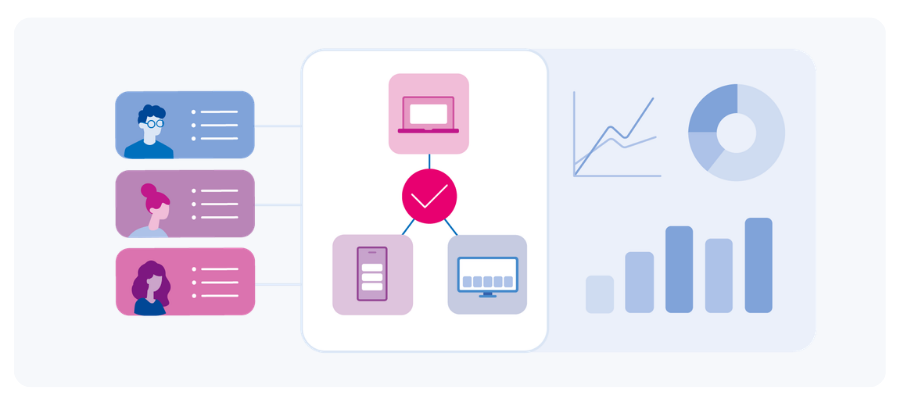
Pharma measurement requires more than knowing whether media ran. Brands need to connect exposure signals to permitted identity frameworks and partner-held outcomes in a way that is accurate, governed, and explainable. Those outcomes may include script lift, qualified HCP engagement, audience quality, and exposure-based HCP reporting where appropriate.
Clean rooms and partner-enabled workflows can help connect exposure, identity, and outcomes in a governed way. For DTC campaigns, this may involve linking tokenized audience or exposure data to a measurement partner environment. For HCP campaigns, this may involve resolving exposure back to HCP identity using NPI, professional address, specialty, practice location, partner identifiers, or measurement partner IDs.
When measurement is planned before activation begins, teams gain a clearer view of how audience strategy, media exposure, identity, and outcomes connect.
How does Experian help pharma marketing teams connect identity, activation, and measurement?
Experian helps pharma marketing teams connect identity, activation, and measurement by serving as a neutral, interoperable workflow layer across data, onboarding, approved destinations, and measurement partners. Experian helps teams keep DTC and HCP identity paths separate while preserving the connection between activation and outcomes. Our role centers on three practical needs. We help teams:
As a neutral, interoperable identity, data, and workflow layer, we help brands translate fragmented inputs into activation-ready audiences, connect those audiences to approved destinations, and preserve the structure needed to evaluate performance.
Download Experian’s pharma marketing playbook
These three priorities give pharma teams a place to start. Our full pharma marketing playbook goes deeper into how pharma brands can build privacy-first workflows across onboarding, activation, sequencing, and partner-enabled measurement. Inside the playbook, you’ll find a more detailed look at how to:
- Keep DTC and HCP identity strategies separate
- Prepare audiences for activation across channels
- Evaluate audience quality and governance
- Connect exposure to trusted outcomes through partner-enabled measurement
For pharma marketers working across fragmented data, platforms, and partner ecosystems, our playbook offers a framework for moving from fragmented inputs to more governed activation and stronger measurement readiness. Download our full playbook to learn how privacy-first identity workflows can help pharma brands connect onboarding, activation, and outcomes.
FAQs
Pharma marketers need separate DTC and HCP identity workflows because patients, caregivers, and healthcare professionals require different data signals, activation paths, and measurement methods. Keeping those paths separate helps teams maintain governance while coordinating both efforts toward the same brand objective.
Privacy-safe identity helps pharma marketers translate audience inputs into activation-ready audiences without treating DTC and HCP workflows as one system. It can support tokenized matching, cohort construction, verified HCP identity inputs, and the separation needed to connect activation with trusted outcomes.
Experian helps pharma brands connect data, identity, onboarding, activation, and measurement across a fragmented partner ecosystem. Experian’s identity foundation and workflow connectivity help teams prepare audiences for approved destinations while preserving the structure needed to evaluate trusted outcomes.
Measurement planning should happen before activation begins. When pharma teams define measurement early, they can connect audience strategy, media exposure, identity, and partner-held outcomes in a more accurate, governed, and explainable way.
Pharma marketers should look for audiences that can be matched accurately, activated across approved destinations, kept separate across DTC and HCP workflows, and connected back to verification and measurement. This gives teams a stronger foundation for audience quality, usable reach, and cross-channel activation.
Latest posts

Distribution via LiveRamp enables seamless cross-device customer experiences through more platforms NEW YORK, Nov. 15, 2016 /PRNewswire/ — Tapad, now part of Experian and the leading provider of unified cross-device marketing technology solutions, today announced an expanded partnership with LiveRamp™, an Acxiom® company and leading provider of omnichannel identity resolution, to make the proprietary Tapad Device Graph™ accessible beyond Tapad-hosted direct integrations. Through LiveRamp, Tapad’s Device Graph Access now extends to more than 400 ad tech and mar tech platforms. Tapad’s Device Graph™ enables marketers to understand, monetize and measure consumer engagement across all digital channels, and Tapad’s unified consumer view is recognized as one of the most accurate, scalable cross-device solutions in the market today. Through the expanded partnership with LiveRamp, the Tapad Device Graph can be distributed to the hundreds of platforms used to reach consumers on digital channels and measure campaign performance – even as devices are added daily to Tapad’s extensive graph. “Increasingly, marketers want access to cross-device targeting and measurement capabilities within their preferred platforms,” said Anneka Gupta, chief product officer of LiveRamp. “Our expanded partnership makes it easy for marketers to access Tapad’s graph through the rapidly growing set of integrations available in our partner ecosystem.” This is the latest of several initiatives between the two technology platforms designed to make the integration of cross-screen platforms seamless, privacy-safe and easy to use for dynamic and engaging marketing efforts. “During the past year, Tapad has expanded its global presence and rapidly grown its data business – Tapad Coral – doubling the number of companies integrating our device graph into their platforms and growing our annualized run rate by 210%,” said Pierre Martensson, GM of Tapad Coral and APAC. “Our expanded partnership with LiveRamp positions us to meet the increased demand for Tapad Device Graph Access and enable new platforms to apply our graph with unprecedented speed.” Contact us today
Cross-Screen Pioneer Explores the Power of Connected Cars as a Vehicle for Customer Engagement LAS VEGAS, NV — (October 26, 2016) –Kate O’Loughlin, GM of Media for Tapad, addressed the J.D. Power Automotive conference audience today in Las Vegas, NV. With more than 1,400 participants representing every facet of the automotive marketing profession, the conference has become the industry’s leading marketing event. Bringing the unified, cross-screen perspective to the stage, O’Loughlin discussed the vital role of connected cars in the consumer engagement process. She is a founding member of Tapad which launched the world’s first cross-screen marketing technology in 2010. Tapad was acquired by the Telenor Group early in 2016. Key points from O’Loughlin’s J.D. Power 2016 address included: The marketers who deliver relevant and engaging content in a privacy-safe setting will be in the strongest position to navigate the proliferation of connected devices, including the connected points in cars. As automakers innovate the technology in cars, marketers need to be prepared for the size and diversity of data available for understanding consumers. It’s going to be increasingly difficult to wade through the data, so now is the time to build a solid framework for understanding the person behind the data. Marketers who evolve — and take a holistic approach — to their campaign measurements will achieve marked improvements in efficiency and an enhanced understanding of their core audiences. Actionable brand engagement metrics like Viewable Exposure Time (VET) will continue to overtake traditional advertising performance metrics. VET evaluates the optimal amount of time an ad is present on a screen to incite consumer action. In early testing by Tapad, campaigns that employ VET see conversion rate performance improvements from 13 to 60%. The consumer-centric technology solutions of the future need to be as scalable as they are affordable. Learn more about Tapads’ recommended Viewable Exposure Time metric contact us today! Contact us today
NEW YORK, Sept. 28, 2016 /PRNewswire/ — Tapad, the leader in cross-device marketing technology, today announced a new metric for cross-device marketers, Viewable Exposure Time (VET). Viewable Exposure Time measures across screens and ad formats, identifying the optimal amount of time a consumer spends with an ad before they take action. The announcement coincides with Unify Tech ’16, Tapad’s third-annual cross-device summit during Advertising Week NY. Frequency caps are currently used to ensure that dollars aren’t wasted on redundant ads. Viewable Exposure Time evolves the frequency capping approach to include accelerating a consumer’s ad exposure rate up to the optimal time spent with the brand. VET is used in affinity, digital transaction and offline purchase models as a key indicator of marketing budget well-spent. Beta users of VET span every vertical, though interest is especially high from CPG, Automotive, Telecommunications and Retail. Viewable Exposure Time unifies and upgrades marketers’ predictors of advertising success by leveraging cross-screen engagement across digital and television, with vendor-agnostic viewability scores for video, rich media and display. “Today’s current measurement options, like click-through rate (CTR) and TV gross ratings points (GRP) tell an incomplete story,” said Tapad GM of Media Kate O’Loughlin. “Tapad is focused on measuring what really matters to marketers – building an efficient connection with a customer. Innovation in metrics was long overdue.” More than just a measurement tool, Tapad also provides clients with VET activation. Factoring in time spent with ads in viewable seconds and minutes, these analytics inform marketers about which audiences are underexposed, enabling them to adjust campaigns and deliver according to optimal viewable exposure time. This effectively increases conversion rates at the lowest cost. Contact us today