
What makes an ad impression valuable to an advertiser? The inventory where an ad appears, the audience it reaches, or its potential to contribute to a business outcome?
The answer often involves all three. Yet curation is frequently discussed in terms of site lists, audience segments, and deal IDs. These play an important role, but they don’t tell the full story of the intelligence and decisioning required to evaluate supply and media opportunities.
Advertisers want to reach relevant audiences across quality inventory, make efficient use of their media investments, and achieve measurable business outcomes. Meeting those goals requires connecting the right identity, consumer intelligence, technology, and optimization closer to the source of each impression. Making decisions too late in the transaction can mean missing more effective, direct, or cost-efficient paths to an advertiser’s target audience.
The four pillars of effective curation
Curation works best when four capabilities come together to connect advertiser objectives with relevant media opportunities.
1. Identity makes data useful across environments
Advertisers know their customers, publishers know their audiences, supply-side platforms (SSPs) understand their inventory and traffic, and demand-side platforms (DSPs) bring knowledge of campaign goals. Data partners add behavioral insights. Each may use different identifiers, making it harder to recognize the same person or household consistently across the ecosystem.
Identity provides a shared foundation for connecting these signals. A trusted, widely adopted identity graph can link permitted identifiers to a consistent view of people and households across participating ecosystem partners. This allows advertiser, publisher, and audience data to work together under appropriate privacy controls to inform media decisions.

When that identity foundation is available through real-time integrations, audience signals can be interpreted more effectively as media opportunities arise. Decisioning can apply a consistent understanding of the audience across participating supply environments, keeping audience context connected as opportunities move through the ecosystem.
2. Consumer intelligence adds context to each opportunity
Effective consumer intelligence starts with trusted data and understanding who consumers are, what they do, and what they care about, collected and used with appropriate consent, privacy protections, and permissions.
To achieve that, it’s critical to identify which data providers, audience segments, and types of data are best suited to a specific campaign and deal. Different sources offer different insights, and selecting the right combination helps advertisers identify relevant audiences and make more informed media decisions.

The right signals depend on the campaign. Retail campaigns may draw on purchase history and other behaviors that help predict future spending. Automotive campaigns may rely more on in-market signals, given longer buying cycles, to inform audience, messaging, and channel strategies. First party audiences play a crucial role in many use cases, and the ability to apply these audiences through an independent decisioning system maximizes match rates while minimizing data sharing across platforms.
Rather than relying on a predefined mix of audience segments, an advanced decisioning system can use campaign goals, brand context, and other available signals to shape the audience for each opportunity.
It can help identify which data providers, segments, and data types are most relevant, and then adjust the audience mix as performance and outcomes provide new information. This supports more tailored media decisions throughout a campaign.
3. Technology integrations connect intelligence to supply
Real-time connections with SSPs let decisioning systems consider signals such as context, device information, and format alongside advertiser audience and campaign criteria as opportunities arise. But each SSP integration can expose different signals and data structures, making it difficult to apply a strategy consistently across supply. A neutral intelligence layer connected through the right technology framework can normalize those inputs across participating SSPs and return qualifying deal and audience signals through the SSP, helping DSPs prioritize relevant opportunities in their existing workflows.
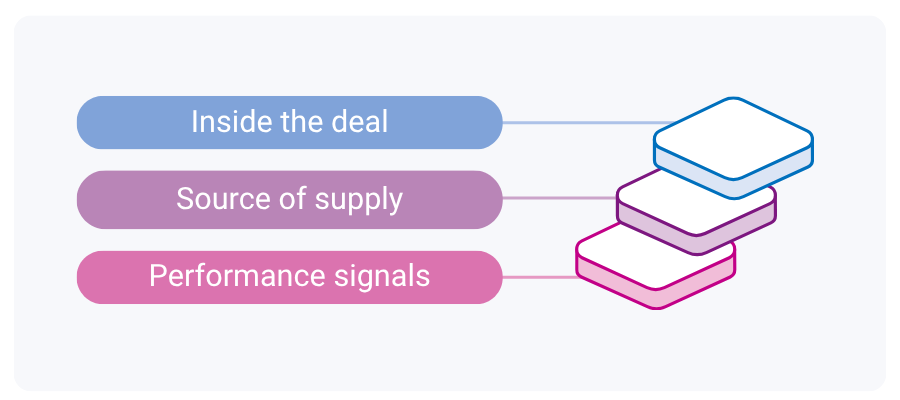
4. Optimization turns insights into better decisions
Optimization becomes more informed as demand-side performance data, signals from real-time supply integrations, and online and offline conversion data come together. Connected through a consistent audience view, these signals can help categorize inventory and identify supply paths associated with stronger performance.

Real-time decisioning and optimization help apply those insights quickly during a campaign, while accumulated learnings can inform future campaign setup and delivery. Decisioning systems can evaluate impressions quickly. The quality, relevance, and connectivity of the information behind them determine how useful those decisions are.
Bringing intelligence closer to the impression
Advances in real-time technology are creating new opportunities to apply this intelligence earlier in the media transaction.
Traditionally, much of the intelligence informing programmatic buying has been applied through DSPs. Curation was developed and widely adopted in part because it improved decisioning and performance by layering supply side signals into the ad buying workflow. Containerization is how SSPs are extending that shift, allowing decisioning capabilities to operate within or alongside their infrastructure, closer to the source of supply.
While containers are powerful tools, containerization alone doesn’t create interoperability across supply. Each container operates within its SSP environment, therefore utilizing native features and signals available there.
Real-time integrations are needed to pass signals from participating SSP environments into a neutral decisioning layer. That layer can connect varying signals and identifiers across supply sources, helping apply decisioning more consistently across different sources and types of supply. Imagine an automotive campaign focused on test-drive bookings. Identity and audience signals help recognize likely buyers. SSP signals such as context and format describe the available placements. Campaign and conversion feedback can show which audience, context and placement combinations are performing better. Real-time integrations help apply those learnings across participating SSPs during the campaign, so the DSP can prioritize stronger opportunities while retaining control of bidding.
Advertisers, publishers, data providers, DSPs, and SSPs each contribute different signals that can inform media selection. Connecting those signals through trusted identity and interoperable technology can make decisioning more relevant to individual campaign objectives.

AI can take this a step further by analyzing connected signals and executing media decisions faster and more dynamically. As more relevant data becomes available in real time, AI-driven models could tailor how opportunities are evaluated based on an advertiser’s campaign objectives, audience priorities, and the specific requirements of a DSP. With access to appropriate performance feedback, these systems could refine their decisions over time, making curation increasingly responsive to individual campaigns.
What’s next for curation?
Curation will continue evolving into a real-time decisioning engine for the advertising ecosystem, connecting identity, consumer intelligence, technology, and optimization closer to where media opportunities become available. Neutrality and interoperability will be central to making that intelligence work across platforms and creating value for everyone involved.
Site lists and deal IDs remain useful components of programmatic activation. Relying on site lists and contextual signals alone, though, means overlooking much of what curation can offer. The broader value comes from connecting identity, consumer intelligence, technology, and optimization through real-time supply integrations to inform media decisions. As these capabilities become more connected, curation can play a greater role in how the industry evaluates and acts on media opportunities, helping advertisers and their partners make faster, more customized decisions across the open web.
That’s where the value of modern curation comes into focus, and where its future in media lies.
About the author

Budi Tanzi
SVP, Product, Experian
Budi Tanzi is the Senior Vice President of Product at Experian Marketing Services, overseeing all identity products. Prior to joining Experian, Budi worked at various stakeholders of the ad-tech ecosystem, such as Tapad, Sizmek, and StrikeAd. During his career, he held leadership roles in both Product Management and Solution Engineering. Budi has been living in New York for almost 11 years and enjoys being outdoors as well as sailing around NYC whenever possible.
Latest posts
NEW YORK, Oct. 24, 2019 /PRNewswire/ — Tapad, part of Experian and a global leader in digital identity resolution, today announced a new partnership with Retargetly, a leading independent full stack data company. The partnership combines Tapad’s cross-device identity resolution technology with Retargetly’s robust data toolset, allowing brands and agencies using Retargetly’s platform to seamlessly access an expanded audience across devices, without compromising precision. In addition to reach expansion, Tapad’s global, privacy-safe digital cross-device solution, The Tapad Graph, enables Retargetly’s brand and agency clients a more holistic digital customer journey analysis, and efficient campaign capabilities like frequency capping and online attribution. At the same time, Tapad will be able to extend its presence into the LATAM region, tapping into Retargetly’s existing regional footprint. Understanding a consumer’s cross-device journey is a marketing necessity. A recent study showed that 75% of consumers expect a consistent experience from brands1. With the number of devices per individual rapidly increasing, digital identity resolution becomes essential to create that streamlined experience consumers crave. “Similarly to Tapad, our goal is to offer marketers a suite of products that can increase the ROI of their campaigns,” said Juan Amuchastegui, Head of Product at Retargetly. “In order to achieve this, marketers need digital cross-device identity resolution to gain attribution, acquisition and reach expansion capabilities. We chose Tapad as our partner because The Tapad Graph has differentiated global scale, and privacy-safe measures, which we knew would benefit our clients’ campaigns.” Santi Darmandrail, Managing Director at Retargetly added, “Across the Americas our clients choose to work with us because of our scale, our precision, and our unique approach to what data can do to transform business outcomes. In that scenario, partnering with Tapad and integrating The Tapad Graph onto our platform was really a no-brainer and we are beyond excited to be making that available for our more than 700 clients across the region.” To learn more about Tapad and our digital identity resolution products, visit our identity solutions page. About Tapad Tapad, Inc. is a global leader in digital identity resolution. The Tapad Graph, and its related solutions, provide a transparent, privacy-safe approach connecting brands to consumers through their devices globally. Tapad is recognized across the industry for its product innovation, workplace culture and talent, and has earned numerous awards including One World Identity’s 2019 Top 100 Influencers in Identity Award. Headquartered in New York, Tapad also has offices in Chicago, Denver, London, Oslo, Singapore and Tokyo. About Retargetly: Retargetly is the leading independent data solution from Latam. Their proprietary platform processes over 25 billion data events a month and transforms them into actionable analytics that drive business results across the board. The recently launched Retargetly Audience Platform (RAM) is the number one data exchange in Latin America, with over 1000 active buyers and millions of dollars traded every year. Regargetly provides services across Latam and has offices in Buenos Aires, Mexico City, São Paulo and New York. For more information, visit www.retargetly.com. Contact us today
NEW YORK, Oct. 16, 2019 /PRNewswire/ — Tapad, part of Experian and a global leader in digital identity resolution, and The Trade Desk, a global advertising technology leader, partnered to integrate The Trade Desk’s unified ID solution in April 2019. The Trade Desk’s unified ID solution’s objective is to serve as a standardized cookie ID to help marketers reach more of their audience on the open internet. After an initial six month period, Tapad reports significant adoption rates and enhanced customer results since their joint integration in April. As a result of the partnership, client brands, agencies, DMPs/ DSPs, Data Providers, Mobile Networks and Measurement/Analytics Providers, saw increased match rates up to 38% and more global coverage without compromising precision. With this combined offering, Tapad’s global, privacy-safe digital cross-device solution, The Tapad Graph, connects brands with consumers over 4 billion devices globally. Over 25 companies who license The Tapad Graph, such as Annalect, Semasio, Retargetly, and ThinkCX, have also included The Trade Desk’s unified ID solution as a key identifier in their graph output. “The vast improvement in scale that Tapad has seen illustrates the value digital identity resolution products can bring for brands,” said Nate Gawel, General Manager of Data Partnerships at The Trade Desk. “We’re looking forward to continuing work with Tapad to prove that the open internet can deliver the very same benefits many reserve for large platforms.” Adoption of the unified ID solution allows all parties across the supply chain (SSPs, DSPs, DMPs and data providers) to utilize The Trade Desk’s cookie footprint to increase their own cookie coverage across the global independent internet. For more information, please visit The Trade Desk’s unified ID solution site, or https://www.experian.com/marketing/consumer-sync to learn more about Tapad’s digital identity resolution products. About Tapad:Tapad, Inc. is a global leader in digital identity resolution. The Tapad Graph, and its related solutions, provide a transparent, privacy-safe approach connecting brands to consumers through their devices globally. Our one-of-a-kind Graph Select offering enables marketers the flexibility and freedom of choice to correlate devices to varied objectives, driving campaign effectiveness and business results. Tapad is recognized across the industry for its product innovation, workplace culture and talent, and has earned numerous awards including One World Identity’s 2019 Top 100 Influencers in Identity Award. Headquartered in New York, Tapad also has offices in Chicago, London, Oslo, Singapore and Tokyo. About The Trade Desk:The Trade Desk™ is a technology company that empowers buyers of advertising. Through its self-service, cloud-based platform, ad buyers can create, manage, and optimize digital advertising campaigns across ad formats and devices. Integrations with major data, inventory, and publisher partners ensure maximum reach and decisioning capabilities, and enterprise APIs enable custom development on top of the platform. Headquartered in Ventura, CA, The Trade Desk has offices across North America, Europe, and Asia Pacific. To learn more, visit thetradedesk.com or follow us on Facebook, Twitter, LinkedIn and YouTube. Contact us today

Gen Z is ready to be noticed and become a force to be reckoned with in the market. In the auto market alone, Gen Z made up 3.8 percent of all new vehicle registrations in the first quarter of 2019.