Loading...

Navigating the multi-ID landscape

Published: November 14, 2024 by Budi Tanzi, VP, Product

Identity as a strategic asset: Today and in the future

Originally appeared on MediaPost

As the digital ecosystem becomes more complex, managing multiple identifiers for consumers has emerged as a significant challenge. From cookies and IP addresses to mobile IDs and universal IDs, marketers and platforms face increasing difficulty in maintaining a unified view of their consumers. Without a coherent identity strategy, campaigns can suffer from poor targeting, limited personalization, and flawed attribution.

Experian understands these challenges and offers solutions to help our partners navigate the complexities of a multi-ID landscape. By utilizing both digital and offline data, we provide the tools to unify fragmented identifiers and maintain a persistent view of consumers. As a result, marketers and platforms get rich insights, accurate cross-device targeting, improved addressability, and measurable advertising.

The shifting identity landscape

For years, the industry has relied on cookies to identify consumers across devices and platforms. However, with ongoing signal loss, including the uncertainty around cookies, and the evolution of privacy regulations, the digital identity landscape has grown more complicated. As consumers hop from one device to another, they are now represented by multiple signals, each tied to a different aspect of their digital behavior.

While this shift brings complexity, it also opens the door for innovation. Marketers and ad platforms now have the opportunity to rethink their identity strategies and adopt more flexible approaches that are not reliant on a single identifier.

This is where Experian comes in.

Connecting the dots: A holistic view of the customer journey

Our identity solutions are designed to help manage today’s multi-ID ecosystem by connecting digital and offline identifiers to a single customer profile. This creates a unified view of the consumer, and when combined with our understanding of customer behavior (e.g. demo, interests, shopping patterns) marketers and platforms get both insights about their customers and the addressability to reach them across channels.
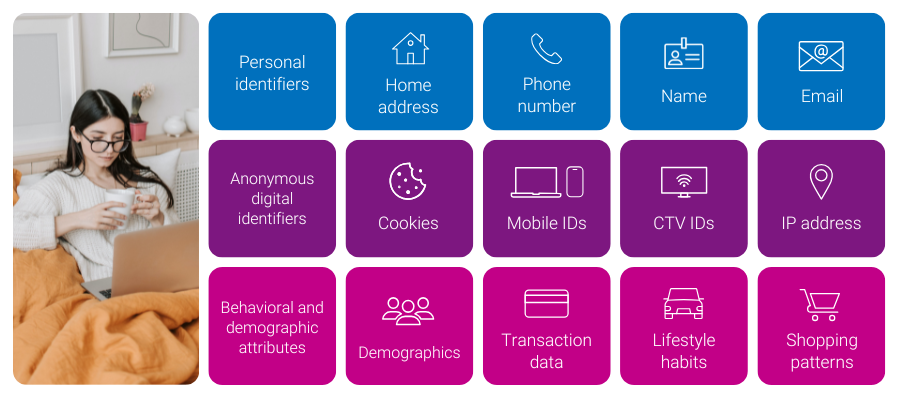
Experian’s identity solutions are designed to help manage today’s multi-ID ecosystem by connecting digital and offline identifiers to a single customer profile. This creates a unified view of the consumer, and when combined with Experian’s understanding of customer behavior (e.g. demo, interests, shopping patterns) marketers and platforms get both insights about their customers and the addressability to reach them across channels.

Four examples of what you can do with a strong identity foundation

  1. If an advertiser wants to make its first-party data more addressable, it can utilize our Digital Graph with universal IDs, hashed emails (HEMs), and connected TV (CTV) IDs to extend its reach.
  2. A publisher who wants to gain further insights into their audiences and create private marketplaces (PMPs) can achieve this goal with the use of our Digital Graph with hashed emails, universal IDs, mobile ad IDs (MAIDs), CTV IDs, and IPs. The publisher can use this in concert with Marketing Attributes to understand age, gender, household income, buying behavior, and more. The publisher can connect marketing attributes to the Digital Graph via our Living Unit ID (LUID) to understand more about consumers that fall into their segments.
  3. A demand-side platform (DSP) who wants to extend first-party and third-party audience reach across all digital devices on their platform will use the Digital Graph with all digital IDs to allow users of their platform to select cross-device extension against first-party and third-party audiences.
  4. A retail media network (RMN) can use our Offline and Digital Graphs to connect in-store and online purchases to a household profile—even when purchases are made by different people. The RMN can then reach that household across digital media platforms and accurately attribute the in-store purchase back to digital ad exposure.

Identity as a strategic asset: Today and in the future

In our paradoxical world where consumers are represented by multiple identifiers, yet marketers and platforms face signal loss, identity is more than a technical issue—it’s a strategic asset. The ability to unify identity data into a single profile provides marketers with the customer intelligence needed to drive growth and stay competitive. Here’s how we do it:

  • Deep, persistent customer understanding: With roots in offline, deterministic data like names, addresses, and emails, we provide an accurate and persistent view of identity to our customers. This allows you to maintain a consistent and comprehensive understanding of your customers and their marketing attributes over time.
  • Highly accurate and refreshed digital identities: Our signal-agnostic graph is not reliant on any one signal as it includes HEMs, cookies, MAIDs, IPs, Universal IDs, and CTV IDs. Our Digital Graph is updated weekly, ensuring the data is always fresh and addressable. This persistent linkage of individuals and households to their identifiers and devices means your campaigns are always targeting the right people.
  • Connected offline and digital graphs for holistic insights: We connect offline and digital identities by following privacy-first best practices, such as preventing re-identification, to allow insights from the offline world to be used in the online world. This integrated approach, enriched with marketing data, gives you better insights, more addressable advertising, and the ability to engage customers across multiple devices while accurately measuring campaign impact.

Transform challenges into opportunities

The rise of the multi-ID landscape presents both challenges and opportunities for the advertising industry. We stand as the trusted partner to navigate this complexity, utilizing insights from the offline world to inform decisions in the online world, enabling personalized marketing and accurate attribution, and helping you achieve your current and future goals.


Get started today

This site is protected by reCAPTCHA and the Google Privacy Policy and Terms of Service apply.


Latest posts

Loading…
Five considerations for the future of addressability and personalization

Brands are increasingly focused on offering personalized experiences while respecting consumer privacy. Addressability enables them to reach specific audiences with relevant messages, and personalization crafts unique content that aligns with each audience's interests and needs. By combining these strategies, brands can create more relevant and effective marketing campaigns. With new regulations and signal loss reshaping the landscape, alternative identifiers like the ID5 ID and The Trade Desk's Unified I.D. 2.0 (UID2) are gaining importance. These tools give advertisers a more holistic view of consumers across channels, enhancing personalization and addressability even as traditional third-party cookies lose relevance. To shed light on this topic, we interviewed experts from Audigent, Basis Technologies, CvE, ID5, MiQ and others. They shared insights on navigating privacy, utilizing new identifiers, and enhancing personalization with consent. Drawing from their perspectives, we've identified five considerations to help brands adapt and succeed in this evolving landscape. 1. Embrace a privacy-centric approach With the increasing focus on consumer data protection, prioritizing privacy in your addressability efforts is essential. Implement strict data guidelines to protect personally identifiable information (PII) and maintain compliance with state-specific regulations. To achieve this, empower consumers by providing clear and transparent choices about data sharing and honoring their preferences. Avoid targeting based on protected categories or sensitive information. By adopting a privacy-first mindset, you can build consumer trust while still delivering relevant advertising experiences. “It's important to champion consumer privacy and the free internet. We need to strike a balance between the two. This balance is essential for our jobs, the economy, news, politics, and all the valuable content and information we rely on.”Drew Stein, Audigent 2. Personalize with consent Consumers are more willing to share their information when they see clear benefits. In fact, over half of shoppers—and two-thirds of Gen X and Millennials—express a desire to receive holiday shopping deals directly from their preferred brands1. By offering value through loyalty programs, special offers, or interactive platforms, you can personalize experiences without compromising privacy. To implement this strategy, encourage consumers to share their preferences and needs by being transparent and giving them control over their data. This approach builds trust, empowers your audience, and enhances personalization. “Building personalization based on the data consumers have consented to share should lead to a positive experience that drives better engagement because it's relevant to them.” April Weeks, Basis Technologies 3. Personalize with contextual targeting Contextual targeting involves delivering ads based on the content users are currently engaging with rather than user identifiers. By focusing on personalization through contextual targeting and dynamic content, you can align your strategies with your audience's real needs and interests. This approach allows advertisers to reach consumers on websites with more visitors matching the demographics, behaviors, or interests they want to target. “Personalization absolutely can thrive. We have various solutions, all utilizing IDs for targeting and personalization. Beyond that, we can also personalize using context, geo-contextual data, and creative strategies.” Georgiana Haig, MiQ 4. Use alternative identifiers As advertisers move beyond third-party cookies, exploring alternative identifiers offers reliable means to connect with consumers. Options like email addresses or device IDs provide direct connections, improving targeting accuracy. Utilize identity graphs to link different signals and identifiers to establish strong ties to individual users or households. This approach maintains, and can even enhance, your ability to reach the right audience and measure campaign performance. “It's not just about maintaining addressability. It's about massively improving addressability. When we run tests with some of our clients, they're seeing 30, 40, 50, 60% incremental reach by using ID5 versus cookies.” Mathieu Roche, ID5 5. Build partnerships Navigating the complexities of addressability doesn't have to be a solo effort. Partnerships between brands, publishers, and tech providers can lead to innovative solutions that benefit everyone. Consider engaging in data partnerships to access new audience segments without maintaining extensive data. Collaborations focused on your tech stack can enhance your ability to deliver personalized content effectively and at scale. “The rise of second-party data partnerships is going to be an interesting trend over the next couple of years. And if you need mass scale across the world, I think that's a much more cost effective and scalable way to do it.”  Paul Frampton, CvE Steering toward success The future of addressability and personalization hinges on your ability to adapt to the changing privacy landscape while delivering meaningful, personalized experiences. By focusing on these five key considerations, you can navigate the complexities of modern advertising, build stronger relationships with consumers, and drive sustainable growth. Connect with our addressability experts Footnote Online survey conducted in June, 2024 among n=1,000 U.S. adults 18+. Sample balanced to look like the general population on key demographics (age, gender, household income, ethnicity, and region). Latest posts

Oct 24,2024 by Experian Marketing Services

The essential role of authenticated audiences in CTV advertising

Originally appeared on VideoNuze Connected TV (CTV) is a leading platform in digital advertising, combining the precise targeting of digital ads with the broad reach and storytelling power of traditional TV. This creates an immersive experience that offers full-funnel marketing results. As consumer time spent watching CTV has doubled over the past five years and linear TV viewing patterns have shifted, advertisers now see CTV as essential for reaching and engaging audiences. Of those CTV users, viewers increasingly choose to watch content with ads. By 2025, free ad-supported streaming TV (FAST) viewers will increase to 49% of CTV users, further highlighting the opportunity for marketers to captivate audiences in ways standard digital display ads can't match. With the explosion of consumer time spent and advertising dollars following, making CTV more addressable and targeted requires a combination of identity and audience.   Historically, the IP address has been the most popular way to target a household with a CTV (e.g., LG, Samsung, Vizio device) or streaming platform (e.g., Disney+, Paramount+, Roku, Amazon Prime, etc.). As IP addresses continue to fluctuate in terms of durability, consistency, and type, including the increased adoption of IPv6, we have seen a new incumbent enter the CTV ecosystem: Unified ID 2.0 (UID2). UID2 stands out as a particularly valuable tool for CTV advertisers. It provides a standardized way to identify and target users across CTV and traditional channels like display and mobile while respecting consumer privacy. Given that purchases might not occur on CTV, UID2's ability to link ad exposure on CTV to conversions on other devices is crucial for demonstrating a CTV campaign's true impact. Authenticated audiences are key to CTV's appeal A significant advantage of CTV is its high rate of logged-in, authenticated users. This provides marketers with reliable first-party data for targeting and measurement purposes. UID2 benefits from this since it's a universal identifier based primarily on first-party data, such as people’s email addresses and phone numbers. Authenticated viewers can also be connected across different devices, enabling marketers to understand the full customer journey, which helps attribute conversions more accurately to CTV ads. Key advantages of CTV for digital marketers Superior viewing experience: Larger screens and a captive audience watching high-quality on-demand content Authenticated users: Enables precise audience targeting, more personalized ad experiences, and enhanced cross-device attribution Value exchange: Viewers get cost-effective content with personalized ads, leading to higher engagement "Authenticated viewers and universal IDs like UID2 are revolutionizing CTV advertising, enabling the effective delivery of personalized content and ensuring strong engagement for marketers; Paramount is committed to optimizing across platforms and will continue to utilize tools and advancements that maximize reach for our partners and improve the user experience for our viewers."Travis Scoles, Executive Vice President, Paramount Advertising The role of universal IDs in CTV advertising Universal IDs, like UID2, play a critical role in CTV by ensuring consistent user identification across platforms while respecting privacy. Adoption of UID2 is gaining traction in the TV industry, with brands such as AMC Networks, Disney, Dish Media, FreeWheel, NBCUniversal, Roku, and Paramount integrating it into their digital advertising ecosystem. As authentication increases across traditional digital and mobile apps, especially CTV, universal IDs like UID2 enable cross-device and cross-channel identity strategies without cookies. This is especially important as traditional identifiers like third-party cookies and IP addresses face an uncertain future.  Better understand and reach your audience with identity graphs For CTV ad spending to catch up to time spent with CTV, the industry must use these authenticated signals and universal IDs. Identity graphs, like Experian’s, integrate various identifiers (e.g., universal IDs, CTV IDs, IP addresses), allowing CTV platforms to understand relationships between households, individuals, and devices. This understanding enables: Publishers using universal IDs can make advertising on their platform more addressable, which will lead to higher demand.  Marketers can achieve greater precision with cross-device targeting, cross-channel frequency management, and more holistic measurement since conversions often happen on non-CTV devices.  Viewers receive a more personalized ad experience (without seeing the same ad repeatedly), which will increase engagement with a marketer's campaign.  Watch our Ask the Expert video with The Trade Desk to deepen your knowledge on CTV advertising and UID2. Watch the video here Contact us Latest posts

Oct 21,2024 by Budi Tanzi, VP, Product

Top five retail marketing challenges in 2024

In this article…The rise of omnichannel retailingData and identity-related retail marketing challengesStrategies to help you overcome retail marketing challengesExperian can help advance your retail marketing strategies  The questions that keep retail marketers up at night have evolved significantly over the last decade. It wasn’t long ago that marketers would spend their time debating which highway to place their billboard on, whether or not their next TV commercial should be comical or heart-tugging, or even what the optimal time of day was to blast an email campaign to their entire customer list. In 2024, retail marketing has new challenges on the radar. The rise of omnichannel retailing The modern, digital-savvy customer expects a flawless and interconnected shopping experience across touchpoints — one of the many reasons omnichannel marketing is on the rise. Research shows that over half of B2C consumers engage with between three and five channels whenever they make a purchase. For businesses, omnichannel engagement is a lucrative opportunity; McKinsey reports that customers who engage across channels shop nearly twice as much as those using a single channel and usually spend more money.  However, the rise in omnichannel engagement also presents several retail marketing challenges, such as the complexity of managing vast amounts of data and piecing together an accurate picture of consumer behavior. Data and identity-related retail marketing challenges Today’s data-driven environment has turned the retail marketing landscape on its head, and businesses have a whole new set of struggles that revolve around identity and data. We identified the top five retail marketing challenges and how to solve them. 1. Knowing what data to capture  In the omnichannel era, online and offline data is abundant. When a customer shops at a physical store, they create data points like:  What items they purchased What time they visited How long they were there When the same customer shops online, they create a whole new set of data points, such as: What device they used Which items they browsed but didn’t purchase How long they spent on specific pages The vast available data can overwhelm retailers and make it a challenge to determine which data points to prioritize. Start by identifying the challenge you’re addressing. By defining your problem, you can better decide which data is most relevant. For instance, if you’re optimizing the timing of incentives, analyze when customers shop most frequently and customize offers based on individual behavior patterns. How Experian’s Activity Feed can help Experian Activity Feed connects online and offline data to promote precise targeting and measurement across mobile, web, connected TV (CTV), and more. We provide addressable insights that work across all channels by integrating real-time device IDs, cookies, and IP addresses. Our case study with Cuebiq, found here, discusses how we used Activity Feed to deliver in-store lift analyses to Cuebiq’s clients. Because our impressive breadth of addressable data works across channels, we’re perfectly positioned to be your comprehensive identity solution, as we’re capable of addressing the entire U.S. population. With access to over 250 behavioral and demographic attributes per individual, our data fills in audience gaps to help you create a complete customer profile.  2. Understanding customer behavior  The complexity of modern consumer behavior is growing, and one of the biggest retail marketing challenges is merging all this information into a single unified customer view. With consumers moving seamlessly between devices like tablets, mobile phones, and laptops, retailers face the grueling task of keeping up with their fragmented journey.  For instance, a customer may spot a pair of shoes in-store, add them to their cart via mobile due to long cashier lines, and finish the purchase later from their laptop. However, if they cannot be recognized across these touchpoints, they may abandon the purchase out of frustration. Retailers need solutions that link offline customer relationship management (CRM) and purchase data with a customer's online activity, regardless of channel or device.  This is where Experian identity resolution and Graph come into play. How Experian’s Graph and identity resolution can help Experian’s identity solutions help brands resolve disparate data by merging fragmented identifiers into a singular customer profile for a 360-degree view. We ensure each touchpoint is connected, whether the interaction happens online or offline, across mobile apps, or in-store. This enables retailers to recognize the same customer across various devices and enhances the customer experience by keeping items in their cart and personalizing their journey across platforms. With Experian’s identity graph, brands can further enrich these customer profiles with digital identifiers that span hashed emails (HEMs), cookies, mobile device IDs (MAIDs), IP addresses, universal IDs, and CTV IDs to create a more accurate, actionable view of consumer behavior. We rebuild the graph weekly, which ensures persistent and refreshed connections between households, individuals, and their devices. This ongoing linkage allows for precise targeting and measurement over time and aligns with privacy standards and compliance obligations.  By organizing identity into households and device IDs and enriching them with marketing data, brands can gain deeper customer insights, addressability across devices, and the ability to measure the impact of their retail marketing strategies. 3. Building trust between consumers and your brand  Trust is the foundation of online relationships, and consumers who trust your brand are likelier to share their data. To establish this trust, retailers must collect customer data transparently and respectfully.  According to Experian data, 80% of consumers believe more transparency around the use of their information fosters greater trust in a business. Additionally, the same data revealed that 56% of companies plan to invest more in transparency initiatives, such as consumer education, clearer terms of communication, and consumer control over personal data. Experian’s commitment to data accuracy and transparency further strengthens this trust. Our data is ranked #1 in accuracy by Truthset, which means you can power smarter insights, targeting, and measurement using the highest-rated, most reliable data to build customer profiles.  4. Establishing customer loyalty with retail marketing Today’s consumer has many opportunities and choices available at their fingertips, which makes it harder for retailers to build and maintain customer loyalty. Signal loss and the rise of omnichannel media consumption have made it even more of a challenge to keep loyal customers.  By using data and insights to interact with people more meaningfully, you can overcome these difficulties to provide a more personalized, relevant experience and establish loyalty. Experian’s new Digital Graph and Marketing Attributes solution makes it easier to do just that.  Experian’s Digital Graph and Marketing Attributes solution Using our Digital Graph and Marketing Attributes, you can gain comprehensive insights into consumer behavior by combining offline and digital data through our Living Unit ID (LUID). Our Digital Graph provides robust digital identifiers like MAIDs, CTV IDs, HEMs, and universal IDs, while our Marketing Attributes offer detailed consumer insights spanning age, gender, purchase behaviors, and content consumption habits. With this data, you can create relevant messaging and informed audience segmentation to enhance your personalization and targeting efforts across all digital channels. Using our solution can help you deliver what customers need when they need it — like winter gear before a ski trip or swimwear before a beach vacation. These personalized experiences drive additional revenue and build lasting relationships that keep customers coming back, establishing a strong foundation of loyalty in an increasingly competitive market. 5. Finding your technology solution  Retailers need to integrate technology to make their data actionable and use it to streamline the customer experience. They need to integrate data storage platforms with fulfillment and reporting solutions, such as email service providers, display networks, and marketing intelligence tools. Whether retailers are exploring the industry or gearing up to make a substantial investment in the right technology partner, it’s vital to ensure you evaluate potential partners equally and consistently.  Experian works with major platforms, marketers, and agencies, meaning we have existing partnerships across the ecosystem for you to connect with that can bring your consumer data to life and meet your needs. Our offline and digital graphs are baked into partner integrations so customers can achieve higher match rates that improve addressability. Strategies to help you overcome retail marketing challenges When it comes to modern retail marketing, you’ll need to take a strategic approach to handle emerging challenges. Here are five retail trends of 2024 to consider integrating into your retail marketing strategy: Use predictive analytics: Data can be overwhelming, but you can analyze historical purchase patterns to capture and prioritize the most relevant data for your retail marketing efforts. Optimize omnichannel campaigns: Cross-channel data integration can help you ensure consistent messaging, provide a seamless experience, capture a unified view of customer interactions, and improve engagement. Personalize experiences with AI: Utilize AI data capture across touchpoints to create personalized recommendations and tailored experiences that resonate with individual customer preferences and behaviors. Adopt dynamic pricing: Use real-time data to adjust prices based on customer behavior and market conditions so your pricing strategies align with current demand and maximize revenue. Invest in customer experience tech: Virtual fitting rooms, augmented reality, and other advanced technologies allow customers to engage with your brand across platforms, which can improve their shopping experience. Utilize Experian’s retail media network (RMN) solution Experian’s solution for RMNs is another tool for overcoming retail marketing challenges. We empower RMNs to better understand their customers with unified views of online and offline behavior across channels and extend their reach across environments. Using our top-ranked identity and audience services, we can help RMNs access expanded customer insights, enhance cross-channel audience targeting, and improve real-time measurement and attribution to enable precise, streamlined, personalized omnichannel campaigns. Our solution’s integration with major platforms improves data match rates and addressability so retailers can overcome data fragmentation and optimize their retail marketing strategies.  Experian can help advance your retail marketing strategies  Experian can help retailers effectively use data and insights to interact with customers and prospects meaningfully. Our data and identity solutions help you deliver relevant, impactful messaging to ensure the customer who puts shoes in the cart at the store is the same customer who wants to finalize their transaction later that evening online. As the holiday season approaches, it’s time to refine your retail marketing strategies and connect authentically with shoppers. With over a billion consumers preparing to shop, Experian offers 19 new syndicated audiences available for activation across major ad platforms, including TV and programmatic, to help you reach the most relevant prospects. Whether you’re targeting discount seekers, last-minute gift-buyers, or frequent travelers, our audiences align with diverse shopping styles and preferences. Choosing the right audience segments aligns your holiday marketing efforts with consumer expectations and maximizes impact.  With our tools, you can seamlessly connect with the same customer across various channels, whether they’re shopping in-store or online. Embrace the holiday season confidently, and let Experian help your retail marketing strategy shine. Get started with us today Latest posts

Oct 15,2024 by Experian Marketing Services

Subscribe to our newsletter

Enter your name and email for the latest updates

This site is protected by reCAPTCHA and the Google Privacy Policy and Terms of Service apply.

About Experian Marketing Services

At Experian Marketing Services, we use data and insights to help brands have more meaningful interactions with people. As leaders in the evolution of the advertising landscape, Experian Marketing Services can help you identify your customers and the right potential customers, uncover the most appropriate communication channels, develop messages that resonate, and measure the effectiveness of marketing activities and campaigns.

Visit our website

Subscribe to our newsletter

Stay up to date on the latest industry news and receive expert tips from our marketing experts.
Subscribe now!