Experian is excited to introduce our new Geo-Indexed audiences. Our Geo-Indexed audiences use a new advanced indexing classification technology to identify and reach consumers based on their geo-regional attributes. These audiences can help you discover, segment, and craft messaging for consumers without the use of sensitive personal information, so you can confidently reach your target audience without sacrificing data privacy.
In this blog post, we’ll review how our new Geo-Indexed audiences can help you reach your audience while balancing data privacy and accuracy.
How we collect and use data is changing
The AdTech industry is undergoing a transformation as various forces shape its trajectory. One significant factor is legislation, with as many as 26 states currently considering data privacy laws. Consumer preferences also play a crucial role, as more individuals look to brands for responsible and ethical data handling practices. According to Forbes, 82% of people view brands positively when they consciously opt to refrain from using personal data for personalized ads. Major players in the field such as Apple and Google are actively pushing for a shift away from traditional methods like cookies and other identifiers in data collection and usage. These developments mark a considerable shift in how we use data.
Many brands are seeking a few solutions to continue to find and reach their target audience online, but at Experian, we see a great opportunity for innovation and impact within geo-based targeting solutions.
“We predict that over the next year, you will begin to see innovations in geo-based targeting methodologies that satisfy the industry’s need for audience targeting with responsible data strategies. By embracing innovations in geo-based targeting and adhering to responsible data strategies, you can not only comply with these laws but continue to reach your intended audiences effectively.”
jeremy meade, vp, marketing data & operations
Introducing Experian’s Geo-Indexed audiences
Geo-Indexed audiences from Experian allow brands to reach consumers and households based on geographic regions that over-index for a common set of attributes.
Our Geo-Indexed audiences give brands the ability to:
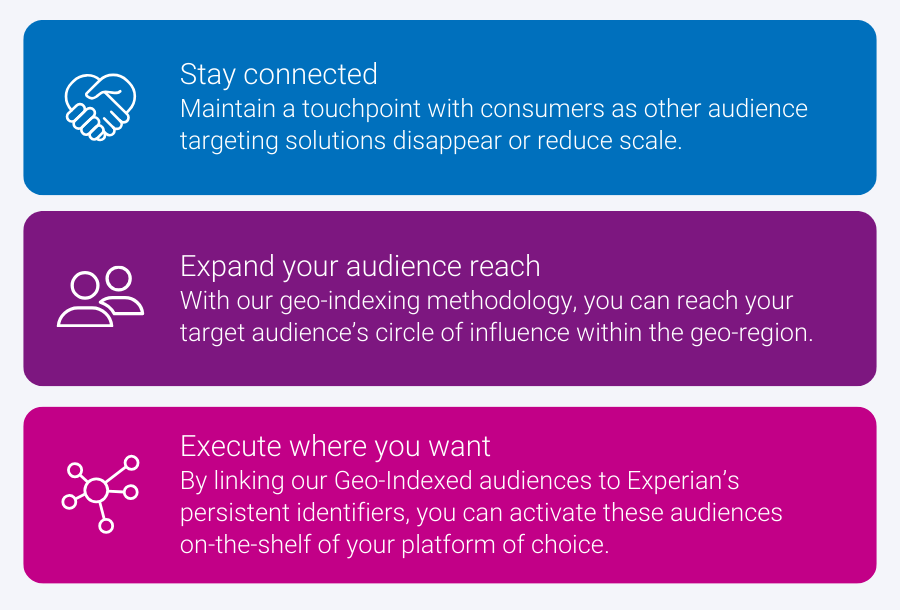
- Stay connected: Maintain a touchpoint with consumers as other audience targeting solutions disappear or reduce scale due to new legislation.
- Expand your audience reach: With our sophisticated geo-indexing methodology, you will be reaching your target audience’s circle of influence within the geo-region.
- Execute where you want: By linking our Geo-Indexed audiences to Experian’s persistent identifiers, you can activate these audiences on the shelf of your platform of choice.
As a part of the release of Geo-Indexed audiences, we will be rolling out three main categories:
- Language
- Ethnic Group
- Demographics which include:
- Education
- Household Income
- Marital Status
- Occupation
- Presence of Children
Over the next year, we will continue to release new audiences within Geo-Indexed audiences.
How you can use Geo-Indexed audiences
An Auto brand has a new corporate policy restricting the use of sensitive personal information in audience targeting but would like to reach high-income earners. To reach their target audience they use the Geo-Indexed audiences to reach households who are in geographic regions that index highly for income ranges ‘$175,000 – $199,999’ and ‘$200,000+.’
Prioritize privacy without sacrificing accuracy with Experian’s Geo-Indexed audiences
Our Geo-Indexed audiences are available in most major data and demand-side platforms. Visit our partner page for more information.
Don’t see our audiences on your platform of choice? We can help you build and activate an Experian audience on the platform of your choice.
Latest posts

The concept of identity resolution has emerged over the years as a strategic imperative among marketers and technology vendors. A report by Forrester contends that accurately establishing and maintaining customer identity is one of the most perplexing challenges facing marketers today. Customers have footprints in the offline and online worlds and tend to seamlessly transition across various channels and devices – presenting a unique challenge to truly understand who they are. But the ability to stitch these disparate components of information together means marketers can make better decisions and have more meaningful interactions with their customers. And for customers, this means an experience with personalized advertising content more likely to resonate with them. Why should marketers prioritize identity? The ability to accurately identify customers is the most basic prerequisite for marketing analytics, orchestration and execution. As such, it is becoming increasingly important for brands and marketers planning to link together disparate systems of audience insights and engagement to foster a more seamless and personalized omnichannel customer experience. For example, if an advertiser can identify a customer’s interests, as well as how that person prefers to consume information, then the advertiser can create and deliver messaging that will resonate with the customer. However, like most competitive differentiators, the mission critical components to accurately determine an identity reside within the suite of identity management tools at the marketers’ disposal and the expertise required for proper execution – a struggle for most marketers. But when properly implemented, a comprehensive customer identity strategy can be among a brand or marketer’s most valuable and proprietary assets. Where to begin with identity resolution? With the convergence of CRM platform data, cross-channel online touchpoints, offline record linkage management, probabilistic cross-device graphs, and data onboarding—evolving from point solutions to unified platforms—marketers are faced with an increasingly complex set of challenges in addressing and solving for customer identity management. To properly implement from the get go, and to avoid having to bolt on disparate technologies down the road, emerging industry trends and success stories suggest marketers need a neutral technology service provider that can provide each of these solutions via a single, unified platform. A vendor that can build a solid identity management foundation comprised of omni-channel targeting and attribution, cross-device resolution, online-offline linkage management, and data onboarding form the nexus of a cohesive identity strategy, built to last. Experian helps connect consumer identity As a trusted name in data and information services for more than 40 years, we are committed to privacy by design and the responsible usage and security of data. Whether you’re a brand, agency, or publisher, Experian has the wide-ranging toolset to help you put people at the heart of your business and make better marketing decisions. By harnessing the power of the sum of these parts, fusing both offline and online identifiers and attributes, Experian has established a leadership position in identity management. If you’re ready to begin building your identity foundation, contact us and get started today! Learn more about why identity matters to marketers and consumers, here! Contact us today

Tapad, part of Experian, partners with Flashtalking to create impactful attribution modeling strategy
FeaturedPartnership Yields Increased Match and Connectivity Rate Through Tapad Graph, acquired by Experian March 27, 2018 — New York, N.Y. — Tapad, part of Experian, is reinventing personalization for the modern marketer and today announced the impactful results of its strategic partnership with Flashtalking, the leading global independent platform for ad delivery, unification and insights. Flashtalking is one of Tapad’s most engaged partners, using the Tapad Graph to unify cross-device engagement and identity-driven consumer behaviors for attribution modeling. The company leverages a unique identifier that, in conjunction with Tapad’s Graph, provides robust multi-touch attribution solution for its clients. This partnership has resulted in above-industry match and bridge rates for Flashtalking and its customers. Overall, the Tapad Graph yielded a 71 percent match rate with 41 percent of converters engaging on multiple devices, highlighting the importance of cross-device measurement. Tapad’s identity solutions provide Flashtalking with a more holistic view of global engagement. Flashtalking marries ad server log file data with the Tapad Graph to connect all interactions in the consumer journey. This enables Flashtalking to provide more accurate and impactful cross-device attribution, which ultimately enables better optimization. These achievements have led to recognition of Tapad and Flashtalking’s work by the I-COM Global Forum for Marketing, Data and Measurement. “Tapad allows us to understand user engagement across devices and platforms at both the household or individual user level, which is extremely beneficial when providing marketers with true path to conversion and attribution,” said Steve Latham, global head of analytics at Flashtalking. “Since our relationship began, we’ve successfully leveraged Tapad data to provide more accurate, actionable insights that have helped numerous brands achieve substantial gains in media effectiveness.” Flashtalking client Michael Lamontagne, SVP of analytics and CRM at 22squared says “We are big believers in using cross-device insights to improve our campaigns. Flashtalking has been a strategic partner in the pursuit of that goal. By incorporating the Tapad Graph, Flashtalking delivers powerful insights into user engagement and media attribution across browsers and devices. Of equal importance, their bundled solution makes it easy and efficient, saving our team countless hours of busy work.” Contact us today
Tapad, part of Experian, partners with Freckle IoT to enable cross-device offline attribution for brands
FeaturedThe Tapad Device Graph™ Complements Freckle’s IoT Capabilities to Extend Scale and Precision of Audience Data New York, NY — December 6, 2017 — Tapad, part of Experian, is the leader in cross-device marketing technology and Freckle IoT, the global leader in multi-touch, offline attribution, today announced they are partnering to provide brands with a holistic and insightful view of their customers, in predefined locations in all global markets. Starting today Freckle IoT will be leveraging the Tapad Device Graph™ to supplement the company’s data set to offer brands more granular attribution data. Consumer’s online behavior is becoming more and more complex, with the average consumer owning three or more devices and 35 percent of consumers converting on a different device from the one on which they started their research. These interactions become even more complicated when considering how online interactions and media impact offline sales. The collaboration between Tapad and Freckle, which combines Freckle IoT’s persistent location data with Tapad’s proprietary cross-device technology, is an important step in empowering brands with the information they need to better understand how digital media, consumed across multiple devices, is impacting offline attribution. Using its opt-in, first-party data, Freckle IoT helps brands measure the effectiveness of their advertising by independently matching media spend to in-store visits. Tapad’s technology extends Freckle’s data-set by allowing brands to access additional deterministic and probabilistic data, at scale and across all devices, to analyze consumer behavior ahead of in-store purchase. “Combining our technology with Tapad’s identity-driven solutions was a natural fit for our business,” said Neil Sweeney, founder and CEO at Freckle IoT. “With our unbiased, agnostic measurement and Tapad’s precise and privacy-safe data set, we knew this partnership would be a strong complement to providing more effective results for the needs of our brand partners.” For more information on Freckle IoT’s measurement offerings, please visit www.freckleiot.com. Contact us today