
Ditch the cookie, not the data with the next evolution of contextual targeting
Today, we’re excited to announce Contextually-Indexed Audiences, a game-changer in contextual targeting. Experian’s new solution offers advertisers a powerful, privacy-safe solution that combines the precision of deterministic audience targeting with the flexibility of contextual targeting. Powered by real-time analysis from two million websites, access to 1,400 trusted audience segments, and easy activation through the top demand-side platform’s contextual marketplace or Audigent private marketplaces (PMPs), this solution offers advertisers a scalable way to reach their target consumers.
With this solution, advertisers can reach consumers on websites that over-index for visitors with the demographics, behaviors, or interests, they are looking to target. For example, an automotive brand can select Experian’s “Contextually-indexed in-market for a luxury electric car” audience segment and reach consumers when they are browsing websites that often attract that exact segment. Best of all, this is done in a privacy-safe way since it’s not reliant on cookies, mobile ad IDs (MAIDs) or other user identifiers.
How Contextually-Indexed Audiences work
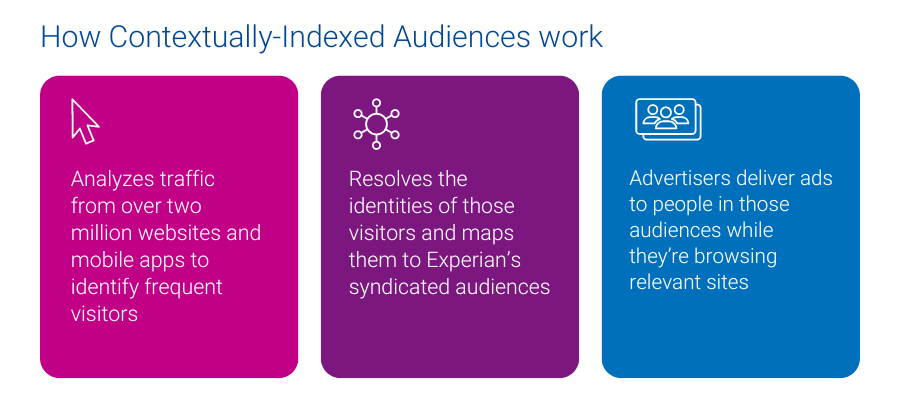
Contextually-Indexed Audiences harness advanced machine learning technology to move beyond traditional keyword-based strategies. The solution works in three steps:
- First, it analyzes traffic from over two million websites and mobile apps to identify the types of frequent visitors to those platforms.
- Next, using Experian’s Digital Graph, it resolves the identities of those visitors and maps them to more than 1,400 of Experian’s Syndicated Audiences, determining which audiences are most overrepresented on each site.
- Finally, the relevant audiences are assigned to those sites, allowing advertisers to deliver ads to people in those audiences while they are actively browsing the websites — without relying on user identifiers.
Customer success story
A leading auto manufacturer was among the first clients to activate this new solution while we were in beta. The goal was to identify new contextual targeting solutions that focus on privacy while maintaining scale and performance. The client identified two key target audiences: first-time vehicle buyers and experienced buyers. The initial campaigns using this new solution were highly successful. Even as the campaign scaled to twice the original volume, it continued to deliver three times the targeted click-through rate (CTR) goal.
“Partnering with industry leaders like Experian, we’re pushing the boundaries of contextual targeting with innovative data strategies that offer buyers greater flexibility and improved performance. These advanced contextual solutions are exciting as they not only drive results but also have the same privacy safeguards as traditional contextual targeting.”
Matt Griffith, CTO & Co-Founder, Audigent
Benefits of Contextually-Indexed Audiences
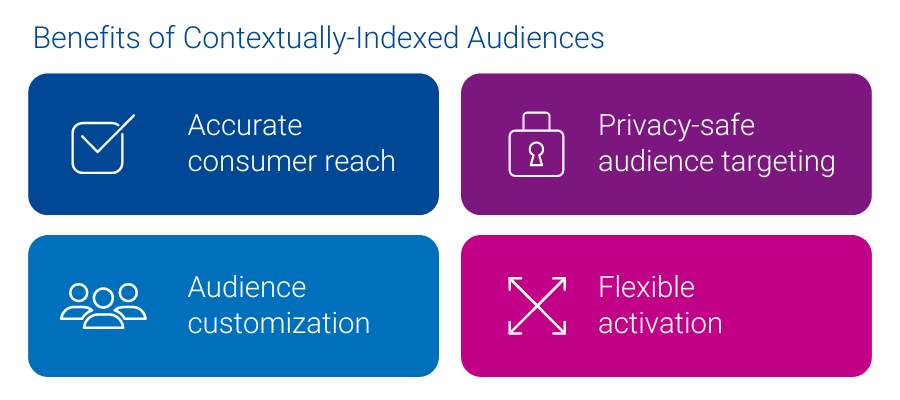
- Accurate consumer reach: Real-time integrations with over two million websites and apps coupled with machine-learning indexing technology ensure audience segments are constantly refreshed, which means advertisers reach consumers based on their latest habits.
- Privacy-safe audience targeting: These audiences are not reliant on cookies or any other user identifiers for targeting.
- Audience customization: Create the right audience segment for your campaign by using a combination of over 1,400 audiences across 12 data categories like demographics, politics, health, travel, finance, and TV.
- Flexible activation: Activate these audiences instantly in the top demand-side platform’s contextual marketplace or utilize our partnership with Audigent to create a custom private marketplace (PMP), where they can be activated across any media buying platform. When using a PMP, advertisers benefit from additional performance optimization capabilities.
Experian’s Contextually-Indexed Audiences offer advertisers a powerful solution that combines the precision of audience targeting with the flexibility of contextual targeting. With real-time analysis of over two million sites and access to 1,400 trusted audience segments, advertisers can reach consumers based on their exact behaviors and interests. This is done in a privacy-safe, yet scalable way since it’s not reliant on cookies or other user identifiers. Whether activating instantly through the top demand-side platform or customizing through Audigent PMPs, this is the future of audience targeting.
Ditch the cookie, not the data, and elevate your strategy today.
Contact us
Latest posts

Tapad, now part of Experian, technology now powers Lifesight's real world intelligence platform with cross-device and reach expansion in the Asia Pacific Region SINGAPORE, Nov. 20, 2019 /PRNewswire/ — Tapad, part of Experian and a global leader in digital identity resolution, today announced a new partnership with Lifesight, a leading provider of real world intelligence for advertisers in the Asia Pacific region (APAC). With the combined offering of The Tapad Graph, Tapad's global, privacy-safe digital cross-device solution, and Lifesight's real world intelligence platform, brands and agencies across APAC can benefit from better consumer targeting, expanded reach for targeted audiences and web-to-mobile footfall attribution. Through this multi-layered offering, Lifesight's brand and agency partners can access an omnichannel view of consumers' paths to purchase, thereby enabling them to increase the reach, measurability and ROI of their advertising campaigns. Rohit Maheswaran, Co-founder of Lifesight commented, "The consumer journey is getting increasingly more complex with ever changing digital and physical world behaviours, making it difficult for marketers to make strategic marketing spend decisions. That's why it's our mission at Lifesight to empower the brands and agencies within the APAC market to achieve better targeting and measurement capabilities, and our partnership with Tapad will help further this cause." Abhay Doshi, Head of APAC at Tapad added, "The Tapad Graph, which enables a unified view of consumers across their multiple digital devices, has a reach of 1 billion devices across the APAC market today. Paired with Lifesight's consumer insights of more than 500 million unique devices, this valuable partnership will offer the market extended consumer reach and prove beneficial to brands and advertisers across APAC who have historically struggled with resolving attribution." To learn more about Tapad and our digital identity resolution capabilities, visit www.experian.com/marketing/consumer-sync About Tapad Tapad, Inc. is a global leader in digital identity resolution. The Tapad Graph, and its related solutions, provide a transparent, privacy-safe approach connecting brands to consumers through their devices globally. Our one-of-a-kind Graph Select offering enables marketers the flexibility and freedom of choice to correlate devices to varied objectives, driving campaign effectiveness and business results. Tapad is recognized across the industry for its product innovation, workplace culture and talent, and has earned numerous awards including One World Identity's 2019 Top 100 Influencers in Identity Award. Headquartered in New York, Tapad also has offices in Chicago, London, Oslo, Singapore and Tokyo. About Lifesight Lifesight is Asia's leading real world intelligence company that helps marketers understand, target, and measure consumers based on their real world behaviour. Lifesight's robust platform and data solutions power business decisioning, audience activation, footfall measurement, and in-depth location analytics for leading brands and enterprises. The company is headquartered in Singapore with a rapidly expanding footprint in the Asia Pacific region operating in India, Malaysia, Indonesia, UAE, Saudi Arabia, Thailand, Philippines, Vietnam, Japan, Australia and New Zealand. To learn more, visit https://www.lifesight.io/. Contact us today
NEW YORK, Oct. 24, 2019 /PRNewswire/ – Tapad, part of Experian and a global leader in digital identity resolution, today announced a new partnership with Retargetly, a leading independent full stack data company. The partnership combines Tapad's cross-device identity resolution technology with Retargetly's robust data toolset, allowing brands and agencies using Retargetly's platform to seamlessly access an expanded audience across devices, without compromising precision. In addition to reach expansion, Tapad's global, privacy-safe digital cross-device solution, The Tapad Graph, enables Retargetly's brand and agency clients a more holistic digital customer journey analysis, and efficient campaign capabilities like frequency capping and online attribution. At the same time, Tapad will be able to extend its presence into the LATAM region, tapping into Retargetly's existing regional footprint. Understanding a consumer's cross-device journey is a marketing necessity. A recent study showed that 75% of consumers expect a consistent experience from brands1. With the number of devices per individual rapidly increasing, digital identity resolution becomes essential to create that streamlined experience consumers crave. "Similarly to Tapad, our goal is to offer marketers a suite of products that can increase the ROI of their campaigns," said Juan Amuchastegui, Head of Product at Retargetly. "In order to achieve this, marketers need digital cross-device identity resolution to gain attribution, acquisition and reach expansion capabilities. We chose Tapad as our partner because The Tapad Graph has differentiated global scale, and privacy-safe measures, which we knew would benefit our clients' campaigns." Santi Darmandrail, Managing Director at Retargetly added, "Across the Americas our clients choose to work with us because of our scale, our precision, and our unique approach to what data can do to transform business outcomes. In that scenario, partnering with Tapad and integrating The Tapad Graph onto our platform was really a no-brainer and we are beyond excited to be making that available for our more than 700 clients across the region." To learn more about Tapad and our digital identity resolution products, visit our identity solutions page. About Tapad Tapad, Inc. is a global leader in digital identity resolution. The Tapad Graph, and its related solutions, provide a transparent, privacy-safe approach connecting brands to consumers through their devices globally. Tapad is recognized across the industry for its product innovation, workplace culture and talent, and has earned numerous awards including One World Identity's 2019 Top 100 Influencers in Identity Award. Headquartered in New York, Tapad also has offices in Chicago, Denver, London, Oslo, Singapore and Tokyo. About Retargetly: Retargetly is the leading independent data solution from Latam. Their proprietary platform processes over 25 billion data events a month and transforms them into actionable analytics that drive business results across the board. The recently launched Retargetly Audience Platform (RAM) is the number one data exchange in Latin America, with over 1000 active buyers and millions of dollars traded every year. Regargetly provides services across Latam and has offices in Buenos Aires, Mexico City, São Paulo and New York. For more information, visit www.retargetly.com. Contact us today
NEW YORK, Oct. 16, 2019 /PRNewswire/ – Tapad, part of Experian and a global leader in digital identity resolution, and The Trade Desk, a global advertising technology leader, partnered to integrate The Trade Desk's unified ID solution in April 2019. The Trade Desk's unified ID solution's objective is to serve as a standardized cookie ID to help marketers reach more of their audience on the open internet. After an initial six month period, Tapad reports significant adoption rates and enhanced customer results since their joint integration in April. As a result of the partnership, client brands, agencies, DMPs/ DSPs, Data Providers, Mobile Networks and Measurement/Analytics Providers, saw increased match rates up to 38% and more global coverage without compromising precision. With this combined offering, Tapad's global, privacy-safe digital cross-device solution, The Tapad Graph, connects brands with consumers over 4 billion devices globally. Over 25 companies who license The Tapad Graph, such as Annalect, Semasio, Retargetly, and ThinkCX, have also included The Trade Desk's unified ID solution as a key identifier in their graph output. "The vast improvement in scale that Tapad has seen illustrates the value digital identity resolution products can bring for brands," said Nate Gawel, General Manager of Data Partnerships at The Trade Desk. "We're looking forward to continuing work with Tapad to prove that the open internet can deliver the very same benefits many reserve for large platforms." Adoption of the unified ID solution allows all parties across the supply chain (SSPs, DSPs, DMPs and data providers) to utilize The Trade Desk's cookie footprint to increase their own cookie coverage across the global independent internet. For more information, please visit The Trade Desk's unified ID solution site, or https://www.experian.com/marketing/consumer-sync to learn more about Tapad's digital identity resolution products. About Tapad:Tapad, Inc. is a global leader in digital identity resolution. The Tapad Graph, and its related solutions, provide a transparent, privacy-safe approach connecting brands to consumers through their devices globally. Our one-of-a-kind Graph Select offering enables marketers the flexibility and freedom of choice to correlate devices to varied objectives, driving campaign effectiveness and business results. Tapad is recognized across the industry for its product innovation, workplace culture and talent, and has earned numerous awards including One World Identity's 2019 Top 100 Influencers in Identity Award. Headquartered in New York, Tapad also has offices in Chicago, London, Oslo, Singapore and Tokyo. About The Trade Desk:The Trade Desk™ is a technology company that empowers buyers of advertising. Through its self-service, cloud-based platform, ad buyers can create, manage, and optimize digital advertising campaigns across ad formats and devices. Integrations with major data, inventory, and publisher partners ensure maximum reach and decisioning capabilities, and enterprise APIs enable custom development on top of the platform. Headquartered in Ventura, CA, The Trade Desk has offices across North America, Europe, and Asia Pacific. To learn more, visit thetradedesk.com or follow us on Facebook, Twitter, LinkedIn and YouTube. Contact us today