
Originally published in Adweek
Key takeaways
- 56% of U.S. media buyers plan to increase commerce media spend this year, but 55% cite missing cross-network measurement standards.
- New-to-brand definitions, lookback windows, and attribution rules differ by network, so results across networks can’t be compared directly.
- Off-site commerce media is growing twice as fast as on-site, carrying purchase signal away from the retail environment that created it.
- A shared identity layer lets brands recognize the same consumer across every network, and Experian’s independence from demand-side platforms (DSPs) and supply paths keeps that layer neutral.
Commerce media keeps expanding, and brands are running campaigns across more networks than ever. Most still can’t say which network performed better.
More media networks haven’t produced a more complete view
Investment keeps climbing, and 56% of U.S. media buyers plan to increase commerce media network spending this year, often by reallocating from social, display, and search budgets. Nearly half of advertisers, 47.5%, now fund those campaigns from two or three separate budgets.
Every network in that mix brings its own identity system, audience definitions, and measurement approach. Brands add the fourth or fifth network expecting a fuller picture of performance. Instead, they get more numbers that no one designed to sit next to each other.
I don’t think commerce media has a data problem. Every network has audience data and purchase data. Consistency across them is what nobody has built yet.
The inconsistency lives in the definitions
Take new-to-brand, the metric meant to separate new customers from repeat buyers. It means different things at different networks. Lookback windows differ. Some definitions apply at the brand level, others at the product line. Some count in-store purchases, others count only digital. View-through credit varies across display, video, and connected TV (CTV). Attribution windows vary by partner and by format. Audience portability compounds it. Retailer audiences often can’t move across platforms, so teams rebuild the same strategy in several systems and hope the definitions roughly align.
Over half of advertisers, 55%, name the lack of cross-network measurement standards as a top challenge. A campaign can look stronger on one network than another for no reason other than a different reporting rule. You can’t move budget on numbers that don’t compare or show incremental lift, and yet most teams are trying to.
Off-site growth makes this harder to ignore
On-site inventory is approaching its ceiling. Sponsored results now appear on 99% of product search pages at Amazon and Walmart, and ad density has reached as high as 50% on key retail search pages. Off-site spending is growing at twice the rate of on-site.

Off-site carries commerce signal away from the environment that created it. Every handoff is a point where the audience definition, the match rate, and the measurement logic have to hold. These are solvable problems, and they show up in the same form at every handoff, which makes them worth solving once instead of campaign by campaign. Fragmentation that stayed manageable inside a retailer’s own properties becomes something to design for the moment the signal travels.
Interoperability starts with a shared identity layer
Brands and networks need a common way to recognize the same consumer wherever a campaign runs. That layer has to draw on retailer, brand, and campaign signals together, and it needs consistent definitions from one network to the next. Get that right and performance sits on common ground, even with every network’s particular reporting rules.
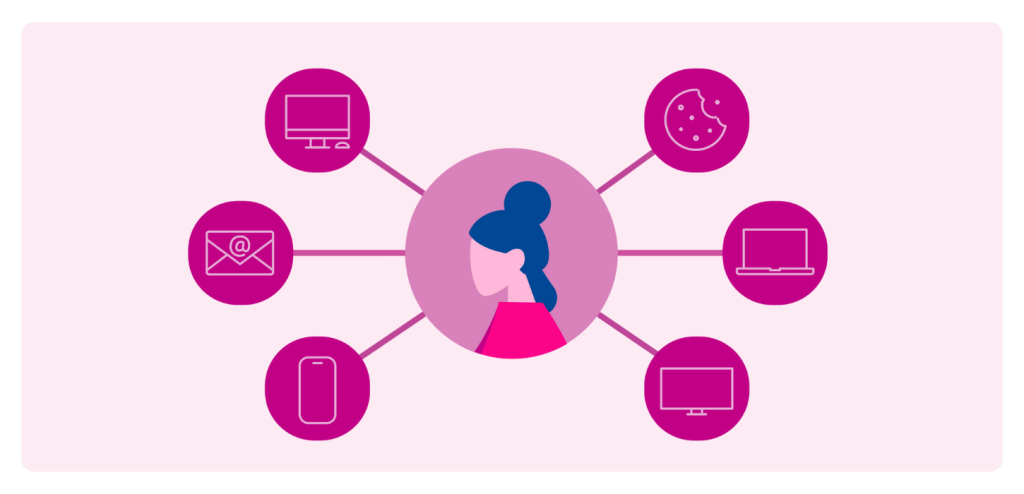
That layer matters more as AI takes over more of the optimization. Models inherit whatever inconsistency sits in the data beneath them, so audience definitions that shift from one network to the next degrade every decision that follows. Better models won’t fix a fragmented identity layer, but they will scale its errors faster. Networks can get ahead of this by settling the identity layer first, standardizing audience definitions so they hold on-site and off-site and give the models downstream something dependable to learn from.
Signal expansion belongs in the same conversation. First-party data reflects the customers who logged in, joined the loyalty program, or completed a transaction. Irregular buyers, emerging segments, and high-value prospects who are actively in-market show up faintly or not at all in that view, even though signal about them exists elsewhere in the ecosystem. A shared identity layer that connects to a marketplace of data providers closes part of that gap, and it does so without asking any network to hand over raw records.
This is also what opens commerce media to brands that will never own a media network. Most companies sitting on valuable first-party data don’t have the traffic or the assortment to build what Amazon and Walmart built, and they don’t need to. Combining signal with trusted partners produces audiences larger and more valuable than any one of those brands holds alone. That’s how a brand participates in commerce media without becoming a media company.
Networks need infrastructure, and neutrality decides whose
A mid-sized commerce media network runs into the same ceiling from the other direction. Owned inventory has a limit, and so does owned data. Growing past both means off-site reach, enriched audiences, and measurement that holds up next to the largest players, and building all of that in-house isn’t realistic for most networks. What they need is infrastructure that supports expansion without giving up control of the customer relationship.
That makes the choice of whose infrastructure a consequential one. Brands and networks should look hard at the commercial position of any partner they put at the center of identity and measurement. A partner with interests in a specific demand-side platform (DSP), supply path, or set of agency relationships gains visibility into every deal that moves through it, and that visibility shapes incentives over time. Networks are right to weigh it carefully.
Experian competes in none of those layers. Our position strengthens when the ecosystem stays open and brands keep the freedom to work across partners, platforms, and evolving technologies. Independence is what makes shared infrastructure possible.
Consistency is the constraint on the next round of growth
Commerce media maturity trails its ambition. 42% of teams believe they have operationalized commerce media, while only 13% qualify as advanced against leadership, technology, measurement, and operations.
Closing that gap depends on identity discipline more than network count. A brand that recognizes the same consumer across every network it buys can compare results, move budget with confidence, and hold every partner to one standard. Without that, each new network adds spend and subtracts clarity.
Consistency is what turns commerce media from a set of separate programs into something a brand can actually manage.
About the author

Kevin Dunn
Chief Revenue Officer, Experian
Kevin Dunn joins Experian Marketing Services with more than 20 years of leadership experience across marketing and advertising technology, most recently serving as Senior Vice President of Brands and Agencies at LiveRamp. In that role, he led growth across retail, CPG, travel, hospitality, financial services, and healthcare, overseeing new business, account expansion, and channel partnerships.
Kevin is known for building cohesive, accountable teams and leading with optimism, clarity, and a strong sense of shared purpose. His leadership philosophy centers on empowering people, driving positive outcomes for clients and fostering a culture where teams can grow, take smart risks, and succeed together.
Latest posts
Advertisers continue to increase their spending across addressable TV, connected TV (CTV), and digital. According to IAB’s “2021 Video Ad Spend and 2022 Outlook” report, digital video ad spending is expected to increase by 26% to $49.2 billion in 2022. Understanding who consumers are and how to best reach them in their preferred channel is becoming more complex. Damian Amitin and Colleen Dawe discuss how a seamless identity strategy can address the complexity of the emerging TV space. The evolution of identity resolution Around ten years ago, the idea of digital “identity resolution” or “Device Graphs” was born. This idea connected cookies and MAIDs to understand when many IDs were the same person or household. In more recent years, our industry began to connect that initial understanding to the CTV ecosystem. But, a large part of the TV ecosystem existed in silos, like first and third-party audience data, and the growing advanced TV market. The goal of identity resolution has always been to understand the consumer better. To achieve more accurate targeting and measurement in the CTV ecosystem, we must incorporate the following: What we know about the household and consumer from an ID perspective Who the consumer is as it relates to audience data, as well as the wealth of first-party data in the advanced TV space We know the cookie is a flawed way to collect data. While Google delayed the deprecation of third-party cookies, there are other challenges that we face right now. Such as the glaring gap in Safari traffic and the Identifier for Advertisers (IDFA) turning to “opt-in.” Understanding consumer behavior across devices and platforms continues to challenge marketers and publishers. These challenges are creating the need to find more stable identifiers. Though the cookie remains valuable, it has an uncertain future. This has led advertisers to place bigger bets on the combination of addressable and CTV. The overlap in addressable and CTV data leads to fragmentation Personally identifiable information (PII) makes up the majority of addressable TV households’ data. Part of the attraction to CTV is that their IDs remain universal, persistent, and stable. Analysts project that CTV ad spending will hit $23B in 2023. Consumers now have an average of 4.7 streaming subscriptions per household. It’s no surprise then, that Disney+, HBO, and Netflix released or announced ad-supported tiers. Addressable TV and CTV are often thought of as distinct markets across the industry. But, in the context of identity, we should look at them through the same lens. Millions of households still consume TV and video content via a set-top box or through apps on CTVs. This is in addition to what they consume on their laptops, tablets, and phones. Of the top 11 cable and satellite providers, 65 million U.S. households still have a box in their homes. On the other hand, approximately 96 million U.S. households have at least one or more Smart TVs and streaming services. With about 126 million total U.S. TV households, that’s a lot of overlap. There are still significant numbers of both addressable and CTV homes. How can we address fragmented TV consumption? Through a holistic and comprehensive approach to identity. An approach that captures addressable TV, CTV, and digital identifiers. An approach that captures all audience attributes inside of a single identity graph. This is the ideal approach for publishers, AdTech vendors, and brands. Discover how to unlock holistic identity How can we achieve a holistic identity? Through a three-pillared approach: First-party data onboarding Digital identifiers Consumer data First-party data onboarding Bringing offline data from a brand’s consumers is very valuable due to the quality of the data. Because the data is being collected right from the source, you know it’s accurate. It provides the foundation you can build your identity strategy from. Digital identifiers Once you create a foundation with first-party data, you need to connect it. Either with an internal or licensed digital ID graph. Then you can understand the connections between all devices within the household. Consumer data After you know which devices tie to a single consumer, you’ll want to act on that knowledge. The next step is to partner with a data provider that can help you understand your consumers. Establishing this partnership will help improve targeting, measurement, and the customer experience. To achieve a well-rounded customer view tomorrow, we need to start today The three-pillared approach bridges the gap between the offline and online worlds. This provides a well-rounded view of customers and audiences. However, the ability to tie these aspects of identity together still presents several challenges. To achieve the three-pillared approach today, you need to use many vendors and fragmented data sources. Often with conflicting data. As we look forward, the tools to do this are becoming more advanced and unified. The players in our ecosystem should adopt a seamless identity strategy. One that provides a privacy-safe yet full-picture solution. That means capturing and unifying all devices within a household. While also understanding the consumer behaviors and profiles behind those devices. Keep up with your customers and their data Once we create an informed identity strategy, we can begin to understand the makeup of each household and the individuals within. In this new world, personalizing the experience for an audience is key. Where do they prefer to spend their time? What type of content are they most engaged in? Only then can we as an industry provide an optimal experience for each consumer. All while driving greater ROI for advertisers and publishers. Are you ready to know more about your customers than ever before? Let’s get to work together to achieve your marketing goals. Contact us to learn how we can connect the complex dots of identity resolution. About our experts Damian Amitin, VP of Enterprise Partnerships, Experian Marketing Services Damian Amitin is the VP of Enterprise Partnerships and joined Experian during the Tapad acquisition in November 2020. Damian is a senior sales and partnerships executive, specializing in the identity resolution and marketing data ecosystem. Damian helps brands, publishers, and technology vendors enable enhanced ID resolution through The Experian/Tapad platform to attain a 360 view of the customer across targeting analytics, attribution, and personalization. Colleen Dawe, Senior Account Executive, Experian Marketing Services Colleen Dawe is a Senior Account Executive on the Advanced TV Team within Experian Marketing Services. With 15 years of experience working within the television ecosystem, Colleen works with clients to bring the value and expertise of Experian to support their objectives in the areas of data, identity, activation, and measurement. Get in touch

Brands can leverage non-clinical factors, like the social determinants of health, to gain a holistic view of their patients and increase access to care.

Next up in our Ask the Expert series, we hear from Sarah Ilie and Lauren Portell. Sarah and Lauren talk about the internet’s value exchange – what we gain and lose when it’s so easy to share our information. Is convenience hurting or helping us? The age of connectivity Today, it’s almost unimaginable to think about how your day-to-day life would look without the convenience of the internet, smartphones, apps, and fitness trackers; the list goes on and on. We live in the age of connectivity. We have the convenience to buy products delivered to our homes on the same day. We can consume content across thousands of platforms. We also have watches or apps that track our health with more granularity than ever before. The internet’s value exchange In exchange for this convenience and information, we must share various kinds of data for these transactions and activities to take place. Websites and apps give you the option to “opt in” and share your data. They also often let you know that they are collecting your data. This can feel like an uncomfortable proposition and an invasion of privacy to many people. What does it mean to opt-in to a website or app’s tracking cookies? What value do we exchange? What opting in means for you Opting in to cookies means that you are allowing the app or website to track your online activity and collect anonymous data that is aggregated for marketing analytics. The data provides valuable information to understand users better to create better online experiences or offer more useful products and content. Granting access to “tracking” offers several benefits to users such as a customized, more personal user experience or advertising that is more likely to be relevant. For example, let’s imagine you have recently been using an app or website to plan a camping trip. By sharing your data, the website or app has visibility into what is interesting or useful to you which can lead to related content suggestions (best campsites) or relevant advertising and product recommendations (tents and camping equipment). It’s important to know that the marketing data collected when you opt in is extremely valuable. The revenue that advertising generates is often very important to websites and apps because this is how they make money to continue providing content and services to consumers. Data privacy practices Privacy concerns regarding how companies and developers use tracking information have risen over the last couple of years and have resulted in additional protection for consumers’ privacy while still allowing companies to improve their products and advertising. One big step in this direction has been simply making people aware that their data is being collected, why it’s being collected, and providing users with the option to share this data for marketing analytics through opting-in or not. Other important steps to maintain online privacy include formal legal legislation and self-regulation. The right to privacy is protected by more than 600 laws between individual states and federal legislation and the U.S. House Committee on Energy and Commerce recently voted to pass the American Data Privacy and Protection Act. Additionally, marketing organizations such as the Interactive Advertising Bureau and Association of National Advertisers regulate themselves with codes of conduct and standards given there is so much attention on privacy issues. Is the internet’s value exchange worth it? The data that we choose to share by opting in has a lot of benefits for us as consumers. There are laws in place to protect our data and privacy. Of course, it’s important to be aware that data is collected and used for marketing purposes, but it’s also reasonable to share a certain amount of data that translates into benefits for you as well. The best data unlocks the best marketing. Contact us to tap into the power of the world’s largest consumer database. Learn how you can use Experian Marketing Services’ powerful consumer data to learn more about your customers, drive new business, and deliver intelligent interactions across all channels. Meet the Experts: Lauren Portell, Account Executive, Advanced TV, Experian Marketing Services Sarah Ilie, Strategic Partner Manager, Experian Marketing Services Get in touch