
Audio platforms that overcome consumer identity challenges are winning new advertisers and driving higher ROAS. In this article, you’ll hear from leading audio platforms that are solving these challenges—and seeing results.
Digital audio is evolving fast. What was once a niche channel of host-read sponsorships and direct buys is now a must-have in the modern media mix. Streaming platforms, podcasts, and digital radio are drawing more ad dollars thanks to audio’s ability to capture attention and connect with listeners.
But with growth comes new pressure. Advertisers expect accuracy, scale, and to see results. At the same time, listeners want more relevant content and more personalized ad experiences. That’s where identity becomes essential.
With Experian’s identity and audience solutions, audio platforms can:
- Bolster addressable audience targeting and personalization capabilities.
- Gain a comprehensive view of listeners’ digital identity to reach audiences across channels.
- Better understand consumer preferences, enabling advertisers to reach audiences with greater accuracy.
- Enhance the listening experience with more relevant content.
Let’s break down the key challenges in audio—and how Experian can help solve them.
Challenge 1: Anonymous listening limits addressability
Most listening happens in environments where people aren’t logged in—via apps, smart speakers, and mobile devices. Without logged-in data, platforms struggle to know who’s listening and advertisers are unable to reach those anonymous listeners who don’t have an addressable ID.
To overcome the identity gap in unauthenticated listening environments, leading audio platforms are turning to partners that connect fragmented signals—like device type, location, and behavioral patterns—to broader household and individual profiles. By using hashed emails and other alternative identifiers, platforms can begin to make anonymous sessions more addressable. This increase in addressability ensures the platform’s entire userbase can be reached, which leads to an increase in revenue.
Experian’s solution
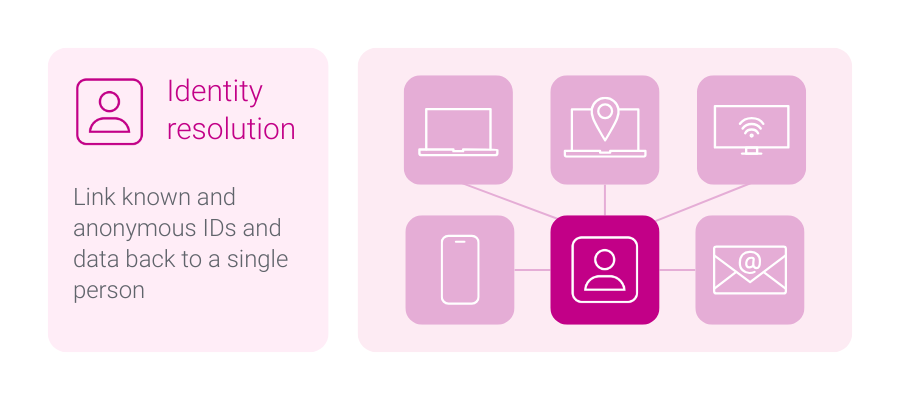
Experian’s identity spine, comprised of our Digital and Offline Graphs, helps you recognize listeners even when they’re outside your ecosystem. Platforms like Audacy are already leading the way. By integrating Experian’s Digital Graph, they’re gaining a more complete view of listeners’ digital identifiers—enhancing the experience across their app and website. With a better audience understanding, Audacy can deliver personalized content while helping advertisers reach specific groups with greater accuracy.
Challenge 2: IP-based targeting falls short
Audio has traditionally relied on IP addresses, but that’s no longer enough. A single IP could represent an entire household—or a public setting like a coffee shop. It’s not precise.
Forward-thinking platforms are moving beyond IP-based targeting by integrating identity resolution technologies that combine household-level data with device-level intelligence. These solutions help distinguish between shared devices and individual listeners, allowing advertisers to serve more relevant messages without over-reliance on a single signal like an IP address. This layered approach improves precision—especially in dynamic listening environments like vehicles or communal spaces.
Experian’s solution
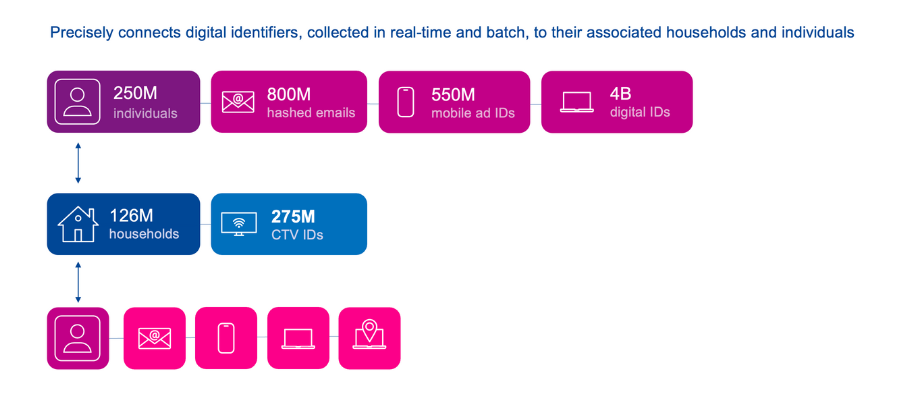
Our identity spine links home IPs to households, then connects them to specific devices and individuals. This helps platforms move beyond basic IPs and target real people based on accurate signals—even in shared listening environments like smart speakers and cars.
We also help platforms and advertisers integrate alternative IDs—like Unified I.D. 2.0 (UID2)—into their programmatic audio campaigns. That means more reach, without compromising consumer trust.
Challenge 3: Audio buying is fragmented
From podcasts to streaming to radio, audio lacks consistency in how inventory is packaged and bought. It’s hard for advertisers to run scaled campaigns across channels—and harder still to measure performance.
Plus, advertisers don’t think in silos—they think in strategies. If audio can’t connect to their display, connected TV (CTV), and social buys, it loses ground. What they need is a way to define audiences once and activate everywhere.
To reduce friction in audio ad buying, platforms are investing in infrastructure that unifies audience insights across formats. By building a centralized view of the listener—regardless of whether they’re tuning in via podcast, stream, or radio—publishers can offer advertisers consistent targeting parameters, clearer reporting, and better campaign orchestration. Identity graphs and audiences are playing a growing role in streamlining this complexity and unlocking scale.
Experian’s solution
Experian helps simplify audio buying. Experian audiences are built on top of our identity graph and are expanded to a deep set of digital identifiers, ensuring accuracy, scale and maximum addressability across channels. Platforms can blend their first-party data with advertiser data and our audiences—then deploy those audiences onsite or activate programmatically across open web and CTV.
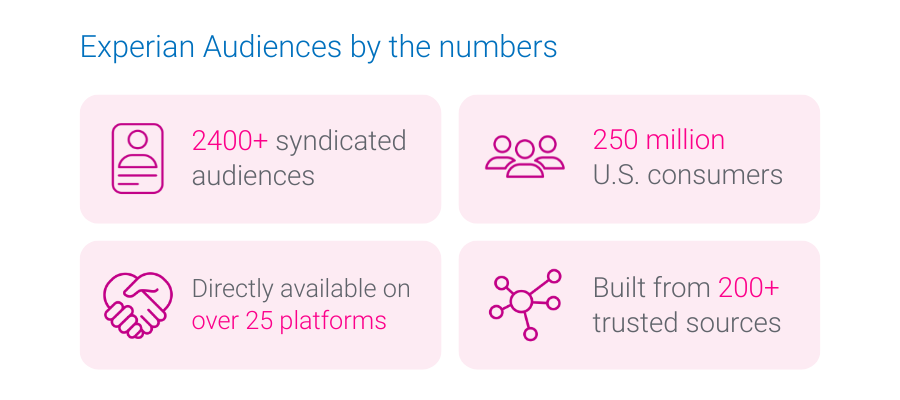
DAX is doing just that. DAX’s partnership with Experian combines Experian’s 2,400+ audiences for targeting and activation with DAX’s innovative audio advertising approach. We’re helping advertisers connect with passionate and engaged listeners nationwide.
“Through our partnership with Experian Marketing Services, advertisers can unlock deeper audience insights and execute more impactful digital audio campaigns. By combining our shared market presence, knowledge, and forward-thinking approach, we’re strengthening our digital audio network offering and delivering value to all our advertising partners.”
Brian Conlan, President of DAX United States
Watch our identity-driven audio panel from our Curated Couch at CES 2026
In addition to integrating Experian’s Digital Graph, Audacy is also integrating Experian’s syndicated audiences to unlock accurate insights like demographics, shopping behavior, and interests – providing listeners with a more personalized advertising experience and advertisers with a higher return on investment.
Privacy is non-negotiable
Everything we do is privacy-forward by design. Backed by Experian’s Global Data Principles and decades as a regulated institution, we rigorously vet every data source to ensure compliance with all federal and state laws.
Build an audio strategy that performs with Experian
Your advertisers want more from their audio investments. With Experian, you can give it to them. We help you:
Audio has always been a powerful way to connect. Now, it’s ready to perform.
Let’s connect
Latest posts

To our valued customers and partners, it’s been an exciting week here at Tapad! As announced in a press release this morning, Tapad is now a member of the Experian family. We’re thrilled to continue to grow as a leader in identity resolution under the umbrella of a global expert in data, analytics and technology. Tapad and Experian are deeply connected by our commitment to serving the needs of our customers; and with a focus on quality of the data we provide, we have a common goal for the future of identity in the advertising ecosystem. As part of this announcement, we wanted to assure you, our valued customer, that we remain deeply committed to serving you today just as we always have. Nothing will change in your daily operations with Tapad. Experian immediately recognized that the success and growth of Tapad was directly tied to the strength and depth of its team members. As such, the acquisition will not result in any changes to day-to-day contacts at Tapad, or processes with weekly graph deliveries and other product support. Experian’s faith and investment in Tapad’s future and the future of identity resolution underscores what we’ve always believed our products could achieve and that we will be able to continue serving brands, advertisers, publishers, and the advertising and marketing ecosystem for years to come. On a personal note, I am excited to be transitioning my role as Chief Operating Officer of Tapad to the General Manager position of a global business that’s achieved exponential growth over the past several years; culminating in this strategic acquisition that will no doubt bring even more value to our customers in the future. We remain committed to open communication and welcome any questions you may have. Thank you,Mark Connon | General Manager, Tapad Contact us today
Addressable TV has been through a transformation in the past year. Streaming content has become the most coveted space for creators and advertisers with the rise of new apps and platforms; but the influx of stay-at-home orders around the country have shifted television viewership as we know it, and streaming apps are popping up in droves to take advantage. So, how can you? With no shortage of opportunities to advertise on addressable TV and CTV, how does it fit into the media mix? And furthermore, how can you attribute this household-level device into your overall strategy? Tying it all together Layering addressable TV within digital ad campaigns couldn’t be easier today — but applying the right targeting and cadence between all of your digital efforts; and tying them together in attribution takes the right kind of data. Marketers can use CTV identifiers coupled with other device identifiers available in The Tapad Graph to not only target impressions but also map addressable TVs within the consumer journey; and unify strategies between household decision makers to better personalize messaging. 1 The Trade Desk Q2 2020 Earnings Call Transcript, August 2020; 2 iSpot Report, via Deadline, July 2020; 3 Flixed.io, January 2020 Contact us today
For the past several years ad-tech defined the value of identity at the individual level; made possible by the evolution of data, technology and machine-learning. But, earlier this year COVID-19 set in motion many shifts in consumer digital behavior. The more we’ve been working and learning from home, using devices that are shared amongst an entire household, the more apparent it is that marketers need to shift their strategies to align with these changes. Did you know the average household owns eleven or more connected devices? And the longer we’ve been at home, the more these devices are shared by multiple individuals. If you’re looking for a few simple ways to evolve from an individual focused strategy to a household strategy, here’s a good place to start: Audience segmentation Traditionally, audiences are built with a narrow focus on a single user, and what known attributes about that individual or their brand engagement can be leveraged for a targeting strategy. Now that screens are being shared between multiple users in a home, how can you be sure you’re identifying them correctly, and thus, segmenting them in the right buckets for targeting? The key lies in the ability to connect those points through identity resolution. Using ad exposure from household level devices, followed by a second engagement from an individual within that household can indicate a user is a better candidate for purchase or conversion than others. So before you build audiences for targeting, you can qualify them at the household level for segmentation with more confidence. Example: An auto advertiser uses audience segments from a third party provider such as ‘auto intenders’ to target individuals with new pricing offers. They would continue retargeting these users, unaware that some are connected in the same household, and thus are probably not all in the market to actually get a new car. By bucketing users that share a common household device within this third party segment, they can hone in on which individuals are actually in-market for a car and evolve their strategy to be more effective. Targeting Retargeting, frequency capping and sequential messaging have always been meant for an individual user — the more they’re exposed to your brand in a personalized way, the more likely they are to take the desired action. But, have you considered that multiple users could have a shared initial exposure to your brand? Today, you can target a household of potential consumers on a shared device like a CTV, and employ those retargeting strategies based on that common initial exposure. Starting at the household level, means you can compare movement through the funnel between different individuals in that household, and tailor your targeting accordingly. Perhaps you realize only one person in that household will convert and you tailor messaging to them more frequently, while confidently suppressing the other individuals. Example: a CPG brand uses OTT advertising, but doesn’t incorporate it within their sequential strategy, because they consider it just a ‘brand awareness’ opportunity. By using OTT more strategically as a household level engagement, it can reveal which individuals within a household are more favorable towards a brand further down the funnel. So, you can spend impressions targeting those users, rather than wasting impressions on multiple individuals within the household. Measurement Measurement and attribution are imperative to understanding the path to purchase and making strategies more efficient over time. Often that efficiency involves adding or removing devices and channels from a targeting strategy based on their contribution to an action or conversion by an individual. This year we’re seeing addressable TV devices explode in use, which are shared at the household level. Even desktop computers are being used by more people in the home due to COVID-19. So, assuming a linear path of attribution by an individual is missing the full picture. Identity resolution can help you understand where messaging was more effective for some users in the household than others, and leverage that insight to continue more effective strategies in the future. Example: Without a household view, a direct-to-consumer brand would assume all interactions from one device would be coming from a single individual, and that could create a higher cost-per analysis. By incorporating the household level devices into attribution models, they can find efficiencies between touch points of multiple users, and learn how those split off into individual paths to conversion. Not only can this DTC create a more effective model, but they can use that model to create cost efficiencies in the future. Contact us today