Loading...

How contextual advertising addresses signal loss

Published: February 28, 2023 by Experian Marketing Services

At A Glance

Experian and Yieldmo collaborate to help marketers navigate signal loss with privacy-safe contextual advertising. By combining Experian’s identity solutions with Yieldmo’s advanced targeting, this collaboration enables effective audience engagement in a world with fewer traditional signals.

Note: While third-party cookies are no longer being phased out, this webinar was recorded in 2023 when cookie deprecation was still a key industry focus. The strategies discussed reflect that time frame and remain relevant for addressing broader signal loss challenges.

With major browsers discontinuing support for third-party cookies, marketers must rethink how to identify and engage their audiences. Contextual advertising offers a privacy-safe solution by combining contextual signals with machine learning to deliver highly targeted campaigns. In a Q&A with our experts with eMarketer, Jason Andersen, Senior Director of Strategic Initiatives and Partner Solutions at Experian, and Alex Johnston, Principal Product Manager at Yieldmo, we discuss how contextual advertising addresses signal loss, improves addressability, and delivers better outcomes for marketers.

A thumbnail image taken from our webinar

The macro trends impacting marketers

How important is it for digital marketers to stay informed about the changes coming to third-party cookies, and what challenges do you see signal loss creating?

Jason (Experian): Third-party cookies have already been eliminated from Firefox, Safari, and other browsers, while Chrome has held out. It’s just a matter of time before Chrome eliminates them too. Being proactive now by predicting potential impacts will be essential for maintaining growth when the third-party cookie finally disappears.

An illustration of three people with charts in the background

Alex (Yieldmo): Third-party cookie loss is already a reality. As regulations like the General Data Protection Regulation (GDPR) and the California Consumer Privacy Act (CCPA) take effect, more than 50% of exchange traffic lacks associated identifiers. This means that marketers have to think differently about how they reach their audiences in an environment with fewer data points available for targeting purposes. It’s no longer something to consider at some point down the line – it’s here now! Also, as third-party cookies become more limited, reaching users online is becoming increasingly complex and competitive. Without access to as much data, the CPMs (cost per thousand impressions) that advertisers must pay are skyrocketing because everyone is trying to bid on those same valuable consumers. It’s essential for businesses desiring success in digital advertising now more than ever before.

Solving signal loss with contextual advertising

How does contextual advertising help marketers engage audiences with new strategies like machine learning and artificial intelligence (AI)?

Jason (Experian): Contextual advertising helps marketers engage audiences by combining advanced machine learning with privacy-safe strategies. We focus on using AI and machine learning to better understand behavior, respect privacy, and deliver insights. As third-party cookies go away, alternative identifiers are coming to market, like Unified I.D. 2.0 (UID2). These are going to be particularly important for marketers to be able to utilize them. As cookie syncing becomes outdated, marketers will have to look for alternative methods to reach their target audiences. It’s essential to look beyond cookie-reliant solutions and use other options available regarding advertising.
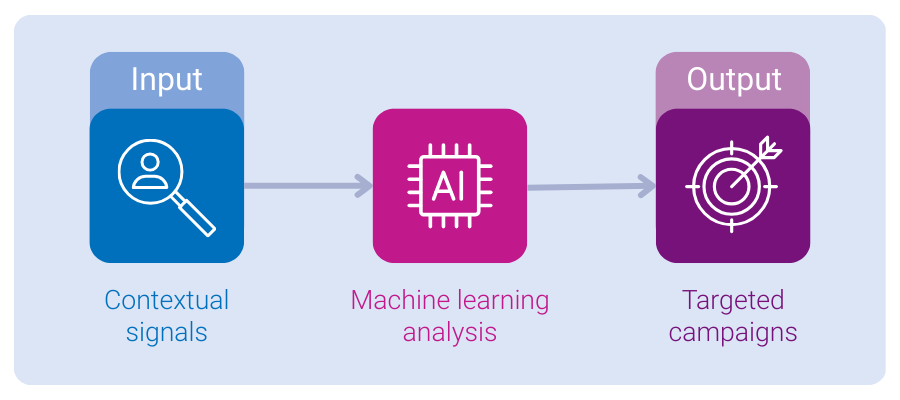
Input: Contextual signals, then AI machine learning analysis, then the output is targeted campaigns

Alex (Yieldmo): There’s been a renaissance in contextual advertising over the last couple of years. Three key drivers are shaping this shift:

  1. The loss of identity signals is forcing marketers to rethink how they reach audiences.
  2. Advances in machine learning allow us to analyze more granular contextual signals, identifying patterns that are most valuable to advertisers.
  3. Tailored models now use these signals to deliver more effective campaigns. This transformation is occurring because of our ability to capture and operate on richer, more detailed data.

Reach consumers with advanced addressability

How does advanced contextual advertising help marketers reach non-addressable audiences?

Jason (Experian): Advanced contextual advertising helps marketers reach non-addressable audiences by taking a set of known data (identity) and drawing inferences from it with all the other signals we see across the bidstream. It’s about using a small seed set of customers, those who have transacted with you before or match your target audience, and training contextual models to make the unknown known. Now we can go out and find users surfing on any of the other sites that traditionally don’t have that identifier for that user or don’t at that moment in time and start to be able to advertise to them based on the contextually indexed data.

An illustration that shows three icons of three different people with a cloud of connected people over their heads

Alex (Yieldmo): I think the exciting opportunity for many people in the industry is figuring out how to reach your known audience in a non-addressable space, that is based on environmental and non-identity based signals, that helps your campaign perform. Machine learning advancements allow you to take your small sample audience and uncover those patterns in the non-addressable space. High-quality, privacy-resilient data sets are critical for building these campaigns. Companies like Experian, with deep, rich training data, are well positioned to support advertisers in building extension audiences.

Creative strategies that improve ad performance

Why does creative strategy remain essential for digital advertising success?

Jason (Experian): Creative strategy remains essential because it provides valuable signals for targeting and engages audiences effectively. In this advanced contextual world, good creative in the proper ad format that you can test and learn from is paramount. It comes back to that feedback loop. We can use that as another signal in this equation to develop and refine the right set of audiences for your targeting needs.
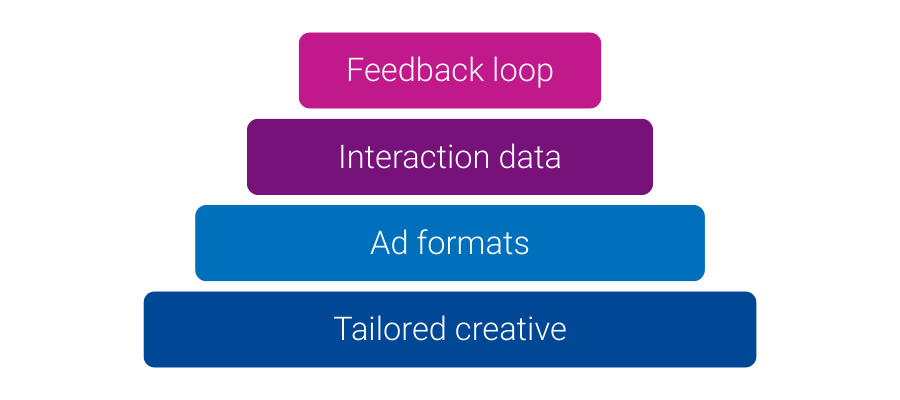
A hierarchy that shows feedback loop, interaction data, ad formats, and tailored creative

Alex (Yieldmo): Creative and ad formats are powerful signals for understanding audience engagement. At Yieldmo, we collect interaction data every 200 milliseconds, such as scrolling behavior or time spent on an ad. This data fills the gap between clicks and video completions, helping us build models that predict downstream actions. Tailoring creative to specific audience groups has always been one of the best ways to improve performance, and it remains essential in this new era of contextual advertising. Throughout my career, I learned that designing or tailoring your creative to different audience groups is one of the best ways to improve performance. We ran many lift studies with analysis to understand how you can tailor creative customized for individual audiences. That capability and the ability to do that on an identity basis is.

Our recommendations for actionable marketing strategies

Do you have recommendations for marketers building out their yearly strategies or a campaign strategy?

Jason (Experian): My recommendation for marketers building out their yearly strategies is to be proactive and start testing and learning these new solutions now. I mentioned addressability and being in the right place at the right time. That’s easier in today’s third-party cookie world. But as traditional identity is further constricted, you will have these first-party solutions that will not be at scale, so you’re less likely to find your user at the scale you want. It would be best if you thought about how to reach that user at the right place at the right time. They may not be seen from an identity basis. They might not be at the right place at the right time when you were delivering or trying to deliver an ad. But you increase your chance of reaching them by building these advanced contextual targeting audiences using this privacy-safe seed ‘opted-in’ user set; this is a way to cast that wider net and achieve targeted scale.

Alex (Yieldmo): Build your seed lists, test your formats with different audiences, and understand what’s resonating with whom. Take advantage of some of the pretty remarkable advances in machine learning that are allowing us, really, for the first time to fully uncork the potential and the opportunity with contextual in a way that we’ve never done before.

Contact us

This site is protected by reCAPTCHA and the Google Privacy Policy and Terms of Service apply.


About our experts

Jason Andersen, Senior Director, Strategic Initiatives and Partner Solutions, Experian headshot

Jason Andersen

Senior Director, Strategic Initiatives and Partner Solutions, Experian

Jason Andersen heads Strategic Initiatives and Partner Enablement for Experian Marketing Services. He focuses on addressability and activation in digital marketing and working with partners to solve signal loss. Jason has worked in digital advertising for 15+ years, spanning roles from operations and product to strategy and partnerships.

Alex Johnston, Principal Product Manager, Yieldmo headshot


Alex Johnston

Principal Product Manager, Yieldmo

Alex Johnston is the Principal Product Manager at Yieldmo, overseeing the Machine Learning and Optimization products. Before joining Yieldmo, Alex spent 13 years at Google, where he led the Reach & Audience Planning and Measurement products, overseeing a 10X increase in revenue. During his time, he launched numerous ad products, including YouTube’s Google Preferred offering. To learn more about Yieldmo, visit www.yieldmo.com.

Yieldmo logo

About Yieldmo

Yieldmo is an advertising platform that fuses media and creative to meet audiences in the moments that matter. Using proprietary data and AI, Yieldmo uses advanced targeting to deliver context-aware creative when and where it’s most effective, all while respecting user privacy. The result: ads that belong on inventory brands trust. For more information, please visit www.yieldmo.com.


Contextual advertising FAQs

What is contextual advertising, and how does it work?

Contextual advertising works by targeting audiences based on the content they’re engaging with, rather than relying on personal identifiers or traditional tracking methods. Yieldmo’s platform uses advanced contextual signals and machine learning to deliver relevant ads in privacy-safe ways.

How does contextual advertising address signal loss?

Contextual advertising addresses signal loss by focusing on environmental and content-based signals instead of relying on thir-dparty cookies or other traditional identifiers. Experian’s identity solutions complement this approach by enabling marketers to connect with audiences in a compliant and scalable way.

Why is creative important in contextual advertising?

Creative is important in contextual advertising because it engages audiences and provides valuable signals for targeting. Yieldmo’s platform collects interaction data, such as scrolling and time spent on ads, to refine campaigns and improve performance.

How can marketers reach non-addressable audiences?

Marketers can reach non-addressable audience through advanced contextual targeting, which uses known data, like seed audiences, to identify patterns and extend reach. Experian’s identity solutions and contextual data from, Audigent, a part of Experian, help marketers connect with these audiences in privacy-safe and effective ways.


Latest posts
Loading…
The end of the Wild West in third-party data 

How third-party data has changed and why it matters in 2025 For years, third-party data operated in an expansive, lightly regulated marketplace: fast-moving, high-growth, and filled with players eager to capitalize on digital marketing’s demand for audience insights.   That era is over. Regulatory scrutiny, stricter compliance standards, and rising consumer expectations have already transformed the market. Today, third-party data belongs to partners with proven expertise and built-in compliance. This isn’t a space for opportunistic newcomers; it’s one that rewards long-term commitment and trust.  Even the rapid rise of retail media networks (RMNs) reflects this shift. These platforms are built on long-standing, trusted relationships between brands, retailers, and data partners, utilizing that foundation in new ways to reach audiences responsibly and effectively. The best providers have already made this transition; those still “shifting” are catching up. From growth to governance: A market defined by accountability The third-party data ecosystem has matured. After years of rapid expansion and recalibration, the market has stabilized around a new standard: data quality and regulatory accountability. Third-party data enriches first-party insights with attributes such as income, gender, and interests that round out the customer view. But when the industry grew unchecked, unreliable providers diluted quality and trust. This resulted in a decline in the overall value and reliability of the third-party data marketplace. That breakdown led directly to today’s privacy laws, now active across more than 20 U.S. states and numerous countries worldwide. These regulations reflect a permanent consumer expectation: relevance delivered responsibly. Consumers aren’t rejecting personalization; they’re rejecting how it’s been done in the past. They still want relevant, tailored experiences, but they expect brands to deliver them through ethical, transparent data practices. Does third-party data still matter in a privacy-first era?  Third-party data isn’t disappearing, if anything, it’s become more important. Brands will always need additional insight to deepen customer understanding; first-party data alone only reflects what’s already known. The industry has entered a mature phase where data quality and compliance are table stakes. The companies leading today built their data infrastructure on rigorous standards, regulatory foresight, and transparent governance. That same foundation powers the next wave of innovation, including the explosive growth of RMNs. RMNs rely on responsibly sourced third-party data to enrich shopper insights, validate audiences, and extend addressability beyond their own walls. Trusted data partners make that expansion possible, connecting retail environments with broader media ecosystems while maintaining privacy and accuracy. High-quality, compliant third-party data remains essential because it: Fills knowledge gaps Good third-party marketing data complements first-party insights with demographic, behavioral, and transactional context, providing the missing puzzle pieces to complete the full customer profile.  Improves accuracy Filling in gaps in customer understanding helps you identify, reach, and engage your customers more effectively. This helps improve the delivery of relevant messages and offers to your customers and prospects across channels.  Builds connections Third-party data helps brands build loyalty with consumers by speaking to their interests, and intent behind purchases.  Fuels prospecting Third-party data can help you find your best prospects. By enriching customer files, you can understand who your best customers are, and how to find more of them. By modeling this data, you can determine who your best customers are and source prospects similar to them.  Advancements in AI and machine learning are reshaping how this data is used across the ecosystem. What was once primarily a buy-side tactic is now expanding into the sell-side, where publishers and platforms are using data to curate, package, and activate audiences more intelligently. As AI enhances modeling accuracy and automation, third-party data will play an even greater role in connecting brands and consumers in more meaningful, privacy-conscious ways.  The bottom line: it’s not about having more data; it’s about having better, verified data you can trust. How can you spot a trustworthy data partner?  The strongest third-party data partners demonstrate accountability through experience, infrastructure, and integrity. Swipe right on the perfect data partner Look for providers that: Operate with clear data principles  Trustworthy partners publish and follow codified data principles that guide every step of data handling. Experian adheres to a set of global data principles designed to ensure ethical practices and consumer protection across all our operations. Treat new privacy regulations as routine  For mature providers, evolving privacy laws are routine, not disruptive. At Experian, privacy and compliance have long been built in. Every partner and audience goes through Experian’s rigorous review process to meet federal, state, and local consumer privacy laws. Decades of experience have shaped processes that emphasize risk mitigation, transparency, and accountability. Stay deeply connected  Leading data companies maintain deep relationships with technology partners and industry and regulatory groups to ensure that ethical data practices are put into practice and their customers are aware of platform-specific regulations. Experian's relationships with demand-side platforms (DSPs), supply-side platforms (SSPs), and even social platforms like Meta, ensures we are aware of any platform-specific initiatives that may impact audience targeting. We’re also active participants in many trade groups to ensure that the industry puts ethical data practices in place to ensure consumers still receive personalized experiences but their data usage and collection is opt-in, transparent and handled with their privacy at the center of the transaction. Have a proven track record in the industry  Longevity matters in a regulated and compliance-driven industry. Providers that have thrived through economic cycles and regulatory shifts are the ones equipped for the future. The ability to source high-quality third-party data is core to their business, not an afterthought. Our data is ranked #1 in accuracy by Truthset, giving our clients confidence that every decision they make is backed by the industry’s most reliable insights. Why the future of third-party data depends on accountability  The third-party data industry has already crossed the threshold from expansion to accountability. The companies leading this era have established their credibility through governance and proof. The future belongs to providers that:  Build with regulatory foresight  Maintain rigorous quality assurance  Prioritize partnership over profit The Wild West days are long gone. The third-party data ecosystem is now defined by stability, transparency, and shared responsibility. Partner with Experian for data you can trust and results you can prove  When accuracy and accountability define success, you need a partner built on both. Work with the company that’s setting the standard for responsible data-driven marketing and helping brands connect with people in meaningful, measurable ways.  Get started About the author Jeremy Meade VP, Marketing Data Product & Operations, Experian Jeremy Meade is VP, Marketing Data Product & Operations at Experian Marketing Services. With over 15 years of experience in marketing data, Jeremy has consistently led data product, engineering, and analytics functions. He has also played a pivotal role in spearheading the implementation of policies and procedures to ensure compliance with state privacy regulations at two industry-leading companies. Third-party data FAQs What is third-party data? Third-party data is information collected by organizations that don’t have a direct relationship with the consumer. It supplements first-party data by adding demographic, behavioral, and interest-based insights. Why are privacy regulations reshaping data practices? Privacy regulations are reshaping data practices because consumers expect control over how their information is used. That expectation led directly to today’s privacy laws, now active across more than 20 U.S. states and numerous countries worldwide. These regulations reflect a permanent consumer expectation: relevance delivered responsibly. Consumers aren’t rejecting personalization; they’re rejecting how it’s been done in the past. They still want relevant, tailored experiences, but they expect brands to deliver them through ethical, transparent data practices. Laws like the CCPA and state-level privacy acts enforce this expectation, holding brands and data providers accountable for the ethical use of data. Can brands still use third-party data safely? Yes, brands can still use third-party data safely when sourced responsibly. Partnering with established, compliant providers like Experian ensures both legal protection and data accuracy.  How does Experian ensure compliance with evolving privacy regulations? Experian adheres to a set of global data principles designed to ensure ethical practices and consumer protection across all our operations. At Experian, privacy and compliance have long been built in. Every partner and audience goes through Experian’s rigorous review process to meet federal, state, and local consumer privacy laws. Decades of experience have shaped processes that emphasize risk mitigation, transparency, and accountability. Experian's relationships with demand-side platforms (DSPs), supply-side platforms (SSPs), and even social platforms like Meta, ensures we are aware of any platform-specific initiatives that may impact audience targeting. We’re also active participants in many trade groups to ensure that the industry puts ethical data practices in place to ensure consumers still receive personalized experiences but their data usage and collection is opt-in, transparent and handled with their privacy at the center of the transaction. What should marketers look for in a data partner? Marketers should look for transparency, longevity, and evidence of compliance when looking for a data partner. The best partners can clearly explain how their data is sourced, validated, and maintained. Read Experian's guide on how you can swipe right on the perfect data partner here. Latest posts

Oct 30,2025 by Jeremy Meade, VP, Marketing Data Product & Operations

What “good data” really means in the age of AI

What makes data “good” in the age of AI? In AI-driven marketing, data quality now defines success. “Good data” in AI isn’t about volume; it’s about the balance of accuracy, freshness, consent, and interoperability. As algorithms guide decisions, they must learn from data that’s both accurate and ethical. At Experian, we believe good data must meet four conditions: 1. Accurate Verified and anchored in real human identity. 2. Fresh Continuously updated to reflect today’s consumers. 3. Consented Collected and governed transparently. 4. Interoperable Easily integrated across platforms through a secure, signal-agnostic identity spine, enabling seamless data activation. This is the data AI can trust and the data that keeps marketing relevant, predictive, and privacy-first. Listen to InfoSum's Identity Architect's podcast for more on AI, outcomes, and curation Why does data accuracy matter more than ever? AI models are only as intelligent as their inputs. Incomplete or inconsistent data leads to bad predictions and wasted spend. As the industry moves toward agentic advertising, where autonomous systems handle campaign buying and optimization, data accuracy becomes even more critical. If your ad server or audience data is flawed, these new AI agents will simply automate bad decisions faster. Experian applies rigorous quality filters and conflict resolution rules to ensure our data is both deterministic and accurate. Deterministic signals alone don’t guarantee accuracy; they must be verified, deduplicated, and contextualized. Our identity resolution process anchors every attribute to real people, giving brands and platforms the confidence that every insight stems from truth, not noise. Our data is ranked #1 in accuracy by Truthset, giving our clients confidence that every decision they make is backed by the industry’s most reliable insights. See how Experian's Digital Graph improved attribution accuracy for a demand-side platform (DSP) with 84% of IDs resolved Just because it is deterministic, doesn’t mean it’s highly accurate. You still need to refine and validate your data to make sure it tells a consistent story. You need to anchor your data around real people. Calculate the real impact of data accuracy Why does AI need fresh data? Outdated data can’t predict tomorrow’s behavior. AI thrives on recency. At Experian, our audiences are refreshed continuously to mirror real-world signals, from purchase intent to media habits, so every campaign reflects what’s happening now, not six months ago. And we don’t just advocate for fresh data, we rely on it ourselves. Our own AI-powered models, used across our audience and identity platforms, are continuously retrained on the most current, consented signals. This allows us to see firsthand how freshness drives better accuracy, faster optimization cycles, and more relevant outcomes. But freshness alone isn’t enough. With predictive insights, our models go beyond describing the past. They forecast behaviors, fill gaps with inferred attributes, and recommend next-best audiences, helping you anticipate opportunity before it happens. Fresh and predictive data means you’re reaching people in the moment that matters and shaping what comes next. With AI, that’s what defines performance. Explore Experian's most popular audiences, ready to activate now How do consent and governance build trust in AI? Responsible AI starts with responsible data. With 20 U.S. states now enforcing privacy laws, data compliance isn’t optional, it’s operational. At Experian, privacy and compliance are built in. Every data signal, attribute, audience, and partner goes through our rigorous review process to meet federal, state, and local consumer privacy laws. With decades of experience in highly regulated industries, we’ve built processes that emphasize risk mitigation, transparency, and accountability. Governance isn’t just about regulation, it’s also about innovation done right. We drive transparent and responsible innovation through safe, modular experimentation, from generative applications to agentic workflows. By balancing bold ideas with ethical guardrails and staying ahead of evolving legislation, we ensure our innovations protect consumers, brands, and the broader ecosystem while moving the industry forward responsibly. Compliance and governance aren’t just boxes to check; they’re the foundation that gives AI its license to operate. How does interoperability enable AI’s full potential? AI delivers its best insights when data connects seamlessly across fragmented environments. Our signal-agnostic identity spine allows data to move securely between platforms (connected TV, retail media networks, and demand-side platforms) without losing context or compliance. Interoperability isn’t just about moving data between systems; it’s about connecting insights across them. When signals connect across environments, AI gains a more complete view of the customer journey revealing true behavior patterns, intent signals, and cross-channel impact that would otherwise remain hidden. This unified perspective allows AI to connect insights in real time, improving predictions, performance, and personalization while protecting privacy. Where do AI and human oversight meet? AI can make marketing more predictive, but people make it meaningful. At Experian, our technology brings identity, insight, and generative intelligence together so brands, agencies, and platforms can reach the right people with relevance, respect, and simplicity. Our AI-powered models surface connections, recommend audiences, and uncover insights that would take humans months to find. But our experts shape the process, crafting the right inputs, ensuring data quality, reviewing model outputs, and refining recommendations based on industry knowledge and client goals. It’s this partnership between advanced AI and experienced people that turns predictions into actionable, trustworthy solutions. What “good data” looks like in action “Good data” becomes most powerful when it’s put to work. At Experian, our marketing data and identity solutions help brands and their partners connect accurate, consented, and interoperable data across the ecosystem, turning insight into measurable outcomes. Learn more about Experian's data solutions Learn more about Experian's identity solutions When Windstar Cruises and their agency partner MMGY set out to connect digital media spend to real-world bookings, they turned to Experian’s marketing data and identity solutions to close the attribution loop. By deploying pixels across digital placements and using Experian’s identity graph to connect ad exposure data with reservation records, we created a closed-loop attribution system that revealed the full traveler journey, from impression to confirmed booking. The results were clear: 6,500+ bookings directly tied to digital campaigns, representing more than $20 million in revenue, with a 13:1 ROAS and $236 average cost per booking. Attributed audiences booked $500 higher on average, and MMGY’s Terminal audience segments powered by Experian data achieved a 28:1 ROAS. This collaboration shows that responsible, high-quality data and AI-driven insights don’t just tell a better story; they deliver measurable business performance. Download the full case study How to choose the partner built for responsible AI Why the future of AI depends on “good” data The next phase of AI-driven marketing won’t be defined by who has the most data, but by who has the best. Leaders will: Operate with clear data principles grounded in transparency and truth Build consent and compliance into every workflow Keep data accurate, current, and interoperable Pair automation with human oversight   AI success starts with good data. And good data starts with Experian, where accuracy, privacy, and purpose come together to make marketing more human, not less. Partner with Experian for AI you can trust About the author Budi Tanzi VP, Product, Experian Budi Tanzi is the Vice President of Product at Experian Marketing Services, overseeing all identity products. Prior to joining Experian, Budi worked at various stakeholders of the ad-tech ecosystem, such as Tapad, Sizmek, and StrikeAd. During his career, he held leadership roles in both Product Management and Solution Engineering. Budi has been living in New York for almost 11 years and enjoys being outdoors as well as sailing around NYC whenever possible. "Good" data in AI FAQs What defines “good data” according to Experian? At Experian, we define "good data" as the balance of accuracy, consent, freshness, and interoperability. We apply rigorous governance, validation, and cleansing across every signal to ensure that AI systems learn from real-time behaviors, not assumptions. This approach turns data into a foundation for reliable, ethical, and high-performing intelligence. How does Experian ensure AI-ready data accuracy? Experian ensures AI-ready data accuracy through advanced cleansing, conflict resolution, and human anchoring. Experian ensures AI models rely on verified, high-quality inputs. Experian's data is ranked #1 in accuracy by Truthset. Can Experian help brands stay compliant with privacy laws? Yes, Experian can help brands stay compliant with privacy laws. Experian’s privacy-first governance framework integrates ongoing audits, legal oversight, and consent management to ensure compliance with all federal, state, and global privacy laws. Compliance isn’t an afterthought; it’s embedded in every step of our data lifecycle. How does Experian make AI more human? Experian makes AI more human by pairing innovation with human oversight to ensure AI helps marketers understand people, not just profiles. At Experian, we believe the future of marketing is intelligent, respectful, and human-centered. AI has long been part of how we help brands connect identity, behavior, and context to deliver personalization that balances privacy with performance. Our AI-powered solutions combine predictive insight, real-time intelligence, and responsible automation to make every interaction more relevant and ethical. Where can marketers access Experian’s high-quality data? Marketers can activate Experian's high-quality data directly in Experian’s Audience Engine, or on-the-shelf of our platform partners where Experian Audiences are ready to activate. Built on trusted identity data and enhanced with partner insights, it’s where accuracy meets accessibility, helping brands power campaigns with confidence across every channel. Latest posts

Oct 29,2025 by Budi Tanzi, VP, Product

How AI is reshaping identity and marketing: Insights from Cannes Lions 2025

Artificial intelligence (AI) is becoming a bigger part of modern advertising, changing how brands connect with people. At Experian, we believe this technology should make marketing more human, not less. We use AI to help marketers understand consumer behavior, respect privacy, and deliver messages that matter. As part of our latest Cannes Content Studio series, we spoke with leaders from AdRoll, MiQ, OpenX, Optable, PMG, PubMatic, and Yieldmo. Their insights show a clear path forward; one where technology supports human strategy to create more meaningful connections.  1. How does AI help you see audiences more clearly? AI decodes complex behavioral signals to reveal the values and mindsets behind decisions, and increasingly, it predicts what audiences will care about next. This allows marketers to deliver timely, relevant messages that resonate with audiences. At Experian, we help brands use these insights to connect more meaningfully and ethically. Takeaway: Experian’s tools help brands uncover audience insights, enabling more meaningful and ethical connections. 2. Where does AI actually save time, and improve results? Running campaigns is time-consuming. Solutions like Agentic AI now orchestrate end-to-end campaign workflows, audience building, trafficking, QA, pacing, and routine optimizations, so teams focus on strategy and creativity. Many leaders (94%) are investing broadly in AI to drive efficiency and impact, and 49% of marketers use it daily for image and video generation, shifting repetitive tasks from people to tools. By quickly combining past and current performance data, AI can pre-optimize before launch and refine mid-flight, while marketers steer the message and experience. "AI uses past campaign data to optimize performance before launch, continues learning during the campaign, and refines strategies based on the insights it generates, driving better results over time.”Howard Luks Takeaway: Experian’s solutions streamline campaign workflows, allowing marketers to focus on creativity and strategy while improving results. 3. How do AI and human strategy work together in real time? AI handles real-time data analysis and optimization, freeing marketers to focus on strategy, messaging, and creativity. By defining audiences once and activating them across platforms, teams can adapt quickly and confidently. At Experian, we combine machine intelligence with human insight to deliver smarter, more agile campaigns. “AI analyzes data, pulls insights, and automates optimizations, allowing marketers to focus on strategy, messaging, and creativity instead of spending time digging through numbers and data."Lizzie Chapman Takeaway: Experian solutions empower marketers to adapt quickly and confidently, combining human strategy with insights. 4. What does privacy-first look like now? Relying on simple, static data points is no longer enough. A modern approach to identity blends deterministic data (like known identifiers) with modeled components, ensuring data remains de-identified where possible. Clear, transparent guardrails, permitted-use policies, retention limits, sensitive-category blocks, and audit trails, help brands balance personalization with privacy, build trust, and respect user choice. "A new blend of identity systems combines deterministic data, known identifiers, and model driven components, creating fresh ways to address identity and activate campaigns with precision.” Vlad Stesin Takeaway: Experian’s privacy-first identity solutions help brands balance personalization with safety, ensuring trust and compliance. 5. Which new data signals matter, and why? AI is unlocking a new generation of data signals, like content context, sentiment, emotional tone, suitability, attention, and commerce intent, that go beyond legacy identifiers like cookies and demographics. These signals can help brand messages appear in the most relevant environments and by high-value audiences. Used well, they improve relevance, avoid placements near unsuitable or off-brand content, and drive stronger campaign outcomes. "Unlocking new data sets (like emotion, sentiment, and context), AI is creating innovative ways to connect client content with advertising opportunities and rethink how we approach the market.” Sam Bloom Takeaway: Experian’s solutions use advanced data signals to help marketers create more effective and innovative campaigns. Why Experian for human-centered AI? We deliver on the promise of AI-powered marketing through five pillars: See audiences clearly across households, individuals, and devices. Recommend next‑best audiences and automate setup for faster execution. Adapt in real‑time to keep relevance high. Innovate responsibly with strong governance and transparency. Plan, activate, and measure campaigns on one unified platform. The future of intelligent marketing AI will keep accelerating, but the goal stands: make marketing more human. Teams that blend privacy‑first identity, predictive insight, AI‑powered simplicity, and real‑time intelligence will earn trust and drive outcomes. Experian helps you bring those pieces together so every campaign moves from assumptions to clarity, and from activity to measurable results. Talk to Experian about building human-centered AI into your marketing strategy AI marketing trends FAQs How does AI help marketers understand audiences better? AI analyzes complex signals, behaviors, values, and mindsets to provide a clearer picture of what matters to audiences. That clarity makes messaging feel personal and relevant. Learn more about Experian’s Digital Graph and how it can help marketers understand audiences better.  Where is AI improving campaign efficiency today?   Automation reduces manual setup and reporting, so teams focus on strategy and creative. Nearly half of marketers (49%) use AI daily for image and video generation, reflecting this shift.  What does “smarter activation across platforms” mean? Smarter activation across platforms means defining audiences once, then carrying them across channels with live feedback, so relevance and suitability stay high. See how Experian enables smarter activation with our data and identity solutions.  How is AI changing identity?  Privacy‑first identity blends deterministic and modeled components, keeping data de‑identified where possible. Experian’s solutions balance personalization with safety. Learn about Experian’s identity solutions is changing identity.  Why is structured data important for AI‑driven marketing?   AI systems rely heavily on brand‑managed sources. 86% of citations come from websites, listings, and reviews, so clean, accurate, structured data makes your answers and your brand more discoverable. Discover how Experian supports structured data for AI-driven marketing.  Latest posts

Oct 29,2025 by Experian Marketing Services

Subscribe to our newsletter

Enter your name and email for the latest updates

This site is protected by reCAPTCHA and the Google Privacy Policy and Terms of Service apply.

About Experian Marketing Services

At Experian Marketing Services, we use data and insights to help brands have more meaningful interactions with people. As leaders in the evolution of the advertising landscape, Experian Marketing Services can help you identify your customers and the right potential customers, uncover the most appropriate communication channels, develop messages that resonate, and measure the effectiveness of marketing activities and campaigns.

Visit our website

Subscribe to our newsletter

Stay up to date on the latest industry news and receive expert tips from our marketing experts.
Subscribe now!