At A Glance
Experian and Yieldmo collaborate to help marketers navigate signal loss with privacy-safe contextual advertising. By combining Experian’s identity solutions with Yieldmo’s advanced targeting, this collaboration enables effective audience engagement in a world with fewer traditional signals.Note: While third-party cookies are no longer being phased out, this webinar was recorded in 2023 when cookie deprecation was still a key industry focus. The strategies discussed reflect that time frame and remain relevant for addressing broader signal loss challenges.
With major browsers discontinuing support for third-party cookies, marketers must rethink how to identify and engage their audiences. Contextual advertising offers a privacy-safe solution by combining contextual signals with machine learning to deliver highly targeted campaigns. In a Q&A with our experts with eMarketer, Jason Andersen, Senior Director of Strategic Initiatives and Partner Solutions at Experian, and Alex Johnston, Principal Product Manager at Yieldmo, we discuss how contextual advertising addresses signal loss, improves addressability, and delivers better outcomes for marketers.

The macro trends impacting marketers
How important is it for digital marketers to stay informed about the changes coming to third-party cookies, and what challenges do you see signal loss creating?
Jason (Experian): Third-party cookies have already been eliminated from Firefox, Safari, and other browsers, while Chrome has held out. It’s just a matter of time before Chrome eliminates them too. Being proactive now by predicting potential impacts will be essential for maintaining growth when the third-party cookie finally disappears.

Alex (Yieldmo): Third-party cookie loss is already a reality. As regulations like the General Data Protection Regulation (GDPR) and the California Consumer Privacy Act (CCPA) take effect, more than 50% of exchange traffic lacks associated identifiers. This means that marketers have to think differently about how they reach their audiences in an environment with fewer data points available for targeting purposes. It’s no longer something to consider at some point down the line – it’s here now! Also, as third-party cookies become more limited, reaching users online is becoming increasingly complex and competitive. Without access to as much data, the CPMs (cost per thousand impressions) that advertisers must pay are skyrocketing because everyone is trying to bid on those same valuable consumers. It’s essential for businesses desiring success in digital advertising now more than ever before.
Solving signal loss with contextual advertising
How does contextual advertising help marketers engage audiences with new strategies like machine learning and artificial intelligence (AI)?
Jason (Experian): Contextual advertising helps marketers engage audiences by combining advanced machine learning with privacy-safe strategies. We focus on using AI and machine learning to better understand behavior, respect privacy, and deliver insights. As third-party cookies go away, alternative identifiers are coming to market, like Unified I.D. 2.0 (UID2). These are going to be particularly important for marketers to be able to utilize them. As cookie syncing becomes outdated, marketers will have to look for alternative methods to reach their target audiences. It’s essential to look beyond cookie-reliant solutions and use other options available regarding advertising.
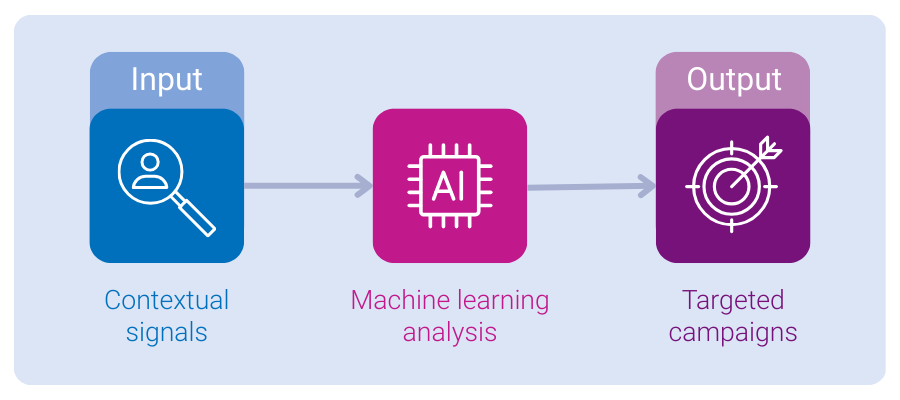
Alex (Yieldmo): There’s been a renaissance in contextual advertising over the last couple of years. Three key drivers are shaping this shift:
- The loss of identity signals is forcing marketers to rethink how they reach audiences.
- Advances in machine learning allow us to analyze more granular contextual signals, identifying patterns that are most valuable to advertisers.
- Tailored models now use these signals to deliver more effective campaigns. This transformation is occurring because of our ability to capture and operate on richer, more detailed data.
Reach consumers with advanced addressability
How does advanced contextual advertising help marketers reach non-addressable audiences?
Jason (Experian): Advanced contextual advertising helps marketers reach non-addressable audiences by taking a set of known data (identity) and drawing inferences from it with all the other signals we see across the bidstream. It’s about using a small seed set of customers, those who have transacted with you before or match your target audience, and training contextual models to make the unknown known. Now we can go out and find users surfing on any of the other sites that traditionally don’t have that identifier for that user or don’t at that moment in time and start to be able to advertise to them based on the contextually indexed data.

Alex (Yieldmo): I think the exciting opportunity for many people in the industry is figuring out how to reach your known audience in a non-addressable space, that is based on environmental and non-identity based signals, that helps your campaign perform. Machine learning advancements allow you to take your small sample audience and uncover those patterns in the non-addressable space. High-quality, privacy-resilient data sets are critical for building these campaigns. Companies like Experian, with deep, rich training data, are well positioned to support advertisers in building extension audiences.
Creative strategies that improve ad performance
Why does creative strategy remain essential for digital advertising success?
Jason (Experian): Creative strategy remains essential because it provides valuable signals for targeting and engages audiences effectively. In this advanced contextual world, good creative in the proper ad format that you can test and learn from is paramount. It comes back to that feedback loop. We can use that as another signal in this equation to develop and refine the right set of audiences for your targeting needs.
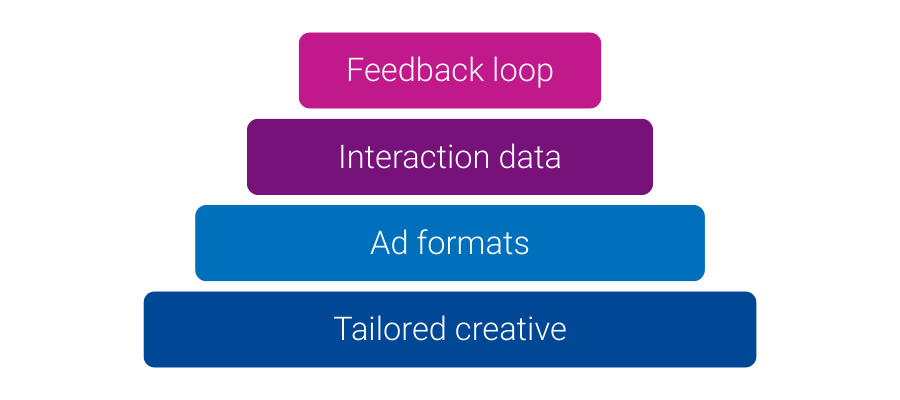
Alex (Yieldmo): Creative and ad formats are powerful signals for understanding audience engagement. At Yieldmo, we collect interaction data every 200 milliseconds, such as scrolling behavior or time spent on an ad. This data fills the gap between clicks and video completions, helping us build models that predict downstream actions. Tailoring creative to specific audience groups has always been one of the best ways to improve performance, and it remains essential in this new era of contextual advertising. Throughout my career, I learned that designing or tailoring your creative to different audience groups is one of the best ways to improve performance. We ran many lift studies with analysis to understand how you can tailor creative customized for individual audiences. That capability and the ability to do that on an identity basis is.
Our recommendations for actionable marketing strategies
Do you have recommendations for marketers building out their yearly strategies or a campaign strategy?
Jason (Experian): My recommendation for marketers building out their yearly strategies is to be proactive and start testing and learning these new solutions now. I mentioned addressability and being in the right place at the right time. That’s easier in today’s third-party cookie world. But as traditional identity is further constricted, you will have these first-party solutions that will not be at scale, so you’re less likely to find your user at the scale you want. It would be best if you thought about how to reach that user at the right place at the right time. They may not be seen from an identity basis. They might not be at the right place at the right time when you were delivering or trying to deliver an ad. But you increase your chance of reaching them by building these advanced contextual targeting audiences using this privacy-safe seed ‘opted-in’ user set; this is a way to cast that wider net and achieve targeted scale.
Alex (Yieldmo): Build your seed lists, test your formats with different audiences, and understand what’s resonating with whom. Take advantage of some of the pretty remarkable advances in machine learning that are allowing us, really, for the first time to fully uncork the potential and the opportunity with contextual in a way that we’ve never done before.
Contact us
About our experts

Jason Andersen
Senior Director, Strategic Initiatives and Partner Solutions, Experian
Jason Andersen heads Strategic Initiatives and Partner Enablement for Experian Marketing Services. He focuses on addressability and activation in digital marketing and working with partners to solve signal loss. Jason has worked in digital advertising for 15+ years, spanning roles from operations and product to strategy and partnerships.

Alex Johnston
Principal Product Manager, Yieldmo
Alex Johnston is the Principal Product Manager at Yieldmo, overseeing the Machine Learning and Optimization products. Before joining Yieldmo, Alex spent 13 years at Google, where he led the Reach & Audience Planning and Measurement products, overseeing a 10X increase in revenue. During his time, he launched numerous ad products, including YouTube’s Google Preferred offering. To learn more about Yieldmo, visit www.yieldmo.com.

About Yieldmo
Yieldmo is an advertising platform that fuses media and creative to meet audiences in the moments that matter. Using proprietary data and AI, Yieldmo uses advanced targeting to deliver context-aware creative when and where it’s most effective, all while respecting user privacy. The result: ads that belong on inventory brands trust. For more information, please visit www.yieldmo.com.
Contextual advertising FAQs
Contextual advertising works by targeting audiences based on the content they’re engaging with, rather than relying on personal identifiers or traditional tracking methods. Yieldmo’s platform uses advanced contextual signals and machine learning to deliver relevant ads in privacy-safe ways.
Contextual advertising addresses signal loss by focusing on environmental and content-based signals instead of relying on thir-dparty cookies or other traditional identifiers. Experian’s identity solutions complement this approach by enabling marketers to connect with audiences in a compliant and scalable way.
Creative is important in contextual advertising because it engages audiences and provides valuable signals for targeting. Yieldmo’s platform collects interaction data, such as scrolling and time spent on ads, to refine campaigns and improve performance.
Marketers can reach non-addressable audience through advanced contextual targeting, which uses known data, like seed audiences, to identify patterns and extend reach. Experian’s identity solutions and contextual data from, Audigent, a part of Experian, help marketers connect with these audiences in privacy-safe and effective ways.
Latest posts
Originally appeared on MediaPost As the digital ecosystem becomes more complex, managing multiple identifiers for consumers has emerged as a significant challenge. From cookies and IP addresses to mobile IDs and universal IDs, marketers and platforms face increasing difficulty in maintaining a unified view of their consumers. Without a coherent identity strategy, campaigns can suffer from poor targeting, limited personalization, and flawed attribution. Experian understands these challenges and offers solutions to help our partners navigate the complexities of a multi-ID landscape. By utilizing both digital and offline data, we provide the tools to unify fragmented identifiers and maintain a persistent view of consumers. As a result, marketers and platforms get rich insights, accurate cross-device targeting, improved addressability, and measurable advertising. The shifting identity landscape For years, the industry has relied on cookies to identify consumers across devices and platforms. However, with ongoing signal loss, including the uncertainty around cookies, and the evolution of privacy regulations, the digital identity landscape has grown more complicated. As consumers hop from one device to another, they are now represented by multiple signals, each tied to a different aspect of their digital behavior. While this shift brings complexity, it also opens the door for innovation. Marketers and ad platforms now have the opportunity to rethink their identity strategies and adopt more flexible approaches that are not reliant on a single identifier. This is where Experian comes in. Connecting the dots: A holistic view of the customer journey Our identity solutions are designed to help manage today’s multi-ID ecosystem by connecting digital and offline identifiers to a single customer profile. This creates a unified view of the consumer, and when combined with our understanding of customer behavior (e.g. demo, interests, shopping patterns) marketers and platforms get both insights about their customers and the addressability to reach them across channels. Four examples of what you can do with a strong identity foundation If an advertiser wants to make its first-party data more addressable, it can utilize our Digital Graph with universal IDs, hashed emails (HEMs), and connected TV (CTV) IDs to extend its reach. A publisher who wants to gain further insights into their audiences and create private marketplaces (PMPs) can achieve this goal with the use of our Digital Graph with hashed emails, universal IDs, mobile ad IDs (MAIDs), CTV IDs, and IPs. The publisher can use this in concert with Marketing Attributes to understand age, gender, household income, buying behavior, and more. The publisher can connect marketing attributes to the Digital Graph via our Living Unit ID (LUID) to understand more about consumers that fall into their segments. A demand-side platform (DSP) who wants to extend first-party and third-party audience reach across all digital devices on their platform will use the Digital Graph with all digital IDs to allow users of their platform to select cross-device extension against first-party and third-party audiences. A retail media network (RMN) can use our Offline and Digital Graphs to connect in-store and online purchases to a household profile—even when purchases are made by different people. The RMN can then reach that household across digital media platforms and accurately attribute the in-store purchase back to digital ad exposure. Identity as a strategic asset: Today and in the future In our paradoxical world where consumers are represented by multiple identifiers, yet marketers and platforms face signal loss, identity is more than a technical issue—it’s a strategic asset. The ability to unify identity data into a single profile provides marketers with the customer intelligence needed to drive growth and stay competitive. Here’s how we do it: Deep, persistent customer understanding: With roots in offline, deterministic data like names, addresses, and emails, we provide an accurate and persistent view of identity to our customers. This allows you to maintain a consistent and comprehensive understanding of your customers and their marketing attributes over time. Highly accurate and refreshed digital identities: Our signal-agnostic graph is not reliant on any one signal as it includes HEMs, cookies, MAIDs, IPs, Universal IDs, and CTV IDs. Our Digital Graph is updated weekly, ensuring the data is always fresh and addressable. This persistent linkage of individuals and households to their identifiers and devices means your campaigns are always targeting the right people. Connected offline and digital graphs for holistic insights: We connect offline and digital identities by following privacy-first best practices, such as preventing re-identification, to allow insights from the offline world to be used in the online world. This integrated approach, enriched with marketing data, gives you better insights, more addressable advertising, and the ability to engage customers across multiple devices while accurately measuring campaign impact. Transform challenges into opportunities The rise of the multi-ID landscape presents both challenges and opportunities for the advertising industry. We stand as the trusted partner to navigate this complexity, utilizing insights from the offline world to inform decisions in the online world, enabling personalized marketing and accurate attribution, and helping you achieve your current and future goals. Get started today Latest posts

The concept of the "hedged garden" is gaining traction in the AdTech space as a promising new approach. It offers a more controlled and protected environment for advertisers, reshaping how digital advertising operates. But what exactly is a hedged garden, and could it be the solution we've been looking for? Let's dive into the details and explore its implications. Walled gardens vs. the open web Walled gardens continue to disrupt the advertising industry to stay relevant. Google, Meta (Facebook), and Amazon, the largest walled gardens, offer consumer privacy and rich first-party data to advertisers. But, time spent within these platforms, Google and Meta specifically, continues to decrease. Open web: Pros and cons On the other hand, the open web allows for more transparency, scale, and constant diversification. Yet, this has not led to increased spending. As a result, the open web continues to lag behind walled gardens. With a heavy reliance on third-party data and growing concerns over signal loss, the open web faces significant challenges. Under these circumstances, advertisers turn to easy activation channels like walled gardens, even as they become less effective to marketers. Consumers are increasingly focused on privacy, pushing the industry toward alternatives to third-party cookies. As Google rethinks its cookie deprecation plans, channels like connected TV (CTV) and mobile apps, which don't rely on cookies, are gaining traction. “A significant portion of web traffic does not support cookies today — and that number will grow as Google rolls out [its] new solution. This means that the industry shouldn't slow down investments in cookieless solutions, including alternative IDs, first-party data and data-driven contextual targeting.”kimberly gilberti, general manager, experian This shift emphasizes first-party data and user choice as a potential solution that balances privacy with effective advertising sources. Enter the hedged garden So, what is a hedged garden? The “hedged garden” is a new industry concept where a network of publishers works together to activate first-party data sets in a privacy-compliant way across many partners at scale. These publishers run their businesses with large amounts of first-party consumer data. But they are not big enough on their own. What does a hedged garden look like? Hedges are more permeable and not as tall as walls. This idea is key to the success of the hedged garden. Data protection and privacy regulations As hedged gardens grow, staying compliant with privacy laws like the General Data Protection Regulation (GDPR) and California Consumer Privacy Act (CCPA) is vital. These rules focus on protecting user data by requiring clear consent and transparency. Hedged gardens help publishers share first-party data in a safe, privacy-compliant way. By working together, they ensure data is used responsibly, aligning with strict privacy regulations. This not only keeps marketers compliant but also builds trust with consumers at a time when data protection is more important than ever. Opportunities for marketers in hedged gardens Hedged gardens offer unique opportunities for marketers to enhance their strategies. Unlike walled gardens, hedged gardens offer the ability to work with a wider array of data sources and provide more diverse insights into audience behavior. This flexibility lets marketers develop more tailored, cross-platform campaigns that reach users in different ways. Additionally, hedge gardens encourage collaboration with multiple partners, allowing for new partnerships and innovative strategies. With data from several sources, marketers can create more precise and privacy-compliant targeting methods to deliver better results. With the right approach, hedged gardens give marketers the freedom to break away from restrictive ecosystems and drive creative and impactful growth. How Experian navigates through hedged gardens As our ecosystem moves toward a hedged garden solution, how do we get involved? We are already a key ingredient for this type of solution within the TV landscape. Below, we walk through how we partner with one of our current TV media clients. Organize our client’s data and provide a Living Unit ID (LUID) First, we work with our client to clean and enhance their data, matching individual personal identifiable information (PII), such as an email address, to a household through a LUID. Our Digital Graph, which includes hashed emails (HEMs), cookies, mobile ad IDs (MAIDs), IPs, universal IDs, and CTV IDs, is rebuilt weekly to create accurate, refreshed connections. This consistent linkage creates precise targeting and measurement over time. Our interconnected Offline and Digital Graphs organize identity into households and devices, enriched with marketing data for deeper insights and better addressability. With partnerships across major platforms, we improve match rates, helping you activate audiences seamlessly for optimal reach and measurement. Enrich data through Experian Marketing Data Next, our TV media client licenses our Marketing Attributes. This data is the most comprehensive resource for both traditional and digital marketing campaigns. With its multi-channel availability and addressable capabilities, our Marketing Attributes allow our clients to develop insights and build audiences based on a wide range of attributes within their segment set, ensuring they reach relevant audiences across all channels. Activate audiences across the ecosystem Finally, we help our client execute their audiences across the full digital and TV ecosystem. We enable the connection that allows these audiences to be activated by matching partner LUIDs (example: LUID123 = LUIDABC). By using client-specific LUIDs to match up data in a privacy-first manner, we can continue to build strong partnerships within the fast-growing ecosystem. Are hedged gardens the future of advertising? Have we found the perfect bridge between walled gardens and the open web? We’re hedging our bets. Our vote is yes, but only time will tell. The future of advertising is shifting, and hedged gardens appear to be a promising model that balances the scale of walled gardens with the flexibility of the open web. We’re using what we learned from the TV industry to support other hedged garden verticals (retail media networks, audio, and gaming). Now that we know what a hedged garden is, we should consider what the future holds for both walled and hedged gardens. What’s next for walled gardens Increased privacy regulations: Walled gardens will face stricter regulations on data use, pushing them to adapt for compliance and trust. Reduced market dominance: As advertisers want more control, reliance on walled gardens could decline, shifting focus to hedged gardens. Diversified ad spend: Brands may spread their budgets across multiple platforms instead of being locked into walled gardens. The future of hedged gardens Greater industry collaboration: Expect more publishers and platforms to join forces in hedged gardens for better data activation. Expansion into new channels: Hedged gardens will expand into emerging channels like gaming and connected devices. Improved data integration: Privacy-first data sharing in hedged gardens will lead to smoother, more secure ad targeting. Data collaboration in a post-cookie world As signal loss becomes a growing concern, the need for secure, privacy-first data collaboration will rise. Hedged gardens offer a pathway forward, allowing advertisers to activate first-party data across multiple partners while complying with data regulations. This is where Experian Collaboration shines. By enabling data sharing without exposing raw consumer data, clients and partners can collaborate at Experian in their own environment or in clean rooms. Each of these environments allows partners to exchange data and gain insights without compromising privacy. Maximize your advertising reach with Experian As the advertising landscape changes, one thing remains clear: successful campaigns will require flexible, privacy-first solutions. At Experian, we are at the forefront of this shift. With our data expertise and advanced collaboration solutions, we’re here to help you navigate through both walled and hedged gardens to maximize your advertising reach. Together, we can navigate across the walled and hedged garden ecosystems. Contact us to learn how. Contact us Latest posts

Originally appeared on Adweek The advertising industry is experiencing a significant shift resulting from Oracle's market exit. Over the years, Oracle’s advertising tools—built through key acquisitions like Crosswise, BlueKai, Datalogix, and Grapeshot—have become essential for many marketers, data providers, and platforms. With Oracle’s departure, stakeholders are left searching for reliable alternatives to maintain their data-driven strategies. While this transition may seem daunting, it presents a unique opportunity to reassess audience and identity solutions. With the growing importance of adaptability and interoperability, now is the perfect time for advertisers, agencies, publishers, and platforms to adopt future-focused strategies. Oracle’s legacy: A combination of acquisitions Oracle’s advertising business wasn’t a unified solution but a collection of acquired technologies. Crosswise provided a cross-device identity graph; BlueKai offered a robust data management platform (DMP); Datalogix specialized in offline purchase data; and Grapeshot was known for its contextual targeting. Together, these tools powered a comprehensive offering for advertisers, data providers, and platforms. Yet, much of Oracle’s advertising success stemmed from the external data it used. For example, many of Oracle’s automotive audiences relied heavily on third-party data, largely powered by Experian data. This means that while Oracle may no longer be an option, many of the services marketers depended on through Oracle are still available from Experian, ensuring continuity. What this means for advertisers and agencies For advertisers and agencies, Oracle’s exit means losing access to its syndicated audiences. Fortunately, this doesn’t have to cause a major disruption. As one of Oracle’s primary data providers, we've mapped Oracle’s audiences to our own, ensuring marketers can easily maintain their targeting strategies without losing performance or efficiency. With access to over 2,400 syndicated audiences across key verticals such as demographics, automotive, retail purchases, or financial data, advertisers can continue their campaigns with confidence and precision. What sets us apart? Powered by data ranked #1 in accuracy by Truthset, our audiences are built on reliable, offline, deterministic data — like name, address, phone number, and email. This means advertisers can be confident that they are reaching the right audiences across all channels. With our audiences available across 30+ ad platforms, including programmatic, TV, and social media, advertisers and agencies have easy access to keep their campaigns running. For advertisers that ran audience targeting using Grapeshot's Contextual Platform, our new Contextually-Indexed Audiences are a replacement built for the evolving digital media landscape. By combining the precision of audience targeting with the flexibility of contextual targeting, marketers get a privacy-safe, yet scalable way to target audiences that is not reliant on cookies or other user identifiers. Marketers can activate these audiences through leading demand-side platforms (DSPs) or through Audigent private marketplaces (PMPs). A new opportunity for data providers Oracle’s marketplace has long been a crucial distribution channel for third-party data providers, particularly through BlueKai. With its closure, providers have an opportunity to explore new onboarding services and marketplaces that offer similar or even better reach and effectiveness. New alternative onboarding solutions are emerging, particularly in areas like TV and digital, ensuring that the loss of Oracle’s services does not leave a significant gap. These solutions are being built to overcome the challenges typically present with data onboarding — complicated integration processes, limited ID matching capabilities, and opaque pricing structures. One such solution is Experian’s new Third-Party Onboarding. What sets us apart? With our digital and offline identity capabilities embedded within this solution, data providers receive superior programmatic and connected TV (CTV) reach and addressability compared to the competition. The first data providers – Adentro, Kontext, L2, and Webbula – are already using this solution to increase the adoption of their audiences and maximize their revenue. Additionally, new marketplaces are emerging that aim to fill the void left by Oracle, offering distribution to key destinations and providing data providers with continued access to advertisers who require high-quality, third-party data. Platforms shift to new audience solutions Platforms that relied on Oracle for third-party data and audience onboarding are now facing challenges in maintaining their ability to target specific audiences. This could affect their inventory's attractiveness to buyers. However, we offer a seamless solution for platforms looking to replace Oracle’s capabilities. As one of Oracle’s primary data providers, we've already mapped Oracle’s audiences to our catalog of over 2,400 syndicated audiences. Platforms can continue providing precise audience targeting and ensure advertisers receive the performance that they demand. Additionally, Third-Party Onboarding builds upon the investment and infrastructure used to distribute our own audience segments, providing platforms with audiences from leading third-party data providers. Moving forward: Embracing connectivity We're dedicated to powering data-driven advertising through connectivity. With best-in-class syndicated audiences, new Contextually-Indexed Audiences, and an easy-to-use Third-Party Onboarding solution, we're enabling advertisers, agencies, data providers, and ad platforms to improve their marketing operations. Oracle’s departure marks the end of one era, but it also opens the door to a future where collaboration, interoperability, and connectivity define the landscape. By choosing partners like us, advertisers, agencies, and platforms can ensure they remain agile, innovative, and well-equipped to thrive in this new era of data-driven marketing. Reach out to your account representative or our audience team for information about our comprehensive audience mapping and finding the right audiences for your campaigns. Download our audience lookbook to discover more about Experian’s audiences. Contact us Latest posts