At A Glance
Experian and Yieldmo collaborate to help marketers navigate signal loss with privacy-safe contextual advertising. By combining Experian’s identity solutions with Yieldmo’s advanced targeting, this collaboration enables effective audience engagement in a world with fewer traditional signals.Note: While third-party cookies are no longer being phased out, this webinar was recorded in 2023 when cookie deprecation was still a key industry focus. The strategies discussed reflect that time frame and remain relevant for addressing broader signal loss challenges.
With major browsers discontinuing support for third-party cookies, marketers must rethink how to identify and engage their audiences. Contextual advertising offers a privacy-safe solution by combining contextual signals with machine learning to deliver highly targeted campaigns. In a Q&A with our experts with eMarketer, Jason Andersen, Senior Director of Strategic Initiatives and Partner Solutions at Experian, and Alex Johnston, Principal Product Manager at Yieldmo, we discuss how contextual advertising addresses signal loss, improves addressability, and delivers better outcomes for marketers.

The macro trends impacting marketers
How important is it for digital marketers to stay informed about the changes coming to third-party cookies, and what challenges do you see signal loss creating?
Jason (Experian): Third-party cookies have already been eliminated from Firefox, Safari, and other browsers, while Chrome has held out. It’s just a matter of time before Chrome eliminates them too. Being proactive now by predicting potential impacts will be essential for maintaining growth when the third-party cookie finally disappears.

Alex (Yieldmo): Third-party cookie loss is already a reality. As regulations like theGeneral Data Protection Regulation (GDPR) and the California Consumer Privacy Act(CCPA) take effect, more than 50% of exchange traffic lacks associated identifiers. This means that marketers have to think differently about how they reach their audiences in an environment with fewer data points available for targeting purposes. It’s no longer something to consider at some point down the line – it’s here now! Also, as third-party cookies become more limited, reaching users online is becoming increasingly complex and competitive. Without access to as much data, the CPMs (cost per thousand impressions) that advertisers must pay are skyrocketing because everyone is trying to bid on those same valuable consumers. It’s essential for businesses desiring success in digital advertising now more than ever before.
Solving signal loss with contextual advertising
How does contextual advertising help marketers engage audiences with new strategies like machine learning and artificial intelligence (AI)?
Jason (Experian): Contextual advertising helps marketers engage audiences by combining advanced machine learning with privacy-safe strategies. We focus on using AI and machine learning to better understand behavior, respect privacy, and deliver insights. As third-party cookies go away, alternative identifiers are coming to market, like Unified I.D. 2.0 (UID2). These are going to be particularly important for marketers to be able to utilize them. As cookie syncing becomes outdated, marketers will have to look for alternative methods to reach their target audiences. It’s essential to look beyond cookie-reliant solutions and use other options available regarding advertising.
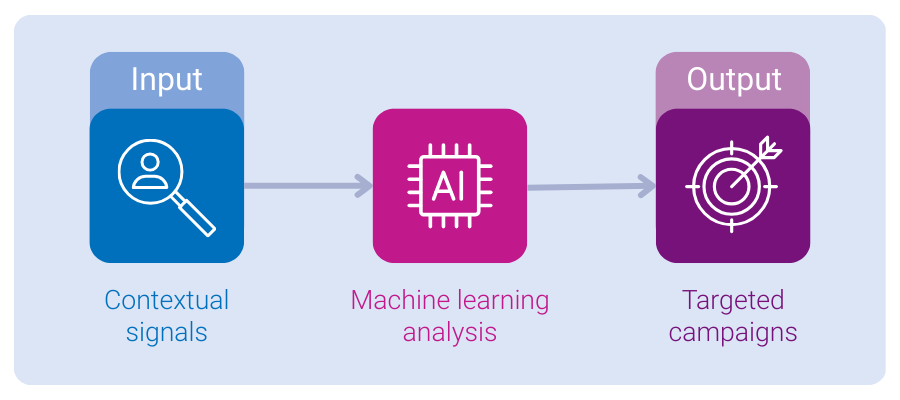
Alex (Yieldmo): There’s been a renaissance in contextual advertising over the last couple of years. Three key drivers are shaping this shift:
- The loss of identity signals is forcing marketers to rethink how they reach audiences.
- Advances in machine learning allow us to analyze more granular contextual signals, identifying patterns that are most valuable to advertisers.
- Tailored models now use these signals to deliver more effective campaigns. This transformation is occurring because of our ability to capture and operate on richer, more detailed data.
Reach consumers with advanced addressability
How does advanced contextual advertising help marketers reach non-addressable audiences?
Jason (Experian): Advanced contextual advertising helps marketers reach non-addressable audiences by taking a set of known data (identity) and drawing inferences from it with all the other signals we see across the bidstream. It’s about using a small seed set of customers, those who have transacted with you before or match your target audience, and training contextual models to make the unknown known. Now we can go out and find users surfing on any of the other sites that traditionally don’t have that identifier for that user or don’t at that moment in time and start to be able to advertise to them based on the contextually indexed data.

Alex (Yieldmo): I think the exciting opportunity for many people in the industry is figuring out how to reach your known audience in a non-addressable space, that is based on environmental and non-identity based signals, that helps your campaign perform. Machine learning advancements allow you to take your small sample audience and uncover those patterns in the non-addressable space. High-quality, privacy-resilient data sets are critical for building these campaigns. Companies like Experian, with deep, rich training data, are well positioned to support advertisers in building extension audiences.
Creative strategies that improve ad performance
Why does creative strategy remain essential for digital advertising success?
Jason (Experian): Creative strategy remains essential because it provides valuable signals for targeting and engages audiences effectively. In this advanced contextual world, good creative in the proper ad format that you can test and learn from is paramount. It comes back to that feedback loop. We can use that as another signal in this equation to develop and refine the right set of audiences for your targeting needs.
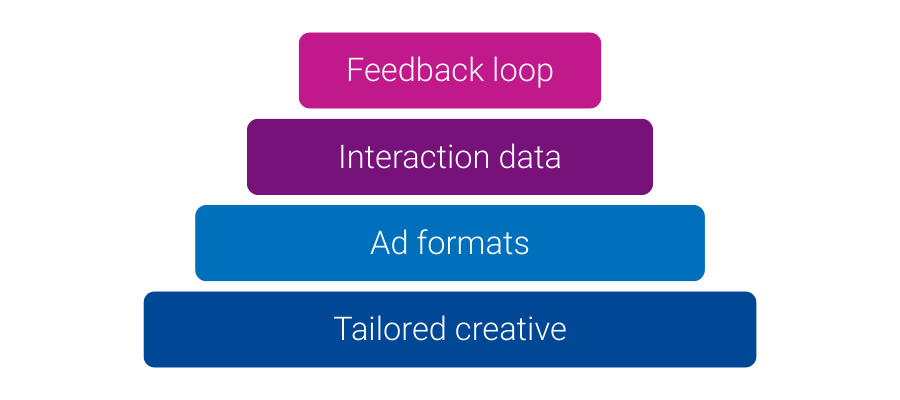
Alex (Yieldmo): Creative and ad formats are powerful signals for understanding audience engagement. At Yieldmo, we collect interaction data every 200 milliseconds, such as scrolling behavior or time spent on an ad. This data fills the gap between clicks and video completions, helping us build models that predict downstream actions. Tailoring creative to specific audience groups has always been one of the best ways to improve performance, and it remains essential in this new era of contextual advertising. Throughout my career, I learned that designing or tailoring your creative to different audience groups is one of the best ways to improve performance. We ran many lift studies with analysis to understand how you can tailor creative customized for individual audiences. That capability and the ability to do that on an identity basis is.
Our recommendations for actionable marketing strategies
Do you have recommendations for marketers building out their yearly strategies or a campaign strategy?
Jason (Experian): My recommendation for marketers building out their yearly strategies is to be proactive and start testing and learning these new solutions now. I mentioned addressability and being in the right place at the right time. That’s easier in today’s third-party cookie world. But as traditional identity is further constricted, you will have these first-party solutions that will not be at scale, so you’re less likely to find your user at the scale you want. It would be best if you thought about how to reach that user at the right place at the right time. They may not be seen from an identity basis. They might not be at the right place at the right time when you were delivering or trying to deliver an ad. But you increase your chance of reaching them by building these advanced contextual targeting audiences using this privacy-safe seed ‘opted-in’ user set; this is a way to cast that wider net and achieve targeted scale.
Alex (Yieldmo): Build your seed lists, test your formats with different audiences, and understand what’s resonating with whom. Take advantage of some of the pretty remarkable advances in machine learning that are allowing us, really, for the first time to fully uncork the potential and the opportunity with contextual in a way that we’ve never done before.
Contact us
About our experts

Jason Andersen
Senior Director, Strategic Initiatives and Partner Solutions, Experian
Jason Andersen heads Strategic Initiatives and Partner Enablement for Experian Marketing Services. He focuses on addressability and activation in digital marketing and working with partners to solve signal loss. Jason has worked in digital advertising for 15+ years, spanning roles from operations and product to strategy and partnerships.

Alex Johnston
Principal Product Manager, Yieldmo
Alex Johnston is the Principal Product Manager at Yieldmo, overseeing the Machine Learning and Optimization products. Before joining Yieldmo, Alex spent 13 years at Google, where he led the Reach & Audience Planning and Measurement products, overseeing a 10X increase in revenue. During his time, he launched numerous ad products, including YouTube’s Google Preferred offering. To learn more about Yieldmo, visit www.yieldmo.com.

About Yieldmo
Yieldmo is an advertising platform that fuses media and creative to meet audiences in the moments that matter. Using proprietary data and AI, Yieldmo uses advanced targeting to deliver context-aware creative when and where it’s most effective, all while respecting user privacy. The result: ads that belong on inventory brands trust. For more information, please visit www.yieldmo.com.
Contextual advertising FAQs
Contextual advertising works by targeting audiences based on the content they’re engaging with, rather than relying on personal identifiers or traditional tracking methods. Yieldmo’s platform uses advanced contextual signals and machine learning to deliver relevant ads in privacy-safe ways.
Contextual advertising addresses signal loss by focusing on environmental and content-based signals instead of relying on thir-dparty cookies or other traditional identifiers. Experian’s identity solutions complement this approach by enabling marketers to connect with audiences in a compliant and scalable way.
Creative is important in contextual advertising because it engages audiences and provides valuable signals for targeting. Yieldmo’s platform collects interaction data, such as scrolling and time spent on ads, to refine campaigns and improve performance.
Marketers can reach non-addressable audience through advanced contextual targeting, which uses known data, like seed audiences, to identify patterns and extend reach. Experian’s identity solutions and contextual data from, Audigent, a part of Experian, help marketers connect with these audiences in privacy-safe and effective ways.
Latest posts

Curation — the intelligent packaging of data and inventory actionable in a private marketplace deal — can no longer be considered a trend or buzzword. With over 66% of all open exchange – representing $100 billion in annual spend – being transacted through private marketplace deals (PMPs), curation is a key part of how data and identity are addressed and actioned in programmatic media. Programmatic advertising is certainly known for big shifts, but as shared by Index Exchange CEO Andrew Casale, “Curation will be bigger than header bidding and as big as programmatic or real-time bidding (RTB) – that’s our bet.” And we agree. But why has curation become a critical component of brands and media agencies' digital advertising strategies? Put simply, the math. Case study after case study empirically shows curation performs well for both the buy and sell-sides. For media agencies and brands, curation consistently shows four main benefits: Significant cost efficiencies Buying curated PMPs shows significant cost efficiencies when compared to buying data from the buy-side alone. Strong performance Data-enriched, curated PMPs can be optimized through the supply path, unlike a data management platform (DMP) segment, which leads to strong performance. Futureproofs media buying When data is curated through the supply path, it does not need to rely on legacy identifiers (like cookies), and the door is open to robust, next-gen addressability which better futureproofs media buying opportunities. Value-added insights Curation comes with robust log-level data that can be used for value-added data science including analytics, insights, reporting, and attribution – all critical in a world where addressability and identity resolution are becoming even more challenging. Curation introduced efficiency into homeopathic brand Boiron’s media buys, reducing the brand’s data costs by 30%, which enabled the brand to reinvest the same budget in brand awareness goals. Curation not only met but also exceeded the CPA for display by 82% and for video by 41%. “Audigent has been a top 5 performer in terms of CPA during our testing, helping our teams deliver 44% more efficient spend for brands across CTV campaigns."Sam Bloom, Head of Partnerships at agency PMG A big boost for addressability Legacy identity signals are changing. Whether it’s by browser, device, or platform, both buy-side and sell-side platforms need strong identity signals to reach their intended audiences, and this has become harder than ever before. Curation, with its real-time data connection and enrichment capabilities, solves signal loss challenges by directly connecting to the supply path and using a broader spectrum of identity solutions to boost addressability. Curation allows platforms to target first-party, third-party, contextual, indexed and modeled audiences. This alleviates the dependence on any one identifier and boosts the relevant bidding opportunities for brands and media agencies to target audiences. Not all curation is created equally As with any hot innovation, AdTech is notorious for companies jumping on the bandwagon of the largest trends. Curation is no different, with seemingly everyone now claiming to be a “curator.” As the industry works to define what is and isn’t “curation," we are uniquely positioned to define this as Audigent has pioneered curation for seven years and is the industry leader. The definition of curation is the intelligent packaging and optimization of data curated against the inventory supply path. There are three definitional elements to any curation product: Unique audience data Curation must include first-party, third-party, contextual, indexed and/or modeled data. Robust SSP integration To apply data in real-time to the inventory supply path, a curator must have deep partnerships and integrations that enable the combination of data and inventory into a single package. Optimization The whole point of curating data against the supply path is that it opens the door for robust real-time optimization to drive performance. If the solution ticks all three boxes, then brands and agencies should test curation and gauge its results firsthand. Curation done right drives results for brands, agencies, and publishers When done well, curation improves media buying efficiency and performance for brands and agencies. Importantly, it also drives results for publishers and content creators. Advertisers realize average data segment savings of 36-81% when using PMPs over the open exchange (Internal data) Advertisers see 10-70% lower CPC, 1.5x-3.0x higher CTR, and 10-30% higher video completion rate when using data-enriched PMPs over the open exchange (Internal data) When including their inventory in curated PMPs, publishers see an average 70% revenue uplift for mobile and 13% for connected TV (CTV) Beyond voting with budgets, media agencies and brands are also weighing in on the curation conversation: “Our Conditions Marketplace strategies have driven a 48% improvement in eCPM and a 26% improvement in CPA across our pharma client portfolio as of May 2024. For one client, we saw ROAS improve by 58% compared to their overall omnichannel performance while maintaining quality. These results aren’t outliers—they’re proof that curation is no longer a nice-to-have; it’s a must-have for marketers who want performance, precision, and scale working in lockstep.”Amanda DeVito, Butler/Till Industry-leading curation with Experian Tapping into an end-to-end solution that enables marketers to understand and reach their desired customers across channels through curation is a win-win for all parties. In the past three years, Experian and curation company Audigent have delivered a range of industry-leading innovations together, including the integration of Experian data into Audigent’s PMPs. As one company now, Experian's unique identity and data capabilities amplify how curation activates on the buy-side at scale, setting a new standard for audience targeting with added benefits like audience customization and flexible activation through Audigent’s PMPs or demand-side platforms. Connect with us Latest posts

The partnership between Experian and Fusion92 exemplifies how collaboration can deliver real marketing impact. This article explores the ways Fusion92 relies on Experian’s data to sharpen its audience targeting, streamline engagement across channels, and achieve measurable success. A need for unified audiences When Fusion92 set out to advance how their clients connect with precise audiences, they needed a data partner that could deliver comprehensive and actionable insights. Enter Experian. By using Experian’s marketing data and digital identity graph as a core source of data, Fusion92 built a solid foundation for their tools, DIOS (Data Input Output Solution), DAX (Data Advertising Exchange), and NoMi (pronounced “Know Me”). These powerful technologies enable Fusion92’s clients to control audiences more precisely, connect with the right people across optimal channels, avoid wasted impressions, and measure results with confidence. Why Fusion92 chose Experian Quality and reliability Experian’s commitment to data accuracy has earned the #1 ranking from Truthset, ensuring Fusion92’s campaigns are built on precise, actionable, and privacy compliant data that businesses can trust. Breadth and depth By offering demographic, behavioral, and channel preference data, Experian enables Fusion92 to have greater control over precision activation, empowering better results. Expert support Experian works closely with Fusion92 to provide tailored solutions and dependable expertise, adapting to meet the unique needs of their diverse clients. “Experian never really let me down in terms of data quality, data accuracy, and data reliability.”Dave Nugent, EVP of Data Science & Strategy, Fusion92 The power of teaming up Challenge A regional amusement park needed to increase membership renewal sales during peak season while reducing spend on households unlikely to visit. Solution Fusion92 combined the park’s first-party buyer file with Experian consumer data and custom geographic boundaries, built an advanced targeting model, and used Experian’s channel-preference insights to prioritize the media mix. The unified audience was then delivered omnichannel through Fusion92’s in-house proprietary DAX activation technology, with Experian’s identity graph supporting attribution. Result The marketing conversions beat the park’s stretch goal by 70%, confirming that accurate data and coordinated activation drive revenue lift. “It doesn’t matter if you’re a beginner or an expert. Experian will help you make the best use out of an incredible set of data assets.”Dave Nugent, EVP of Data Science & Strategy, Fusion92 Using marketing data to power omnichannel marketing Tools built by Fusion92 that meet client needs Fusion92’s suite of tools handles every essential phase of a campaign. DIOS starts by creating audience definitions and setting a foundation for strategy. Once these insights are established, DAX takes over, activating consistent, controlled engagement with tailored messaging. Detailed performance metrics throughout help optimize strategy along the way, ensuring campaigns remain impactful and cost efficient. DIOS in action DIOS eliminates guesswork, combining Experian’s data with advanced analytics to create precise audience models. This capability enables Fusion92 to define customer segments with accuracy, providing businesses with a roadmap to success from the outset. While currently in use as a managed service by Fusion92, a public-facing SaaS version is expected to be released in 2025. Activating every channel through DAX The campaign execution phase is pivotal, and DAX ensures smooth delivery and transparent measurement across channels. By incorporating Experian’s identity graph, DAX provides a clear picture of cross-channel behaviors and preferences, and how they impact business goals. This holistic approach enhances personalization, connecting online and offline interactions to create campaigns that resonate with consumers and drive ROI. Getting to know NoMi NoMi offers next-generation audience intelligence, empowering businesses with audience profiles built from behavioral insights, like transactional activity or in-market signals. This ensures that campaigns connect with people authentically and at scale. With NoMi, Fusion92 clients streamline targeting efforts, improving efficiency while reducing wasted spend. Thinking about your own transformation? Whether you’re tackling siloed activation, enhancing attribution models, or aiming for improved targeting, Experian’s data solutions can help amplify your efforts – just ask Fusion92. Explore how we can help you target smarter, engage better, and measure success confidently. Connect with an Experian representative today About our experts Dave Nugent, EVP of Data Science & Strategy, Fusion92 Dave Nugent, EVP of Data Science & Strategy at Fusion92, has over 27 years of experience in data-driven services, helping organizations better understand and target their audiences through predictive modeling and segmentation. Before joining Fusion92, he spent 11 years at American Spirit Corporation as VP of Data Solutions and co-founded Market Reason, where he secured a patent for an identity technology known as "identity solutions." Dave’s expertise bridges traditional, digital, and social advertising, offering innovative approaches to data utilization. He also shares his knowledge as a guest lecturer at the University of Chicago Booth School of Business. Crystal Jacques, VP of Enterprise Partnerships, Experian Crystal Jacques is the VP of Enterprise Partnerships, leading Experian's go-to-market team across all verticals. With over ten years of experience in the Identity space, Crystal brings a wealth of expertise to her role. She joined Experian in 2020 through the Tapad acquisition, following her successful stint as the head of Global Channel Partnerships for Adbrain, which The Trade Desk later acquired.

Audio platforms that overcome consumer identity challenges are winning new advertisers and driving higher ROAS. In this article, you’ll hear from leading audio platforms that are solving these challenges—and seeing results. Digital audio is evolving fast. What was once a niche channel of host-read sponsorships and direct buys is now a must-have in the modern media mix. Streaming platforms, podcasts, and digital radio are drawing more ad dollars thanks to audio’s ability to capture attention and connect with listeners. But with growth comes new pressure. Advertisers expect accuracy, scale, and to see results. At the same time, listeners want more relevant content and more personalized ad experiences. That’s where identity becomes essential. With Experian’s identity and audience solutions, audio platforms can: Bolster addressable audience targeting and personalization capabilities. Gain a comprehensive view of listeners’ digital identity to reach audiences across channels. Better understand consumer preferences, enabling advertisers to reach audiences with greater accuracy. Enhance the listening experience with more relevant content. Let’s break down the key challenges in audio—and how Experian can help solve them. Challenge 1: Anonymous listening limits addressability Most listening happens in environments where people aren’t logged in—via apps, smart speakers, and mobile devices. Without logged-in data, platforms struggle to know who’s listening and advertisers are unable to reach those anonymous listeners who don’t have an addressable ID. To overcome the identity gap in unauthenticated listening environments, leading audio platforms are turning to partners that connect fragmented signals—like device type, location, and behavioral patterns—to broader household and individual profiles. By using hashed emails and other alternative identifiers, platforms can begin to make anonymous sessions more addressable. This increase in addressability ensures the platform’s entire userbase can be reached, which leads to an increase in revenue. Experian’s solution Experian's identity spine, comprised of our Digital and Offline Graphs, helps you recognize listeners even when they’re outside your ecosystem. Platforms like Audacy are already leading the way. By integrating Experian’s Digital Graph, they’re gaining a more complete view of listeners’ digital identifiers—enhancing the experience across their app and website. With a better audience understanding, Audacy can deliver personalized content while helping advertisers reach specific groups with greater accuracy. Challenge 2: IP-based targeting falls short Audio has traditionally relied on IP addresses, but that’s no longer enough. A single IP could represent an entire household—or a public setting like a coffee shop. It’s not precise. Forward-thinking platforms are moving beyond IP-based targeting by integrating identity resolution technologies that combine household-level data with device-level intelligence. These solutions help distinguish between shared devices and individual listeners, allowing advertisers to serve more relevant messages without over-reliance on a single signal like an IP address. This layered approach improves precision—especially in dynamic listening environments like vehicles or communal spaces. Experian’s solution Our identity spine links home IPs to households, then connects them to specific devices and individuals. This helps platforms move beyond basic IPs and target real people based on accurate signals—even in shared listening environments like smart speakers and cars. We also help platforms and advertisers integrate alternative IDs—like Unified I.D. 2.0 (UID2)—into their programmatic audio campaigns. That means more reach, without compromising consumer trust. Challenge 3: Audio buying is fragmented From podcasts to streaming to radio, audio lacks consistency in how inventory is packaged and bought. It’s hard for advertisers to run scaled campaigns across channels—and harder still to measure performance. Plus, advertisers don’t think in silos—they think in strategies. If audio can’t connect to their display, connected TV (CTV), and social buys, it loses ground. What they need is a way to define audiences once and activate everywhere. To reduce friction in audio ad buying, platforms are investing in infrastructure that unifies audience insights across formats. By building a centralized view of the listener—regardless of whether they're tuning in via podcast, stream, or radio—publishers can offer advertisers consistent targeting parameters, clearer reporting, and better campaign orchestration. Identity graphs and audiences are playing a growing role in streamlining this complexity and unlocking scale. Experian’s solution Experian helps simplify audio buying. Experian audiences are built on top of our identity graph and are expanded to a deep set of digital identifiers, ensuring accuracy, scale and maximum addressability across channels. Platforms can blend their first-party data with advertiser data and our audiences—then deploy those audiences onsite or activate programmatically across open web and CTV. DAX is doing just that. DAX's partnership with Experian combines Experian’s 2,400+ audiences for targeting and activation with DAX’s innovative audio advertising approach. We’re helping advertisers connect with passionate and engaged listeners nationwide. "Through our partnership with Experian Marketing Services, advertisers can unlock deeper audience insights and execute more impactful digital audio campaigns. By combining our shared market presence, knowledge, and forward-thinking approach, we’re strengthening our digital audio network offering and delivering value to all our advertising partners." Brian Conlan, President of DAX United States In addition to integrating Experian’s Digital Graph, Audacy is also integrating Experian's syndicated audiences to unlock accurate insights like demographics, shopping behavior, and interests – providing listeners with a more personalized advertising experience and advertisers with a higher return on investment. “Historically, audio advertising lacked precise targeting capabilities, making it challenging for advertisers to reach specific audiences. By integrating our digital identity graph and syndicated audiences with Audacy’s platform, we’re transforming how advertisers connect with listeners. This collaboration enables more effective audience targeting and delivers personalized, impactful audio experiences across all channels.”Chris Feo, Chief Business Officer, Experian Privacy is non-negotiable Everything we do is privacy-forward by design. Backed by Experian’s Global Data Principles and decades as a regulated institution, we rigorously vet every data source to ensure compliance with all federal and state laws. Build an audio strategy that performs with Experian Your advertisers want more from their audio investments. With Experian, you can give it to them. We help you: Expand digital addressability to maximize reach for marketers and drive revenue growth for your platform. Create and activate addressable audiences across all channels. Enhance the listening experience with relevant content and personalized ads. Audio has always been a powerful way to connect. Now, it’s ready to perform. Let's connect Latest posts